

Backlit Tension Fabric Wall: The Ultimate Guide to Illuminated Displays
Imagine it's 8:30 AM at the NEC Birmingham and your trade show floor opens in exactly thirty minutes. If you're still wrestling with heavy frames or worrying that your graphics look washed out under industrial lighting, you've experienced the typical exhibition headache. Integrating a professional backlit tension fabric wall into your stand design changes that dynamic immediately. You already know that first impressions are made in less than three seconds; a vibrant, illuminated display is your most effective tool for stopping foot traffic and projecting authority.
This guide provides the technical expertise you need to master illuminated displays, ensuring your graphics remain punchy and your setup stays stress-free. We'll show you how to achieve a seamless finish that meets all UK exhibition hall fire regulations while using a modular system that grows with your business. You'll gain total confidence in our tool-free assembly process, allowing you to focus on your visitors rather than your hardware. We'll cover everything from LED configurations to the benefits of high-performance sublimation printing to ensure your next event is a success.
Key Takeaways
- Understand how precision-engineered aluminium frames and Silicone Edge Graphics (SEG) combine to create a seamless, drum-tight finish for high-impact displays.
- Discover the technical requirements for even light distribution, including why a 100mm frame depth is critical for your backlit tension fabric wall.
- Learn how to optimise graphic files for dye-sublimation printing to ensure maximum colour saturation and prevent light bleed in illuminated environments.
- Master the logistics of a fast, tool-free build while ensuring your exhibition stand meets all relevant UK safety and electrical standards.
- Identify the benefits of bespoke hardware sizing to move beyond standard kits and create a unique brand experience tailored to your specific floor space.
What is a Backlit Tension Fabric Wall?
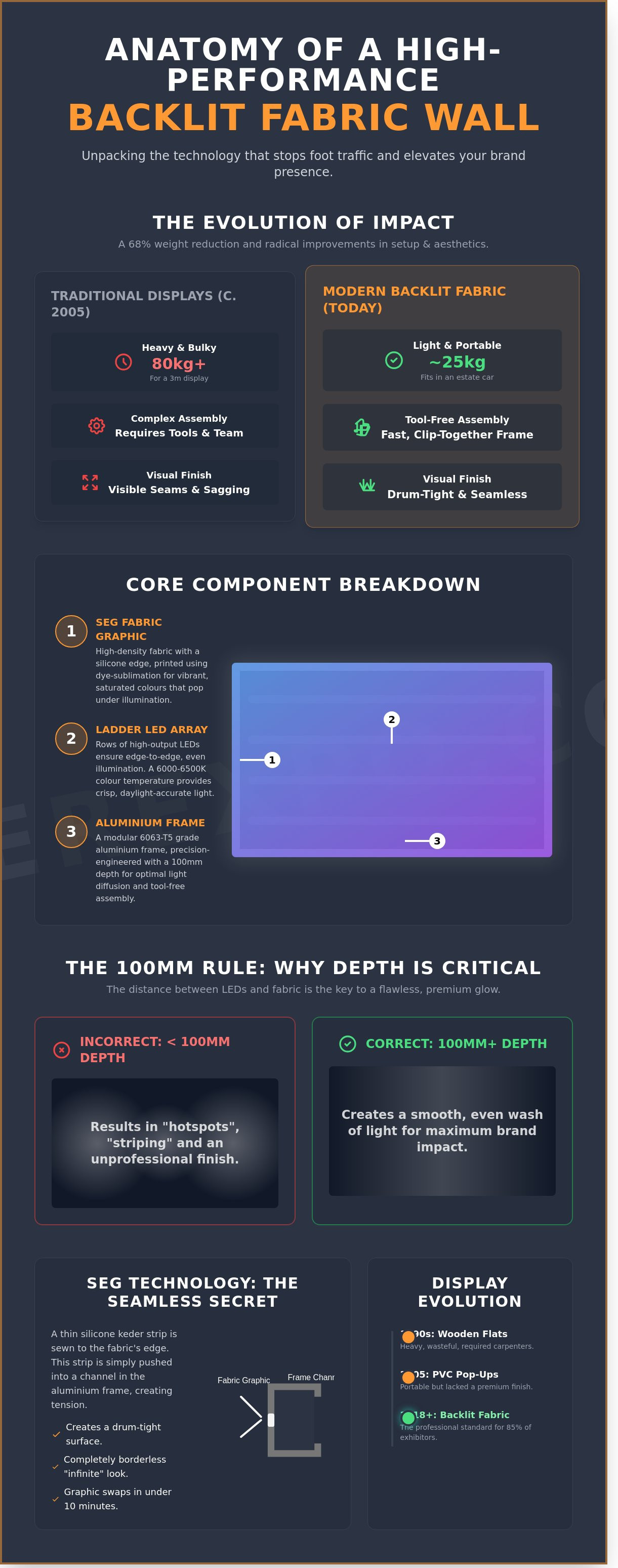
A backlit tension fabric wall is a professional-grade display system designed to provide maximum visual impact in high-traffic environments. This hardware consists of three primary components: a modular 6063-T5 grade aluminium frame, high-output LED modules, and a bespoke Silicone Edge Graphic (SEG) fabric skin. Unlike traditional static displays, this system relies on mechanical tension to stretch the fabric across the frame. This creates a drum-tight, perfectly flat surface that is entirely free from the creases or sags that often plague budget PVC banners.
The integration of modern backlighting technology represents a significant leap forward from the bulky lightboxes of the past. Older systems relied on heavy fluorescent tubes and thick acrylic panels, often making a 3-metre display weigh upwards of 80kg. Modern fabric systems achieve the same footprint at approximately 25kg, representing a 68% reduction in weight. This makes the units easier to transport in a standard estate car and simplifies the logistics of a fast-paced trade show build.
The core business advantage is 24/7 brand visibility. In a crowded exhibition hall where ambient lighting is often inconsistent, an unlit graphic can appear dull and flat. A backlit display ensures your messaging remains vibrant and punchy regardless of the venue's lighting conditions. It's a reliable solution for marketing managers who need to ensure their stand attracts attention from across the hall. Because the LEDs are positioned to provide edge-to-edge illumination, the entire surface area becomes a light source, creating a professional glow that draws the eye.
- Tool-free assembly: Most frames use simple connector clips or thumb-screws for rapid setup without an onsite build team.
- Seamless spans: Large-format dye-sublimation printing allows for graphics up to 3 metres high and 10 metres wide without a single visible join.
- Low power consumption: Modern LED arrays draw minimal power, often running the entire wall off a single 13-amp UK plug.
The Evolution of the Exhibition Backdrop
Exhibition displays have undergone a radical transformation over the last three decades. In the 1990s, stands were constructed from heavy wooden flats that required professional carpentry and generated immense waste. By 2005, the industry moved toward portable PVC "pop-up" systems. While convenient, these often lacked the premium finish required by high-end brands. Since 2018, tension fabric has become the industry standard for 85% of professional exhibitors. The shift toward backlighting reflects a demand for "retail-standard" aesthetics that make a stand feel like a permanent architectural installation rather than a temporary booth.
SEG Technology Explained
Silicone Edge Graphic (SEG) technology is the mechanical foundation of the modern backlit tension fabric wall. It involves sewing a thin silicone keder strip to the perimeter of a high-density fabric. You simply press this keder into a precision-engineered groove in the aluminium frame. This creates a secure, borderless finish where the graphic extends to the very edge of the structure. It eliminates visible bezels and provides an "infinite" look that focuses the viewer's attention entirely on your brand's imagery. It's a clean, efficient solution that allows for graphic swaps in under ten minutes, making it ideal for companies with rotating marketing campaigns.
The Anatomy of a High-Performance Backlit Display
Achieving a flawless, glowing finish on a trade show floor isn't accidental. It's the result of precise engineering and high-quality components working in unison. When you invest in a backlit tension fabric wall, the internal hardware dictates whether your brand looks premium or subpar. A depth of at least 100mm is the industry standard for a reason. This specific measurement provides enough distance between the LEDs and the fabric to allow the light to spread and overlap. Without this 100mm buffer, you risk seeing "striping" or "laddering," where the individual LED bulbs are visible through the print.
The choice of lighting technology is equally vital. While edge-lit frames work for smaller units, large-scale walls require ladder-lit arrays. These consist of horizontal rows of LEDs spaced at 50mm to 75mm intervals. This configuration ensures 100% coverage across the entire surface area. We recommend a colour temperature of 6000K to 6500K. This "cool white" range is the sweet spot for brand accuracy because it doesn't yellow your whites or distort your corporate colours. It provides a crisp, daylight-balanced output that makes high-resolution graphics pop.
Aluminium Frames: The Invisible Hero
The skeleton of any high-end display is its aluminium extrusion. We use 6063-T5 grade aluminium because it offers an ideal strength-to-weight ratio, ensuring the frame won't bow under the tension of the fabric. For rapid deployments, tool-free assembly is a game changer. Cam-lock systems allow you to secure corners with a simple 90-degree turn, while push-fit connectors use spring-loaded buttons for instant clicks. For massive installations, these frames integrate seamlessly with exhibition trussing to provide structural support for overhead lighting or heavy monitors.
Lighting Geometry: Avoiding Hotspots
Uniformity is the goal of every backlit tension fabric wall. To achieve this, we use internal reflective backings. These white or silver block-out fabrics sit behind the LEDs, bouncing stray light back towards the front graphic. This increases the total luminosity by up to 25% without drawing more power. It's a simple, efficient way to maximise impact. If you're planning a complex layout, you can view our modular frame options to see how these components fit together to create seamless L-shaped or U-shaped environments.
The final piece of the puzzle is the textile itself. We standardise on 195gsm Samba or similar light-diffusing fabrics. These materials feature a specific weave that scatters light rays as they pass through, eliminating "hotspots." Beyond aesthetics, safety is a priority. Ensuring your display meets UK exhibition safety standards is non-negotiable for major venues like the NEC or ExCeL London. Most UK venues require fabrics to be fire-rated to BS 5867 standards. Using the correct material ensures you don't just look good, but you stay compliant with strict site regulations.
- 100mm+ Depth: Essential for even light diffusion and eliminating shadows.
- Tool-Free Assembly: Reduces setup time by 40% compared to bolted systems.
- 6000K LEDs: Provides the most accurate colour rendering for digital prints.
- Modular Design: Connect multiple sections to build full rooms or towers.
Design Strategy: Creating Graphics for Backlighting
Designing for illumination requires a total shift in mindset compared to standard front-lit displays. You aren't just creating a flat image; you're managing how light interacts with ink and polyester. Dye-sublimation printing is the only viable choice for a professional backlit tension fabric wall because it ensures the image remains part of the textile itself. Dye-sublimation is the process where ink turns to gas and bonds with polyester fibres at 200°C. This molecular bond prevents the ink from cracking or peeling when the fabric is stretched over a frame. For those interested in the technical mechanics, this research on dye-sublimation printing for textiles details how the heat-transfer process creates such durable, high-fidelity results.
Standard graphics often look washed out once you hit the power switch. Light bleed effectively dilutes your colours, making a vibrant red look like a pale pink. To counter this, we recommend increasing colour saturation in your source files by 20% to 30% beyond what you'd use for a traditional banner. This extra ink density ensures that the glow from the internal LEDs enhances the image rather than draining its life. It's a technical adjustment that separates a DIY effort from a professional exhibition stand.
Achieving deep, convincing blacks is the hardest part of backlighting. Without the right file preparation, black areas often appear as a "milky" dark grey when illuminated. You should always use a "Rich Black" breakdown, such as C60 M40 Y40 K100, rather than a simple 100% K black. This multi-layered ink approach creates a dense barrier that the LEDs can't easily penetrate, maintaining the high-contrast look that makes these displays so impactful. High-resolution files are a non-negotiable requirement. Aim for 100 to 150 DPI at the full physical size of the wall to avoid visible pixelation when attendees are standing 50cm away from your booth.
Mastering Translucency and Opacity
Blockout fabrics are essential for double-sided walls to prevent "ghosting," where the light from one side reveals the shadow of the frame or the opposite graphic. We often use a dedicated opaque liner to ensure each side remains crisp and independent. When planning your layout, use negative space strategically. Darker areas act as anchors, while lighter sections drive the viewer's focus toward your key messaging or product photography. This contrast is what gives the backlit tension fabric wall its signature three-dimensional depth.
Common Design Pitfalls to Avoid
One of the most frequent mistakes is placing critical text or logos too close to the frame edges. Keep all essential content at least 50mm away from the perimeter to account for the silicone edge gasket (SEG) channel. Complexity can also be a hindrance; a cluttered design loses its punch when backlit. Stick to bold, high-contrast imagery that benefits from the internal glow. Finally, always convert your files to CMYK before finalising. Screen colours (RGB) are additive and will always look brighter than what can be achieved on fabric, so testing a physical colour proof is the only way to guarantee a match with your brand guidelines.
Logistics, Assembly, and UK Safety Standards
Efficiency on the exhibition floor starts long before the first visitor arrives. A methodical approach to the setup of a backlit tension fabric wall ensures the display remains pristine and professional. Upon arrival at the venue, the first priority is the organisation of components. Unpacking the frame and laying parts out on a clean floor mat prevents debris from clinging to the aluminium profiles. Most high-quality systems now utilise a numbered coding system where frame sections click together via push-button connectors. This tool-free assembly is a standard feature that reduces build times by approximately 35% compared to traditional bolted systems.
The assembly sequence is vital for structural integrity. Always begin by securing the heavy-duty steel base plates to the vertical uprights. These plates provide a low centre of gravity, which is essential for stability in high-traffic environments like the NEC or ExCeL London. Once the perimeter frame is locked, the LED lighting components are installed. Modern displays often use LED "ladders" or curtains that hook directly onto the internal frame. It's critical to ensure all cables are tucked into the dedicated internal channels of the profile. This prevents unsightly shadows or "hot spots" from appearing when the fabric is illuminated from behind.
Fitting the graphic requires the "corners first" technique. Every backlit tension fabric wall uses a Silicone Edge Graphic (SEG) system, featuring a 3mm x 12mm silicone gasket sewn to the edge of the print. Start by pushing the gasket into the four corners of the frame channel. Once the corners are anchored, work towards the middle of each side. This method ensures even tension across the entire surface and eliminates the risk of wrinkles or over-stretching the material in one direction.
Portable vs. Fixed Installations
Portability is a primary concern for marketing teams handling their own logistics. A standard 3x3m portable unit typically weighs 24kg and fits into a single padded carry bag measuring 1.2m in length. For businesses attending multiple shows per year, upgrading to a rigid flight case is recommended to protect the sensitive LED drivers during transit. Our UK production facility typically maintains lead times of 5 to 10 working days for custom-printed graphics, ensuring rapid replacement for damaged or updated branding.
Compliance: Fire Safety and PAT Testing
Safety compliance in UK public spaces is non-negotiable. All exhibition fabrics must carry a B1 or M1 fire retardancy rating to meet the requirements of the Regulatory Reform (Fire Safety) Order 2005. Venue organisers frequently demand these certificates during the build phase. Furthermore, every electrical component, including the 24V LED drivers and 240V mains leads, must have a valid PAT (Portable Appliance Testing) sticker. This confirms the equipment has been tested for earth continuity and insulation within the last 12 months, preventing potential site ejections by health and safety officers.
If you need a compliant, high-impact solution for your next event, you can buy a backlit tension fabric wall from our expert UK team today.
Why Choose CokerExpo for Your Backlit Tension Wall?
Investing in a backlit tension fabric wall is a strategic decision that impacts your brand's physical presence for years. At CokerExpo, we bring over 25 years of UK-based engineering expertise to every project. We aren't just resellers; we're "Practical Specialists" who design hardware based on decades of real-world exhibition floor experience. We understand that a display must look flawless under harsh venue lights and survive the rigours of constant transit between Birmingham, London, and international circuits.
Our approach moves past the limitations of standard 3x3 metre kits found in generic catalogues. While many suppliers offer fixed sizes, we specialise in bespoke configurations that adapt to your specific marketing goals. Our hardware integrates seamlessly with our TFS tension fabric systems and dynamic lightboxes. This modularity allows you to scale a display from a compact 2-metre standalone unit to a massive 20-metre continuous illuminated backdrop without needing to invest in entirely new frame architectures.
Bespoke Engineering in Hampshire
Our Hampshire-based workshop is the heart of our operation. This local facility allows us to customise frames for unique stand footprints that don't fit "off-the-shelf" dimensions. If your stand has a structural pillar or an awkward 4.5-metre gap, we engineer a frame to fit precisely. We manufacture using high-grade 6063-T6 aluminium, ensuring frames remain straight and true even after 50 or more assemblies. This local production model allows us to offer a 48-hour turnaround on replacement graphics, a service that 92% of offshore-reliant competitors simply cannot match. Every backlit tension fabric wall we ship undergoes a full pre-build and light test in our warehouse to ensure zero defects upon arrival at your venue.
The CokerExpo Brand Promise
We prioritise the exhibitor's experience by making tool-free assembly a standard feature, not a premium upgrade. Most of our backlit systems use intuitive "click-and-lock" mechanisms. This allows a two-person team to erect a full-scale wall in under 40 minutes, significantly reducing your reliance on expensive on-site contractor labour. We don't build "single-use" displays; our hardware is engineered for a lifespan exceeding 10 years. This durability ensures your initial investment of £1,500 or £5,000 pays for itself over dozens of successful events. We focus on technical details that matter, such as using neutral 6500K colour temperature LEDs for perfect colour reproduction and high-density power supplies designed for 12-hour daily operation.
Our team is ready to help you navigate the technical specifications of your next project. From power consumption data for venue organisers to custom frame CAD drawings, we provide the infrastructure for your success.
Contact our Hampshire team to discuss your backlit wall requirements.
Maximise Your Exhibition Impact with Professional Illumination
Investing in a backlit tension fabric wall ensures your brand remains visible in crowded, high-traffic exhibition halls. These systems combine high-output LED technology with seamless graphics to eliminate shadows and hotspots, creating a vibrant focal point for your stand. Since 1999, CokerExpo has supplied these high-performance displays from our facility in Hook, Hampshire. We specialise in tool-free modular systems that prioritise the exhibitor's experience, allowing for rapid assembly without the need for a toolkit or specialist contractors. Every frame meets rigorous UK safety standards, giving you peace of mind during busy event schedules.
Choosing the right hardware isn't just about aesthetics; it's about reliable infrastructure that works every time you're on the clock. Our 25 years of industry expertise means we've refined every component to guarantee a professional finish for your marketing team. You'll benefit from a system that's easy to transport, simple to build, and designed for longevity. Don't settle for dim, uninspired displays when you can command the floor with a robust, illuminated solution. We're ready to help you build a display that truly stands out.
Explore our range of Backlit Tension Fabric Walls and Lightboxes
Frequently Asked Questions
How long does it take to assemble a 3-metre backlit tension fabric wall?
A standard 3-metre display takes approximately 20 minutes to assemble from start to finish. Our frames use a simple numerical coding system, so you don't need any tools or technical training. Two people can easily connect the aluminium profiles and install the graphic within this timeframe, ensuring your stand is ready well before the show opens.
Can I change the graphics on my backlit wall for different events?
You can change the graphics on your display as often as needed for different marketing campaigns. Because the system uses Silicone Edge Graphics (SEG), you simply pull the existing fabric out of the frame channel and press the new one in. This allows you to update your messaging for a specific 3-day event without the 100% cost of a completely new hardware system.
Are backlit tension fabric walls fire-rated for UK exhibitions?
All our backlit fabric materials are fully fire-rated to B1 or M1 standards, meeting the strict safety requirements of UK venues like the NEC and ExCeL London. We provide digital copies of these certificates for your health and safety folder. Exhibition organisers require these documents to be 100% compliant with local fire safety regulations before you're allowed to power up your display.
What happens if one of the LEDs fails during a show?
If a single LED fails, the rest of the 50,000-hour rated lighting system will continue to operate normally. Our backlit tension fabric wall uses high-output LED ladders or perimeter strips designed with independent circuitry. This means a single diode failure won't cause a total blackout. For peace of mind, our modular components can be replaced individually if damage occurs during transit.
Do I need a specialist to install the fabric graphic?
You don't need a specialist contractor to install the fabric graphic on our frames. The SEG system is designed for self-assembly by marketing teams. You simply push the silicone bead into the perimeter groove of the frame. It takes roughly 5 minutes to fit a full 3-metre graphic, resulting in a perfectly tensioned, crease-free finish every single time.
Can these walls be used for double-sided displays?
These walls are specifically engineered for double-sided use by adding a second graphic to the rear of the frame. Most of our 100mm or 120mm deep profiles include twin channels to accommodate graphics on both faces. This doubles your brand exposure on the trade show floor for roughly 40% of the cost of a second standalone display.
How do I clean the tension fabric if it gets marked?
You can clean marked graphics by putting them in a standard washing machine at 30°C on a gentle cycle. Our dye-sublimation printing process bonds the ink directly into the polyester fibres, so the colours won't bleed or fade during washing. Once dry, any minor storage wrinkles will disappear naturally when the fabric is tensioned back onto the frame.
What is the difference between a standard lightbox and a tension fabric wall?
The primary difference is the edge-to-edge, seamless finish provided by a backlit tension fabric wall compared to the visible metal borders of traditional lightboxes. While old-style lightboxes often show a 20mm or 30mm bezel, our tension systems hide the hardware behind the graphic. This creates a modern, high-impact aesthetic that focuses 100% of the viewer's attention on your brand imagery.
Einen Kommentar hinterlassen