

Buying Guide for Arch, Goal, and Back Wall Truss Builds
Why do many exhibitors restrict their brand to a flat backdrop when they could be commanding the vertical space above the crowd? We know the logistical pressure you face when planning a major trade show. It's common to worry about the stability of your stand in busy aisles or struggle to match truss dimensions with your graphic sizes. This guide simplifies the process of choosing arch / goal / back wall style truss builds that offer both high impact and structural integrity.
You'll learn how to select a gantry or back wall system that maximizes your visibility and fits your specific footprint. We'll also cover how these modular components can be reused across various events to ensure your hardware remains a sound long-term investment. By the end of this article, you'll have a clear understanding of how to transform a standard floor space into a professional, three-dimensional environment that draws attention from every corner of the hall.
Key Takeaways
- Distinguish between goal post frames for backdrops and arch systems designed to create high-impact entrances.
- Learn how to match your stand footprint to arch / goal / back wall style truss builds ranging from 3m to 10m wide.
- Understand why base plate selection and graphic attachment methods are critical for maintaining stability in high-traffic areas.
- Discover how modular components allow you to reconfigure a single truss kit for multiple event layouts without specialist tools.
- Identify the ideal height configurations between 2.5m and 3m to ensure clearance from venue lighting and rigging.
Understanding Arch, Goal, and Back Wall Style Truss Builds
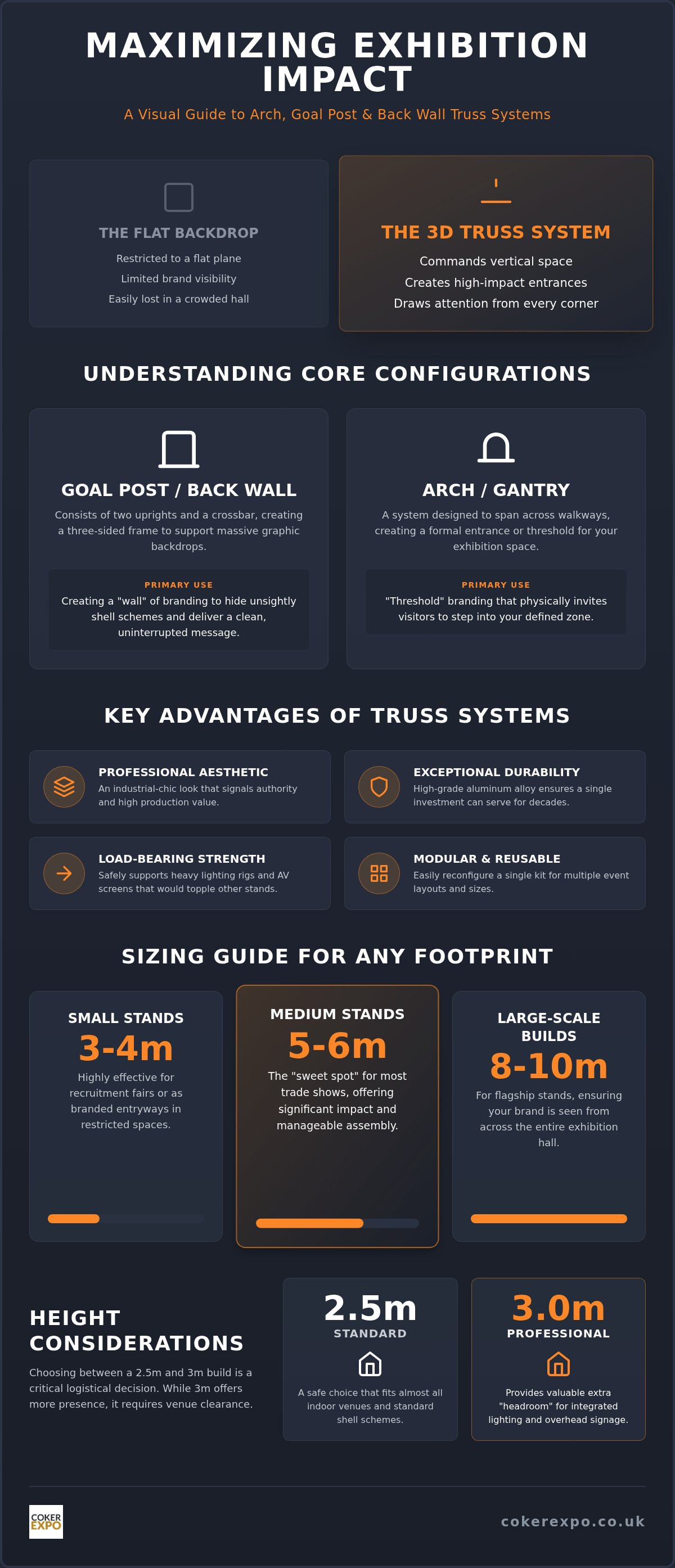
Selecting the right infrastructure for a trade show is a balance between aesthetic impact and logistical reality. When we discuss arch / goal / back wall style truss builds, we are referring to modular aluminum systems designed to scale with your brand. A "Goal Post" or "Back Wall" configuration consists of two uprights and a crossbar; this creates a three-sided frame that supports massive graphic backdrops. Conversely, an "Arch" style build serves as a gantry system, spanning across walkways to create a formal entrance or "threshold" that defines your exhibition space.
To understand the engineering behind these systems, it helps to look at What is a Truss? and how its triangular units distribute weight. Unlike lightweight pop-up stands, these structures are rigid, load-bearing, and fully modular. You can add or remove sections to transition from a 3m recruitment fair setup to a 10m flagship exhibition stand. This flexibility makes them a critical asset for managers who need to adapt to different floor plans throughout the year.
Why Choose a Truss Structure for Your Exhibition?
Standard pop-up displays often lack the presence required for high-stakes B2B environments. Aluminum truss builds provide a professional, industrial-chic aesthetic that signals authority and high production value. Beyond the look, the primary benefit is functionality. These systems are designed to safely support heavy lighting rigs and AV screens that would topple a standard fabric stand. Because they're made from high-grade aluminum alloy with precision-machined ends, they're incredibly durable. A single investment can serve your business for decades across hundreds of shows.
The Difference Between Arches and Back Walls
While they use similar components, their roles on the show floor are distinct. Back Walls focus on creating a "wall" of branding. They're often used to hide unsightly shell schemes or the backs of neighboring stands, providing a clean, uninterrupted surface for your message. Arches focus on "threshold" branding; they invite visitors to step into your zone by creating a physical sense of entry. For maximum impact, many exhibitors opt for hybrid builds. These configurations use cross-beams to combine the backdrop of a back wall with the overhead presence of an arch, ensuring your brand is visible from across the hall.
How to Choose the Right Configuration for Your Event
Selecting the correct dimensions for arch / goal / back wall style truss builds is a critical decision that impacts both your brand's visibility and your team's stress levels on setup day. You must look beyond the simple width of your stand. Consider the total volume of the space, including the overhead clearance and the physical depth required for stable base plates. A structure that's too small gets lost in the hall, while one that's too large can create a cramped, uninviting environment for visitors.
Sizing Guide: From 3m Compacts to 10m Spectacles
- Small Stands (3m-4m): These are highly effective for recruitment fairs or as branded entryways in restricted spaces. They provide a professional frame without overwhelming a smaller footprint.
- Medium Stands (5m-6m): This range is the "sweet spot" for the majority of UK trade shows. It offers significant visual impact while remaining manageable for a two-person team to assemble without specialist machinery.
- Large-Scale Builds (8m-10m): Reserved for flagship stands and open-plan island sites. These structures ensure your brand is seen from the opposite end of the exhibition hall, though they require more careful planning regarding floor weight limits.
Height Considerations: 2.5m vs. 3m Tall Builds
Venue height is a common logistical hurdle. A standard 2.5m build is a safe choice that fits almost all indoor venues and shell scheme environments. However, if the venue allows, a professional 3m build provides valuable extra "headroom" for integrated lighting and overhead signage. For more detailed advice on maximizing your vertical space, read our Exhibition Stand Design guide.
Safety is non-negotiable in high-traffic areas. When planning your configuration, ensure your setup adheres to industry safety standards for structural integrity and load distribution. You also need to account for transport logistics. While a 10m arch looks impressive, it must break down into components that fit your company vehicle. Our modular systems are designed to pack away efficiently, ensuring that even our largest builds remain portable for national events. If you're ready to upgrade your presence, explore our range of modular truss systems to find a configuration that matches your logistics.
Stability, Graphics, and Logistics: Planning Your Truss Setup
Planning the physical setup of your arch / goal / back wall style truss builds requires attention to the hardware that keeps your stand upright and your branding visible. Beyond the dimensions, the weight and depth of your base plates are the most critical factors for free-standing goal-post structures. These plates provide the necessary ballast to prevent tipping in high-traffic exhibition halls. Every build must comply with UK event safety standards for temporary structures, ensuring that your team and your visitors remain safe throughout the event.
Lighting is the final touch for a professional finish. By positioning LED light bars or spotlights along the top cross-beam, you eliminate shadows and draw the eye toward your key messaging. This integrated approach is far more effective than relying on the general hall lighting, which is often insufficient for detailed product displays. If you want to ensure your stand is the brightest in the hall, view our full range of exhibition lighting truss and accessories.
Maximising Brand Impact with Graphics
A truss frame is only as good as the branding it supports. For a high-end, custom appearance, many exhibitors now use tension fabric systems (TFS) alongside their truss builds. This creates a seamless look where the hardware is hidden behind a taut, vibrant fabric face. If you're looking for even more impact, consider how backlighting can transform your stand. You can find inspiration in The Ultimate Guide to Exhibition Lightboxes. Additionally, the depth of the truss allows for double-sided branding. This ensures your message is visible to visitors approaching from both directions, effectively doubling your exposure without increasing your floor space requirements.
Tool-Free Assembly and Transport
Logistical stress is often the biggest hurdle for event managers. Our systems use a conical connector method, which allows modular truss pieces to lock together securely without needing a complex toolkit. This simplicity speeds up the build process and reduces the risk of lost parts. We favor lightweight aluminum over steel because it's easier for portable exhibition teams to handle. Despite their scale, these builds are remarkably portable. For example, a standard 6m goal post build can pack down into a standard transit van, making it an ideal choice for national tours and regional roadshows. This blend of durability and ease of transport ensures your equipment remains a versatile business asset for years to come.
Standout Truss Build Solutions from CokerExpo
Selecting from our range of 24 different configurations allows you to tailor your presence to the specific demands of each venue. For small businesses and recruitment fairs, the 3m Compact Goal Post provides a professional frame where floor space is at a premium. It offers the same structural reliability as our larger systems but in a footprint that fits standard shell scheme areas. If you're attending a medium-sized trade show, the 6m Modular Arch is our most popular build. It balances significant visual impact with a manageable assembly process, making it the practical choice for most UK exhibitors.
For those managing flagship island sites or large corporate events, the 10m Grand Gantry delivers maximum authority. These expansive builds are TUV-certified for load-bearing capabilities, ensuring they can safely support the heavy lighting and AV requirements of a major brand activation. While our pre-configured kits cover most needs, we also provide bespoke planning. Our team can use CAD design services to tailor a system to your specific floor plan, including options for custom painting to match your exact brand guidelines.
Comparison of Top Truss Configurations
Choosing between a 4m and a 6m build often comes down to the balance between graphic real estate and floor flow. A 4m build is excellent for highlighting specific product ranges, whereas a 6m build allows for a more immersive "walk-through" experience. Height is equally important. A 2.5m build is a safe, versatile choice for almost any venue, but a 3m build significantly increases your visibility from across the hall. You can explore these variations in our Arch / Goal / Back Wall Style Truss Builds collection to find the right fit for your next event.
Ready to Build Your Stand?
CokerExpo is the trusted partner for UK truss sales and hire because we combine over 25 years of experience with a focus on practical, tool-free solutions. We understand the high-pressure nature of exhibition deadlines, which is why our national supply network is designed for speed and reliability. Our modular systems aren't just a one-off purchase; they're a long-term investment that can be reconfigured as your business grows. If you need assistance with technical specifications or bespoke stand planning, contact our event management team today for expert advice. You can also browse the full Arch and Goal Post Truss collection here to see our complete range of hardware.
Elevate Your Exhibition Presence for 2026
Investing in the right infrastructure is the definitive step toward transforming a flat floor space into a high-impact, three-dimensional brand environment. By now, you understand how to match your stand dimensions to the ideal height and width to ensure maximum visibility while respecting venue restrictions. You also know that structural stability and ease of transport are non-negotiable requirements for any professional exhibition team. Our arch / goal / back wall style truss builds offer a versatile solution that grows with your business and scales to meet the needs of any event.
These systems rely on lightweight yet high-load aluminum to support everything from massive tension fabric graphics to complex lighting rigs. With modular tool-free assembly and reliable national UK shipping for all 2026 events, we provide the essential framework for your success. Choosing a system that can be reconfigured for different floor plans ensures your hardware remains a high-value asset for years to come. It's about combining professional aesthetics with the practical reliability your team needs on setup day.
Explore our full range of Arch, Goal, and Back Wall Truss Builds and start planning your most impactful exhibition stand yet. We're ready to help you make a lasting impression on the show floor.
Frequently Asked Questions
What is the difference between a goal post and an arch truss build?
A goal post truss build is a three-sided frame consisting of two vertical uprights and one horizontal crossbar. It's primarily used as a backdrop to support large-format graphics at the rear of a stand. An arch truss build functions as a gantry or threshold, spanning over a walkway to create a formal entrance. While both use the same modular components, arches are designed to define the perimeter of your space and invite visitors inside.
Do I need special tools to assemble a modular truss stand?
You don't need any specialist tools or a complex toolkit to assemble our systems. Our modular truss stands utilize a conical connector system that secures pieces together using simple pins and clips. This design allows for rapid assembly and dismantle by a two-person team. It's a highly efficient process that reduces setup time and eliminates the logistical stress of managing various hand tools during a busy exhibition build-out.
Can I add more sections to my truss build later if I get a bigger stand?
Yes, the modular nature of these systems means you can expand your configuration as your business requirements grow. You can purchase additional straight sections or corner pieces to transform a 3m setup into a 6m or 10m version. This scalability makes arch / goal / back wall style truss builds a sound long-term investment. One kit provides the essential infrastructure that can be adapted for different stand dimensions throughout the year.
How do I attach graphics and banners to an aluminum truss frame?
Graphics are typically attached using bungee ties, keder tracks, or specialized clamps that wrap around the truss tubes. For a premium, seamless look, many exhibitors use Tension Fabric Systems (TFS) that clip directly onto the frame. If you're using PVC banners, eyelets and elasticated ties provide a secure fit. These methods allow you to swap branding quickly between shows while ensuring the graphics remain taut and professional under venue lighting.
Are truss builds safe for use in high-traffic exhibition halls?
Our truss builds are engineered for total reliability in high-traffic environments. They're constructed from robust aluminum alloy and are TUV-certified for load-bearing capabilities. Stability is maintained through heavy, wide-profile base plates that provide the necessary ballast for free-standing structures. When assembled correctly, these builds meet all UK event safety standards for temporary structures. They offer a level of structural integrity that far exceeds standard pop-up or fabric displays.
Will a 10m wide truss build fit in a standard van for transport?
A 10m wide truss build will comfortably fit into a standard transit van because it breaks down into manageable modular sections. The longest individual piece in a standard kit is usually 2m or less. This portability is a key advantage for companies managing national event schedules. You don't need specialist heavy-goods transport to move even our largest configurations, which helps keep your overall logistical costs under control during the show season.
Einen Kommentar hinterlassen