

Choosing Hanging Display Frames and Aerial Lighting Truss: The 2026 Buyer’s Guide
With the median cost for trade show floor space hitting $42 per square foot in 2026, you're paying a high premium for every inch of your footprint. It's a common frustration to invest in a prime location only to have your brand submerged in a crowded hall of ground-level displays. You understand that capturing attention from across the room is vital, but the technical confusion surrounding hanging display frames and aerial lighting truss often makes the vertical transition feel like a logistical risk rather than a strategic win.
We're here to eliminate that uncertainty. This guide provides the practical framework you need to master the technical and aesthetic requirements of aerial structures, allowing you to dominate the airspace of any exhibition venue. You'll learn how to choose between tension fabric shapes and heavy-duty truss systems while ensuring your setup meets strict ANSI guidelines and NFPA 701 fire safety standards. We'll preview the essential rigging deadlines for 2026 events and show you how to integrate professional lighting to build a high-impact, compliant presence that commands the hall.
Key Takeaways
- Utilize the vertical space above your stand to create a wayfinding beacon that ensures your brand is visible from any location in the exhibition hall.
- Select the right hardware by comparing the technical advantages of hanging display frames and aerial lighting truss for graphic-heavy or equipment-intensive setups.
- Align your aerial structure with your specific floor plan and venue rigging limits to ensure a safe, compliant, and aesthetically balanced installation.
- Identify high-impact geometric solutions, such as circular or octagonal truss systems, to maximize branding impact and lighting coverage.
Why Invest in Hanging Display Frames and Aerial Lighting Truss?
Hanging display frames are suspended branding structures designed to utilize the often-ignored vertical volume of an exhibition hall. When you integrate hanging display frames and aerial lighting truss, you create a comprehensive overhead infrastructure that serves both aesthetic and technical functions. These systems allow you to project your brand identity far above the eye-level clutter of a standard trade show floor. It's a strategic move that transforms your stand from a simple booth into a landmark.
The primary tactical benefit is wayfinding. In massive venues, attendees use high-altitude graphics as beacons to navigate the hall. If your stand is visible from the entrance, you've already won the first battle for attention. Beyond visibility, moving your primary branding upward frees up valuable floor space. With trade show space costs rising to a median of $42 per square foot in 2026, every meter of floor you reclaim for visitor flow or product demonstrations represents a direct improvement in your booth's efficiency.
Maximising Vertical Space in Exhibition Centres
The traditional "eye-level" rule is no longer sufficient for high-density trade shows. Professional stand design now relies on a clear hierarchy of visibility. This starts with floor graphics for immediate proximity, eye-level displays for engagement, and aerial structures for long-distance discovery. We define the "aerial zone" as the space above 2.5 metres. Mastering this zone requires a practical understanding of entertainment rigging, which ensures that these large-scale structures are safely secured to the venue's ceiling points without compromising safety or aesthetics.
Brand Impact and Professional Authority
Suspended structures immediately signal a premium market position to your competitors and clients. They suggest that your company is a "destination stand" rather than a temporary walkthrough booth. This psychological cue tells the market that you're a settled, authoritative player with the logistical capacity to manage complex installations. A well-executed aerial display provides the essential infrastructure needed for advanced lighting, which further enhances your stand's impact. For a deeper look at how these elements contribute to your overall success, consult our Exhibition Stand Design: The Professional Guide.
Technical Specifications: Comparing Truss Rigs and Fabric Structures
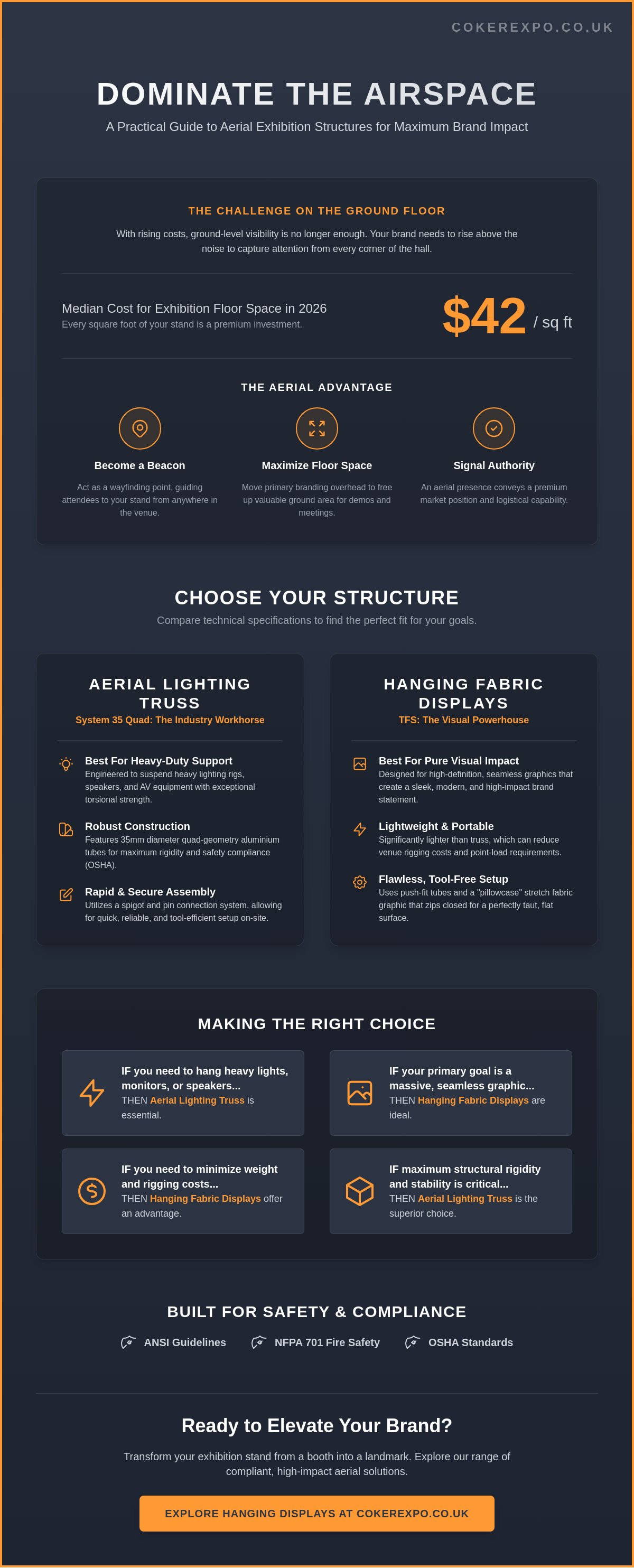
Selecting the right hardware requires a clear understanding of your load requirements and aesthetic goals. Choosing between hanging display frames and aerial lighting truss depends entirely on whether your priority is heavy-duty equipment support or lightweight, high-definition branding. While both systems excel at dominating the vertical space, their engineering serves different operational purposes on the trade show floor.
Aluminium truss systems are the workhorses of the industry, built to support significant weight. In contrast, tension fabric frames prioritize portability and seamless visuals. Assembly methods also differ. Truss typically uses a spigot and pin connection for structural rigidity, while fabric frames utilize push-fit aluminium tubes for tool-free setup. Despite their large assembled size, both systems are designed to break down into manageable components that fit into standard transport cases, ensuring logistical efficiency between events.
Aerial Lighting Truss (System 35 Quad)
The System 35 Quad is a professional-grade solution featuring 35mm diameter main tubes. Its quad-geometry provides exceptional torsional strength, making it the standard choice for suspending heavy lighting rigs, including multiple spotlights or moving heads. This structure is essential for maintaining OSHA safety standards when suspending temporary electrical equipment. The spigot and pin system allows for rapid, secure assembly without the need for complex tools, providing a reliable foundation for any high-impact lighting design. If you need a robust rig for your next event, you can explore our lighting truss hire options for a scalable solution.
Hanging Tension Fabric Displays (TFS)
For brands focused on pure visual impact, tension fabric systems (TFS) offer a sleek, modern alternative. These frames use a "pillowcase" graphic application, where the stretch fabric slides over the frame and zips closed to create a perfectly flat, seamless surface. Because these frames are significantly lighter than truss, they often reduce venue rigging costs and point-load requirements. The print quality on these systems is exceptional, mirroring the high standards found in our Ultimate Guide to Exhibition Lightboxes. These displays are ideal for island stands where 360-degree branding is required without the industrial look of exposed metalwork.
Key Factors for Choosing Your Aerial Exhibition Structure
Selecting between hanging display frames and aerial lighting truss requires more than just picking a size. It's a calculation involving your stand's footprint and the venue's technical capabilities. Your choice should be driven by the specific layout of your booth and the functional requirements of your brand presence. A mismatch here doesn't just look unprofessional; it can create logistical bottlenecks during the high-pressure build phase of an event. To avoid these pitfalls, many exhibitors work with technical production specialists like Straight Street Event Services to coordinate the rigging and technical logistics required for a successful, high-altitude brand presence.
Successful aerial integration starts with your floor plan. If you operate an island stand, circular hanging display frames offer 360-degree visibility, ensuring no blind spots for approaching visitors. For booths backed against hall walls, rectangular structures provide an architectural, structured look that aligns with the venue's lines. Beyond aesthetics, you must evaluate your lighting needs. If your stand requires heavy functional illumination, a truss system is mandatory to support the weight of multiple spotlights or moving heads.
Matching Shape to Brand Messaging
The geometry of your overhead structure speaks volumes about your brand identity. Circular displays are the most popular choice for "soft" brand aesthetics and open-access island stands. Square and rectangular displays are ideal for structured designs that need to define a clear boundary in the air. For complex, large-scale builds, hexagonal and octagonal displays provide a premium, custom-engineered feel that distinguishes your brand from standard exhibitors.
Safety, Rigging, and Venue Compliance
Technical due diligence is mandatory. You must consult the venue's technical manual before finalizing a purchase. Every hall has specific point load limits. For instance, the Fira de Barcelona (MWC) enforces a maximum load weight of 250 kg per rigging point. Ignoring these limits can lead to last-minute booth rejections. We recommend reviewing the International Code of Practice for Entertainment Rigging to understand global safety benchmarks.
Safety also extends to fire regulations. In the UK and across major international venues, all fabrics used in hanging signs must be flame retardant. This is typically certified to NFPA 701 or equivalent local standards. For detailed checklists on securing your structure and managing point loads, refer to our Truss Truss: The Ultimate Guide. If you're ready to specify a system for your next show, you can browse our complete range of aerial and hanging displays for events to find a compliant solution.
Standout Solutions: Selecting Your CokerExpo Hanging Display
Choosing the right hardware is the final step in securing your vertical presence. Our range of hanging display frames and aerial lighting truss is engineered to balance structural integrity with visual precision. We provide systems that cater to both high-intensity lighting requirements and lightweight branding needs. Every structure we offer is designed for rapid assembly, ensuring your team spends less time on logistics and more time engaging with visitors.
For stands requiring a significant lighting rig, the Lighting Truss Aerial Circle is a versatile industry standard. Available in diameters ranging from 2m to 5m, these quad-truss circles provide a robust foundation for suspending heavy equipment. If your goal is a complete venue transformation, the Octagonal Aerial Lighting Truss offers a unique, architectural silhouette that commands attention. For those prioritising high-resolution graphics, our Overhead Hanging Stretch Fabric Displays provide a seamless, wrinkle-free finish that's significantly lighter than traditional metal-clad signage.
Customisation remains a core part of our service. We offer rectangular aerial rigs specifically scaled for 6m x 4m floor areas, allowing you to mirror your stand's footprint exactly. These systems are crafted from high-performance aluminium, ensuring they remain a durable business investment for years of event cycles.
Top Recommendations for Large Island Stands
The 4.3m Octagon Quad Lighting Truss is the gold standard for visibility on large island stands. Its multiple facets provide natural mounting points for spotlights, ensuring your products are illuminated from every angle. If your layout is more fluid, the 5m Circular Lighting Truss offers maximum 360-degree coverage. These structures aren't just functional; they're crafted for high visual appeal, acting as a premium crown for your exhibition space.
Best Options for Lightweight Branding
When transport efficiency is your priority, Circular Tension Fabric Hanging Displays are the ideal choice. These systems break down into small, portable cases and use lightweight aluminium tubes that click together in minutes. For standard shell scheme upgrades, our "Build 20" rectangle rigs provide a structured, professional look without the weight of heavy-duty truss. These options allow you to achieve a "big stand" feel while maintaining a nimble logistical footprint.
Ready to elevate your next event? Browse the full range of hanging display frames and aerial truss to find the perfect infrastructure for your brand.
Secure Your Vertical Impact for 2026
Dominating the exhibition hall requires a strategic shift from the floor to the ceiling. By selecting the right hanging display frames and aerial lighting truss, you turn your stand into a high-visibility beacon that commands attention across the venue. We've detailed the technical differences between heavy-duty aluminium truss and lightweight tension fabric systems, ensuring you can match your hardware to your brand's specific load and aesthetic requirements. Remember that venue compliance and safety certifications are the foundation of any successful aerial installation.
Success in a crowded hall depends on reliable infrastructure. We provide UK-based expert support to help you navigate complex rigging requirements with our rigorous safety-tested truss systems. Whether you need durable aluminium for heavy lighting or high-resolution fabric for seamless branding, our hardware represents a sound business investment in your event ROI. Take the next step in professional stand design and ensure your brand is seen from every corner of the hall.
Elevate your brand with CokerExpo Hanging Structures
Frequently Asked Questions
Do I need a special contractor to install a hanging display frame?
Yes, you must use venue-approved riggers for the final installation. While your team can assemble the aluminium components on the ground, the actual suspension and attachment to the ceiling points require certified professionals. Most UK venues mandate that rigging crews are led by qualified specialists to ensure the setup meets strict health and safety insurance requirements.
What is the difference between a lighting truss and a hanging fabric display?
The primary difference is the weight-bearing capacity and intended use. A lighting truss is a structural rig designed to support heavy electrical equipment like spotlights. A hanging fabric display is a lightweight frame designed solely for high-resolution branding. Choosing between hanging display frames and aerial lighting truss depends on whether you need to illuminate your stand or simply project your brand identity.
Can I add my own lighting to a suspended tension fabric frame?
You should not attach heavy spotlights directly to a tension fabric frame. These structures are engineered for the weight of the graphic only and don't have the torsional strength of a truss. If you require integrated illumination, it's best to use a hybrid system where a structural truss supports the lighting while the fabric frame provides the visual branding.
Are all hanging structures compatible with UK exhibition venue rigging points?
Most standard structures are compatible, but you must verify the venue's specific point load limits before purchase. Major UK sites like the NEC or ExCeL have detailed technical manuals specifying maximum weights per suspension point. You're typically required to submit your rigging plans and equipment weights at least 21 days before the event to avoid rush charges or rejection.
How do I choose the right diameter for a circular aerial display?
Select a diameter that is at least one metre smaller than your stand's narrowest dimension. For a 6m x 6m island stand, a 4m diameter circle provides a balanced look without feeling cramped. This clearance ensures your display remains within your allocated airspace and doesn't interfere with neighbouring stands or venue infrastructure like fire sprinklers and ventilation.
What fire safety certifications are required for hanging fabric displays in the UK?
All suspended fabrics must be flame retardant and certified to BS 5867 or the international NFPA 701 standard. You must have the physical certificate available for inspection by the venue's health and safety officer during the build phase. Using non-certified materials is a significant risk, as venues will refuse to hang any structure that doesn't meet these mandatory fire safety benchmarks.
Einen Kommentar hinterlassen