

Hiring Exhibition Truss vs Buying: The Ultimate Decision Guide for 2026
That £10,000 investment in a permanent gantry system might actually be the least cost-effective decision you make for your 2026 trade show circuit. Deciding between hiring exhibition truss vs buying is no longer just a question of upfront capital. It's a complex calculation of rising UK warehousing fees, transport logistics, and evolving venue safety standards. You want a robust, high-impact stand that commands attention on the floor, but the hidden drain of maintenance and technical rigging specs can quickly turn a professional asset into a logistical headache.
We've developed a comprehensive framework to help you determine which path delivers the best return on investment for your specific event calendar. This guide explores the practicalities of modular systems, from navigating UK hall regulations to calculating the exact point where ownership outweighs the flexibility of a hire model. You'll gain the clarity needed to secure a professional silhouette without the technical confusion or hidden costs that often derail a marketing budget.
Key Takeaways
- Master the "Three-Show Rule" to accurately calculate your break-even point and decide if long-term ownership provides better value than recurring rental fees.
- Evaluate the financial and logistical trade-offs of hiring exhibition truss vs buying based on your 2026 event frequency and storage capabilities.
- Ensure full compliance with UK venue regulations by understanding the structural calculations and rigging requirements essential for major sites like the NEC and ExCeL.
- Identify when to leverage standard modular hardware for efficiency and when bespoke finishes are required for a high-impact, professional brand presence.
- Learn how to streamline your event workflow with robust, tool-free assembly systems that reduce on-site labour costs without compromising on safety.
The Strategic Role of Exhibition Truss in Modern Stand Design
Exhibition truss is far more than just a collection of aluminium tubes. It serves as the structural skeleton of high-impact stands, providing the essential framework required to support complex technical requirements. For the 2026 event season, truss has become the "Swiss Army knife" of hardware. It offers a modular solution that adapts to various floor plans while maintaining the load-bearing capacity needed for modern displays. By understanding the structural principles of truss systems, exhibitors can move away from flimsy backdrops and toward robust, architectural installations. In crowded UK venues like NEC Birmingham or ExCeL London, the primary challenge is visibility. Most exhibitors remain trapped within the horizontal eye-line of the trade show floor. Truss allows you to "break the silhouette" by building vertically. This hardware is the only reliable way to support heavy lighting rigs, suspended product displays, or massive brand towers that exceed standard 2.4-metre height limits. Whether you are considering hiring exhibition truss vs buying, the goal remains the same: creating a dominant physical presence that commands attention from across the hall.Truss vs. Traditional Shell Schemes
Moving away from a standard shell scheme requires a shift in structural mindset. While shell schemes rely on 2D graphics applied to pre-existing walls, truss enables a transition into 3D architectural design. It facilitates open-plan "island" stands that remove the physical barriers between your team and your prospects. This structural freedom allows for 360-degree branding, ensuring your message is visible from every aisle. By using gantry systems, you create a defined "zone" for your brand without the claustrophobic feel of traditional partitioned booths.The Aesthetic Advantage of Industrial Gantry
The raw aluminium finish of modern truss systems provides a sleek, industrial aesthetic that aligns perfectly with tech-focused and engineering brands. It projects a sense of strength and technical capability. Integrating your hardware with a professional exhibition stand design is critical for maximizing ROI. There is a clear psychology behind height on the trade show floor. A stand that utilizes high-level gantry and overhead signage carries an air of authority and market leadership. It tells attendees that your business has the infrastructure to support large-scale operations. When deciding on hiring exhibition truss vs buyingThe Financial Case: Comparing the ROI of Hiring vs Purchasing
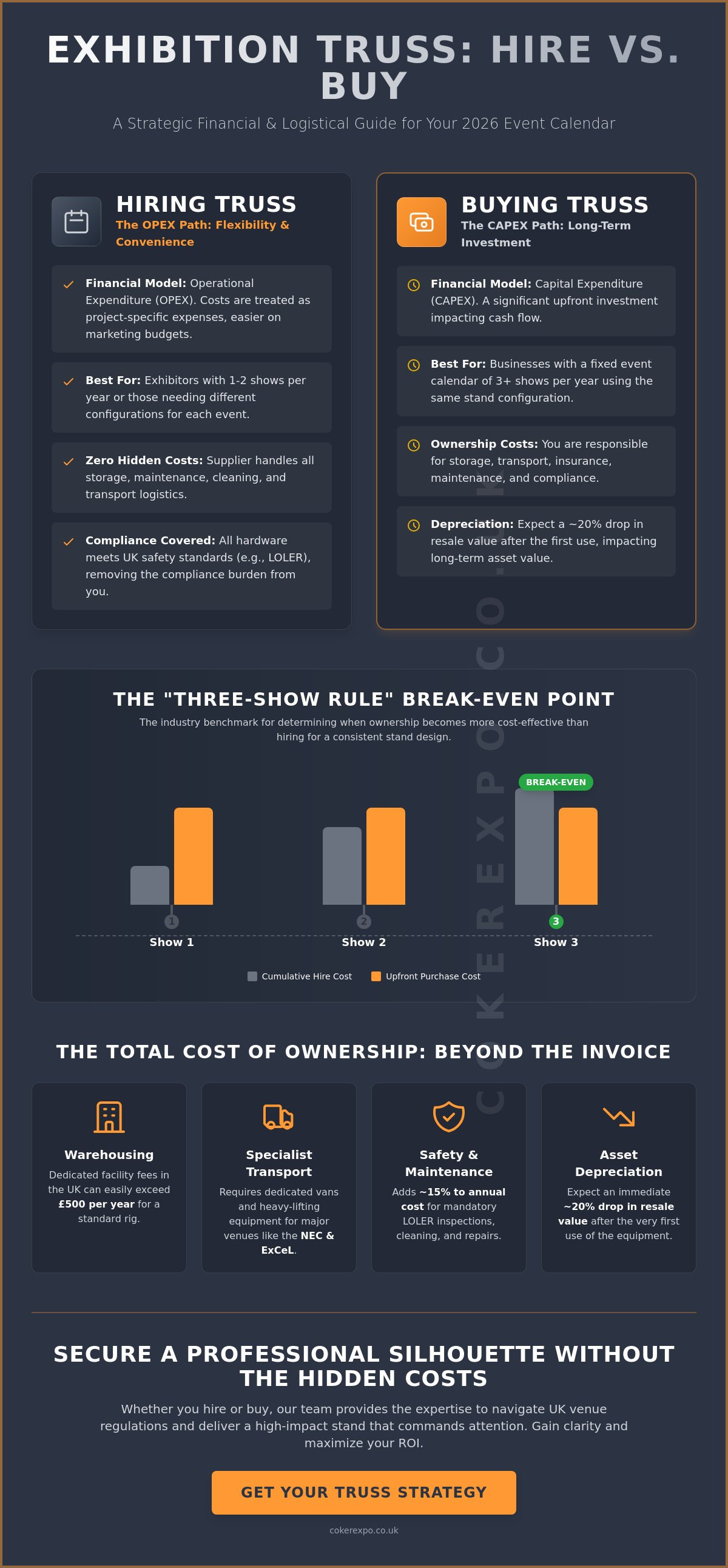
Deciding between hiring exhibition truss vs buying involves a fundamental shift from Capital Expenditure (CAPEX) to Operational Expenditure (OPEX). Buying a modular aluminium gantry requires an upfront investment that can impact cash flow for the fiscal year. Conversely, hiring treats the cost as a project-specific expense, which is often easier to clear through marketing budgets. The industry "Three-Show Rule" remains a reliable benchmark for UK businesses. If your event calendar includes three or more shows within a 12-month period using the same configuration, purchasing usually offers a better return on investment. If you only exhibit once or twice, the depreciation and hidden costs of ownership often outweigh the benefits. Modular aluminium truss holds its value better than bespoke timber stands, but depreciation is a reality. You should expect a 20% drop in resale value immediately after the first use. While the secondary market for high-quality truss remains active in the UK, liquidating these assets takes time and effort that marketing teams rarely have.The Total Cost of Ownership (TCO) Breakdown
Ownership extends far beyond the initial invoice. In the UK, warehouse space is at a premium; storing a 6m x 6m truss rig can cost upwards of £500 per year in dedicated facility fees. You also face the logistical burden of specialised transport. Heavy-lifting equipment and dedicated vans are necessary for transit to venues like the NEC or ExCeL. Owners must strictly adhere to UK safety standards for events, which include mandatory LOLER (Lifting Operations and Lifting Equipment Regulations) inspections to ensure structural integrity. These annual safety checks, combined with professional cleaning to maintain the aluminium's finish, add roughly 15% to the annual cost of ownership. When you hire, these compliance and maintenance burdens stay with the supplier.The Flexibility Value of Hiring
Hiring provides a level of agility that ownership cannot match. Every venue has different height restrictions and floor plans. By renting, you can "right-size" your stand for a 4m height limit at a regional show one month and a 6m gantry at a major international trade fair the next. This prevents "same-stand syndrome," where your brand looks identical at every show regardless of the space. It also eliminates the risk of hardware obsolescence. As truss designs become lighter and connection systems become even more efficient, hire stock is updated to reflect these changes. You'll always have access to modern, robust systems without needing to reinvest. If you aren't ready to commit to a permanent rig, you can explore our rental truss configurationsStrategic Decision Factors: When to Hire and When to Buy
Your annual exhibition calendar is the most reliable indicator for your investment strategy. If you've scheduled four or more major trade shows for 2026, the financial case for ownership becomes compelling. Industry data on renting vs. buying exhibition equipment suggests that capital expenditure often pays for itself by the third or fourth outing. However, the hiring exhibition truss vs buying debate isn't just about the initial price tag; it's about long-term operational agility.
Customisation requirements often tip the scales. While rental fleets offer high-quality modular components, they're typically restricted to standard silver or black finishes. If your brand guidelines demand a specific RAL powder-coated finish or unique structural curves, buying is your only viable path. Owning the asset allows you to maintain a consistent, high-impact aesthetic that's ready to ship from your warehouse at a moment's notice.
You must also assess your team's technical capacity. Owning a large-scale truss system requires dedicated warehouse space, regular safety inspections, and a crew capable of managing the logistics. At Coker Expo, we focus on tool-free assembly and modularity to simplify this process, but the responsibility of asset management remains with the owner. If you lack the internal infrastructure to store and maintain 500kg of aluminium gantry, the hire model provides a "hands-off" solution where the supplier handles the heavy lifting and compliance.
Venue diversity is another critical factor. A configuration that works perfectly in the vast halls of the NEC Birmingham might struggle with the tighter floor plans or height restrictions found at Olympia London or ExCeL. Hiring gives you the freedom to scale your footprint up or down based on the specific venue, ensuring you never pay for floor space you can't fill or hardware you can't fit.
You Should Buy If...
- You attend 4 or more major shows per year with a consistent stand footprint.
- You require a specific, non-standard colour or bespoke branded finish to stand out.
- You have dedicated warehouse space and an experienced build team to manage the asset.
- You want to eliminate recurring rental fees and build long-term equity in your display hardware.
You Should Hire If...
- You're testing new markets or varying stand sizes, such as moving from a 3x3m to a 10x10m space.
- You want access to the latest truss truss technology without the risk of hardware obsolescence.
- Your marketing budget is strictly operational and you prefer to avoid large upfront capital outlays.
- You want the peace of mind that comes with professional installation and breakdown services included in the cost.
Operational Logistics: UK Safety Standards and Rigging
Operating within major UK venues like the NEC Birmingham or ExCeL London requires strict adherence to the eGuide, the primary regulatory framework for UK events. When you're weighing up hiring exhibition truss vs buying, the weight of this logistical burden changes. If you hire, the contractor usually provides the required Engineering Stamps and structural calculations for your specific layout. If you own the kit, your internal team is responsible for producing these documents for every unique configuration you build.
Health and Safety documentation isn't optional for 2026 trade shows. Venues demand detailed RAMS (Risk Assessments and Method Statements) before any truss build starts. You'll also need to confirm your Public Liability Insurance (PLI) covers the specific risks of overhead structures. Most UK venues require a minimum of £5 million or £10 million in coverage. Hired equipment often carries the supplier's insurance backing, while owned equipment requires your business to manage the liability and ensure the hardware meets current British safety standards every year.
Rigging and Load Weights
Calculating point loads for suspended lighting and AV equipment is a precise science. You've got to ensure the venue's roof tension can support the structure without exceeding safety limits. For complex overhead rigs, you must hire professional riggers, which is a cost often overlooked in initial budget planning. For smaller footprints under 40 square metres, our focus on tool-free assembly is a massive advantage. It slashes on-site labour time and reduces the risk of assembly errors that could lead to safety failures during the show.
Fire Safety and Material Compliance
All truss components must use high-grade aluminium alloys, such as 6082-T6, to meet UK fire and structural regulations. Integrating your truss with fire-rated shell scheme graphic panels ensures the entire stand remains compliant with venue fire officers. If you choose to own your system, keep in mind that annual structural integrity checks are mandatory. Stress fractures or damaged chords can compromise the build, making professional inspections a non-negotiable part of your yearly maintenance schedule.
Make sure your next event is fully compliant by exploring our professional truss and rigging solutions today.
Implementing Your Truss Strategy with CokerExpo
Choosing between hiring exhibition truss vs buying is rarely a binary decision. Most UK marketing managers find that the most cost-effective path involves a strategic mix of both. CokerExpo acts as a bridge in this process, providing the technical infrastructure that allows your brand to scale without unnecessary capital expenditure. We operate as a Practical Specialist. This means we focus on the hardware's performance and your team's ability to build it quickly under the high-pressure environment of a venue like the NEC or ExCeL London.
Our systems prioritise tool-free assembly. We've engineered our gantry solutions to ensure that two people can typically complete a standard 6m x 3m perimeter build in under 40 minutes. By removing the need for specialist contractors, you're not just saving on the hardware; you're cutting on-site labour costs that often exceed £500 per day. We provide fast turnaround times on all UK-made components, ensuring your 2026 event schedule stays on track even when floor plans change at the last minute.
Visibility is the primary goal of any overhead structure. To maximise impact, we specialise in integrating truss with exhibition lightboxes. This combination transforms a functional support frame into a high-intensity beacon for your brand. We handle the technical calculations for load weights and power distribution, ensuring your illuminated graphics are safe, secure, and positioned for maximum footfall attraction.
Our Hybrid Solutions
Many of our long-term clients adopt a hybrid model to de-risk their investment. You might buy a core 4m x 3m structure that fits your most frequent shell scheme bookings, then hire additional "add-on" sections for larger, bespoke island stands. This flexibility ensures you're never paying for storage on equipment you don't use, nor are you over-investing in metal that sits idle. Because our equipment is made in the UK, we maintain total control over quality and lead times. Local production means we can often supply replacement parts or expansion kits 50% faster than competitors sourcing from overseas.
Next Steps for Your 2026 Calendar
Planning for 2026 requires more than just picking a stand size. You need to account for structural integrity and lighting requirements from the outset. Our team provides bespoke advice based on your specific floor plan, ensuring every millimetre of your allocated space is utilised effectively. We don't just ship boxes; we provide a full consultation on load weights and technical integration to ensure your stand is compliant with UK venue regulations.
- Request a structural quote tailored to your 2026 floor plan.
- Consult with our engineers on lighting integration and weight limits.
- Review our fast-turnaround options for bespoke powder-coated finishes.
Ready to finalise your event kit? Discuss your truss requirements with the CokerExpo team today to ensure your brand stands tall at your next trade show.
Secure Your 2026 Exhibition Strategy Today
Deciding between hiring exhibition truss vs buying depends on your 2026 event calendar and storage capacity. If you're attending more than three trade shows next year, purchasing hardware often delivers a full return on investment within 18 months. Conversely, hiring provides the agility to scale stand designs without the logistical burden of maintenance or warehousing. Both paths require strict adherence to UK safety standards to ensure structural integrity on the show floor.
Coker Expo brings over 25 years of UK exhibition expertise to your project. We specialise in tool-free, fast-turnaround hardware designed to reduce on-site build times by up to 40% compared to traditional bolted systems. Whether you need a bespoke permanent installation or a temporary rental for a major UK venue, our full-service event management and planning team handles the technical rigging so you can focus on your visitors. Explore our Exhibition Truss Hire and Sales options here and build a professional foundation for a successful show season.
Frequently Asked Questions
Is it cheaper to hire or buy an exhibition truss for a single event?
Hiring is significantly more cost-effective for a one-off exhibition. The rental fee typically averages between 15% and 25% of the total purchase price of the hardware. This allows you to allocate your budget toward high-impact graphics and professional floor space rather than depreciating assets.
Do I need a professional rigger to set up a hired truss system?
You don't usually need a specialist rigger for ground-supported systems that sit directly on the floor. However, if your design involves suspending the gantry from the venue ceiling, UK safety regulations require a qualified rigger. Venues like the NEC or ExCeL London have strict rules ensuring all overhead loads meet the National Association of Exhibition and Events (ESSA) standards.
How much storage space does a standard 6m x 3m truss structure require?
A standard 6m x 3m modular system occupies approximately 1.5 cubic metres when dismantled. This usually fits onto a single UK pallet measuring 1200mm x 1000mm. Storage requirements are a critical factor when deciding on hiring exhibition truss vs buying, as professional warehousing costs can quickly erode the benefits of ownership.
Can I add my own graphics to a hired truss system?
Yes, you can easily attach bespoke branding to hired hardware using bungee-corded banners or tension fabric systems. Most rental frames use standard 50mm diameter tubes, which are compatible with various graphic attachment methods. You keep the custom-printed graphics after the event while returning the metal structure to the supplier.
What are the most common safety regulations for truss in UK venues?
All structures must comply with the Health and Safety at Work Act 1974 and the specific e-guide requirements used by major UK exhibition centres. You're required to provide a detailed Risk Assessment and Method Statement (RAMS) before the build begins. Every piece of mounted equipment, such as a spotlight or screen, must also have a secondary safety bond attached.
How long does it typically take to assemble a tool-free truss stand?
Two people can typically assemble a 3m x 3m tool-free gantry in 20 to 30 minutes. These systems use hand-tightened conical couplers or wing-nut connectors, which remove the need for spanners or power tools. This fast turnaround is a major advantage during the high-pressure build days common in the trade show industry.
Can I use hired truss for outdoor events or is it indoor only?
Most hired truss is made from 6082-T6 grade aluminium, which is perfectly suitable for outdoor environments. You must use heavy steel base plates or water-filled weights to secure the structure against wind loads. Any outdoor setup requires a structural sign-off if wind speeds are forecast to exceed 15mph during the event.
What happens if a hired truss component is damaged during the show?
Rental agreements usually hold the hirer responsible for any damage beyond fair wear and tear. If a component is dented or a thread is stripped, you'll be charged for the replacement part at its current market value. It's best practice to photograph the kit during the initial build to document any pre-existing marks and avoid disputes.
Einen Kommentar hinterlassen