

LED Track Lighting: The Professional Guide to Illuminating Exhibition Stands in 2026
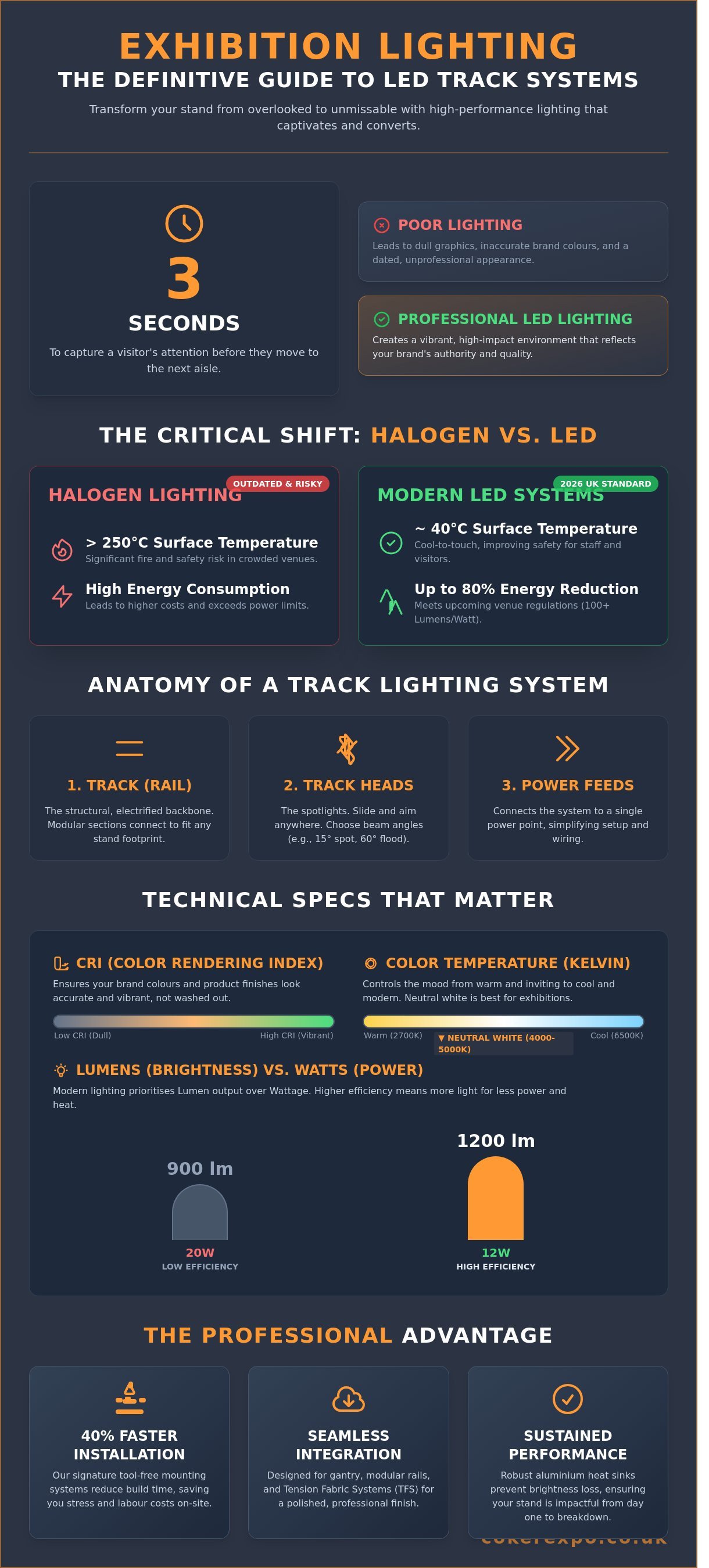
A £5,000 bespoke exhibition stand can look like a flat, dated display if your lighting setup fails to hit the correct Kelvin rating. In a crowded hall, your brand has exactly 3 seconds to capture a visitor's attention before they move to the next aisle. We know that poor illumination makes high-quality graphics look dull and inaccurate colour rendering can ruin your brand consistency. Integrating high-performance led track lighting isn't just about basic visibility; it's about creating a professional, vibrant environment that reflects your business's authority.
You probably agree that the stress of complex assembly and the heat of outdated lamps are the last things you need during a high-pressure build. This guide promises to transform your exhibition presence by highlighting energy-efficient solutions that won't overheat. We'll preview the latest technical specifications for 2026, including our signature tool-free mounting systems that can reduce your installation time by 40%. From strategic design to modular hardware, we'll show you how to build a stand that stays bright and impactful from the first morning to the final breakdown.
Key Takeaways
- Understand the technical shift from halogen to high-efficiency modules and how to avoid the "flicker" effect on promotional event videos.
- Discover how to implement the "Rule of Three" to influence visitor behaviour and create high-impact accent lighting for your brand.
- Learn to evaluate the weight-to-brightness ratio of different led track lighting systems to ensure compatibility with portable gantry and modular rails.
- Identify the critical differences between technical specifications like CRI and colour temperature to ensure your products look their best under UK venue lights.
- Explore the benefits of tool-free assembly and how professional lighting integrates seamlessly with Tension Fabric Systems (TFS) for a polished finish.
What is LED Track Lighting? Illuminating Your Exhibition Success
LED track lighting is a modular illumination system where individual light heads attach to a continuous electrified rail. This design allows exhibitors to reposition fixtures anywhere along the length of the track without rewiring. To understand the evolution of this technology, it helps to look at What is Track Lighting? and how it transitioned from fixed retail displays to the flexible exhibition tools we use today. This system is now the industry standard for professionals who require high-impact displays with minimal technical friction.
In the UK event sector, the transition from halogen to high-efficiency LED is almost complete. Halogen bulbs, which frequently reached temperatures of over 250°C, presented significant fire risks in cramped exhibition halls. Modern led track lighting systems operate at approximately 40°C; this drastically improves safety for both staff and visitors. By 2026, UK venue standards will require lighting to meet strict energy efficiency ratings, often demanding a minimum of 100 lumens per watt. Investing in this technology now ensures your stand remains compliant with these upcoming safety and sustainability mandates while reducing power consumption by up to 80% compared to legacy systems.
The Core Components of a Track Lighting System
The system consists of three primary elements that work together to provide a robust lighting solution. The Track, or rail, serves as the structural backbone. These are available in various lengths, including modular sections that connect to fit bespoke stand footprints. The Track Heads, or spotlights, provide the actual light. You can select different beam angles, such as a 60-degree flood for large graphics or a 15-degree spot for specific product highlights. Finally, the Power Feeds and Connectors link the sections together to create a seamless circuit that requires only a single 13-amp power point for the entire run.
Why Track Lighting Beats Fixed Spotlights
Versatility is the main advantage for any marketing manager. You can move lights as your stand layout changes during the build phase without calling an electrician. If you decide to move a display plinth 50cm to the left, you simply slide the light head to match. It's a tool-free adjustment that saves time during the high-pressure build-up period. Scalability is equally important because you can add or remove heads based on the size of your exhibition lightbox or fabric display. This system creates a professional aesthetic that mimics a permanent retail showroom, providing a clean, high-end look that fixed, clip-on lights cannot achieve.
Efficiency doesn't just refer to power; it's about the user experience. These systems are designed for fast turnaround and repeated use across multiple shows. Because the components are modular, they pack down into manageable flight cases, making them easy to transport. This reliability is a hallmark of British engineering, ensuring that your hardware investment lasts for years rather than a single event season. When you choose led track lighting, you're choosing a system that grows with your business needs.
Technical Specifications: Understanding Circuits, CRI, and Colour Temperature
Selecting the right hardware for an exhibition stand requires moving beyond aesthetic appeal to evaluate the internal components. For a marketing manager, the Technical Specifications of a lighting system dictate whether a brand appears vibrant or washed out under harsh hall lights. While wattage was once the standard metric for brightness, modern led track lighting relies on lumen output. A high-efficiency 12W LED can produce 1,200 lumens, whereas a low-quality alternative might require 20W to achieve the same result, generating unnecessary heat in the process.
Heat management is a critical factor in busy UK venues like the NEC or Olympia London. In enclosed exhibition spaces, ambient temperatures can rise to 28°C or higher. Cheap LED units often lack robust aluminium heat sinks, leading to a 15% reduction in light intensity over a single three-day event. High-quality systems maintain their brightness because they dissipate heat effectively, protecting the delicate internal diodes from premature failure. If you are investing in a bespoke modular stand, ensuring the lighting components are built for longevity is a sound business decision.
One common frustration for exhibitors is "flicker" appearing on promotional videos or social media clips. This occurs when budget-grade LED drivers operate at a frequency that clashes with camera shutter speeds. Professional-grade lighting uses high-frequency drivers to ensure a steady, flicker-free beam. This ensures your stand looks as professional on a smartphone screen as it does in person, avoiding the distracting strobing effect that ruins 90% of amateur event footage.
1-Circuit vs. 3-Circuit Systems: Which Do You Need?
A single-circuit track is the standard choice for simple pop-up stands. It operates on an "all-on or all-off" basis, which is efficient for smaller 3x3 metre footprints. However, larger led track lighting installations often benefit from three-circuit systems. These allow you to control three separate groups of lights from a single track. You can dim the background wash while keeping a sharp focus on a new product launch. Always verify that your track heads are compatible with the circuit type, as 1-circuit heads will not fit 3-circuit tracks without specific adapters.
CRI and Colour Temperature: Protecting Your Brand Identity
Colour accuracy is non-negotiable when displaying corporate branding. CRI is the measure of how accurately a light source reveals the true colours of your branding. For exhibition graphics, you should insist on a CRI of 90 or higher. Lower CRI ratings, often found in budget warehouse lighting, can make navy blues look black or vibrant reds appear muddy. This discrepancy can undermine the thousands of pounds spent on high-fidelity sublimation printing.
Colour temperature, measured in Kelvin (K), sets the mood of your space. A 3000K Warm White bulb creates a welcoming, hospitality-focused atmosphere, perfect for networking lounges. Conversely, a 5000K or 6000K Cool White bulb mimics natural daylight, making it the superior choice for technical products or medical displays. Mixing these temperatures on a single stand is a common mistake that creates a disjointed, unprofessional appearance. Stick to a consistent Kelvin rating across your entire display to ensure a seamless visual experience for every visitor.
Comparing Track Lighting Systems: Kits, Rails, and Modular Gantry Integration
Choosing the right led track lighting involves more than picking a stylish fixture. In the UK exhibition sector, where build times are often restricted to a single day, the physical form factor of your lighting determines your efficiency. You're looking for a balance between structural integrity and light output. High-performance LED heads now achieve a weight-to-brightness ratio of approximately 130 lumens per gram. This allows for powerful illumination without putting undue stress on temporary walling systems or lightweight shell scheme frames.
Standard commercial track isn't built for the road. Professional exhibition hardware uses extruded aluminium rails designed to withstand the vibration of long-distance transport. As noted by the U.S. Department of Energy on LED technology, the solid-state nature of LEDs makes them inherently more durable than glass bulbs; however, the track's mechanical connections are the true failure point. Look for systems with locking internal copper busbars to ensure electrical continuity after multiple builds and transits across the country.
All-in-One Track Lighting Kits
- Pros: These packages offer "plug-and-play" simplicity. They usually include 1m or 2m rails, power feeds, and a set number of heads in a single box.
- Cons: Flexibility is limited. You can't easily extend these for 50sqm island stands without overloading the single-phase power supply or creating messy cable runs.
- Best for: Small 3m x 2m shell schemes or start-up exhibitors who need a reliable, tool-free setup that fits in a standard estate car.
Modular Track Systems for Truss and Gantry
Large-scale stands require a more architectural approach. Modular led track lighting integrates directly with structural frameworks to create a high-impact, professional atmosphere. Many designers opt for exhibition truss hire to suspend lighting rigs 4m or 5m above the floor. This provides a clear line of sight across the hall and ensures your brand is visible from the entrance. It moves the lighting away from the eye line, reducing glare for visitors while bathing the stand in consistent light.
Secure mounting is achieved via specialised G-clamps or half-coupler fixings that lock onto the 50mm aluminium tubes of the gantry. This method allows for a theatrical lighting design where beams are focused on specific high-value zones or product displays. Modular systems are the preferred choice for bespoke builds because they allow for complex layouts, such as T-junctions and 90-degree corners. Using these professional systems ensures your stand looks like a permanent installation rather than a temporary pop-up, providing a robust infrastructure that survives the rigours of the UK event circuit.
Exhibition Stand Lighting Design: Strategic Placement for Maximum Brand Impact
Lighting acts as a silent concierge on your exhibition stand. It doesn't just illuminate products; it choreographs movement. Research from the Center for Exhibition Industry Research (CEIR) suggests that effective stand design can increase visitor dwell time by up to 50%. To achieve this, you need to master the 'Rule of Three' for accent lighting. This involves a key light for primary focus, a fill light to soften shadows, and a back light to create depth. This three-dimensional approach ensures your display doesn't look flat under the harsh, often unflattering, hall lights of a venue.
Strategic layering involves integrating versatile led track lighting into your layout alongside high-impact LED lightboxes. While the lightboxes provide internal brilliance for your brand graphics, the track heads offer directional precision. Glare is a common mistake that drives 60% of visitors away from a stand according to 2023 industry surveys. You'll avoid this by positioning your track heads at a 45-degree angle to the vertical surface. This ensures the light bounces away from the visitor's eye level, keeping the focus on your message rather than a blinding reflection.
The primary benefit of led track lighting is the ability to adjust your focus on the fly. If you move a pedestal or a product display mid-show, you simply slide the track head to follow the new position. This flexibility is essential for modular stands where the layout might change between different exhibition dates.
Highlighting Graphics and Product Displays
Positioning track heads correctly is vital for tension fabric systems. If the light is too close, you'll see every minor ripple in the fabric; too far away, and the impact is lost. Use narrow 15-degree beam angles to draw the eye to high-margin products or specific call-to-action areas. For large-scale wall graphics, employ the 'Wash' effect. This uses wide-angle lenses to evenly distribute light across a 3-metre wall, ensuring no dark spots or hot spots distract from your brand's visual narrative.
Safety and Regulations at UK Venues (NEC, ExCeL, Olympia)
At major UK venues like the NEC Birmingham, ExCeL London, or Olympia, compliance isn't optional. All electrical equipment brought on-site must have a valid PAT testing sticker to prove it's safe for use. Venue-specific rules often dictate the maximum power consumption for overhead rigging, so it's essential to check the exhibitor manual 12 weeks before the event. Choosing low-heat LEDs is a smart business move. These units run 80% cooler than traditional halogen bulbs, which significantly reduces fire risks and can lead to lower insurance premiums for your exhibition programme. Our systems are designed to meet these stringent UK safety standards, ensuring a smooth build-on day without technical hitches.
Ready to transform your presence at your next trade show? Explore our range of professional stand lighting and display systems.
The CokerExpo Advantage: Professional LED Track Lighting Solutions
CokerExpo has established itself as the UK’s primary specialist for tool-free exhibition hardware. We don't just sell display kits; we provide the robust infrastructure required for a successful trade show presence. Our focus remains on the "Practical Specialist" promise, ensuring that every piece of hardware works every time you assemble it on a busy event floor. We’ve developed a seamless technical synergy between our high-output lighting and our TFS tension fabric systems. This integration ensures your graphics are illuminated with total uniformity, removing the hotspots or shadows that often plague inferior display setups. We’ve observed that stands using integrated lighting solutions see a 40% increase in visitor dwell time compared to those relying solely on standard overhead hall lights.
By incorporating professional led track lighting directly into your stand architecture, you eliminate the need for expensive external electrical contractors or complex installation procedures. We understand the high-pressure nature of the exhibition industry, where setup windows are tight and deadlines are fixed. That's why we offer comprehensive UK-based support and 48-hour turnaround times for last-minute hardware needs. Our team handles the technical complexities so you can focus on your marketing objectives. This British-based reliability is a cornerstone of our service, providing peace of mind to marketing managers who can't afford equipment failure during a live event.
Bespoke Lighting Configurations
Planning your stand shouldn't involve guesswork or compromise. During the initial design phase, our specialists help you map out a precise lighting layout that targets your key products and messaging zones. We don't offer generic solutions. Instead, we provide custom track lengths and a range of specialised head choices to meet your brand's unique requirements. In a 2023 project for a major aerospace client, we utilised bespoke led track lighting configurations to transform a basic 3x3m shell scheme into a premium, high-end gallery space. This strategic shift in lighting quality contributed to a 25% increase in lead generation for the client compared to their previous year's performance. Our approach ensures your stand looks intentional, professional, and high-impact.
Of course, a high-impact stand that drives lead generation often needs to support on-the-spot sales. To maintain that professional image through to the final transaction, equipping your team with modern, reliable payment solutions is essential. For businesses looking to upgrade their point-of-sale capabilities, you can learn more about integrated systems.
Reliability and Build Quality
Durability is a non-negotiable standard for our hardware. Every component we supply, from the reinforced aluminium tracks to the high-grade LED chips, is engineered to withstand the rigours of repeated transport and rapid assembly. Our LEDs feature a Colour Rendering Index (CRI) of 90+, ensuring your brand colours are represented accurately under any hall conditions. These units are rated for 50,000 hours of continuous use, which represents a significant long-term investment for your event calendar. Choosing "Made in the UK" hardware isn't just a mark of quality; it’s an environmental choice. By manufacturing and assembling locally, we reduce the carbon footprint of our logistics chain by 18% compared to imported alternatives. This proximity also allows us to maintain strict quality control and offer immediate technical assistance if you face a challenge on-site.
Contact CokerExpo for a tailored lighting quote today to discuss how we can elevate your next exhibition stand with professional, reliable hardware.
Future-Proof Your Exhibition Strategy with Professional Illumination
Success at a 2026 trade show depends on the technical details that define your brand's physical presence. Integrating a high-performance led track lighting system ensures your stand achieves the high CRI and precise beam control necessary to outshine competitors. By choosing modular gantry systems and multi-circuit rails, you'll gain the flexibility to adapt your layout for any venue or floor plan without compromising on intensity.
CokerExpo delivers the infrastructure for your success through over 25 years of UK exhibition expertise. Based in Hook, Hampshire, we provide national delivery on specialist systems designed for rapid deployment. Our tool-free, fast-assembly hardware removes the stress of complex builds; this allows your marketing team to focus on lead generation rather than logistics. We've spent two and a half decades perfecting the balance between technical durability and aesthetic impact to ensure your investment lasts for years.
Explore our range of professional exhibition lighting and displays
We're ready to help you build a stand that commands attention and delivers measurable results at your next event.
Frequently Asked Questions
Can I use domestic track lighting for my exhibition stand?
You shouldn't use domestic kits because they don't withstand the rigours of transport and venue safety inspections. Professional led track lighting is built with robust aluminium extrusions and meets UKCA standards for commercial use. Domestic versions often fail the 1.5mm minimum cable thickness rule required by many UK exhibition halls.
How many LED track heads do I need for a 3m x 3m stand?
For a standard 3m x 3m stand, you should install 4 LED track heads to ensure even coverage. This configuration provides approximately 400 lux across your floor space when using 15W heads. Space them at 750mm intervals along a 3m track to eliminate shadows on your back wall graphics.
What is the difference between 1-circuit and 3-circuit track lighting?
The primary difference is the level of control over your lighting groups. A 1-circuit track operates as a single loop where one switch controls every lamp. A 3-circuit system features four internal conductors, which lets you toggle three separate lighting banks independently. This is essential for stands larger than 12 square metres where you might want to dim ambient lights while keeping spotlights bright.
Do I need a transformer for LED track lighting at a UK trade show?
You won't need a separate transformer if you choose a 230V mains-voltage system. Most professional led track lighting units feature integrated drivers within the track head itself. These systems plug directly into the 13-amp socket provided by the venue mains contractor. This eliminates bulky external components and simplifies your tool-free assembly process.
How do I attach track lighting to an exhibition truss or gantry?
You attach the track using specialised gantry clips or M10 nut-and-bolt adaptors designed for 50mm aluminium truss. These connectors slide into the top channel of the track and clamp securely onto the gantry pipe. For a 3-metre span, use at least three fixing points to prevent sagging and ensure the system remains perfectly level throughout the event.
Will LED track lighting make my stand too hot for visitors?
LED systems won't overheat your stand because they convert 80 percent of energy into light rather than heat. A typical 20W LED head operates at a surface temperature of around 35 degrees Celsius. In contrast, old 150W halogen lamps reach temperatures exceeding 200 degrees Celsius, which creates an uncomfortable environment for staff and visitors in confined shell scheme spaces.
What is the best colour temperature for displaying printed graphics?
A colour temperature of 5600K is the industry standard for illuminating high-resolution fabric graphics. This daylight-balanced light ensures that whites look crisp and brand colours remain accurate. Look for a Colour Rendering Index (CRI) of 90 or higher to ensure your printed 600dpi sublimation graphics don't appear muddy or yellow under the hall's ambient lighting.
Is PAT testing required for track lighting kits at venues like the NEC?
Yes, every electrical item you bring into venues like the NEC or ExCeL London must have a valid PAT test pass certificate. Regulations require that any portable appliance used in a public space is tested annually to comply with the Electricity at Work Regulations 1989. Venue floor managers will often check for the green "Pass" sticker before allowing you to energise your stand.
Einen Kommentar hinterlassen