

Lighting Truss Hire: The 2026 Guide to Professional Installation vs. Self-Setup
Opting for the lowest dry hire price might be the most expensive mistake you make for your next UK event. You want to maximize your exhibition budget while ensuring your lighting rig looks professional and stays securely overhead. It's a common dilemma when considering lighting truss hire, installed or self setup, especially when you're balancing high-impact visuals against strict venue RAMS requirements and safety protocols. We understand that the pressure to deliver a flawless environment often clashes with the reality of tight load-in windows and complex hardware specifications.
This guide will help you master the logistics of truss selection, ensuring you choose the right hardware and service level to guarantee both structural integrity and legal compliance. You'll gain a clear understanding of the hardware needed to achieve your vision without risking safety failures. We'll break down the technical differences between square and triangular truss; examine the mandatory requirements of LOLER and PUWER regulations; and identify the hidden logistics costs that often lurk within basic dry hire quotes. Whether you're planning a trade show or a large-scale corporate function, you'll leave with a practical roadmap for a safe, high-performance installation.
Key Takeaways
- Identify the critical logistical differences between lighting truss hire, installed or self setup, to ensure your event remains on schedule and within budget.
- Learn how to select the right truss geometry, from heavy-duty square chords for rig stability to lightweight ladder truss for simple banner suspension.
- Understand your legal obligations under LOLER and PUWER regulations to maintain safety compliance and meet venue RAMS requirements.
- Discover how to integrate modular truss with exhibition lightboxes and fabric displays to create a high-impact, professional brand environment.
Lighting Truss Hire: Professional Installation vs. Self-Setup
Lighting truss hire offers a modular aluminium framework that serves as the essential skeleton for modern event infrastructure. These systems provide the strength needed to support heavy equipment while remaining portable enough for rapid deployment. In 2026, the industry has seen a significant shift toward lightweight, high-load modular systems such as the Prolyte H30V. This hardware allows for greater spans and higher weight capacities without the bulk of traditional steel rigs. When you begin your planning process, the most critical decision involves lighting truss hire, installed or self setup. This choice dictates your project's safety profile and your total logistical spend.
What is Dry Hire? The Self-Setup Model
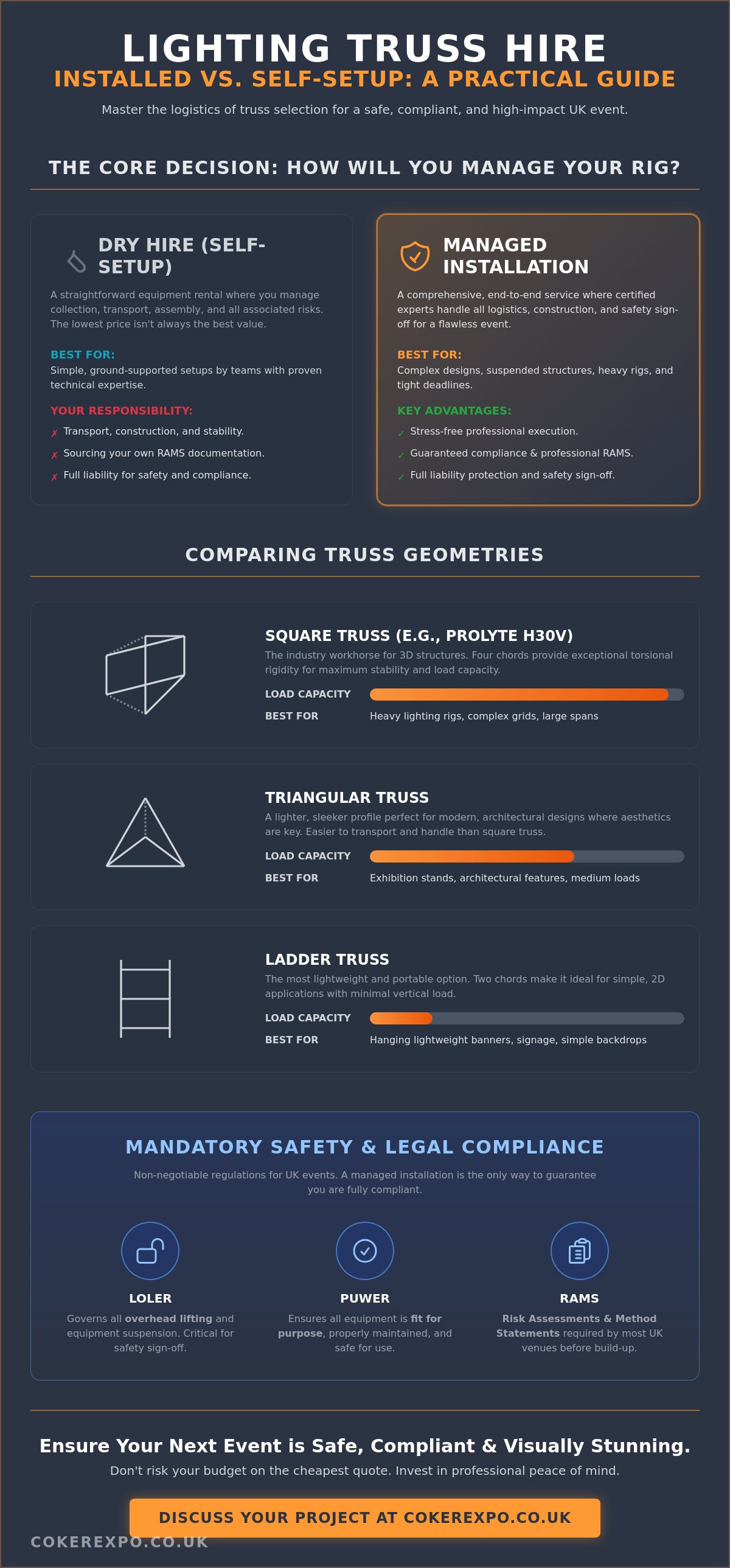
Dry hire is a straightforward equipment rental where you take delivery of the components and manage the assembly. It's the preferred option for teams with internal technical expertise who want to minimize costs. This model is best suited for simple, ground-supported configurations like goalpost rigs or branded display plinths. While it's budget-friendly, it places the burden of transport and construction entirely on your shoulders. You're responsible for ensuring every connection is secure and that the structure remains stable throughout the event. If you choose this route, you must be confident in your team's ability to handle the hardware safely and efficiently.
The Managed Installation Advantage
A managed installation provides a comprehensive service where experts handle the heavy lifting and technical sign-off. This approach is vital for complex designs or whenever you need suspended structures. Professional installers apply core stage lighting principles to ensure that every fixture is mounted safely and that load limits are strictly respected. A key benefit is the provision of professional RAMS (Risk Assessment and Method Statements) documentation. Most UK venues require these documents before they allow any construction to begin. By opting for a managed service, you ensure compliance with BS 7905 standards and receive a safety sign-off that protects your business from liability. It's the most reliable way to achieve a high-impact visual result while eliminating the stress of structural oversight.
Comparing Truss Geometries: Square, Triangular, and Ladder
Choosing the right profile is a balance of aesthetics and engineering. The geometry of your aluminium framework determines how much weight it can carry over a specific span and defines the visual footprint of your stand. When evaluating lighting truss hire, installed or self setup, the physical dimensions and weight of the truss sections are your first logistical hurdle. Each shape offers distinct advantages for different rigging scenarios.
Square Truss (M290 / H30V) for Maximum Load
Square truss, often referred to as box truss, is the industry workhorse. Models like the Prolyte H30V or Milos M290 use a four-chord design that provides exceptional torsional rigidity. This makes it the only viable choice for complex 3D structures or heavy lighting rigs where stability is paramount. In the UK, the 290mm standard is the default for most exhibition halls because it perfectly balances load-bearing capacity with manageable transport dimensions.
These systems are highly modular. They use standardized corner blocks and heavy-duty base plates to create everything from simple goalposts to elaborate multi-level grids. Because square truss provides four attachment points, it's significantly easier to mount fixtures or large-format graphics without compromising the center of gravity. If you're planning a heavy rig, ensure your team understands the LOLER regulations regarding lifting and overhead loads to maintain a safe working environment.
Triangular and Ladder Truss for Design Flexibility
Not every event requires the extreme load capacity of a box truss. Triangular truss, or three-chord truss, offers a sleeker, more architectural profile. By orienting the "point" of the triangle either up or down, designers can create a modern, high-end look for exhibition stands. It's lighter than square truss, which simplifies the physical experience of assembly for teams choosing a self-setup model. This weight reduction doesn't just help with construction; it also lowers transport costs and makes it easier to meet venue floor-loading limits.
Ladder truss is the most portable option in the inventory. Consisting of only two chords, it's ideal for hanging lightweight signage, banners, or simple decorative spans where vertical load is minimal. It's particularly useful in shell scheme environments where space is at a premium and a full box truss would feel too industrial. While these lighter profiles are easier to handle, they still require professional attention to ensure they aren't overloaded beyond their rated capacity. For those looking for a versatile solution, exploring our range of Exhibition Lighting Truss can help you find the perfect balance between visual style and structural strength.
Safety Compliance: LOLER, PUWER, and Venue Requirements
Safety isn't just a checkbox; it's a legal mandate. In the UK, the regulatory framework for lighting truss hire, installed or self setup is governed by two primary pieces of legislation: LOLER (1998) and PUWER (1998). Failure to adhere to these standards is a criminal offense that can result in unlimited fines or custodial sentences for managers. These regulations ensure that all equipment is fit for purpose and maintained to a rigorous standard, protecting both your staff and the general public.
LOLER requires that any equipment used for lifting accessories or people be inspected every six months. Standard truss used for static displays must undergo a thorough examination every 12 months. PUWER focuses on the suitability of the equipment for its specific use at work. Venues will not permit assembly without comprehensive RAMS (Risk Assessment and Method Statements). These documents prove you've calculated the risks and established a safe method of work. For outdoor events, these calculations must include wind loading and ballast requirements to prevent structural failure in high gusts. The infrastructure must be resilient enough to handle local weather variables without compromise.
Determining Competency for Self-Setup
Before you choose a dry hire model, you must objectively assess your team's technical competency. Do they understand the difference between a distributed load and a point load? Every section of aluminium has a specific Safe Working Load (SWL) that must never be exceeded. Overloading a single point can cause a catastrophic failure, even if the total weight is within the overall limit of the span.
A setup is no longer simple the moment it involves mechanical lifting. At that point, it becomes a lifting operation under UK law. You must use rated hardware, including certified couplers, shackles, and safety bonds. Using unrated or generic hardware in a professional exhibition hall is a major liability risk. If your team cannot identify a bent chord or a damaged conical coupler, they aren't competent to manage a self-setup.
Insurance and Liability in Truss Hire
When you manage your own installation, the legal liability for structural integrity rests entirely with your organization. If a rig fails due to poor assembly or overloading, your public liability insurance may be voided if you cannot prove competent installation. This financial risk often outweighs the initial savings of a dry hire contract.
Opting for professional installation provides a safety sign-off that transfers much of this logistical risk to the experts. This is particularly important for public-facing events where footfall is high. For a deeper look at structural options, read our Truss Truss: The Ultimate Guide to Exhibition & Event Structures. Ensuring your setup meets BS 7905 standards protects your brand and your attendees. If you're ready to secure your event infrastructure, you can explore our professional lighting truss hire services to ensure a compliant and secure installation.
Integrated Event Solutions: Combining Truss with Lightboxes
Trussing isn't just a structural necessity; it's the creative foundation for your entire brand presence. By using an aluminium framework as a skeleton, you can mount high-impact visuals that would otherwise be impossible to support. A major advantage of modern lighting truss hire, installed or self setup, is the ability to integrate advanced display technology directly into the rig. Suspending exhibition lightboxes from a truss grid ensures your messaging is visible from across the hall, effectively cutting through the visual noise of a crowded trade show.
This synergy extends to Tension Fabric Systems (TFS). These lightweight frames clip directly onto the truss chords, creating seamless, large-format graphics that look like permanent architecture. Because these systems are modular, they're incredibly fast to assemble and dismantle. In the high-pressure environment of UK event venues, national fulfillment speed is critical. You need a partner who can deliver hardware to major hubs like the NEC or ExCeL London with precision timing to meet strict load-in windows. Reliable logistics ensure that your infrastructure is on-site exactly when your build team is ready to begin.
Aerial Displays and Suspended Branding
Moving your branding overhead is a strategic way to reduce your floor footprint. When you use a suspended lighting truss, you free up valuable square footage for promotional counters and product demonstrations. These aerial displays provide 360-degree visibility, making your stand a landmark within the venue. However, this requires specific technical coordination with venue riggers. You must provide accurate point load data and ensure all hanging fabric graphics are fire-rated and secured with secondary safety bonds. Shifting your focus upward doesn't just improve aesthetics; it maximizes the ROI of your floor space.
Pre-Configured Truss Packages for 2026
For standard stand sizes, pre-configured packages offer the best balance of speed and value. A 3m x 3m 'Goalpost' or 'Box' package provides a proven, stable structure that's ready for immediate use. These kits include all necessary conical couplers and pins, removing the guesswork from the planning phase. If your vision exceeds a standard footprint, bespoke builds allow you to create multi-tiered environments or unique geometric shapes. No matter the complexity of your project, we provide the essential infrastructure to ensure your event is a success. Contact CokerExpo for a national truss hire quote today to discuss your 2026 event requirements.
Securing Your Event Infrastructure for 2026
Successful event delivery relies on the strength of your underlying hardware. You now have the technical insights to differentiate between heavy-duty square chords and decorative ladder profiles. You also understand how to leverage aerial branding to increase visibility while maintaining strict compliance with UK safety regulations. Deciding on lighting truss hire, installed or self setup, dictates your team's workload and your project's overall safety profile. It's a choice that balances immediate budget needs against long-term risk management.
Established in 1999, we prioritize reliability and craftsmanship in every build. We provide full UK national delivery and installation, ensuring all structures meet BS 7905 and LOLER standards for total peace of mind. Our systems are designed for high-performance environments where speed of fulfillment is a necessity. Our team understands the pressure of tight exhibition deadlines and provides the essential infrastructure to ensure your brand stands out safely.
Take the next step in optimizing your exhibition presence. Explore our 2026 Lighting Truss Hire range and request a quote to secure a robust and professional foundation for your next event. We look forward to helping you achieve a high-impact result.
Frequently Asked Questions
Do I need a special license to set up a lighting truss myself?
You don't need a specific government-issued license to assemble truss, but you must be "competent" under UK Health and Safety law. This requires the technical knowledge to identify structural defects, understand load limits, and ensure the rig complies with PUWER regulations. If your team lacks experience with aluminium structures, a managed installation is the safer choice to ensure venue compliance.
What is the difference between Prolyte H30V and standard F34 truss?
Prolyte H30V and standard F34 truss are both 290mm square profiles, but they use different alloy specifications and coupling systems. Prolyte's conical coupling is often preferred for its speed of assembly and high torsional rigidity. You should always check the specific manufacturer's loading table, as the Safe Working Load (SWL) can vary between brands even if the dimensions look identical.
Can I use a lighting truss outdoors for a UK festival or event?
Yes, you can use truss outdoors, but it requires specialized planning for wind loading and ground stability. Outdoor structures act like sails in high winds, so you must use specific ballast weights or ground anchors calculated for the predicted gust speeds. Our team can advise on these requirements when you're deciding between lighting truss hire, installed or self setup for an external environment.
How much weight can a standard 3-metre square truss section hold?
The capacity of a 3-metre section depends entirely on the total span and how the weight is distributed across the chords. While a single section of Prolyte H30V has a high load rating, this capacity decreases as the total span increases. You must always refer to the manufacturer's Safe Working Load (SWL) charts to ensure your fixtures don't exceed the structural limits of the rig.
What safety documentation will a UK exhibition venue ask for?
UK venues typically demand a comprehensive Risk Assessment and Method Statement (RAMS) before allowing any assembly on the floor. You'll also need to provide proof of Public Liability Insurance (PLI) and current LOLER inspection certificates for any lifting accessories. Providing this documentation is a standard part of our managed service, whereas dry hire clients must prepare these documents themselves.
Is it cheaper to buy or hire lighting truss for multiple events?
Hiring is generally more cost-effective for businesses attending fewer than four events per year. While buying equipment removes hire fees, it introduces significant costs for secure storage, specialized transport, and mandatory annual LOLER inspections. Choosing lighting truss hire, installed or self setup, allows you to access the latest hardware without the long-term burden of maintenance and depreciation.
Einen Kommentar hinterlassen