

The Complete Guide to Double-Sided Fabric Lightboxes for High-Impact Displays
If your exhibition stand only communicates with half the passing footfall, you're effectively wasting 50% of your floor space investment. Most marketing managers agree that standing out amongst the 1.3 million professionals who attend UK trade shows annually is difficult, especially when a standard double-sided fabric lightbox could be capturing attention from both directions simultaneously. You shouldn't have to settle for washed-out graphics or three-hour assembly times that eat into your event schedule.
This guide demonstrates how to maximise your brand visibility using versatile, high-impact display technology that ensures your message hits home from every angle. We'll break down everything from tool-free assembly and UK-engineered frames to selecting high-definition tension fabrics that maintain a professional edge for years.
Key Takeaways
- Understand how a double-sided fabric lightbox provides 360-degree visibility to maximise your brand’s footprint in busy exhibition halls.
- Discover the technical specifications, from 6500K daylight LEDs to cable management, that ensure a professional and colour-accurate finish.
- Learn how to navigate the 'show-through' challenge when designing different messages for each side of your display to maintain visual clarity.
- Compare the cost-to-impact ratio of freestanding versus wall-mounted systems to optimise your event budget and floor space planning.
- Leverage 25 years of UK-based expertise to choose robust, tool-free hardware that simplifies your event logistics and assembly.
What is a Double-Sided Fabric Lightbox?
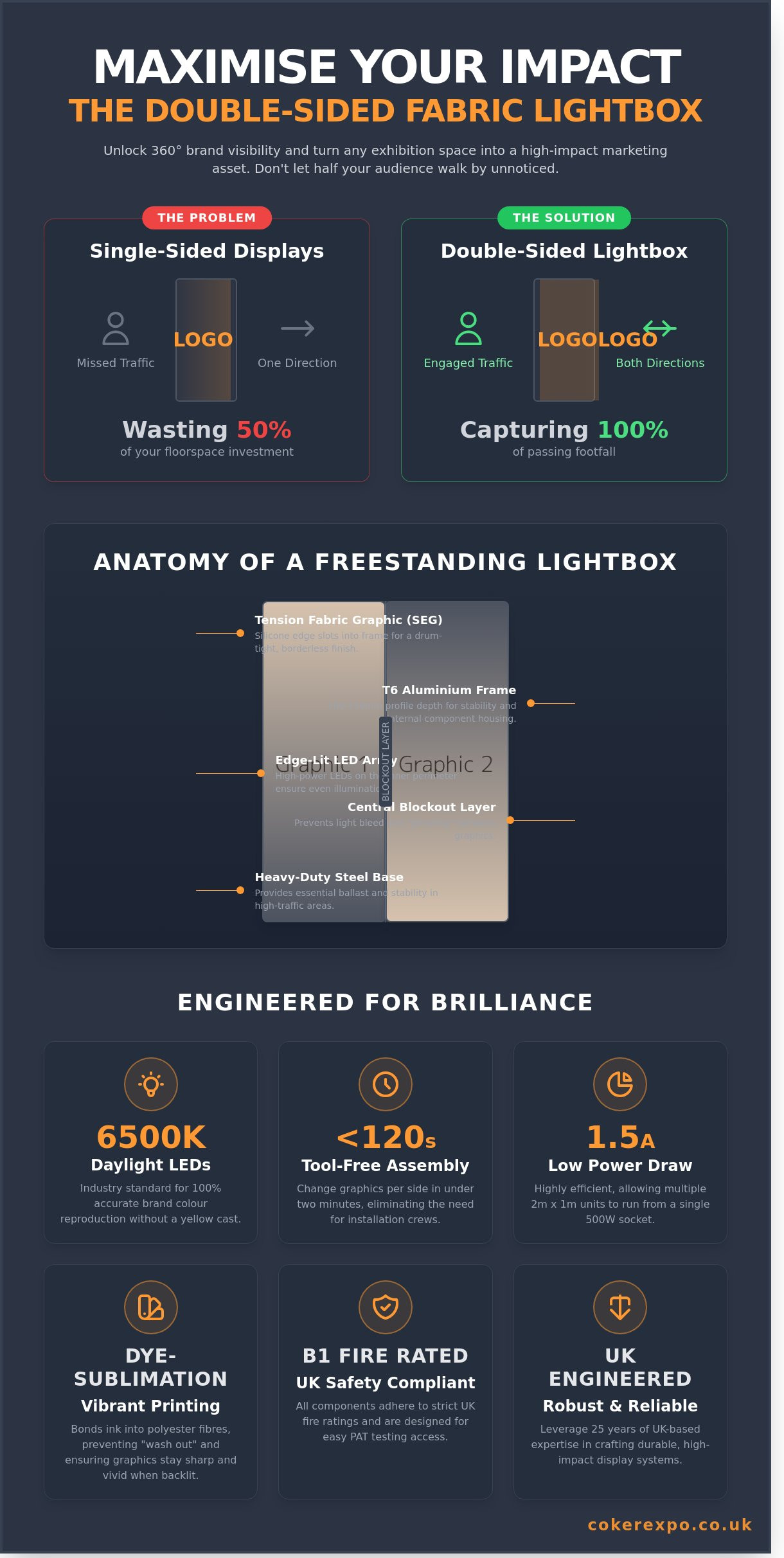
A double-sided fabric lightbox is a freestanding exhibition display engineered from a modular aluminium extrusion frame and powered by internal LED lighting. Unlike traditional signage, these systems use tension fabric graphics on both the front and rear faces, providing 360-degree brand visibility. This technology marks a significant departure from older, heavy-duty "backlit" boxes that relied on fluorescent tubes and rigid acrylic panels. Modern Silicone Edge Graphic (SEG) systems are approximately 40% lighter than their predecessors, making them the standard for professional trade show environments.
To understand why this technology has become the industry benchmark, it is useful to consider the fundamental principles of What is a Lightbox? and how those concepts have been adapted for the portable display market. By moving away from glass and timber, exhibitors now benefit from a system that is easy to transport and quick to assemble. These units are the preferred choice for island stands and high-traffic walkways where attendees approach from multiple directions. They maximise the utility of a floor plan by turning a simple partition into a dual-purpose marketing asset.
The Anatomy of a Freestanding Lightbox Display
The structural integrity of the display depends on the aluminium profile. For a double-sided fabric lightbox, we use profiles with a depth of 100mm to 150mm. This specific width is necessary to house the internal LED array while providing a stable footprint for the freestanding unit. We configure the LEDs in either an edge-lit or ladder-light arrangement to ensure even illumination across the 6000K colour temperature spectrum. Heavy-duty steel base plates provide the essential ballast required to keep the unit secure in busy venues like the NEC or ExCeL London, ensuring there are no trip hazards for passing visitors.
How Tension Fabric Systems (TFS) Work
Tension Fabric Systems (TFS) utilise a thin silicone bead sewn directly into the edge of the printed graphic. This bead, or Keder, slots into a recessed groove in the aluminium frame to create a drum-tight, borderless finish. We use dye-sublimation printing for all graphics because the process bonds ink into the polyester fibres, preventing the "wash out" effect often seen with standard inkjet prints when they are backlit. This mechanism allows marketing teams to change messaging in under 120 seconds per side. It is a tool-free process that eliminates the need for professional installation teams, providing a significant return on investment over multiple event cycles.
Technical Specifications: Engineering for 360-Degree Brilliance
Engineering a high-performance double-sided fabric lightbox requires a precise balance of thermal management and structural integrity. Most professional displays utilise 6500K LEDs as the primary light source. This "daylight" colour temperature is the industry standard because it provides a neutral white point, ensuring that brand colours are reproduced with 100% accuracy without the warm yellow cast found in lower-Kelvin alternatives. Powering these units involves a choice between internal transformers, which offer a cleaner aesthetic for retail environments, or external "plug-and-play" power bricks that allow for rapid component replacement during a live event.
Safety remains a non-negotiable factor for UK exhibitors. Every component we provide adheres to strict UK fire ratings, specifically the B1 flame retardancy standard for tension fabric graphics. Additionally, exhibition venues like the NEC or Olympia require all electrical equipment to undergo PAT testing. Our systems are designed for easy access to cabling, featuring integrated channels that keep wires tucked away, preventing trip hazards and maintaining a professional finish from every angle. Frame finishes are typically available in anodised silver for a modern look, or powder-coated white and black to match specific brand guidelines.
Edge-Lit vs. Backlit Technology
Edge-lit systems are the preferred choice for double-sided displays. High-powered LEDs are mounted to the inner perimeter of the frame, firing light inwards across the graphic face. To ensure the display remains punchy on both sides, a central "blockout" layer is placed between the two fabric graphics. This layer is vital; it prevents light bleed and ensures the silhouette of the internal hardware doesn't "ghost" through the print. Advancements in LED Display Technology have made these units incredibly efficient. A standard 2m x 1m lightbox now draws as little as 1.2 to 1.5 amps, allowing you to run multiple units from a single 500W socket without risking a fuse blow.
Durability and Build Quality
We use architectural-grade T6 aluminium for our frames. It's a material chosen for its high strength-to-weight ratio, which is essential when hardware needs to survive frequent transit in flight cases. Assembly is entirely tool-free, utilising spring-loaded butterfly clips and sliding connectors that click into place. This means a single staff member can assemble a large double-sided fabric lightbox in roughly 8 to 12 minutes. The LEDs themselves carry a lifespan of 50,000 hours, meaning if you used the display for 8 hours every single day, it would last over 17 years. If you need a system that grows with your business, you can browse our modular lightbox range to see how these frames connect to form larger walls.
Double-Sided vs. Single-Sided: Which is Right for Your Event?
Choosing between a single or double-sided system depends on your specific floor plan and long-term marketing budget. A standard 2m x 2m single-sided unit typically costs about £150 less than its double-sided counterpart in initial graphic production. However, you're sacrificing 50% of your potential visibility. For island stands or corner plots at 2024 trade shows, a double-sided fabric lightbox is the superior investment. It ensures your brand is visible to 100% of the passing footfall, regardless of which direction they approach from.
Space planning dictates the hardware you need. Single-sided frames are usually 60mm to 80mm deep and designed for wall-mounting. Freestanding double-sided lightboxes require a 100mm to 120mm profile to accommodate the internal LED ladder and provide the necessary structural stability. Weight is also a factor for international exhibitors. A 1000mm x 2000mm double-sided frame weighs approximately 16kg. This stays comfortably under the 23kg limit for standard airline checked luggage, helping you avoid the £60+ excess baggage fees often found at Heathrow or Gatwick.
Maximising ROI in High-Traffic Zones
In a crowded exhibition hall, 38% of visitors often miss stands because the branding only faces one direction. Double-sided units capture "reverse-flow" traffic in narrow aisles, ensuring your message hits home as attendees walk back towards the exit. These displays also serve as practical room dividers. You can create semi-private meeting spaces on a 6m x 3m stand without the cost of permanent timber walling. Retailers frequently use these systems to align with visual merchandising principles; they engage high-street pedestrians and in-store shoppers with a single piece of hardware.
The 'Blackout' Alternative
If you've booked a shell scheme where the back of the unit faces a partition, you don't need a second printed image. Use a black-back or "blackout" graphic instead. This fabric contains a light-blocking internal layer that prevents light leakage and rear shadows. It actually increases the front graphic brightness by roughly 12% by reflecting light back into the frame. This setup provides excellent flexibility. You can invest in a high-quality double-sided fabric lightbox frame now and simply swap the rear blackout for a printed graphic when you move to a space-only plot later in the year. It's a modular strategy that saves you from buying two sets of hardware.
Designing and Logistics: From Artwork to Assembly
Creating a high-impact display starts with technical precision in your design files. For a professional finish on a double-sided fabric lightbox, provide artwork at a minimum resolution of 150dpi at 100% scale. We require a 50mm bleed on all edges to accommodate the Silicone Edge Graphic (SEG) keder. Use a CMYK colour profile, specifically FOGRA39, to ensure the vibrant LED backlighting doesn't shift your brand colours during the dye-sublimation process.
One common concern with two-sided displays is "show-through," where the image on one side interferes with the other. We solve this by using high-density 260gsm blockout fabric or an internal light-shielding layer. This allows you to run completely different messages on each face. You can promote a specific product on the front while using the reverse for atmospheric branding, with zero light leakage between the two.
Graphic Design Tips for Fabric Lightboxes
LED illumination naturally flattens mid-tones, so high-contrast designs with bold saturation work best. Avoid placing logos or essential text within 60mm of the frame edge to stay clear of the "dead spot" created by the internal frame shadow. To achieve deep, light-absorbing shadows that don't look washed out, always use a "rich black" formula, such as C60, M40, Y40, K100, rather than a standard black ink setting.
Portability and Storage
Logistics shouldn't be a headache. Most of our systems fit into a single wheeled flight case or a reinforced padded bag, making them easy to transport in a standard estate car. To keep your graphics in top condition, roll them onto a cardboard core rather than folding them tightly. If the fabric gets marked during a busy event, you can wash it in a domestic machine at 30 degrees Celsius. The dye-sublimation process ensures the ink stays locked in the fibres, so it won't crack or fade after a wash.
Assembly is a straightforward, tool-free process that takes one person less than 10 minutes. The aluminium frame sections are numbered; you simply click the push-fit components together and press the fabric keder into the perimeter channel. If you need a larger presence, our modular connectors allow you to link multiple units together to create a seamless, illuminated wall of any length.
Ready to upgrade your exhibition presence? Explore our range of professional display solutions to find the perfect fit for your next event.
Why Choose CokerExpo for Your Double-Sided Lightboxes?
Investing in a double-sided fabric lightbox is a strategic decision that impacts your brand's visibility for years. At CokerExpo, we bring over 25 years of UK-based expertise to every project, ensuring your hardware survives the high-pressure environment of major venues like the NEC or ExCeL London. Our engineering promise combines robust structural integrity with high-performance aesthetics. We don't offer flimsy alternatives; we provide professional-grade tools designed for repeated assembly and long-term ROI.
Customisation is a standard part of our service rather than an afterthought. While many suppliers only offer fixed dimensions, approximately 40% of our output consists of bespoke sizes tailored to specific event goals. Whether you need a 3-metre high monolith or a slimline partition to divide a meeting space, we adapt the hardware to fit your exact floor plan. This flexibility ensures your stand remains unique, functional, and perfectly aligned with your marketing objectives.
The CokerExpo Practical Specialist Approach
We don't just sell display boxes; we provide the essential infrastructure for your brand's success. Our team acts as practical specialists who understand the mechanics of a busy trade show. Every double-sided fabric lightbox undergoes a 100% quality control check at our Hampshire centre. We test every LED module and frame connection before it leaves our doors to ensure zero failures on-site.
Deadlines are non-negotiable in the exhibition world. Our local production capabilities allow for a fast turnaround, typically fulfilling orders within 5 to 7 working days. This speed doesn't compromise quality. It reflects our commitment to the user experience of the exhibitor, making transport and tool-free assembly as seamless as possible for your team on the ground.
Comprehensive Event Solutions
A standalone light is effective, but a fully integrated stand is transformative. We specialise in integrating lightboxes with our truss systems to create large-scale, illuminated gantry structures that can be seen from across the hall. You can also pair your signage with our promotional counters and display turntables to create a professional, cohesive brand environment that encourages visitor interaction.
Our support extends from the initial event planning stages through to final graphic production and sublimation printing. We handle the technical complexities of tension fabric and illumination so your marketing team can focus on lead generation. Contact our Hampshire team today for a custom lightbox quote to see how we can elevate your next exhibition presence with a high-impact double-sided fabric lightbox.
Maximise Your Brand Presence at Your Next Event
Choosing a double-sided fabric lightbox ensures your brand commands attention from every angle, effectively doubling your marketing real estate without increasing your floor space costs. These systems eliminate the dark spots of traditional displays, providing a 360-degree glow that draws visitors in from across the hall. At CokerExpo, we manufacture our hardware right here in the UK, providing you with 100% reliable support and fast turnarounds for time-sensitive projects. We understand the high-stakes nature of trade shows and build our kit to survive the rigours of constant travel.
Our engineering focuses on the user experience; you'll benefit from a tool-free assembly that's guaranteed to work every time, even under the pressure of a tight exhibition setup window. Safety is non-negotiable, which is why all our tension graphics are B1 certified fire-retardant as standard. This ensures you're fully compliant with all UK venue regulations. It's a robust, professional investment that simplifies your logistics while making a significant visual impact on your audience. We're ready to help you stand out.
Explore our range of high-impact double-sided fabric lightboxes at CokerExpo and see how easy it's to transform your exhibition stand into a high-performance lead generator.
Frequently Asked Questions
Can I use different graphics on each side of the lightbox?
Yes, you can display completely different graphics on each side of the unit. Each face of a double-sided fabric lightbox operates independently, allowing you to showcase two distinct marketing messages or brand campaigns simultaneously. This versatility is ideal for high-traffic areas where visitors approach from multiple directions. It ensures 100% visibility of your content from both sides without needing extra floor space for a second display.
How long does it take to assemble a freestanding double-sided lightbox?
A standard freestanding unit typically takes between 10 and 15 minutes to assemble from scratch. Our systems use a tool-free design with numbered frame components that slot together using simple push-fit connectors. This rapid setup time reduces the stress of event mornings. It allows a single person to manage the entire installation without additional assistance or specialised equipment, making it a highly efficient choice for busy exhibitors.
Are the LED lights replaceable if one fails?
Yes, the LED components are fully replaceable. While our high-efficiency LEDs are rated for 50,000 hours of continuous use, individual strips or modules can be swapped out if accidental damage occurs. This modular approach to lighting ensures your hardware remains a long-term investment rather than a disposable item. Replacement parts are stocked at our UK facility for 24-hour dispatch to minimise any potential downtime during your event schedule.
Do I need a professional fitter to install the fabric graphics?
You don't need a professional fitter to install or change your graphics. The system uses Silicone Edge Graphic (SEG) technology, where a thin silicone bead sewn into the edge of the fabric pushes into a groove in the frame. This creates a drum-tight, crease-free finish in under 5 minutes. It's a simple process that any member of your team can master after a single demonstration, saving you significant professional installation costs.
Are fabric lightboxes safe for use in public UK exhibition venues?
Yes, our lightboxes are fully compliant with UK exhibition venue safety regulations. All fabric graphics are printed on fire-retardant materials that carry B1 or M1 certification, which is a mandatory requirement for venues like the NEC or ExCeL London. We provide the necessary safety certificates for your health and safety folder. This ensures a smooth approval process with floor managers and venue organisers who require proof of material compliance.
What happens if my fabric graphics get creased during transport?
Most creases will naturally disappear once you tension the fabric into the frame. The 100% polyester material has enough elasticity to pull smooth under the pressure of the SEG system. For stubborn marks, a portable handheld steamer will remove 95% of fold lines in seconds. We recommend folding graphics with the print facing inwards to protect the surface during transit in your padded carry bag or flight case.
Can I link multiple double-sided lightboxes together?
Yes, you can link multiple units to create expansive, illuminated backdrops. We supply specific linking clamps that secure frames together, allowing you to build 6m or 9m straight runs or even 90-degree corners. This modular flexibility means your double-sided fabric lightbox can scale alongside your business. It adapts to different stand sizes and floor plans as your exhibition calendar grows, providing a versatile infrastructure for your brand presence.
How much power does a standard 2m x 1m double-sided lightbox consume?
A standard 2m x 1m double-sided fabric lightbox typically consumes between 120 and 150 Watts of power. This low energy draw is significantly more efficient than traditional halogen systems, which often require 500 Watts or more. Because the power consumption is low, you can often run three lightboxes from a single 500W socket provided by the venue. This setup saves you roughly £120 in electrical supply costs per three-day event.
Einen Kommentar hinterlassen