

2026 Buying Guide for Rotating Display Stands
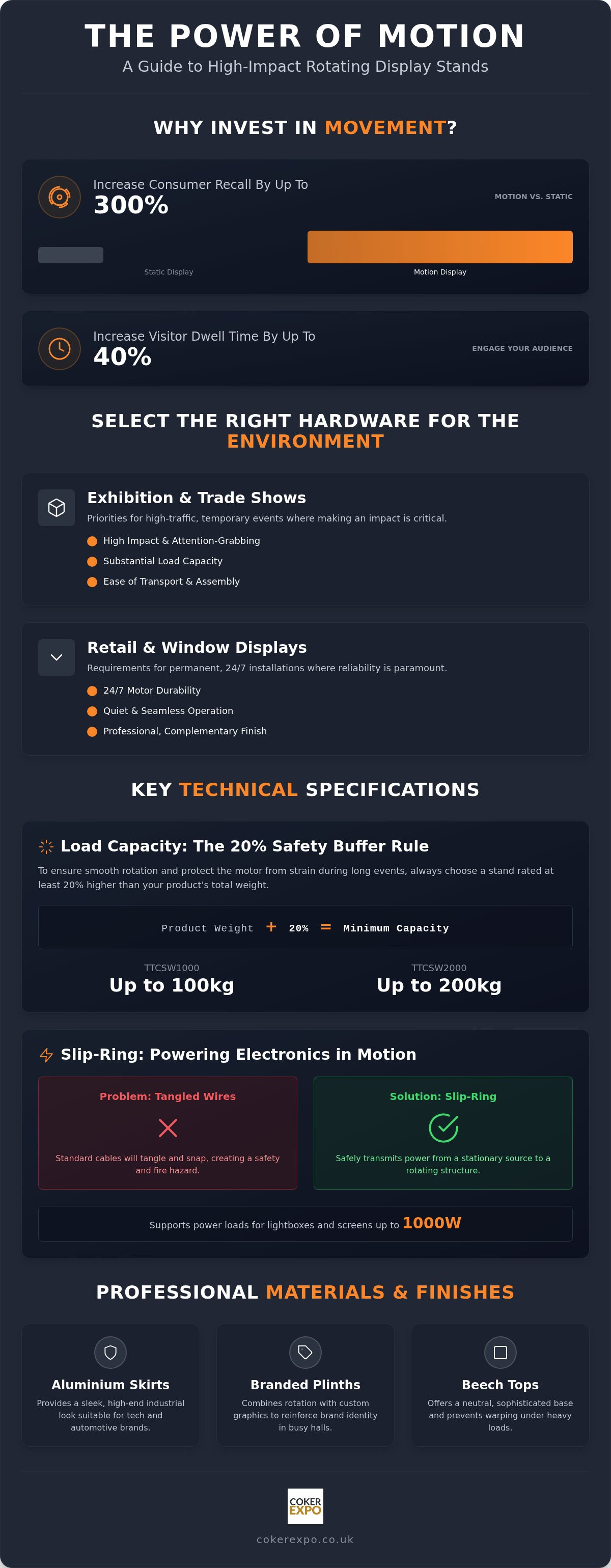
Did you know that displays incorporating motion can increase consumer recall by up to 300% compared to static alternatives? In the high-pressure environment of a UK trade show, that level of engagement is the difference between a captured lead and a lost opportunity. We understand that the logistical reality of using rotating display stands often brings more stress than excitement. You might worry about a motor seizing during a live demonstration or struggle to understand why a large deck size doesn't always guarantee a high load capacity.
We agree that your focus should remain on your clients, not troubleshooting hardware on the floor. This 2026 guide will help you select a stand that provides a seamless 360-degree showcase while maintaining total reliability. We'll examine the engineering behind load capacities, explain how slip-ring technology safely powers illuminated products, and detail the safety features required for public-facing environments.
Key Takeaways
- Learn how adding motion to your exhibit can increase consumer recall by up to 300% compared to static displays.
- Master technical specifications to ensure your rotating display stands operate reliably by maintaining a 20% safety buffer over your product's weight.
- Solve the challenge of powering illuminated electronics on a moving platform using specialised slip-ring technology.
- Choose between manual turntables for interactive customer experiences and motorised units for consistent, automated 360-degree storytelling.
- Understand the importance of professional-grade materials like aluminium skirts and beech tops for hardware that survives multiple event seasons.
The Impact of Movement: Why Invest in Rotating Display Stands?
Human biology dictates that we notice movement. In a crowded environment like a trade show, the human eye naturally tracks objects in motion, a trait that helped our ancestors survive. This instinctual response is why rotating display stands are so effective at breaking through the "static blindness" that occurs when visitors are overwhelmed by rows of stationary exhibits. While the history of the spinner rack shows how rotation has been used for decades to display magazines and comics, modern applications focus on 360-degree storytelling. High-value products, from luxury watches to precision engineering components, require a full view to be fully appreciated. Movement ensures no detail is hidden.
Breaking the Static Barrier at Trade Shows
Movement acts as a passive attention-grabber. It draws the eye without the need for aggressive sales tactics. When you integrate rotation into your exhibition stand design, you create a dynamic focal point that naturally increases visitor dwell time. Research from the Point of Purchase Advertising Institute suggests that adding movement to a booth can increase visitor dwell time by as much as 40%. This is especially valuable for exhibitors with limited space. By rotating a product, you effectively show every facet of an item within a compact footprint, maximising the utility of your square footage.
Retail vs. Exhibition Use Cases
The environment dictates the hardware choice. Retail window displays demand 24/7 reliability and quiet operation. For these permanent settings, motor durability is the priority to ensure the unit survives thousands of hours of continuous use. In contrast, exhibition use cases prioritise high impact, substantial load capacity, and ease of transport. The aesthetic finish also plays a role in professional presentation. We recommend specific finishes based on your brand goals:
- Aluminium skirts: These provide a sleek, high-end industrial look suitable for tech and automotive brands.
- Black fabric or beech tops: These offer a neutral, sophisticated base that ensures the product remains the primary focus.
- Branded plinths: Combine rotation with custom graphics to reinforce brand identity in busy halls.
Whether you're outfitting a flagship store or preparing for a national trade event, choosing the right rotation speed and finish ensures the hardware complements your product. It's about creating a smooth, professional showcase that reflects the quality of your brand.
Technical Specifications: Load Capacity, Deck Size, and Slip Rings
Selecting the right hardware requires a deep understanding of weight distribution and power requirements. While the psychology of movement in marketing confirms that motion drives purchasing behavior, a mechanical failure mid-event will negate any positive impact. When calculating your required load capacity, always choose a stand rated at least 20% higher than your product's total weight. This safety buffer protects the motor from strain during long-duration exhibitions and ensures a consistent rotation speed.
Heavy-Duty Engineering for Professional Displays
Standard rotating display stands often struggle with industrial or high-value mechanical items. For weights up to 100kg, the TTCSW1000 provides a robust solution, while the TTCSW2000 is engineered to handle exhibits up to 200kg. Structural integrity is maintained through the use of solid beech tops, which prevent warping under high pressure. If your exhibit is public-facing, an aluminium skirt adds a layer of motor protection while maintaining a professional aesthetic. Stability also depends on deck size; your product's base shouldn't overhang the turntable edge, as this creates a tipping hazard and unnecessary motor friction.
The Science of the Slip Ring
Powering electronics on a moving platform is a significant logistical hurdle. Standard cables will inevitably tangle and snap as the unit rotates. This is where the TTCSW1000SR and its integrated slip-ring technology become essential. A slip ring is an electromechanical device that allows the transmission of power from a stationary source to a rotating structure. It's the only safe way to manage power for integrated electronics.
This system is vital for illuminated lightboxes or digital screens mounted directly onto the stand. Our slip-ring units typically support power loads up to 1000W, which is more than sufficient for most retail and exhibition hardware. For the most reliable results at multi-day events, mains-powered units are preferable over battery options to ensure consistent performance without the risk of power depletion. You can explore our full range of display turntables to find the exact specification for your next project.
Choosing Your Control: Manual, Motorised, and Variable Speeds
The method of control you select for your hardware determines how your audience interacts with your product. While motorised rotating display stands offer a consistent, hands-off showcase, manual and variable-speed options provide specific advantages for interactive environments or high-precision photography. Choosing between these systems requires balancing the desired customer experience with the technical requirements of your exhibit.
Interactive Manual Displays
The MANTT series represents a robust solution for heavy equipment, capable of handling loads up to 350kg. These manual turntables are designed for "touch and turn" experiences, allowing visitors to physically engage with the product at their own pace. We offer customisation options including white, black, or Pantone-matched tops to ensure the hardware aligns with your brand identity. This interactive approach is particularly effective in educational or information-heavy settings, often serving as a perfect companion to folding display boards where visitors stop to digest technical details.
Precision with Variable Speed Motors
Variable speed rotating display stands provide the flexibility needed for complex item reveals or professional content creation. The TT15 unit is ideal for lightweight items, offering an adjustable range from 1.7 to 4 RPM. For more demanding applications, the TT60100KVS allows for remote control management of both speed and rotation direction. It's a critical feature for managing a display from across a busy stand without interrupting your conversation with a potential client.
Matching rotation speed to product size is essential for a professional aesthetic. Larger items generally require slower speeds to allow the viewer to process details without visual distortion. Smaller items benefit from a slightly higher RPM to maintain visual energy. If you need assistance selecting the correct motor for your specific product dimensions, you can browse our full range of display turntables to compare technical specifications.
Standout Solutions: Top Picks from the CokerExpo Collection
Selecting the right hardware depends on your specific exhibit goals. We've categorised our most popular rotating display stands to help you match technical specifications to your product requirements. Each model is engineered for reliability in high-pressure professional environments.
- Best for Heavy Exhibits: The TTCSW2000 offers a 200kg capacity. It's the industry standard for showcasing industrial machinery, automotive components, or large-scale sculptures.
- Best for Illuminated Displays: The TTCSW1000SR features the slip-ring technology discussed earlier. It provides continuous internal power for products that require their own lighting or digital screens.
- Best for Small Products: The TT15 Variable Speed Turntable provides precise control for items up to 15kg. It's an ideal choice for detailed product photography or jewellery showcases.
Specialised Rotating Signage
Motion isn't limited to physical products; it's equally effective for visual communication. You can transform standard shell scheme graphic panels by integrating rotating columns that stand out from the perimeter walls. The RLB400 and 500mm rotating lightboxes combine 360-degree impact with internal LED illumination. These units ensure your branding is visible from every approach angle in a busy hall. For high-traffic corridors, double-sided "A-frame" style rotating boards act as dynamic wayfinding tools that capture attention more effectively than static signage.
Practical Logistics and Setup
Professional hardware represents a sound business investment, but it requires proper handling. When planning your event, consider the weight of the units for transport. While our aluminium-skirted models are designed for durability, larger 200kg variants require careful handling by event staff. Maintenance is straightforward. Keep the motor housing and deck surface free of carpet fibres or grit. This prevents friction build-up and ensures the safety clutch operates correctly. Regular cleaning ensures a smooth, silent rotation that lasts for multiple seasons.
Ready to upgrade your event presence? Browse the full collection of professional rotating display stands to secure reliable hardware for your next UK exhibition.
Secure Your Event Success with Professional Rotation
Selecting high-performance hardware is a strategic business decision that directly impacts visitor engagement and brand recall. By applying a 20% safety buffer for load capacities and utilising specialist slip-ring technology, you ensure a flawless 360-degree showcase across multiple seasons. These technical foundations allow your team to focus on closing leads while the hardware handles the presentation with total reliability.
We provide the essential infrastructure for high-impact displays, including heavy-duty units with capacities up to 350kg. Our UK-wide national delivery ensures your equipment arrives on time and ready for immediate assembly. It's time to move beyond static exhibits and capture the attention your brand deserves with reliable rotating display stands. We look forward to helping you create a standout presence at your next professional event.
Shop the Full Range of Rotating Display Stands
Frequently Asked Questions
What is a slip ring in a rotating display stand?
A slip ring is an electromechanical device that enables the transmission of electrical power from a stationary base to a rotating platform. Without this technology, cables would inevitably tangle and snap as the unit turns. It's the standard solution for powering integrated electronics, such as illuminated lightboxes or digital screens, ensuring they remain active throughout a 360-degree rotation without any interruption to the power supply.
How do I calculate the load capacity I need for my product?
You should calculate the total weight of your exhibit and then add a 20% safety margin. For example, a 75kg product requires a stand rated for at least 90kg. This buffer protects the internal motor from excessive strain and ensures the rotation speed remains consistent throughout the event. Always consider the distribution of weight; off-centre loads can increase mechanical stress even if the total weight is within the rated capacity.
Can I use a rotating display stand for outdoor events?
Standard motorised units are designed for indoor use and shouldn't be exposed to moisture or direct sunlight for extended periods. If your event is outdoors, you must ensure the unit is placed on a perfectly level surface and protected by a marquee or similar cover. For completely exposed environments, manual rotating display stands are a more resilient choice as they lack sensitive electrical components that could fail due to humidity or dust.
Are motorised turntables noisy for quiet showroom environments?
Professional-grade turntables operate at noise levels below 50 decibels, making them virtually silent in a standard retail or showroom setting. While you might hear a faint hum in a perfectly silent room, it's typically masked by ambient background noise or music. If silence is a critical requirement, opting for a higher-capacity motor than necessary often results in quieter operation as the unit isn't working at its maximum mechanical limit.
What is the difference between a manual and a motorised turntable?
Motorised units provide a consistent, automated rotation that ensures your product is seen from every angle without human intervention. Manual rotating display stands, such as the MANTT series, are designed for customer interaction, allowing visitors to spin the display at their own pace. Manual options are often preferred for heavy industrial equipment up to 350kg or interactive educational displays where "touch and turn" engagement is the primary goal for the exhibitor.
Do rotating display stands come with a UK power plug?
All our mains-powered units are supplied with a standard UK 3-pin plug as standard. They're designed for immediate use with 230V UK power supplies, requiring no additional transformers or adapters for domestic events. We ensure that every motorised unit meets relevant safety standards, including the integration of mandated safety clutches. This plug-and-play approach allows for rapid setup at trade shows where time and electrical simplicity are critical factors for success.
Einen Kommentar hinterlassen