

Buying replacement tension fabric graphics
Settling for subpar print quality on a premium display frame is a shortcut that often leads to expensive logistical failures. If you've dealt with graphics that crease during transport or colours that shift between print runs, you know that technical specifications matter more than the initial price tag. Selecting the correct replacement tension fabric graphics, Latex, Uv and Dyesub, is the only way to ensure your hardware continues to deliver a professional impact. We agree that your focus should be on the event results, not on whether your fabric will fit the frame upon arrival.
This article promises to simplify the selection process by explaining how different ink technologies interact with polyester fibres. You'll learn how to achieve superior light diffusion for backlit displays and why certain methods are better for high-traffic environments. We will preview the specific performance benefits of each printing style, from the deep saturation of dye-sublimation to the rapid curing of UV-LED systems. This knowledge ensures your next brand refresh is both cost-effective and visually flawless, providing a seamless fit for your existing TFS Tension Fabric systems every time.
Key Takeaways
- Maximise your return on investment by refreshing visuals on existing TFS Tension Fabric systems instead of commissioning entirely new hardware.
- Select the optimal print method for your environment by comparing the durability and saturation levels of Replacement tension fabric graphics, Latex, Uv and Dyesub.
- Eliminate installation delays by accurately identifying your Silicone Edge Graphic (SEG) profile and distinguishing between visible area and total fabric dimensions.
- Ensure total brand consistency across high-traffic events by mastering colour management and high-resolution artwork specifications for large-format displays.
Why Refreshing Your Tension Fabric Graphics is the Smartest ROI Move in 2026
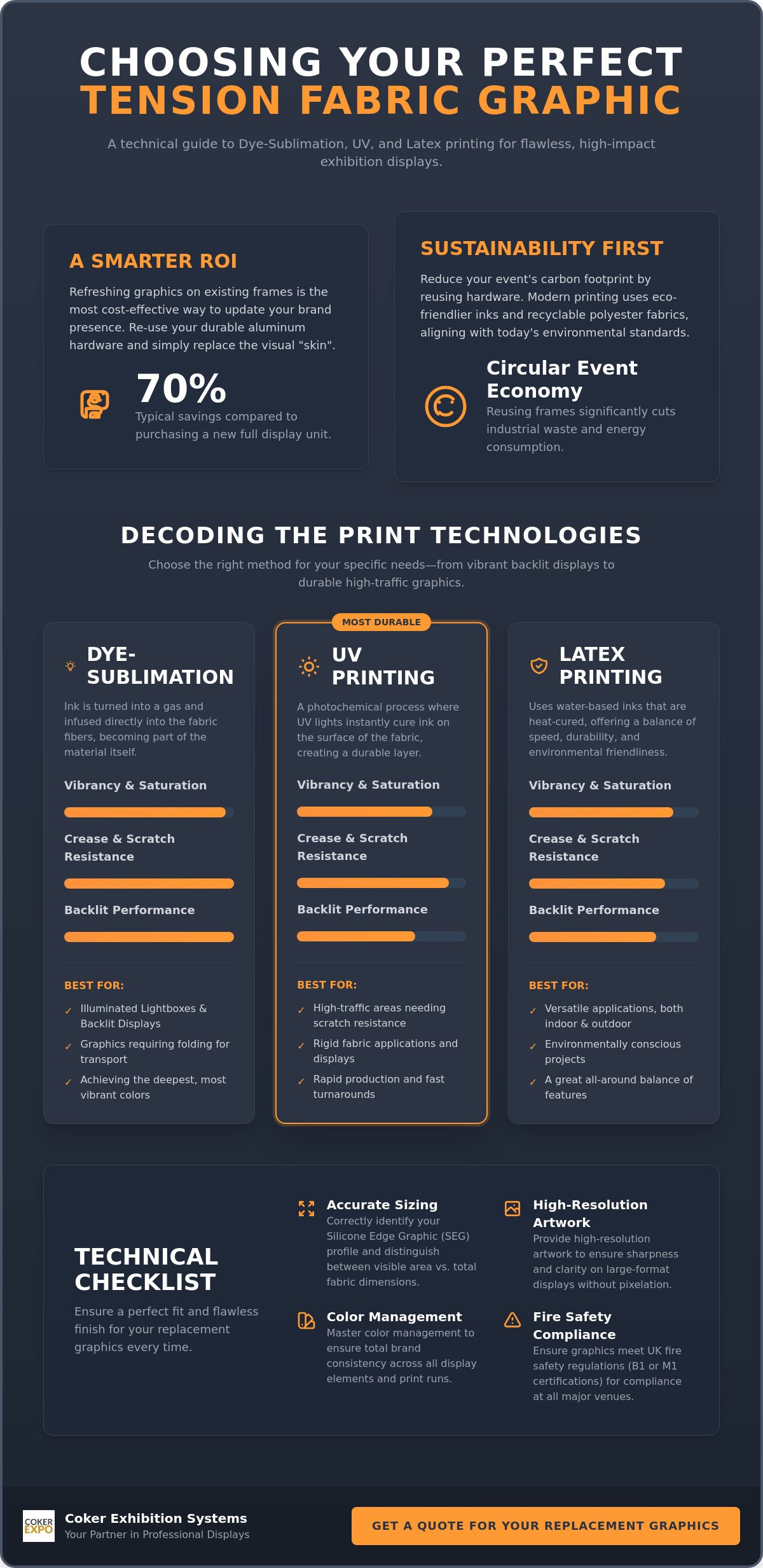
Maximising your exhibition budget requires a shift from viewing displays as single-use purchases to seeing them as permanent infrastructure. The core value of a professional display lies in its aluminium frame, which is engineered for years of repeated assembly. By focusing on Replacement tension fabric graphics, Latex, Uv and Dyesub., you isolate the branding element from the hardware. This allows for rapid updates without the capital expenditure of a new system. Industry data indicates that skin-only updates save up to 70% compared to purchasing a full display unit, making it the most logical financial choice for companies with active event calendars.
Refreshing your graphics isn't just about cost; it's about maintaining a competitive edge. In fast-moving exhibition cycles, a brand that uses the same visuals for three years appears stagnant. High-quality Replacement tension fabric graphics, Latex, Uv and Dyesub. allow you to pivot your messaging for specific audiences or product launches. You keep the structural reliability of your existing TFS Tension Fabric systems while presenting a completely new face to the market. This modular approach ensures your physical presence remains as agile as your digital marketing.
For those seeking inspiration on how to leverage boutique branding for their event presence, you can check out Zodiac Event Displays, which specializes in high-impact soft signage and marketing materials.
The Lifecycle of Professional Exhibition Hardware
Aluminium frames are designed to be a one-time investment. While the hardware is resilient, fabric graphics naturally face wear from light exposure, handling, and environmental dust. You should consider a fabric refresh every 12 to 18 months, or whenever a major brand shift occurs. If the frame shows no signs of structural warping or connector wear, there's no reason to replace it. Integrating these updates into your broader Exhibition Stand Design strategy allows for modular growth, where you can add new frame components to your existing inventory over time.
Sustainability and the Circular Event Economy
Reducing the carbon footprint of your trade show presence is a logistical necessity in 2026. Reusing aluminium frames significantly cuts down on industrial waste and the energy-intensive process of manufacturing new metal structures. The Dye-sublimation printing process is particularly effective here, as it uses water-based inks and produces graphics that are durable enough for multiple uses. When choosing materials, ensure your replacement graphics meet UK fire safety regulations, such as B1 or M1 certifications, to guarantee compliance across all major venues. Using recyclable polyester fabrics further enhances your sustainability credentials, aligning your physical displays with modern environmental standards.
Dye-Sublimation, UV, and Latex: Decoding the Print Technologies
Selecting the right print method for your Replacement tension fabric graphics, Latex, Uv and Dyesub. depends on your display environment and the specific demands of your event schedule. Each technology offers distinct mechanical advantages. Dye-sublimation provides unmatched colour depth; UV and Latex excel in production speed and environmental resilience. Understanding these technical nuances ensures your graphics don't just look good on day one but remain functional throughout their lifecycle. Choosing the incorrect method for high-intensity Exhibition Lightboxes, for example, can lead to visible light leaks or poor colour saturation.
Dye-Sublimation: Why It Dominates Backlit Displays
This process involves a chemical reaction where heat turns solid ink into a gas, allowing it to penetrate and bond with polyester fibres. Because the ink is inside the fabric rather than on the surface, these graphics are virtually impossible to crease. You can fold them for compact transport without fearing permanent white lines or cracked ink. For those using illuminated displays, dye-sublimation provides superior light diffusion. The saturated fibres prevent the "pin-holing" effect often seen with surface-printed alternatives, ensuring a smooth, vibrant glow across the entire display surface.
Latex vs. UV: Speed, Durability, and Environment
UV printing uses a photochemical process where ultraviolet lights instantly cure the ink on the fabric surface. This results in high-opacity prints with excellent scratch resistance, making them ideal for high-traffic areas or rigid fabric applications. In contrast, Latex printing uses water-based, non-flammable inks that are entirely odorless. This makes Latex a preferred choice for sensitive environments like healthcare or boutique retail. A technical comparison of UV and latex printing reveals that Latex inks offer superior flexibility. This elasticity is vital when applying significant tension to Replacement tension fabric graphics, Latex, Uv and Dyesub. during installation.
- UV Inks: Best for instant drying and surface durability on non-stretch materials.
- Latex Inks: Superior for eco-conscious brands and high-stretch applications where odour is a concern.
- Dye-Sublimation: The preferred choice for washability and backlit intensity in premium environments.
If you're planning a full stand refresh, you can view our range of professional display hardware to see how these print technologies integrate with our latest frames. Each method serves a specific logistical purpose, so matching the ink to the application is the most effective way to protect your branding investment.
Ordering Replacement Graphics: The Technical Specification Checklist
Precision in measurement is the difference between a high-impact display and a logistical failure. When you order Replacement tension fabric graphics, Latex, Uv and Dyesub., you must provide the external dimensions of the frame itself rather than measuring a previous graphic that may have stretched over time. The industry standard requires a distinction between the visible area, which is the part seen by your audience, and the total fabric size, which includes the bleed and the silicone gasket. Providing the frame's outer edge dimensions allows the printer to calculate the necessary "under-sizing" required to achieve a drum-tight finish once the fabric is tensioned.
Accounting for the stretch coefficient is a technical necessity. Standard display polyester typically requires a 1% to 2% reduction in size to ensure it doesn't sag. In contrast, heavy-duty backlit or blockout materials are often more rigid and require less under-sizing. If you're unsure of your frame's origin, we recommend sending a small sample of the existing silicone strip to ensure a perfect mechanical match. You can secure high-performance visuals for any system by visiting our Large Format Printing service page to start your technical specification process.
The Silicone Edge (SEG) Profile Guide
The keder, or silicone strip, is the critical interface between your fabric and the frame. Most modern systems use either a 3mm or 4mm thick profile. A gasket that is too thin will slip out under tension; one that is too thick will be impossible to press into the frame channel without tools or potential damage. This level of precision is equally vital when you are fitting Shell Scheme Graphic Panels, where channel depths across different venues can vary significantly. Always measure the width and depth of the silicone strip currently in use before placing your order.
Material Selection for Different Environments
Choosing the right textile is just as important as the print method. Opaque or "Black-back" fabrics are the professional choice for freestanding frames. These materials feature an integrated light-stop layer that prevents internal frame shadows or rear light sources from "ghosting" through your artwork. For illuminated systems, specific backlit textiles are required to ensure even light distribution without hot spots. In high-traffic, echo-prone exhibition halls, you might consider acoustic-rated fabrics. these provide the same vibrant branding while helping to dampen ambient noise, creating a more professional atmosphere for lead generation and meetings.
Maximising Brand Impact with Professional Graphic Finishing
The final aesthetic of your display depends heavily on the transition from digital file to physical textile. Even the highest quality Replacement tension fabric graphics, Latex, Uv and Dyesub. will fail to impress if the artwork is poorly prepared or the installation is rushed. Achieving a drum-tight, professional finish requires a combination of high-resolution file management and disciplined post-print handling. When these elements align, your existing hardware is transformed into a high-impact marketing tool that reflects the quality of your brand.
Installation is the final hurdle in the process. To ensure a seamless look, always use the "corner-first" technique. Start by pushing the silicone gasket into the four corners of the frame before filling in the sides. This method distributes the tension evenly across the fabric and prevents the "bunching" that occurs when you work from one side to the other. If you notice minor wrinkles after installation, a portable steamer can safely remove them from most polyester fabrics, provided you maintain a safe distance to avoid heat damage to the ink.
Artwork Preparation for Tension Fabric
Large Format Printing in the context of event branding refers to the production of high-impact visuals on a scale that exceeds standard commercial presses, specifically engineered to maintain clarity and colour depth across expansive fabric surfaces. To maintain this clarity, logos and text should always be supplied in vector format to allow for infinite scaling without pixelation. For raster images, a minimum of 100 to 150 DPI at full size is the industry benchmark. You must also account for a 50mm bleed and keep critical text within a 50mm "safe zone" from the frame edge to ensure no branding is lost within the silicone channel during finishing.
Post-Event Care and Storage
The longevity of your graphics is determined by how they are handled between shows. Dye-sublimated fabrics are remarkably resilient; they can be machine-washed on a cold, gentle cycle and folded for storage without risk of permanent damage. However, UV and Latex printed graphics require different care. Because these inks are cured on the fabric surface, they should be rolled onto a cardboard core rather than folded. Folding surface-printed graphics can lead to ink cracking or white stress marks along the creases. At CokerExpo, we support national clients with rapid graphic turnarounds, ensuring that your Replacement tension fabric graphics, Latex, Uv and Dyesub. are produced, finished, and delivered to meet even the most aggressive exhibition deadlines.
Future-Proofing Your Brand Presence
Mastering the technical nuances of your display hardware is the most effective way to eliminate logistical friction at your next event. By selecting the correct print method for your environment and ensuring precise technical measurements for your SEG profiles, you protect both your brand's image and your marketing budget. Investing in high-quality Replacement tension fabric graphics, Latex, Uv and Dyesub. ensures that your existing hardware remains a high-performance business asset for years to come.
We provide the essential infrastructure for your success through UK-based expert production and a deep understanding of large-format textiles. As specialists in TFS and Lightbox systems since 1999, we prioritize craftsmanship and speed to help you meet demanding exhibition deadlines. You can order your high-performance replacement graphics from CokerExpo today and benefit from our national delivery and rapid turnaround times. We look forward to helping you achieve a significant impact at your next professional exhibition.
Frequently Asked Questions
Can I wash my replacement tension fabric graphics?
You can machine wash dye-sublimated graphics on a cold, gentle cycle without damaging the print quality. Because the ink is fused into the polyester fibres, it remains colourfast and durable even after cleaning. You should avoid washing UV or Latex surface-printed graphics, as the mechanical action of a washing machine can cause the ink layer to crack or delaminate. Always air dry your fabrics to prevent heat-related shrinkage that could ruin the fit.
Will a new fabric graphic fit a frame I bought from a different supplier?
A new graphic will fit a third-party frame as long as you provide accurate external frame dimensions and identify the correct silicone edge (SEG) profile. Most industry-standard systems use either a 3mm or 4mm keder strip. We recommend measuring the depth and width of your existing gasket with callipers to ensure a mechanical match. This precision is essential for maintaining the structural integrity of your Replacement tension fabric graphics, Latex, Uv and Dyesub.
What is the difference between frontlit and backlit fabric?
Frontlit fabric is an opaque material, often featuring a black-back coating to prevent light from behind the frame from creating shadows on your artwork. Backlit fabric is a specialized textile engineered for Replacement tension fabric graphics, Latex, Uv and Dyesub. used specifically in lightboxes. It features a specific weave that diffuses LED light evenly across the surface. This prevents hot spots and ensures your branding remains vibrant and legible when illuminated.
How do I remove creases from my fabric graphics after storage?
Most minor creases disappear naturally once the fabric is fully tensioned within the frame. If stubborn fold lines remain, you can use a handheld garment steamer on a low heat setting to relax the fibres. Always steam from the reverse side of the graphic and keep the steamer moving to avoid localized heat damage. Avoid using traditional irons, as direct contact with high heat can melt the polyester or distort the print surface.
Do I need to buy a new silicone edge (SEG) strip every time I update my graphic?
You don't need to purchase separate silicone strips because the SEG gasket is sewn directly into the perimeter of your new graphic during production. Each replacement is delivered as a complete, ready-to-install unit. This ensures the tensioning is correctly calibrated for the specific material weight you've chosen. Reusing old strips from previous graphics is not possible as they are permanently stitched to the old fabric skin.
How long do replacement fabric graphics typically last?
Professional fabric graphics typically maintain their aesthetic quality for 12 to 18 months of frequent event use. Their lifespan depends heavily on the display environment and how they are stored between shows. While high-tier materials like solution-dyed acrylic can last many years in permanent settings, standard exhibition polyester is designed for high-impact, short-term cycles. Proper rolling and dry storage will significantly extend the life of your brand assets.
Einen Kommentar hinterlassen