

How to Brief an Exhibition Stand Builder: The Professional 2026 Guide
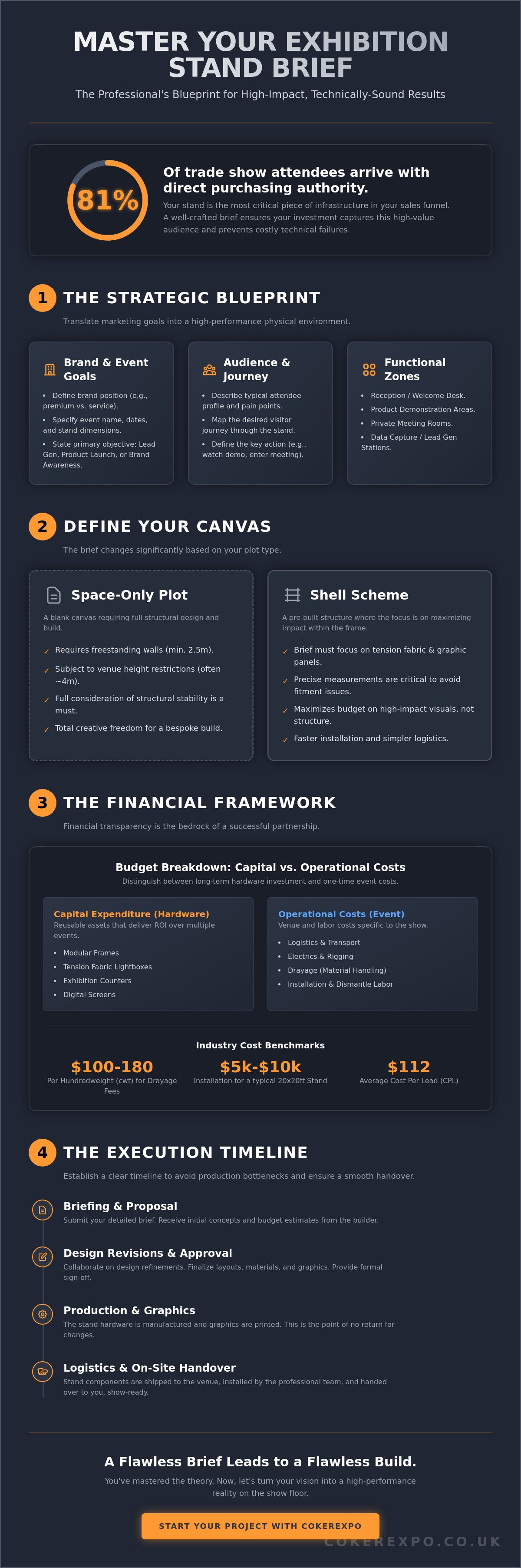
81% of trade show attendees arrive with direct purchasing authority, making your stand the most critical piece of infrastructure in your sales funnel. You likely understand the stress of managing tight deadlines while worrying about technical failures like poor lighting or graphics that don't fit. It's a common fear that a vague initial conversation will lead to hidden costs and a display that fails to represent your brand's quality. Mastering how to brief an exhibition stand builder is the essential first step to ensuring your investment delivers a high-impact, technically sound result on the show floor.
This professional 2026 guide will give you the tools to bridge the gap between your marketing vision and a high-performance physical environment. You'll gain the confidence to lead the process using our professional brief template, ensuring your builder understands every requirement from the start. We'll walk through the logistics of maximizing your event ROI by focusing on superior lighting, precision graphics, and the scalable systems that make your stand a sound business investment.
Key Takeaways
- Define your brand identity and specific event goals to provide a strategic blueprint that aligns with your market position.
- Master how to brief an exhibition stand builder by being transparent about your budget, which helps you distinguish between hardware investment and operational costs.
- Identify specific functional zones, such as reception areas and product demos, to ensure your lighting and tension fabric systems are integrated for maximum impact.
- Establish a clear timeline for design revisions and approvals so you don't hit production bottlenecks as the event deadline approaches.
Defining the Strategic Foundation: Company Profile and Event Goals
An exhibition stand brief is your technical and strategic blueprint. It translates your marketing goals into a physical environment that must perform under high-pressure event conditions. When learning how to brief an exhibition stand builder, you must start with a clear definition of your brand identity and market position. A builder cannot design an effective structure without understanding whether you are a premium hardware manufacturer or a service provider focused on rapid delivery. You need to provide the show name, specific dates, and exact stand dimensions immediately to ensure the design remains feasible within the venue's logistical constraints.
Your primary objective dictates every design choice. Are you focused on high-volume lead generation, a high-impact product launch, or general brand awareness? Each goal requires a different floor plan. For lead generation, you might prioritize integrated exhibition counters for data capture; for a product launch, a central display turntable or dynamic lightboxes might be the focal point to draw attention from the aisles.
Understanding Your Audience Personas
Effective stands are built for the visitor, not the exhibitor. Describe your typical attendee profile and their specific industry pain points in the brief. Understanding these principles of exhibit design allows the builder to map out a logical visitor journey. Decide on the exact action you want a visitor to take. This could range from watching a technical demo on a large format screen to entering a private meeting zone for contract negotiations. The stand design must physically guide them toward that outcome.
Space-Only vs. Shell Scheme Briefing
The briefing process changes significantly based on your plot type. A space-only plot is a blank canvas. It requires you to commission freestanding walls, which regulations often dictate must be a minimum of 2.5 meters high to separate you from neighbors. You'll need to consider structural stability and venue-specific height restrictions, which generally cap at 4 meters for single-story builds. Conversely, if you have a pre-built structure, you should focus on how to brief an exhibition stand builder for shell scheme graphic panels that maximize the existing frame. Mentioning these specific constraints early prevents technical failures and ensures your graphics fit perfectly on arrival.
The Commercial Pillar: Budgeting and ROI Objectives
Financial transparency is the bedrock of a successful partnership. When you determine how to brief an exhibition stand builder, you must be explicit about your budget range from the first meeting. Builders use this figure to select materials and structural systems that meet your needs without over-engineering. Providing a clear financial boundary prevents wasted design time and ensures the proposed solution is commercially viable. It's better to receive a high-impact design within your budget than an aspirational concept that you'll eventually have to strip back for cost reasons.
Distinguish between your capital expenditure and your operational costs. Capital expenditure covers the physical hardware, while operational costs include logistics, electrics, and drayage. At major US shows, drayage fees often reach $100 to $180 per hundredweight, and professional installation for a 20x20 foot architectural stand can range from $5,000 to $10,000. These are fixed venue and labor costs. To maximize your return, prioritize your remaining spend on high-impact exhibition stand design and professional lighting that directly influences visitor behavior.
Clear trade show ROI objectives are essential for measuring success. Whether your goal is a specific cost per lead, which averages around $112 in the industry, or increasing visitor dwell time, your builder needs these targets. Understanding how to brief an exhibition stand builder on these KPIs allows them to design layouts that facilitate specific commercial outcomes, such as dedicated zones for lead capture or product demonstrations.
Allocating Budget for Infrastructure
Choosing between bespoke builds and reusable modular systems is a long-term financial decision. While a one-off custom stand offers unique geometry, high-quality lightboxes and modular frames provide superior ROI over multiple events. You should also factor in hidden fees like electrical orders and rigging. We recommend adding a 30-40% contingency to your initial budget to account for these unforeseen venue charges.
The Value of Reusability
Brief your builder on your full multi-show calendar. Durable hardware like TFS Tension Fabric systems allows for repeated assembly without degrading the visual quality. Modularity is key here; it lets you scale a large design down to a smaller footprint, ensuring brand consistency while reducing per-event costs. If you need assistance with the initial logistics and coordination, our event management and planning services can help streamline the process.
Technical Specifications: Integrating Lighting, Graphics, and Hardware
Technical precision is what separates a conceptual design from a functional sales environment. When considering how to brief an exhibition stand builder, you must define the specific functional zones required for your operation. A standard layout often includes a high-traffic reception area, a dedicated product demonstration space, and a private meeting zone for closing deals. Without these distinctions, your builder cannot optimize the floor plan for traffic flow or sound management. Clear zoning ensures that your staff can work efficiently while visitors navigate the space without friction.
To ensure your staff remains energized and productive throughout the event, consider incorporating ergonomic furniture into these zones; visit EKOBOR to explore professional standing desk solutions designed for high-performance environments.
Visibility is a primary technical requirement. Your stand must be identifiable from across the hall, which requires a strategic approach to illumination. Specify your lighting needs clearly; high-output exhibition lighting and suspended lighting truss systems are essential for eliminating shadows and highlighting key products. For graphics, provide your builder with high-resolution file formats and state your material preferences early. Whether you require large format printing on rigid panels or stretch fabric display stands, the brief should dictate the finish to ensure brand consistency.
IT and AV requirements are often the source of logistical stress if not addressed upfront. Detail the number of screens, tablets, and interactive touchscreens needed for your display. Reliable Wi-Fi integration and power socket placement must be mapped against your furniture layout to avoid exposed cabling. Referencing a professional trade show planning checklist can help you track these technical dependencies alongside your wider event deadlines.
Maximising Impact with Lightboxes and TFS
Illumination is no longer just about visibility; it is about engagement. Brief your builder on the use of dynamic lightboxes to create movement through programmed LED sequences. These systems attract the eye more effectively than static displays. To achieve a premium, seamless finish across large wall sections, specify TFS Tension Fabric systems. If your stand requires a high-end internal finish, you should also consider how to brief an exhibition stand builder on the application of custom wallpaper for a durable, branded interior environment.
Structural Requirements and Trussing
Overhead branding is a powerful tool for dominating the venue skyline. This requires a detailed brief on truss truss systems, which provide the essential infrastructure for hanging displays and heavy lighting rigs. You must specify the weight-loading requirements for any aerial elements and ensure the brief covers floor-loading limits for heavy machinery or equipment. If you need to secure high-impact overhead visibility, our lighting truss hire services provide the structural reliability required for complex rigging installations.
Logistics and Timelines: From Proposal to Handover
Logistics and timelines are where the strategic brief meets operational reality. To avoid rush charges and ensure supplier availability, start the process at least 3 to 6 months before the event. A clear timeline must include milestones for the initial design proposal, a structured revision phase, and final sign-off. Identifying key stakeholders early prevents approval bottlenecks that can derail production schedules. For example, major 2026 events like iGB L!VE require complex stand plans by May 8, 2026. Missing these deadlines often results in penalty fees or restricted build options that can compromise your brand presence.
The handover process is just as critical as the construction phase. It should include an onsite orientation where your builder demonstrates how to operate technical elements like dynamic lightboxes or display turntables. Professional support shouldn't end when the show opens; technical assistance during the event ensures any hardware issues are resolved immediately. Finally, your brief must address the post-show phase. Plan for the efficient breakdown and storage of reusable components to protect your long-term investment. Mastering how to brief an exhibition stand builder on these logistical details ensures your team can focus on sales rather than troubleshooting.
The Design Revision and Feedback Loop
Initial 3D renders are your first opportunity to see the brief in action. Provide constructive feedback that focuses on how the design meets your strategic goals rather than just aesthetic preferences. Double-check technical details during this stage. Ensure power socket placements align with your furniture layout and verify that sightlines to your primary branding remain clear from all approach angles. This is the time to confirm that the proposed hardware meets your durability requirements for a multi-show calendar.
Onsite Management and Support
Managing a build requires coordination between multiple trades. Your brief should clarify who is responsible for onsite services like exhibition flooring installation and carpet fitting. For large-scale projects, a dedicated project manager is essential to oversee the timeline and handle venue communications. Before the show opens, complete a final walk-through to ensure every component meets the agreed specifications. Knowing how to brief an exhibition stand builder regarding onsite expectations reduces the risk of last-minute errors and ensures a stress-free transition to show day.
Executing Your Vision on the Show Floor
A successful event presence relies on the seamless transition from high-level marketing strategy to technical execution. By defining your commercial KPIs and audience personas early, you provide the essential infrastructure for a high-impact stand. Mastering the process of how to brief an exhibition stand builder ensures that every technical specification, from lighting truss loads to seamless fabric finishes, aligns with your brand's vision and maximizes your return on investment.
With over 25 years of UK exhibition experience, we specialize in delivering high-impact tension fabric systems and advanced lightbox displays. Our team provides comprehensive event management and professional truss hire services to ensure your logistical requirements are met with total reliability. Download our exhibition briefing template or contact CokerExpo for expert stand planning to secure a technically sound, high-impact display for your next show. We are ready to help you build a presence that commands attention and delivers measurable results.
Frequently Asked Questions
How far in advance should I brief an exhibition stand builder?
You should brief your builder 3 to 6 months before the event to avoid rush charges and secure production slots. This lead time is essential for navigating complex venue deadlines, such as the May 2026 requirements for major European trade shows. Early planning ensures that structural designs are approved and technical components like custom lightboxes are manufactured to specification without compromising quality or reliability.
What is the most important part of an exhibition stand brief?
The primary objective of your participation is the most critical element of the brief. Whether you're targeting high-volume lead generation or a specific product launch, your builder needs this focus to design a functional floor plan. This goal dictates the placement of exhibition counters, demonstration zones, and private meeting areas to ensure the stand operates as a high-performance sales environment.
Should I include a specific budget in my exhibition brief?
You must include a specific budget range to ensure the proposed solutions are commercially viable. Transparency allows the builder to select the most efficient hardware and materials for your needs. Remember to distinguish between capital expenditure for hardware and operational costs like venue electrics or drayage; it's advisable to set aside a 30-40% contingency for these unforeseen logistical fees.
How do I brief for a stand that will be used at multiple events?
Specify modularity and material durability if you intend to reuse the stand across various shows. Briefing for a multi-show calendar allows the builder to use scalable systems, such as TFS Tension Fabric or modular frames, that adapt to different floorplans. This approach maximizes your long-term ROI by reducing the per-event cost while maintaining brand consistency across your entire event schedule.
What technical venue information does my stand builder need?
Provide the exact stand dimensions, orientation, and any venue-specific height restrictions. Your builder also needs the location of service ducts for power and internet to avoid unsightly cabling across the floor. Understanding these constraints early, including the 4-meter height limit for standard single-story stands, ensures the final structure is both technically compliant and visually impactful.
Can I use the same brief for different exhibition stand designers?
Yes, using a standardized document for multiple designers is an effective way to compare quotes accurately. When you learn how to brief an exhibition stand builder using a professional template, you ensure that every designer receives the same technical and strategic requirements. This consistency makes it easier to evaluate different creative approaches based on their ability to meet your specific commercial objectives.
Einen Kommentar hinterlassen