

Justifying Your Exhibition Budget to Management: A Strategic Business Case Guide
Companies report an average ROI of $21 for every $1 spent on trade shows, yet many directors still dismiss these events as "expensive days out." When you're tasked with justifying exhibition budget to management, you often face a wall of skepticism regarding brand awareness and a constant fear of mid-campaign budget cuts. It's frustrating to know your strategy works but lack the data to prove it to a board that views every line item as a cost rather than an asset. We understand the pressure of securing a signed-off budget in a high-stakes B2B environment where every decision must be backed by logic.
This guide will show you how to transform your exhibition proposal from a simple request into a high-yield investment case. You'll learn a practical framework for reporting success and discover why choosing durable, high-impact hardware like lightboxes or TFS tension fabric systems creates a professional presence that justifies its own price tag. We'll provide the structured information you need to move from logistical stress to a position of total reliability. By the end of this article, you'll have the tools to ensure your next event delivers the measurable impact and lead generation your business demands.
Key Takeaways
- Shift the internal conversation by identifying the "Cost of Inaction" and distinguishing between one-time operational fees and reusable capital assets.
- Master the data-driven approach to justifying exhibition budget to management by comparing your trade show Cost Per Lead against the rising costs of cold-calling and digital advertising.
- Discover how high-impact hardware like lightboxes and TFS tension fabric systems reduce long-term spend through a superior cost-per-use model compared to disposable displays.
- Protect your investment by understanding how professional exhibition event management acts as an insurance policy against the hidden costs of logistical errors and onsite damage.
Shifting the Narrative: From Exhibition Cost to Strategic Investment
When you present a proposal to the board, directors often focus on a single, daunting expenditure figure. To succeed in justifying exhibition budget to management, you must first reframe the conversation around the "Cost of Inaction." Absence from key industry events in 2026 isn't a saving; it's a surrender of market share to competitors who are actively engaging your target audience. Understanding what is a trade show helps clarify that these events are platforms for direct commercial engagement rather than just social gatherings. If your brand isn't there to capture that authority, someone else will be.
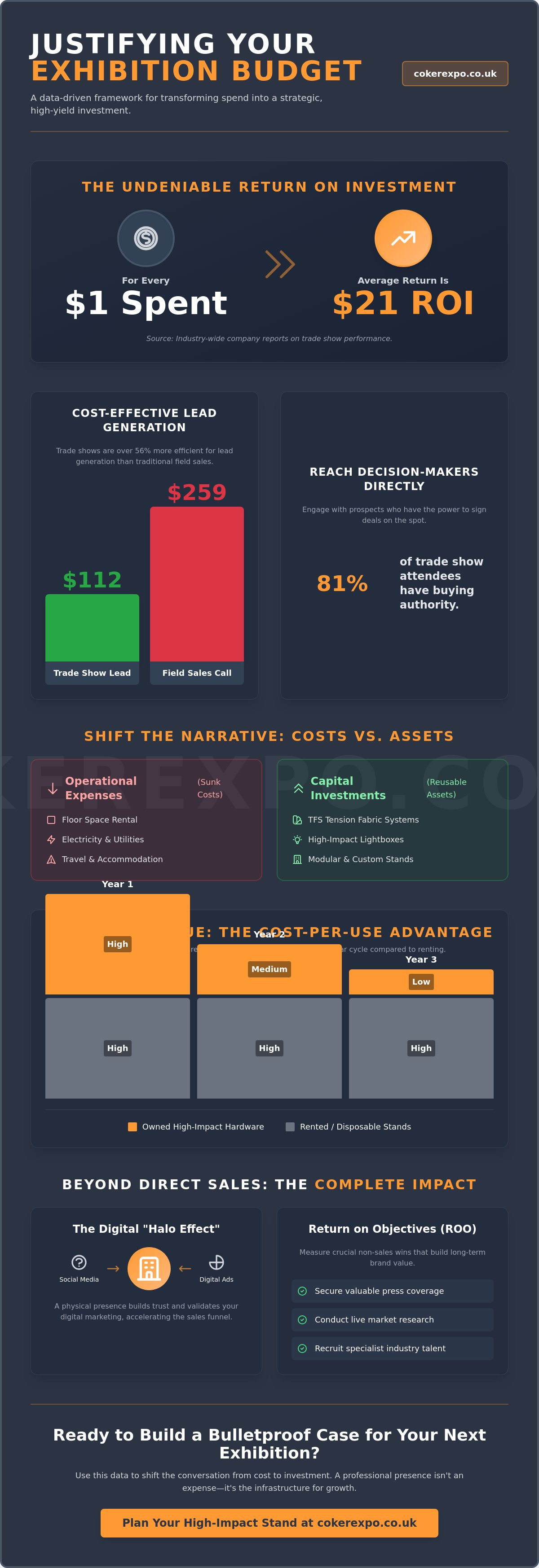
It's essential to distinguish between operational expenses and capital investments. Costs like floor space, electricity, and travel are sunk costs that disappear once the event ends. In contrast, high-quality hardware like TFS Tension Fabric systems and lightboxes are capital investments. These durable assets are designed for repeated use across multiple years and campaigns. By investing in resilient, professional infrastructure, you reduce the long-term cost per event and build a tangible asset library for the business.
A physical presence at an event creates a powerful "halo effect" on your digital marketing efforts. It builds a level of trust and regional reliability that cold outreach simply cannot match. When prospects see your brand represented by high-performance hardware and a knowledgeable team, it validates your digital claims and accelerates the lead nurturing process. This physical touchpoint often acts as the catalyst that moves a long-term prospect into the final stages of the sales funnel.
Identifying Core Business Drivers
You must determine if your primary goal is lead generation, brand repositioning, or defensive positioning against a rising competitor. Link your attendance directly to sales pipeline targets for the next fiscal year to demonstrate a clear path to ROI. Strategic Alignment is the bridge between marketing activity and corporate revenue. This clarity ensures that when justifying exhibition budget to management, you are speaking the language of growth rather than just marketing spend.
The 2026 UK Exhibition Landscape
The 2026 event environment is more competitive than ever. Basic, uninspired stands no longer capture attention in crowded halls where visitor expectations have shifted toward high-quality visual anchors. With the global exhibition market projected to reach $67.4 billion by 2033, your competitors are likely increasing their physical footprint. Investing in professional equipment like dynamic lightboxes or suspended lighting truss is no longer optional; it's the infrastructure required to remain relevant in a high-pressure, deadline-driven industry.
The Data-Driven Business Case: ROI vs. ROO
Building a successful case for justifying exhibition budget to management requires moving beyond vague promises of brand exposure. You need hard data that speaks to the bottom line. For instance, the average cost per lead at a trade show is $112, which is significantly lower than the $259 typically required for a traditional field sales call. When you factor in that 81% of attendees have buying authority, the efficiency of this channel becomes undeniable. While Return on Investment (ROI) remains the primary metric, companies report an average return of $21 for every $1 spent on exhibitions.
It's equally important to introduce Return on Objectives (ROO). This framework captures vital non-sales wins that traditional ROI might overlook, such as securing press coverage, conducting market research, or recruiting specialist talent. The longevity of your hardware also impacts these calculations. A high-quality custom exhibition stand design often pays for itself over a three-year cycle when compared to the recurring costs of renting basic shells or purchasing low-grade, disposable units. You can even quantify "Visual Impact" by tracking "stops per hour," a metric that proves how effectively your lightboxes or dynamic displays capture attention in a saturated hall.
Quantifying Brand Authority
Management values stability and market presence. A premium stand signals a healthy, reliable company to both prospects and competitors. You can measure this through post-event surveys that track shifts in brand perception among key stakeholders. Don't ignore social media reach; a visually striking stand becomes a shareable asset that extends your brand's reach far beyond the exhibition floor. For teams looking to refine these metrics, professional exhibition event management provides the structured reporting needed to prove long-term value.
The Efficiency of Face-to-Face
Consider the logistical reality of B2B sales. Meeting 50 key decision-makers in two days at an event saves weeks of travel time and dozens of separate site visits. This "Trust Accelerator" is why physical interaction closes deals faster than digital-only funnels. An exhibition is a concentrated sales cycle, not just a marketing event. By centralizing these high-value interactions, you reduce the overall cost of acquisition while strengthening regional partnerships through direct, personal engagement.
Justifying High-Impact Hardware: Lightboxes and TFS
When you're justifying exhibition budget to management, the choice of hardware is often the difference between a one-off expense and a multi-year asset. Moving away from single-use materials like foamex boards toward reusable tension fabric systems (TFS) dramatically improves your cost-per-use. While disposable panels are frequently damaged during transit or storage, modular fabric frames are built for resilience. This durability ensures that your initial investment is amortized over dozens of shows rather than being written off after a single weekend.
In 2026, cutting through visual noise is a primary challenge. High-quality exhibition lightboxes provide an essential visual anchor that captures attention without requiring a larger, more expensive floor space footprint. These systems also offer significant sustainability benefits. By adopting modular hardware, you reduce waste disposal fees and align with corporate ESG goals. The ease of assembly inherent in these systems also allows your team to handle setup. This saves thousands in on-site contractor labor costs over the course of a campaign.
Lightboxes: The ROI of Visibility
Illuminated displays are proven to increase visitor dwell time and attraction rates. The initial cost of LED hardware is offset by its long operational lifespan and minimal power consumption. Dynamic lightboxes provide additional versatility; you can update your messaging for different show themes by simply replacing the fabric graphic rather than the entire frame. This flexibility makes them a sound business investment for companies with diverse product lines and evolving marketing messages.
Tension Fabric Systems (TFS) for Scalability
TFS allows your brand to remain agile. You can adapt a simple shell scheme graphic panel setup for a local event into a large-scale island stand for a major international trade show. The logistics savings are substantial. Lightweight fabric graphics are significantly cheaper to ship and store than rigid panels. You achieve a bespoke, high-end look on a modular budget, satisfying management's demand for premium branding without the premium price tag. To see these high-impact systems in action, browse our latest range of exhibition lightboxes and fabric displays.
Mitigating Risk: Logistics, Planning, and Contingency
Management often perceives exhibitions as high-risk because of the many variables involved. A DIY approach frequently leads to hidden costs like damaged graphics, missed shipping windows, or inadequate lighting. These logistical failures don't just cause stress; they represent a significant financial drain. When you're justifying exhibition budget to management, you must position professional exhibition event management as an insurance policy. It ensures that the thousands spent on floor space and hardware aren't wasted due to a preventable onsite error. Committing to a 2026 budget early also yields direct savings. You can often secure 15 to 20 percent discounts on venue and hardware rates by booking well in advance.
You should present a formal Risk Register to the board to demonstrate thorough preparation. This document should outline potential issues, such as shipping delays or technical failures, alongside your specific mitigation strategies. Showing that you've planned for every eventuality builds confidence in your leadership. It shifts the perception of the exhibition from a gamble to a controlled, professional operation with a predictable outcome.
Professional Infrastructure vs. Improvisation
Safety compliance is a critical logistical fact that management cannot ignore. Hiring professional exhibition lighting truss or specialized lighting systems ensures you meet strict venue regulations and avoid expensive fines. This professional infrastructure provides peace of mind. It allows your sales team to focus entirely on lead generation rather than fixing a wobbly stand or struggling with poor visibility. The "Cost of Failure" is the total loss of your investment if a stand underperforms due to poor assembly or technical glitches.
The Final Proposal: A Checklist for Approval
Your final business case should focus on the Total Cost of Ownership (TCO) rather than just the price per event. Break down the costs of reusable hardware across multiple shows to show a diminishing cost-per-lead over time. Include social proof by referencing case studies of how similar investments in high-quality displays led to measurable growth in your sector. This data-driven, risk-aware approach makes it difficult for management to deny the request. To build a robust proposal, contact CokerExpo for a detailed quote to include in your management presentation.
Securing Your Competitive Advantage in 2026
Successfully justifying exhibition budget to management requires a shift from defending costs to highlighting strategic returns. By focusing on high-performance hardware like lightboxes and TFS tension fabric systems, you're transforming one-time expenses into long-term capital assets. These durable systems don't just capture attention in crowded halls; they provide a measurable return on objectives through repeated use and reduced logistical waste. It's about building a business case based on reliability and craftsmanship rather than temporary presence.
Founded in 1999, we bring over 25 years of UK exhibition expertise to your project. Our team provides a comprehensive national service, from supplying resilient hardware to managing complex event logistics. We specialize in the essential infrastructure that ensures your brand achieves a significant impact in any professional environment. Secure your 2026 exhibition success with a professional quote from CokerExpo and enter your next board meeting with the confidence of a data-backed business case. You've prepared the strategy; now secure the tools to deliver it.
Frequently Asked Questions
How do I calculate the ROI of an exhibition stand?
You calculate ROI by subtracting the total event expenditure from the revenue generated by event-sourced leads, then dividing that result by the total cost. This formula is the most direct way of justifying exhibition budget to management during annual reviews. Ensure you include all logistical facts, such as on-site labor and transport, to provide an honest and transparent figure to the board.
What is a realistic percentage of turnover to spend on exhibitions in 2026?
A common rule of thumb for budgeting is to estimate the total exhibition cost to be three to four times the cost of the venue rental. While specific turnover percentages vary by sector, most B2B firms allocate a significant portion of their marketing budget to ensure a consistent physical presence. This structured approach prevents overspending while maintaining the infrastructure needed for lead generation.
Is it better to hire or buy exhibition stand hardware for a multi-event calendar?
Purchasing hardware is the superior financial choice if you plan to attend three or more events over a 24-month period. Owning modular assets like freestanding fabric display frames or Tension Fabric Systems allows for rapid deployment and lower long-term costs. Hiring is generally reserved for one-off regional shows where storage and transport logistics might outweigh the asset's value.
How can I reduce exhibition costs without making the brand look 'cheap'?
You can reduce costs by investing in reusable Tension Fabric Systems (TFS) rather than disposable foamex panels. These systems provide a premium, seamless look while significantly lowering shipping and storage expenses. Focusing on high-impact lighting and modular components also maintains brand authority while keeping the overall budget manageable and professional.
What are the most important KPIs to show management after an event?
Focus on Cost Per Lead (CPL) and Return on Objectives (ROO) when justifying exhibition budget to management. Highlight that 81% of trade show attendees have buying authority, making these leads higher quality than digital prospects. You should also report on brand sentiment shifts and competitor benchmarking to provide a complete picture of the event's strategic impact.
How do I justify the cost of high-end LED lightboxes to a Finance Director?
Justify the cost by presenting the Total Cost of Ownership (TCO) across a three-year cycle. LED lightboxes have a long operational lifespan and low power consumption, making them a more resilient investment than traditional non-illuminated stands. Their ability to increase visitor dwell time directly impacts lead volume, which accelerates the payback period for the initial hardware purchase.
Einen Kommentar hinterlassen