

Outdoor Display Turntables: The Professional Guide to Weatherproof Rotation
An outdoor display turntable is far more than a simple motor; it's a critical piece of engineering that must perform flawlessly under the pressure of unpredictable weather and heavy public footfall. You likely understand that moving parts and moisture are a volatile combination, often leading to technical anxiety when planning high-stakes product launches. With UK outdoor advertising revenue projected to reach £1.471bn in 2026, the pressure to deliver a reliable, high-impact 360-degree showcase has never been greater. There's no room for equipment failure or cable tangles when your brand's reputation is rotating in the public eye.
This guide will provide the technical clarity you need to master these systems, focusing on the essential requirements for durability and safety. You'll learn how to navigate IP ratings, manage wind loading on large structures, and ensure your installation remains fully compliant with UK health and safety standards. We'll examine the specific hardware specifications that turn a risky logistical challenge into a seamless, professional event infrastructure that integrates perfectly with your existing branding. From load capacities to drainage, this is your roadmap to achieving a secure and sophisticated outdoor rotation.
Key Takeaways
- Understand why weather-sealed, high-torque motors are essential for outdoor display turntables to prevent moisture ingress and motor burnout.
- Learn to calculate the critical difference between static and dynamic load capacities to ensure mechanical reliability during heavy-duty rotation.
- Master rigorous installation standards, including the necessity of RCD protection and comprehensive health and safety planning for public spaces.
- Discover how to leverage the "Hero Product" strategy to increase stand dwell time by triggering the audience's natural visual response to movement.
Understanding Outdoor Display Turntables: Engineering for the Elements
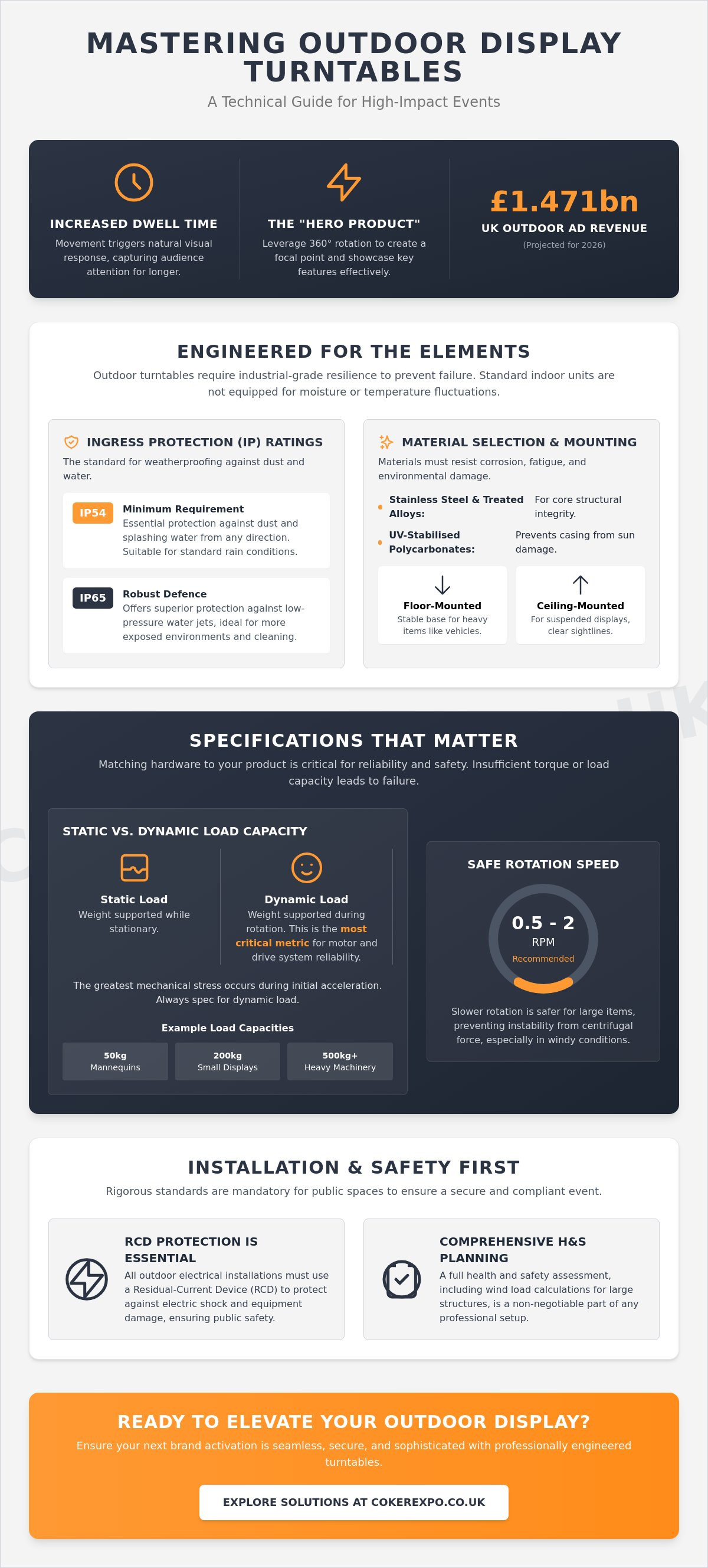
Outdoor display turntables are high-torque, weather-sealed motorised platforms engineered to withstand the rigours of the UK's unpredictable climate. They represent a significant technical step up from retail units. Standard indoor turntables aren't designed to handle moisture ingress or temperature fluctuations; using them outside almost always results in motor burnout or electrical failure. For B2B event managers, the concept of industrial resilience isn't just a buzzword. It's the essential standard for hardware that must perform under pressure without constant maintenance.
Modern rotating platforms draw inspiration from the history of vehicle turntables, where robust engineering was first used to manage massive weight in exposed environments. Relying on UK-made hardware ensures that your equipment meets local safety standards and is ready for the demands of a national event schedule. This regional reliability is a hallmark of professional infrastructure, providing peace of mind that the turntable won't seize mid-rotation during a high-profile launch.
IP Ratings: The Gold Standard for Weatherproofing
Ingress Protection (IP) ratings are the primary indicator of how well a unit resists environmental damage. IP54 is the minimum requirement for outdoor exhibition hardware to ensure protection against dust and splashing water from any direction. While IP54 handles standard rain, higher ratings like IP65 offer a more robust defense against low-pressure water jets. Precision-engineered seals and gaskets are used to shield internal motor components. These barriers prevent driving rain from reaching the drive system, ensuring the motor continues to rotate smoothly even in adverse conditions.
Material Selection: Beyond Aesthetics
Success in the field depends on materials that resist corrosion and structural fatigue. We utilise stainless steel and treated alloys to maintain structural integrity despite constant exposure to damp conditions. For external housings, UV-stabilised polycarbonates are essential; they prevent the casing from becoming brittle or discoloured under direct sunlight. Choosing the right mounting style is also a key logistical decision:
- Floor-mounted housings: These provide a stable, low-profile base for heavy products like vehicles or industrial machinery.
- Ceiling-mounted units: These are ideal for suspended aerial displays, keeping the mechanism out of the reach of the public while maintaining a clear sightline.
By prioritising these technical specifications, you eliminate the logistical stress associated with outdoor movement. Investing in hardware built for the elements ensures your brand remains the focal point, regardless of the weather.
Choosing the Right Turntable for High-Impact Outdoor Events
Selecting the correct hardware requires a precise understanding of your product's physical properties. Outdoor display turntables must balance the force required to start a rotation (torque) with the structural integrity needed to support the weight. If the motor torque is insufficient for the load, the rotation will be staggered or the drive system may fail entirely. We focus on providing hardware that offers a smooth, consistent motion regardless of the product's footprint.
You must distinguish between static load and dynamic load. Static load refers to the weight the unit supports while stationary, whereas dynamic load is the weight during rotation. Technical research into large-scale turntable engineering design confirms that the drive system faces its greatest mechanical stress during the initial acceleration phase. Matching the motor's power to the dynamic load is the only way to ensure long-term reliability for multi-day events.
Rotation speed is another critical safety factor. High RPMs create centrifugal force that can destabilise large outdoor items, especially in windy conditions. We recommend a slower rotation, typically between 0.5 and 2 RPM, for heavy or high-profile displays. This controlled speed ensures the product is visible from all angles while maintaining a safe environment for the public. If you're unsure which motor specification fits your specific project, our team can help you select the right display turntables for your next activation.
Load Capacities: From Mannequins to Machinery
Weight classes vary significantly based on the application. A 50kg unit is sufficient for light retail displays or mannequins, but you'll require a 200kg to 500kg capacity for heavy machinery or large-scale sculptures. We advise a 20% safety margin for all installations. If your item weighs 400kg, you should specify a unit rated for at least 480kg. Your exhibition stand design must also account for these weights to ensure the flooring can support the concentrated pressure of the turntable base.
The Power of Slip Rings for Illuminated Displays
To maximise visual impact, integrated lighting is essential. A slip ring is a specialized electromechanical device that allows electrical power to pass from the stationary base to the rotating platform without tangling cables. This technology allows you to mount lightboxes or digital screens directly on the turntable. The result is a fully illuminated, 360-degree display that maintains its impact throughout the night, providing a professional finish that standard battery-powered solutions can't match.
Installation and Safety: Rigging Your Outdoor Display for Success
Rigorous health and safety planning is the foundation of any successful public activation. When deploying outdoor display turntables, you aren't just managing a visual effect; you're operating heavy machinery in a dynamic environment. Protecting the public and your staff requires a proactive approach to risk assessment. A failure in planning doesn't just risk the equipment; it risks your brand's reputation and public safety.
Electrical safety is non-negotiable for external installations. You must use Residual Current Device (RCD) protection for all outdoor power sources. This equipment acts as a life-saving circuit breaker that shuts off power instantly if a fault is detected, preventing electric shocks in damp or wet conditions. Ensure all cabling is IP-rated to match the turntable's specifications and that all connections are housed in weatherproof enclosures.
A perfectly level base is critical for high-capacity rotation. Even a slight incline puts uneven stress on the motor and bearings, leading to premature wear or mechanical failure. For larger installations, integrating truss structures provides a robust frame to support the display or house overhead lighting. This structural support ensures the entire setup remains rigid and professional throughout the event, regardless of the ground surface. If you need technical assistance with your site plan, contact our expert team today to discuss your specific installation requirements.
Wind Loading and Structural Stability
Large rotating items often act like sails. In high winds, these objects catch the air and generate significant lateral force, which can tip the platform or burn out the motor. We recommend monitoring local wind speeds constantly using a handheld anemometer. If gusts exceed the manufacturer's safe operating limit, you must cease rotation immediately. Using heavy ballast, such as concrete weights or steel plates, ensures the turntable base remains immobile even under high wind pressure.
Cable Management and Trip Hazards
Professional cable routing is the difference between a high-end activation and a hazardous site. Use heavy-duty outdoor ramps or underground ducting to eliminate trip hazards in high-traffic areas. A clean install hides power sources and controllers within branded plinths or exhibition counters, keeping the focus entirely on the product. For heavy rotating equipment, always establish cordoned-off safety zones to keep the public at a safe distance from moving parts.
Maximising ROI: Integrating Turntables into Your Brand Activation
Movement is a powerful psychological trigger. The human eye is naturally programmed to detect motion, making outdoor display turntables a highly effective tool for increasing stand dwell time. In a crowded event space, a static display is easily ignored; a rotating one demands attention. This interaction isn't just about aesthetics; it's a strategic move to ensure your message is received by a larger percentage of the passing audience. By forcing a longer visual engagement, you create more opportunities for lead generation and brand recall.
The "Hero Product" strategy involves placing your most valuable or innovative item on a rotating platform to create a clear focal point. This allows visitors to view the product from every angle without needing to move around it. To create a cohesive visual environment, you should sync this rotation with your shell scheme graphic panels. When the background graphics complement the movement of the product, the entire stand feels like a unified, professional activation rather than a collection of disparate parts.
Combining Movement with Lighting and Graphics
Pairing your turntable with high-contrast graphics ensures maximum visibility even from a distance. You can achieve a cinematic effect by using spotlights that track the rotating product, highlighting specific features as they come into view. To maintain a clean, professional look, we recommend using branded skirts to hide the turntable mechanism. This ensures the audience focuses on the product, not the hardware driving it, while also providing an extra surface for brand messaging.
Logistics: Transport and Rapid Assembly
Efficiency is critical for national tours and multi-day festivals. Modern heavy-duty outdoor display turntables are designed for portability and rapid deployment. One of the signatures of the CokerExpo range is straightforward installation, which allows your team to set up the system quickly without specialised engineering support. This ease of assembly reduces logistical stress and labour costs, contributing directly to your event's total ROI. To ensure continuous operation during outdoor festivals, always carry an essential spare parts kit including spare fuses, drive belts, and basic cleaning supplies to remove grit from the rotation track.
Before the event begins, follow this maintenance and testing checklist:
- Load Test: Run the unit at full capacity for 30 minutes to check for motor heat or noise.
- Seal Inspection: Ensure all gaskets and cable entry points are secure and undamaged.
- Level Check: Use a spirit level to confirm the base is perfectly horizontal on the event surface.
- RCD Test: Verify that the electrical safety cut-offs are functioning correctly before public access.
By following these practical steps, you ensure your investment delivers a reliable, high-impact performance throughout the entire activation, regardless of the environment.
Securing Your Next High-Impact Outdoor Event
Successfully executing a rotating outdoor display requires a meticulous balance of high-torque engineering and rigorous safety protocols. You've seen that the difference between a failed motor and a high-impact showcase lies in the technical details; specifically, the IP ratings, load calculations, and wind-loading strategies discussed in this guide. By prioritising hardware built for industrial resilience, you eliminate the logistical stress associated with unpredictable weather and heavy public interaction.
Integrating outdoor display turntables into your brand activation is a strategic investment in audience engagement. Our hardware is UK-engineered for maximum durability, offering load capacities up to 750kg to handle everything from retail displays to heavy machinery. We also provide expert technical support for bespoke rigging requirements, ensuring your installation is as secure as it is visually striking.
Explore our range of heavy-duty display turntables for your next outdoor event and deliver a seamless, professional experience that reflects the quality of your brand. We're ready to help you turn your technical vision into a reliable reality.
Frequently Asked Questions
Can I use a standard display turntable outside if it is under a marquee?
No, you shouldn't use an indoor unit in a marquee. Humidity, condensation, and wind-blown moisture can still cause electrical failure or motor burnout in non-rated hardware. Outdoor display turntables are specifically sealed to handle these environmental shifts, ensuring the motor remains protected even if the marquee isn't perfectly sealed against the elements. Relying on IP-rated equipment is the only way to ensure total reliability.
How do I calculate the wind load for a large rotating outdoor display?
Calculate wind load by multiplying the total surface area of your rotating item by the wind pressure at your specific location. Since rotating objects act as sails, they generate lateral force that can destabilise the base. It's critical to monitor wind speeds and ensure the turntable's ballast exceeds the projected lateral force. This prevents tipping or mechanical strain on the drive system during high-velocity gusts.
What is the maximum weight a professional outdoor turntable can handle?
Professional heavy-duty models typically support loads up to 750kg. While smaller units are available for 50kg displays, large-scale event hardware is engineered to handle substantial items like industrial machinery or full-sized sculptures. Always ensure your load is centered to maintain the motor's torque efficiency. Off-center loading can put uneven pressure on the bearings, leading to a staggered rotation or premature mechanical wear.
Do outdoor turntables require special power sockets or generators?
Outdoor turntables run on standard mains power but require a Residual Current Device (RCD) for safety. If you're using a generator at a remote site, ensure it provides a stable, regulated output. Inverter generators are preferred because they protect the sensitive control electronics from power surges. Unstable power can lead to intermittent rotation or board failure, which compromises the impact of your product showcase.
How do slip rings prevent cables from tangling during 360-degree rotation?
Slip rings use internal conductive brushes and rings to transfer power from the stationary base to the rotating top plate. This electromechanical design allows for continuous rotation without any physical wires crossing the pivot point. It's the standard solution for powering integrated lighting or digital screens on a moving platform. Using a slip ring eliminates the risk of cable snags or accidental disconnections during a live event.
What maintenance is required for turntables used in coastal or dusty environments?
Daily cleaning is essential to remove salt spray, sand, or grit from the rotation track. These particles can act as abrasives, wearing down the drive belt or seizing the bearings. You should also inspect the weather seals for any signs of cracking. Applying a non-corrosive lubricant to the moving parts ensures the rotation remains smooth and quiet, even when exposed to harsh coastal air.
Einen Kommentar hinterlassen