

Shell Scheme Regulations NEC Birmingham: The 2026 Exhibitor Guide
The rigid constraints of a standard booth are often the catalyst for the most impactful exhibition designs at the NEC. Many exhibitors view the shell scheme regulations NEC Birmingham enforces as a creative barrier, fearing that a single misplaced screw or a 2.5m graphic will lead to a health and safety rejection. It's understandable to feel frustrated by the technicalities of the AEV eGuide or the logistical pressure of securing £5 million in public liability insurance before the event begins.
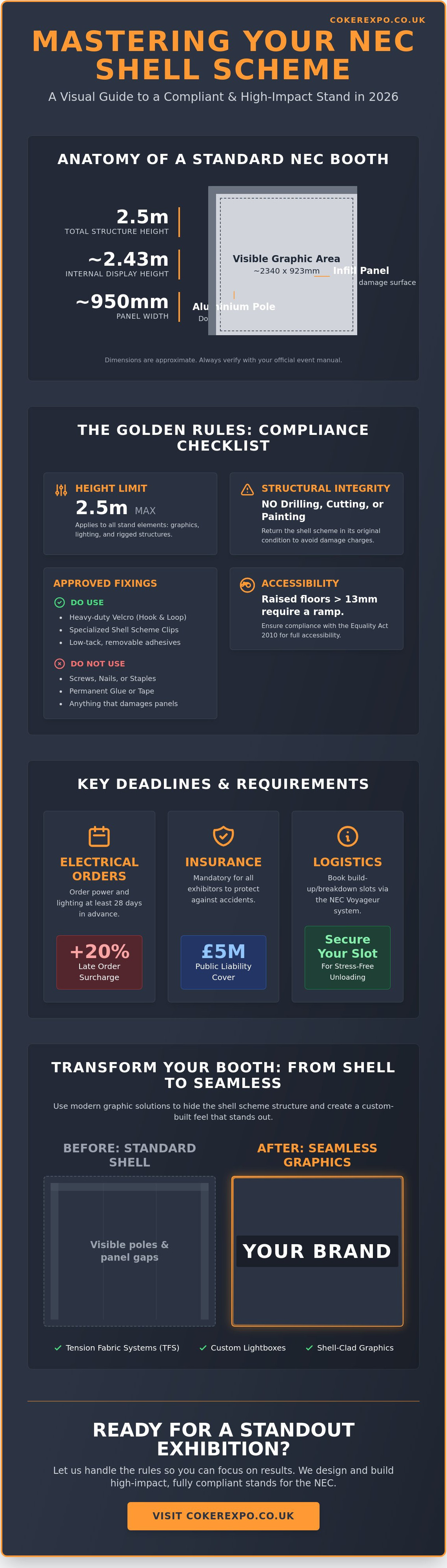
This guide provides a practical framework to master these rules while transforming a basic shell into a high-impact brand environment. You'll learn how to navigate the 2.43m height limit effectively and avoid the 20% electrical surcharges that apply if you miss the 28-day ordering window. We'll outline the essential safety documentation required for 2026 and show you how to use professional shell scheme graphic panels and tension fabric systems to create a seamless, custom-built appearance that passes every inspection. From understanding the weight limits of the ceiling grid to maximizing your footprint with promotional counters, this is your roadmap to a compliant and high-performing stand.
Key Takeaways
- Navigate the 2.43m height restriction and structural boundaries to ensure your stand remains fully compliant with the latest AEV eGuide standards.
- Understand the shell scheme regulations NEC Birmingham enforces regarding fixings to avoid damage charges associated with prohibited screws, nails, or permanent adhesives.
- Learn how to transform a standard booth into a seamless brand space using Tension Fabric Systems (TFS) and lightboxes that hide structural poles.
- Identify the specific electrical limits for 500w sockets and lighting restrictions to avoid safety rejections and costly late-order surcharges.
- Master the NEC’s Voyageur traffic management system to secure your unloading slots and ensure a stress-free logistical experience during build-up.
What is an NEC Shell Scheme? Understanding the 2026 Standard
A shell scheme is a modular stand system provided by event organizers to create a uniform, professional environment for exhibitors. Unlike a "Space Only" plot, which provides nothing but a marked area on the floor, a shell scheme package includes the essential physical infrastructure for your display. Understanding the shell scheme regulations NEC Birmingham enforces is critical because these pre-built structures come with strict technical limitations that dictate how you can brand your space. Most packages at the National Exhibition Centre (NEC) consist of a carpeted floor, perimeter walls, a ceiling grid, and a fascia board featuring your company name.
The universal height for these structures is 2.5m, though the interior display area often sits closer to 2.43m due to the floor and ceiling beams. This standardized approach allows contractors like GES or NEC Fully Connected to assemble hundreds of stands quickly. It also ensures that the exhibition hall maintains a clean, organized appearance. For the exhibitor, it reduces the logistical burden of construction, but it requires a strategic approach to branding to ensure your stand doesn't look identical to your neighbor's. You're effectively renting a blank canvas that must be returned in its original condition.
Anatomy of the Shell: Poles, Panels, and Fascias
The framework consists of vertical aluminium uprights, commonly called poles, and horizontal beams. Between these poles sit the infill panels, typically measuring 2400mm x 950mm. It's vital to recognize that the visible graphic area is smaller, usually around 2340mm x 923mm, because the edges of the panels are recessed into the aluminium frame. The fascia and nameboard are structural components that identify your brand to visitors in the gangway. You cannot remove or modify this framework without express permission. Any attempt to drill into poles or cut into panels will result in significant damage charges from the official contractor.
Common NEC Contractors and Their Systems
Most events at the NEC utilize industry-standard modular systems like Octanorm or Sodem. While they look similar, the specific dimensions of the grooves and poles can vary slightly between manufacturers. You'll find the exact specifications for your show in the NEC Exhibitor Manual provided by the organizer. Before designing your graphics, check your contract to confirm how many "open sides" your stand has. A mid-row stand has three walls, while a corner stand has two, which drastically changes the layout of your shell scheme graphic panels or fabric frames. Knowing your system type early prevents costly reprinting errors.
The Golden Rules: Height, Fixings, and Structural Safety
Compliance is the foundation of a successful exhibition. The shell scheme regulations NEC Birmingham enforces are designed to maintain safety and visual consistency across the hall. The most critical rule is the universal 2.5m height limit. This applies to every element of your stand, including flags, branding, and lighting rigs. If an item exceeds this limit, floor managers will require its immediate removal. You must also respect sightline rules. These regulations prevent you from installing tall, solid structures on open sides that block a neighbor's stand from view, ensuring every exhibitor remains visible to passing traffic.
Structural integrity and accessibility are equally important. If you choose to install a raised floor, it must comply with the Equality Act 2010. This means you've got to provide a ramp for wheelchair access if the floor height exceeds 13mm. You can find the full technical specifications for these requirements in the Official NEC Exhibitor Rules and Regulations. Adhering to these standards from the start prevents costly on-site modifications that can disrupt your show opening.
Approved Fixing Methods for Graphics
The "No Damage" policy is strictly enforced. You're prohibited from using nails, screws, or staples on the shell scheme panels. Even permanent adhesives can lead to hefty fines for residue removal. Instead, use heavy-duty Velcro (hook and loop) to attach lightweight foam boards. For more robust displays, specialized shell scheme clips and brackets provide a secure fit without marking the aluminium uprights. Avoid Blue-Tac and standard Sellotape; they're often banned because they leave greasy marks or peel the panel surface. Using professional Shell Scheme Graphic Panels designed for these systems ensures a secure, damage-free installation every time.
Health & Safety: The eGuide and Risk Assessments
Safety documentation is a mandatory requirement for all exhibitors. The AEV eGuide is the unified health, safety, and operational standard for UK venues like the NEC. You must ensure all fabric graphics meet UK fire safety standards, specifically B1 or equivalent certification. While most standard shell schemes don't require a "Complex Stand" risk assessment, you must still submit a basic Health & Safety Declaration and a Risk Assessment covering your build and breakdown activities. This paperwork guarantees that your stand is safe for both your staff and the millions of visitors who attend UK exhibitions annually.
Electrical and Lighting Regulations at the Birmingham NEC
Managing power requirements is a critical logistical hurdle that requires early planning. The standard shell scheme regulations NEC Birmingham provides usually include a single 500w twin socket. This is sufficient for basic needs like charging a laptop, powering a mobile device, or running a small LED screen. However, you shouldn't attempt to power high-draw appliances like kettles or coffee machines on this circuit. Overloading the supply will trip the breaker, potentially affecting neighboring stands and leading to an inspection by the venue floor manager. Daisy-chaining multiple extension leads is strictly prohibited for fire safety reasons.
Timing is everything when it comes to on-site power. The NEC operates a "Main Switch" rule where power to the stands is typically activated at 8:00 AM on show days and deactivated 30 minutes after the event closes. If your display includes equipment that requires 24-hour power, such as a refrigerator or a server, you must specify this in your order with the official electrical contractor. Failure to do so will result in your equipment losing power overnight. All electrical hardware you bring onto the site must also carry a valid PAT testing (Portable Appliance Testing) tag to prove it has been inspected for safety within the last 12 months.
Spotlights vs. Integrated LED Lighting
The ceiling grid of your shell scheme is designed to support the official spotlights provided by the contractor. You aren't permitted to hang your own heavy lighting fixtures or banners from this grid because it has a limited weight-bearing capacity. To achieve a high-impact look without violating safety rules, many exhibitors now integrate low-heat LED technology into their displays. Using exhibition lightboxes allows you to illuminate your brand from within the stand footprint, reducing the reliance on overhead spots and creating a modern, vibrant aesthetic that stands out in a crowded hall.
Managing Cables and Trip Hazards
Cable management is a major focus for health and safety inspectors. All wiring must be secured and hidden to prevent trip hazards, particularly in high-traffic areas near the gangway. You aren't allowed to run cables under the venue carpet yourself; this work must be performed by the official contractor to ensure compliance with the UK Exhibition Industry e-Guide. A practical solution for keeping your stand tidy is to use promotional counters. These units provide a professional surface for lead capture while offering internal storage to hide unsightly power blocks, transformers, and excess cabling from view.
Branding Within the Rules: Seamless Graphics and Lightboxes
The standard appearance of a modular stand is often criticized for its visible aluminium uprights and recessed infill panels. While the shell scheme regulations NEC Birmingham enforces are strict regarding structural modifications, they offer significant flexibility for creative branding. You don't have to settle for a disjointed look. By selecting the right hardware, you can hide the structural poles entirely and create a high-end, custom-built aesthetic that remains fully compliant with venue safety standards. The goal is to maximize your visual impact while respecting the 2.5m height boundary.
Exhibitors looking for a cost-effective way to brand their space often choose shell scheme graphic panels. These panels are designed to fit precisely within the aperture of the shell system, replacing or covering the standard grey infills. While this is a clean solution, it does leave the aluminium poles visible. For brands that require a more premium finish, thin-profile frames can be used to mount graphics closer to the edge of the stand, maximizing every millimetre of your allocated floor space without encroaching on the gangways.
Tension Fabric Systems (TFS) for Shell Schemes
Tension Fabric Systems (TFS) are the most effective tool for overcoming the "panel gap" issue. These aluminium frames are designed to sit just inside the shell scheme perimeter, allowing a single-piece fabric graphic to be stretched across the entire wall. This eliminates vertical lines and creates a seamless, uninterrupted backdrop for your brand. Because the fabric is lightweight and foldable, it's incredibly easy to transport and assemble, which is a major advantage during the high-pressure setup periods at the NEC. It's a professional solution that provides a custom-build feel without the custom-build price tag.
Lightboxes: Standing Out in a Dim Hall
Illumination is the fastest way to draw the eye from across a busy exhibition hall. Freestanding LED lightboxes act as a powerful "hack" for shell scheme exhibitors, providing internal brilliance that spotlights cannot match. When using these, you must perform a compliance check to ensure the hardware doesn't exceed the 2.5m height limit. Dynamic lightboxes, which use programmed LED sequences, can add movement to your stand to capture even more attention. For smaller footprints, you can integrate these illuminated elements with folding display boards to create a hybrid look that balances information-heavy panels with high-impact visuals.
Achieving a professional result requires hardware that is engineered for resilience and ease of use. Explore our range of NEC-compliant display systems to find the perfect infrastructure for your next Birmingham event.
Preparation and Logistics for NEC Exhibitors
Executing a flawless exhibition presence at the NEC requires more than just a compliant design. It demands precise logistical management. The shell scheme regulations NEC Birmingham enforces extend to the vehicle service areas and the hall floors during build-up. You must use the Voyage Control system, formerly known as Voyageur, to book specific unloading slots for your vehicle. Arriving without a pre-booked slot often results in significant delays or being turned away from the service vehicle park. This system ensures that the thousands of exhibitors moving into the halls do so in a structured, safe manner.
Timing your orders is the most effective way to protect your budget. Official contractors typically apply a 20% surcharge to orders placed within 28 days of the event's tenancy start date. If you wait until you're on-site to request additional graphics or electrical connections, that surcharge can rise to 30%. Beyond the financial implications, early submission of your plans ensures that your stand is ready for your arrival. You don't want to spend your limited build time chasing contractors for missing nameboards or misplaced power sockets.
On-site discipline is vital for maintaining safety standards. The NEC is exceptionally strict about keeping gangways clear and unobstructed. You aren't permitted to store empty crates or packaging behind your shell scheme panels or in the aisles. All waste and packing materials must be removed before the show opens to the public. During the breakdown rush, safety remains the priority. You're responsible for dismantling your graphics and hardware safely, ensuring that no damage is caused to the modular framework, which would result in immediate repair fees.
The NEC Exhibitor Timeline
- 12 Weeks Out: Review your shell scheme dimensions and the number of "open sides" in your exhibitor manual.
- 8 Weeks Out: Finalize your branding and order custom graphics or truss structures to ensure production slots are secured.
- 4 Weeks Out: Submit your compulsory Health & Safety Declaration and Risk Assessment via the online exhibitor manual.
- 2 Weeks Out: Book your specific vehicle access slot for the NEC service area to guarantee a smooth unloading process.
Final On-site Checklist
When you first arrive at your stand, perform a thorough inspection before installing any branding. Check the shell scheme panels for existing damage and report it to the floor manager immediately to avoid being billed for repairs later. Verify that your nameboard spelling is correct and that the electrical sockets are positioned according to your floor plan. Finally, check your sightlines. If a neighboring stand has installed a display that breaches the height or visibility rules mentioned in the shell scheme regulations NEC Birmingham guide, liaise with the venue floor manager to resolve the issue before the show opens.
Maximizing Your Impact at the NEC Birmingham
Mastering the shell scheme regulations NEC Birmingham enforces is the first step toward a successful event. By respecting the 2.5m height limit and utilizing approved fixing methods, you eliminate the risk of on-site rejections or damage fees. Success in 2026 relies on balancing technical requirements with creative branding; tension fabric systems hide structural poles to provide a seamless finish. Proactive logistical planning, from booking vehicle slots to meeting electrical deadlines, ensures your team can focus on engagement rather than troubleshooting.
We provide the essential infrastructure to help you stand out while remaining fully compliant. Our UK-based manufacturing ensures fast lead times and high-performance quality for every display. With expert knowledge of major UK venue regulations, we supply durable, reusable systems that represent a sound business investment for professional exhibitors. Transform your NEC stand with CokerExpo’s compliant shell scheme graphics and lightboxes. With the right hardware and a clear understanding of the rules, your standard booth will become a high-impact brand environment.
Frequently Asked Questions
What is the maximum height for a shell scheme stand at the NEC?
The standard structural height for a shell scheme at the NEC is 2.5m. All interior fittings and branding must remain within this limit to ensure compliance with venue safety standards. If you plan to use flags or tall displays, ensure they don't exceed 2.43m to account for the thickness of the ceiling grid and floor coverings.
Can I use my own carpet on an NEC shell scheme?
You can use your own carpet, provided it meets the fire safety standards outlined in the AEV eGuide. Most shell scheme packages include standard venue carpet, so you must notify the official contractor if you intend to lay your own over the top or replace it. Any flooring you bring must be secured with approved low-residue tape to avoid damage to the hall floor.
Are there specific fire safety requirements for graphics at the NEC?
All graphic materials, including fabric and PVC, must be fire-retardant to British Standard (B1) or equivalent certification. The shell scheme regulations NEC Birmingham enforces require exhibitors to provide proof of certification upon request from a fire officer. We ensure all our shell scheme graphic panels and tension fabric systems meet these rigorous safety benchmarks.
Can I screw shelves directly into the shell scheme walls?
No, it's strictly forbidden to drill, screw, or nail into the modular panels or aluminium uprights. These components are rented and must be returned in their original condition to avoid damage charges. If you need shelving, you should use specialized brackets and clips designed to hook into the system’s grooves or opt for freestanding display units.
What happens if my stand exceeds the 2.5m height limit?
Exceeding the 2.5m limit will result in an immediate instruction from the floor manager to remove or lower the offending item. This rule is strictly enforced to maintain clear sightlines and structural safety across the exhibition hall. Failure to comply can lead to your stand being closed to visitors until the issue is rectified.
Do I need a risk assessment for a standard shell scheme stand?
Yes, every exhibitor is legally required to submit a Risk Assessment and a Health & Safety Declaration before the event. This document must cover your activities during the build, show days, and breakdown. While shell schemes aren't usually classified as "complex," you still need to identify potential hazards like trip risks or heavy lifting.
Can I hang a TV or monitor on the shell scheme panels?
Standard shell scheme panels aren't strong enough to support the weight of a TV or monitor on their own. To display a screen, you must use a specialized monitor bracket that attaches to the aluminium uprights or install a freestanding stand. Always check the load-bearing capacity of the specific system used at your event before planning your tech layout.
How do I hide the aluminium poles in my shell scheme?
The most effective way to hide the structural poles is by installing Tension Fabric Systems (TFS). These frames sit inside the shell footprint and allow a single-piece fabric graphic to stretch across the entire wall surface. This creates a seamless, high-impact look that completely conceals the modular framework while remaining within the shell scheme regulations NEC Birmingham allows.
Einen Kommentar hinterlassen