

A0 Paper Format: A Comprehensive Guide to Dimensions and Exhibition Uses
A single design oversight on your computer screen can transform into a glaring visual error once your artwork is scaled to the a0 paper format. You likely understand that standard office printing cannot compete with the visual gravity of a busy trade show floor, yet transitioning to large-scale exhibition graphics often feels like a technical gamble. It is a common frustration for marketing managers when a high-stakes display arrives looking pixelated or simply fails to fit its intended frame.
We've helped thousands of UK exhibitors perfect their event presence, and we know that technical precision is the foundation of a professional brand image. This guide will eliminate the guesswork by providing the exact 841mm by 1189mm specifications and professional mounting strategies you need to ensure your displays remain sharp and impactful. We'll break down the precise dimensions, 300 DPI resolution requirements, and the best hardware for a seamless, tool-free assembly.
Key Takeaways
- Master the precise technical specifications of the a0 paper format to ensure your large-scale graphics are designed with mathematical accuracy across millimetres, centimetres, and inches.
- Understand the √2 aspect ratio to effectively visualise how A0 scales against other A-series sizes, allowing for better spatial planning of your exhibition stand and signage.
- Learn the essential print requirements, including CMYK colour management and PPI settings, to guarantee professional-grade clarity and impact for your large-format displays.
- Identify the most robust hardware solutions, such as quick-change snap frames and illuminated lightboxes, to securely house and highlight your branding in high-traffic environments.
- Discover how to leverage A0 dimensions for practical exhibition site planning, from detailed architectural blueprints to high-visibility directional signage.
Understanding the A0 Paper Format: Dimensions and Standards
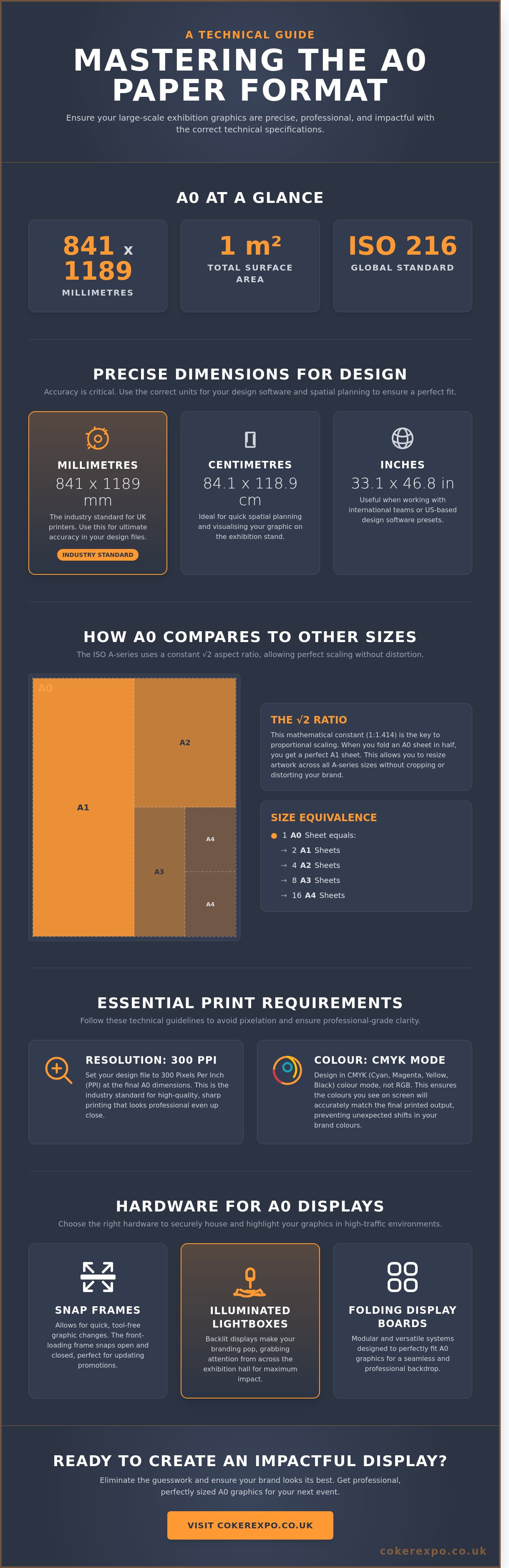
Success at a trade show depends on precision and professional presentation. The a0 paper format serves as the foundation for the entire ISO A-series, providing a massive canvas for high-impact exhibition graphics. It's the "parent" size in this system because every subsequent size, such as A1 or A2, is created by folding the sheet exactly in half across its longest side. This geometric consistency ensures that your branding remains perfectly proportional, whether you're printing a large-scale backdrop or a supporting flyer.
One of the most significant technical aspects of A0 is its surface area. It's engineered to be exactly one square metre. This mathematical property allows marketing managers to calculate ink coverage and substrate weight with high accuracy. When you're planning a modular display, knowing that each A0 panel represents one square metre of visual real estate simplifies your logistics and stand design. It's a practical standard that removes the guesswork from event preparation.
A0 Dimensions in Millimetres, Centimetres, and Inches
Accuracy is vital when you're ordering graphics to fit specific hardware. If your measurements are off by even a few millimetres, the print might buckle or leave gaps in the frame. Use these specific dimensions for your design software and spatial planning:
- Millimetres: 841 x 1189 mm. This is the industry standard for UK printers and ensures a perfect fit for professional folding display boards.
- Centimetres: 84.1 x 118.9 cm. These units are most useful for quick spatial planning on your exhibition stand.
- Inches: 33.1 x 46.8 in. Use these dimensions if you're working with international design teams or specific US-based software presets.
The ISO 216 Standard and Global Recognition
The a0 paper format is governed by the ISO 216 standard. This system evolved from the German DIN 476 standard established in 1922, creating a universal language for the printing and exhibition industries. By sticking to these international paper size standards, you ensure global compatibility. Whether you're exhibiting in London or Paris, your A0 graphics will fit standard frames and mounting systems without requiring expensive bespoke trimming.
Reliability is key in the fast-paced exhibition world. While most of the world follows ISO 216, North American markets often use "Arch E" sizes. An Arch E sheet measures 914 x 1219 mm, which is significantly larger than an A0 sheet. If you mistakenly design for Arch E, your graphics won't fit a standard UK folding display board. Always verify that your design templates are set to the correct ISO A0 dimensions to ensure a seamless, tool-free assembly on the day of your event.
How A0 Compares to Other A-Series Paper Sizes
Understanding the a0 paper format is essential for any exhibitor looking to maximise their visibility within a limited floor space. The ISO 216 standard ensures that every size in the A-series maintains identical proportions, which simplifies the design process for marketing managers and graphic designers alike. This consistency allows for a professional, unified look across all your event collateral, from the largest backdrop to the smallest handheld flyer.
The Mathematical Magic of the √2 Ratio
The √2 aspect ratio is the secret to seamless scaling across all display materials. This specific ratio of 1 to 1.414 means you can resize exhibition posters from a small leaflet to a massive backdrop without cropping your graphics or distorting your brand logo. Because the proportions are fixed, an A0 sheet is exactly double the size of an A1 sheet. When you fold an A0 page in half along its shortest side, the resulting shape is an A1. This prevents distortion when resizing posters, allowing your team to repurpose existing assets for different hardware systems without starting from scratch.
A0 vs A1, A2, and A4: A Visual Comparison
To visualise the scale of the a0 paper format, it helps to think in terms of the standard office paper you use every day. One A0 sheet is equivalent to 16 A4 sheets. This provides a total surface area of exactly one square metre, representing a massive jump in visibility for trade show environments. While an A1 board is often sufficient for secondary information, choosing A0 ensures your "hero" graphic commands attention from distances of 10 metres or more.
- A0 (841 x 1189 mm): Best for primary branding and high-impact "hero" graphics.
- A1 (594 x 841 mm): Ideal for secondary messaging or directional signage.
- A2 (420 x 594 mm): Suitable for detailed technical charts or product specifications.
- A4 (210 x 297 mm): The standard for supporting brochures and take-away literature.
Using A0 as a central focal point allows you to anchor your booth with a high-performance visual while using A4 brochures as supporting collateral for lead generation. When printing in A0 format, you must ensure your source files are high resolution to avoid pixelation at this larger scale. This tiered approach to graphics ensures that your message is clear from a distance but remains detailed for visitors standing at your counter. If you need a reliable way to mount these large-scale graphics, our folding display systems offer a professional and portable solution for any venue.
Professional Applications for A0 in the Exhibition Industry
The a0 paper format serves as the functional backbone for large-scale visual communication in the exhibition sector. Measuring 841mm by 1189mm, it offers a surface area of exactly 0.999 square metres. This specific scale is essential for maintaining legibility in high-traffic environments like major exhibition centers and prominent event spaces. It provides a massive canvas that commands attention from a distance, which is a requirement for any brand looking to stand out in a crowded hall.
Site Maps and Technical Event Blueprints
Venue organisers and site managers prefer A0 for master floor plans because it balances intricate detail with practical portability. A standard A0 sheet provides enough real estate to display complex electrical grids, fire exit routes, and stand allocations without forcing the reader to squint. For instance, a 1:50 scale drawing on A0 allows a site manager to identify individual 13-amp socket placements across a 40-metre hall with 2mm precision on the page.
Durability is a non-negotiable requirement for these documents. Site-use blueprints are often printed on 120gsm uncoated paper to allow for easy notation with pens or pencils. Alternatively, they are encapsulated in 75-micron laminate to withstand the rigours of a build-up day. This ensures the plan remains readable even if it's spread across a dusty concrete floor or handled by dozens of contractors during the installation phase.
A0 Graphics for Folding Display Boards
When you utilise folding display boards, the a0 paper format acts as a primary canvas for high-impact branding. While many portable kits use smaller modular panels, A0 posters are frequently used as central hero graphics that bridge multiple sections to create a seamless visual narrative. This approach helps avoid the disjointed look that sometimes occurs with smaller, individual A4 or A3 sheets.
Consider these practical factors when mounting A0 graphics on your display kit:
- Weight Management: A standard 170gsm silk A0 poster weighs approximately 170 grams. This is light enough to stay securely attached using standard hook-and-loop fasteners without straining the board's hinges or causing the kit to become top-heavy.
- Layout Logic: The dimensions of an A0 sheet often dictate the height of professional display systems. It ensures that your primary headline sits at eye level, which is typically between 1500mm and 1700mm from the floor for the average attendee.
- Modular Integration: Using a standardised size simplifies logistics. A0 prints fit into standard 900mm protective tubes and align perfectly with the frame dimensions of most industry-standard hardware.
This consistency reduces the risk of last-minute printing errors. It ensures your brand looks professional and cohesive every time the boards are unfolded, regardless of the venue's lighting or layout constraints.
How-to Guide: Designing and Printing for the A0 Format
Preparing graphics for an a0 paper format requires a shift in mindset from standard desktop printing. You aren't just scaling up a flyer; you're creating a high-impact visual that must remain crisp from several metres away. Every design choice, from colour profiles to margin settings, dictates whether your folding display board looks professional or amateurish under exhibition hall lights.
Always set your document to CMYK colour mode before you start designing. While RGB offers a wider range of vibrant colours on your monitor, professional wide-format printers use Cyan, Magenta, Yellow, and Black inks. Designing in RGB often leads to "colour shift," where your bright blues turn muddy and your vibrant reds appear dull on the final print. To ensure a clean finish, include a 3mm to 5mm bleed on all sides of your artwork. This extra space allows the printer to trim the a0 paper format sheets without leaving unsightly white slivers along the edges.
Resolution and PPI for Large Format Printing
Standard A4 documents require 300 DPI for hand-held reading, but large format graphics follow the viewing distance rule. Because attendees typically view a folding display board from 1.5 to 3 metres away, you don't need excessive file sizes. Aim for a resolution of 150 to 200 PPI at full size. This provides a sharp image without making the file too heavy to transfer or process.
Always use vector files for logos and typography. While photos are raster-based and will eventually pixelate, vector graphics use mathematical paths that stay perfectly sharp at any scale. If you use a raster logo on an A0 display, the "staircase" effect on the edges will be immediately visible to your prospects, undermining your brand's authority.
Paper Weights and Finishes for Exhibitions
Weight matters for both durability and aesthetic. A 170 GSM paper is the baseline for standard posters, but it can feel flimsy and is prone to creasing during transport. For a premium look that sits flat against your display panels, choose 250 GSM or higher. This heavier stock survives the rigours of multiple events and provides a more opaque, high-quality finish.
The choice between matt and gloss is equally critical. Exhibition halls are notorious for harsh overhead LED lighting that creates distracting hot spots on glossy surfaces. A matt or satin finish is almost always the better choice for readability, as it diffuses light and ensures your text is legible from all angles. For graphics you intend to reuse, consider a 100-micron lamination. It protects the ink from scuffs during the "tool-free assembly" process and allows you to wipe down the panels if they get marked.
Ready to create an impactful display? Explore our range of professional exhibition hardware to find the perfect frame for your A0 graphics.
Hardware Solutions for Displaying A0 Graphics
Displaying graphics in the a0 paper format requires robust hardware that balances high visibility with practical ease of use. For retail environments or seasonal promotions, A0 snap frames are the definitive quick-change solution. These frames use spring-loaded profiles, allowing you to swap out messaging in under 60 seconds without removing the frame from the wall. This efficiency is vital for businesses running time-sensitive offers where speed is a priority.
When durability is the primary concern, mounting your A0 graphics onto rigid substrates like 3mm Foamex or fluted Correx provides a significant advantage. This process prevents the paper from curling or bowing in humid conditions. Rigid boards are particularly effective when used on traditional folding display boards, as they provide a crisp, flat surface that maintains its professional appearance throughout a multi-day event.
A0 Lightboxes and Backlit Graphics
Integrating A0 formats into exhibition lightboxes transforms a standard poster into a high-impact "hero" display. Backlighting increases visual prominence by up to 40% compared to non-illuminated graphics. You can choose between traditional backlit film, which offers photographic sharpness, or Tension Fabric Systems (TFS). TFS is often preferred for its seamless, glare-free finish and lightweight transport properties. Most LED-driven A0 frames are designed for UK 240V power supplies and draw minimal wattage, making them a safe and cost-effective choice for long-duration trade shows.
Portable Rails and Snap Frames
Our "Practical Specialist" approach prioritises tool-free assembly to reduce the stress of event logistics. Portable poster rails are an excellent alternative to heavy frames; they grip the top and bottom of the a0 paper format sheet, creating enough tension to keep the graphic straight. These systems are ideal for window displays or temporary booth partitions where floor space is limited.
For maximum height and impact, hanging A0 banners from truss structures ensures your brand is visible from across the exhibition hall. If you're using floor-standing holders, stability is paramount. Always check that the base is weighted or features an "H-frame" design to prevent tipping in high-traffic aisles.
- Tool-free assembly: Most of our A0 hardware is designed to be built by one person in minutes.
- UK Manufacturing: We prioritise robust materials that survive the rigours of frequent transport.
- Versatility: Use snap frames for permanent wall fixtures or portable stands for pop-up events.
- Stability: Weighted bases are essential for A0 displays to counteract the large surface area's "sail effect" in drafty halls.
Choosing the right hardware isn't just about aesthetics; it's about the user experience. By selecting systems that offer fast turnaround and reliable performance, you ensure your marketing team can focus on the visitors rather than struggling with the equipment.
Maximise Your Impact With Professional Large-Format Displays
Mastering the a0 paper format is about more than knowing its 841mm by 1189mm dimensions; it's about leveraging that 1 square metre of space to dominate a trade show floor. Successful exhibitors understand that high-resolution design requires equally high-performance hardware to ensure graphics remain taut, visible, and professional. By choosing the right display system, you transform a simple print into a robust marketing tool that commands attention from across the hall.
At Coker Exhibition Systems Ltd (CokerExpo), we specialise in the infrastructure of your success. Our UK-based production facility ensures a fast turnaround on all orders, meeting even the tightest event deadlines. We've engineered our portable hardware for tool-free assembly, allowing your team to set up a professional booth in minutes without a single spanner. You'll benefit from our expert advice on large-format graphic integration, ensuring your modular systems look seamless and impactful. Don't leave your brand's physical presence to chance when you can rely on British-made reliability and technical precision.
Explore our range of A0-compatible display boards and lightboxes to find the ideal solution for your next exhibition. We're ready to help you deliver a flawless presentation that captures every lead.
Frequently Asked Questions
How big is A0 paper in cm?
An A0 sheet measures exactly 84.1 cm by 118.9 cm. This size provides a total surface area of one square metre, which serves as the foundation for the ISO 216 international paper sizing system. For exhibitors using our modular folding display boards, this large format ensures your graphics remain visible from across a busy trade show floor. It's a robust choice for technical drawings and high-impact event posters.
Can I print an A0 poster using a standard A4 home printer?
You can print an A0 poster on a standard A4 printer by using the "tiling" or "poster" setting in your print software. This process requires 16 individual A4 sheets to be taped together to create the full a0 paper format dimensions. While this works for internal mock-ups, we recommend professional large-format printing for exhibitions. It ensures a seamless, high-impact finish that reflects the quality of your brand hardware.
What is the best resolution for an A0 print?
The optimal resolution for an A0 print is 300 dots per inch (DPI) at full size to ensure crisp text and sharp imagery. If your file is particularly large, a resolution of 150 DPI is often acceptable for posters viewed from a distance of 1 metre or more. Always check your source files before sending them to the printer; a low-resolution 72 DPI image will appear pixelated when scaled to these dimensions.
Is A0 the largest paper size available in the A-series?
A0 is the standard largest size in the A-series, but 2A0 and 4A0 formats are also defined for oversized requirements. An A0 sheet is exactly half the size of a 2A0 sheet and four times the size of an A2 sheet. For most UK exhibition stands and folding displays, the a0 paper format remains the industry standard for large-scale graphic panels and technical presentations due to its balance of impact and portability.
How much does a sheet of A0 paper weigh?
The weight of an A0 sheet depends on the paper's grammage, but an 80gsm sheet weighs exactly 80 grams. This is because the A0 size is designed to be exactly one square metre in area. If you choose a more robust 170gsm silk paper for your display, a single sheet will weigh 170 grams. Knowing these weights helps you determine the best adhesive or hook-and-loop fasteners to secure the poster to your display boards.
What is the difference between A0 and Arch E paper sizes?
An A0 sheet measures 841 x 1189 mm, while an Arch E sheet is larger at 914 x 1219 mm. Arch E is part of the American Architectural series, whereas A0 follows the ISO 216 standard used throughout the UK. Ensure your display board frames are compatible with ISO dimensions before ordering prints. The 73 mm width difference will prevent Arch E posters from fitting into standard A0 mounts or recessed panels.
How do I transport A0 posters to an exhibition without damaging them?
Use a heavy-duty plastic or cardboard telescopic tube with a minimum diameter of 100 mm to transport your posters safely. Rolling the poster too tightly can cause permanent curls or cracks in the ink, so keep the roll loose. Our clients often prefer 125 mm diameter tubes for laminated graphics. This larger diameter ensures the posters lay flat immediately upon arrival at the venue, saving you time during the booth setup.
Can A0 posters be used outdoors?
Standard paper A0 posters aren't suitable for outdoor use unless they're printed on waterproof PVC or fully encapsulated in a 150-micron lamination. Exposure to UK weather will cause untreated paper to absorb moisture and tear within minutes. For outdoor events, we suggest using weather-resistant materials like 440gsm PVC scrim banner vinyl. These materials fit our outdoor-specific display frames and withstand wind and rain without losing colour vibrance.
Laisser un commentaire