

Buying Guide: Heavy-Duty Display Turntables for 50kg to 3000kg Loads
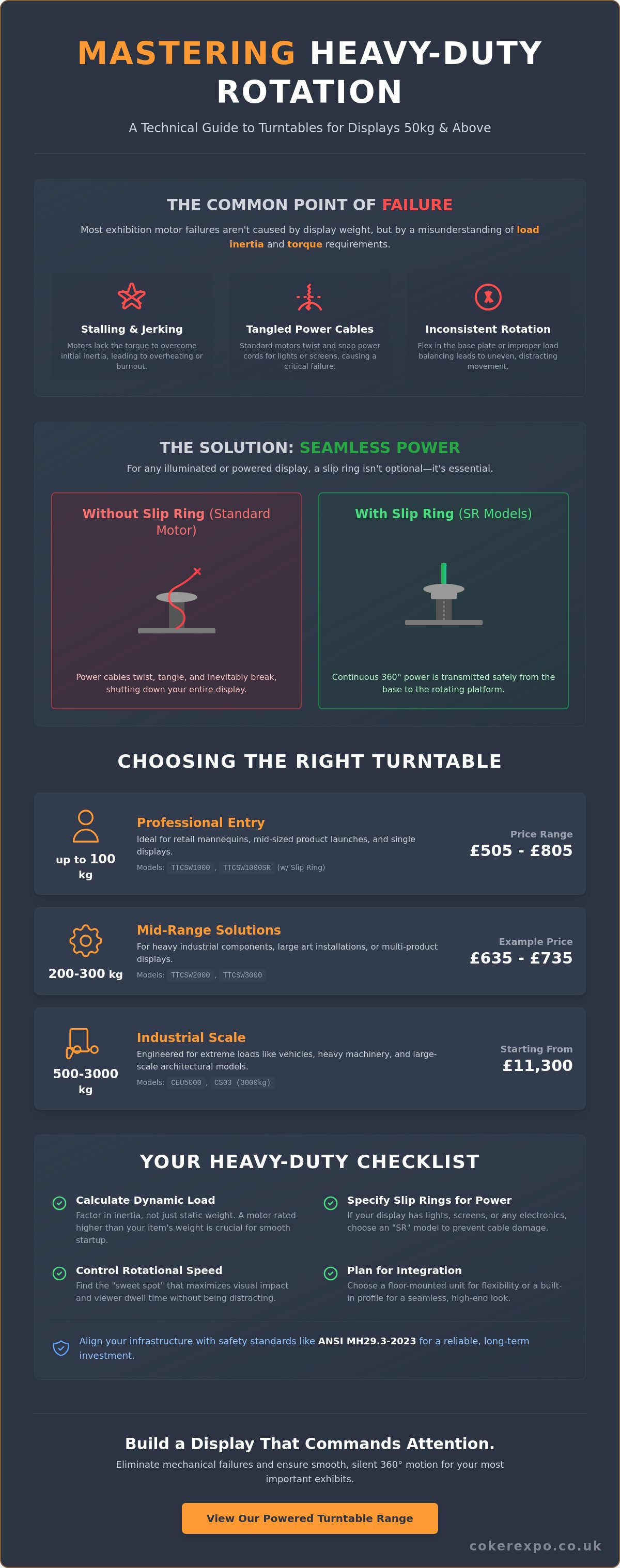
Most exhibition motor failures aren't caused by the weight of the display itself, but by a fundamental misunderstanding of load inertia and torque requirements. When you are specified to rotate items on turntables 50+kilos, the margin for error disappears; a single stutter or a tangled power cable can compromise your entire brand presence. You've likely experienced the frustration of inconsistent rotation speeds or the fear that a heavy-duty motor won't survive a high-pressure trade show environment.
We believe that high-impact displays should be defined by their fluid movement, not their mechanical limitations. This guide provides the technical expertise you need to master heavy-duty rotation, ensuring a smooth, silent 360-degree experience for loads reaching up to 3,000kg. We'll break down the essentials of seamless power integration for lighting and the importance of the ANSI MH29.3-2023 safety standard. By the end of this article, you'll know how to select a durable, low-maintenance system that serves as a reliable foundation for your professional exhibition infrastructure for many seasons to come.
Key Takeaways
- Identify the critical difference between static and live loads to ensure your motor handles the inertia of heavy exhibition pieces without stalling.
- Eliminate the risk of tangled cables in lighted displays by choosing systems equipped with slip rings for continuous power transfer.
- Master the "sweet spot" of rotational speed to ensure your products move at a pace that maximizes visual impact and viewer dwell time.
- Compare floor-mounted and built-in profiles for turntables 50+kilos to achieve a seamless integration with your exhibition flooring and stand design.
- Align your display infrastructure with the latest safety standards to protect your equipment and ensure a reliable investment for multiple event seasons.
Understanding Load Capacity and Stability for 50kg+ Displays
Engineering requirements shift significantly once you move beyond basic retail displays into the territory of turntables 50+kilos. At this weight threshold, the friction on the bearing race increases exponentially. Simple motors found in lightweight units cannot overcome the initial inertia required to start a heavy load without jerking or overheating. Stability depends on a rigid steel construction that maintains axial alignment; any flex in the base plate will lead to inconsistent rotation and eventual motor burnout.
You must calculate both static and live loads before selecting your hardware. A static load is the basic weight of your exhibit while it's stationary. The live load accounts for the dynamic forces generated during rotation, especially if the object's centre of gravity is slightly off-centre. Choosing a motor with a higher capacity than your static load provides a necessary safety buffer for these dynamic forces when using turntables 50+kilos. The TTCSW1000, supporting up to 100kg, is the professional entry point for those transitioning from decorative to functional heavy-duty displays.
The 100kg to 300kg Mid-Range Solutions
The TTCSW1000 is widely considered the industry standard for retail mannequins and mid-sized product launches. With a price range of £505.0 to £750.0, it balances cost-efficiency with professional-grade reliability. When your project involves 200kg industrial components, stepping up to the TTCSW2000 provides the necessary torque to maintain a smooth RPM. For larger art installations or wide-base exhibits, the TTCSW3000 (£635.0-£735.0) offers a broader support surface. These units often feature a Slip ring to allow for internal power routing, ensuring that your display lighting remains powered without the risk of cable entanglement.
Industrial Scale: Rotating 500kg to 3000kg
For automotive exhibits or heavy machinery, you require hardware that can handle extreme pressure. The CEU5000 and CEU7500 models are specifically engineered for these high-impact environments, often used for rotating vehicles at trade shows. If your requirements reach the extreme end of the spectrum, the CS03 Heavy Duty Turntable supports up to 3000kg and is available from £11,300. These massive systems utilise 1250mm deck plates to ensure the load remains balanced. This heavy-duty steel infrastructure is essential for maintaining a silent, 360-degree rotation that reflects the quality of your brand.
Slip Rings vs. Standard Motors: Powering Your Rotating Display
Selecting the right motor for turntables 50+kilos involves more than just calculating weight capacity. If your exhibit requires internal illumination or digital hardware, a standard motor will cause the "tangled cable" problem. As the platform rotates, the power cord winds around the central spindle. This eventually leads to a snapped cable or a mechanical jam that can burn out the motor. Slip rings are the essential engineering solution to this specific logistical hurdle.
A slip ring functions as an electromechanical device that allows the transmission of power from a stationary base to a rotating platform. It uses conductive brushes that maintain a constant electrical connection while the unit is in motion. This technology is grounded in the principles of Torque and Rotational Motion, ensuring that the electrical contact remains stable even under significant axial pressure. For professional 100kg displays, the TTCSW1000SR (£585.0 to £805.0) provides this integrated power capability as standard.
When to Choose a "SR" (Slip Ring) Model
You should specify a slip ring model whenever your display features active electronics. These units are designed for rotating lightboxes, backlit fabric graphics, and digital screens. The 4-amp power ring safely handles LED arrays and interactive tablets in public spaces. These units provide 24/7 power without the maintenance of batteries. You can view our powered display turntable range to see the full technical specifications for your next project.
Non-Slip Ring Alternatives
Standard motors in the TTCSW series are a cost-effective choice for items that don't require electricity, such as mannequins or sculptural pieces. While you might consider battery-powered lighting as a workaround for turntables 50+kilos, it's rarely practical for professional environments. Batteries add extra weight to the live load and require constant monitoring. For a reliable exhibition stand, continuous mains power via a slip ring is the superior choice for high-impact commercial displays.
Motion Control: Revolution Speed and Adjustability
The visual impact of your exhibit depends entirely on the rhythm of its movement. For turntables 50+kilos, the rotational speed dictates how long a viewer engages with your product. Industry data suggests that 1.0 to 2.5 RPM (revolutions per minute) is the "sweet spot" for commercial displays. This range is fast enough to draw the eye from across a hall, yet slow enough to allow the human brain to process technical details without causing visual fatigue. When you're rotating a high-value asset, such as a 2000kg vehicle or a complex industrial component, maintaining a constant, non-jerky speed is a technical necessity.
Achieving this level of control requires professional-grade speed adjustment hardware. We offer a dedicated Speed Adjustment and Electrical Current Converter for £380.0, designed to provide granular control over the motor's output. This ensures that the transition from a standstill to full rotation is seamless, protecting both the motor and the structural integrity of your display from the stresses of sudden torque.
Customising Your RPM (Revolutions Per Minute)
Different environments demand different rotational profiles. A high-energy trade show stand might benefit from a standard 2.5 RPM setting to create a sense of dynamism. Conversely, premium luxury showrooms or art galleries often require a more sedate 1.0 RPM rotation. We provide silent motor variants, such as our custom 1.4 RPM units, specifically for acoustic-sensitive environments. These motors ensure that the mechanical operation doesn't distract from the brand experience. You can also specify counter-clockwise variants if your choreography requires objects to move in a specific direction.
External Speed Regulators
For industrial-scale displays, external regulation is essential. The Speed Regulator for the CEU5000 (£485.0) allows operators to fine-tune the movement of automotive exhibits with precision. Our CS range, including the CS01 and CS03 models, features a 1:10 speed adjustment ratio. This flexibility is critical for preventing "jerkiness" in 1500kg+ displays, where the inertia of the load can cause oscillations if the speed isn't perfectly managed. While UK standards are your primary guide, following the principles found in OSHA heavy equipment safety regulations regarding the blocking and cribbing of heavy machinery ensures your installation remains stable during variable speed operations.
If you need to specify a precise rotational speed for your next event, browse our full range of heavy-duty turntables to find the right motor and regulator combination for your weight class.
Installation and Safety Framework for Heavy Turntables
Proper installation is the final hurdle in achieving a high-impact display. When you deploy turntables 50+kilos, you must decide between a floor-mounted or built-in profile. Floor-mounted units are faster to assemble and ideal for short-term events where speed of fulfillment is a priority. However, a built-in integration provides a flush finish that's essential for a sophisticated exhibition stand design. The CK5000 and CK7500 models are specifically engineered for these seamless floor integrations, allowing the mechanical components to disappear beneath the surface.
Drive systems also dictate your long-term maintenance schedule. Direct-drive industrial units offer exceptional torque and durability for heavy machinery but require precise alignment. Conversely, belt-drive systems provide a smoother start-up for delicate items, though they require periodic checks for belt tension. Choosing the right drive type ensures your investment lasts for multiple event seasons without mechanical degradation.
Suspended and Overhead Safety
Safety is a non-negotiable requirement when rotating heavy loads above public spaces. A Suspended Turntable Safety Restraining Kit (£400.0-£650.0) provides the secondary retention necessary to prevent accidents if a primary coupling fails. We provide specific kits for 150kg and 500kg weight limits to match your specific aerial display. Maintaining strict compliance is vital when truss truss systems are utilised, as the total load must never exceed the certified capacity of the overhead structure.
Mounting and Aesthetics
The physical appearance of the hardware should reflect your brand's quality. For the TTCSW1000 (£710.0), using a 450mm beech top and fabric skirt hides the industrial motor, making it suitable for premium retail environments. Stability depends heavily on the base plate configuration. Square base plates offer the best resistance to tipping for tall exhibits, while circular turning plates are preferred for wider, low-profile items. For diverse environments, the CEU7500 series offers both indoor and outdoor variants to ensure reliable performance regardless of the setting.
Before finalising your selection of turntables 50+kilos, run through this technical checklist:
- Load: Does the capacity account for the dynamic live load and inertia?
- Power: Have you specified a slip ring for any integrated lighting or digital screens?
- Speed: Is the RPM adjustable to ensure smooth, non-jerky movement?
- Mounting: Have you confirmed the floor profile or overhead safety requirements?
Optimising Your Display for Maximum Reliability
Selecting the right hardware for turntables 50+kilos is a technical decision that determines the reliability of your entire exhibition stand. You now understand that success requires more than just a weight rating. It demands a precise match between motor torque and load inertia, the seamless power integration provided by slip rings, and a commitment to rigorous safety frameworks. By prioritising these engineering essentials, you eliminate the risks of motor burnout and cable entanglement, ensuring a flawless 360-degree presentation for your audience.
Our systems are grounded in UK-based engineering and support, offering the resilience needed for high-impact commercial environments. Whether you require a silent motor for a luxury showroom or a heavy-duty industrial unit tested for load capacities up to 3000kg, we provide the infrastructure to support your vision. With customisable RPM options and robust construction, your investment will remain a dependable asset for many event seasons. We look forward to helping you achieve a significant impact at your next professional event.
Browse the full collection of Heavy-Duty 50kg+ Turntables at CokerExpo and secure the foundation for your next professional display.
Frequently Asked Questions
Can I use a 50kg+ turntable for a suspended ceiling display?
You can use specific hanging motors for suspended displays, but you must never invert a standard floor-mounted unit. Safety is paramount; you'll need a dedicated safety restraining kit and a certified truss system to support the load. Always verify the maximum weight limit of your ceiling structure before installation to prevent structural failure or accidental detachment in public spaces.
What is the difference between a slip ring and a standard motor?
A slip ring transmits electrical power to the rotating platform, while a standard motor only provides the physical revolution. Standard motors are suitable for non-powered items like mannequins or sculptures. However, if you need to power digital screens or internal lighting, a slip ring is essential to prevent power cables from twisting and snapping during operation.
How do I calculate the load capacity if my object is off-centre?
Off-centre loads create uneven torque that effectively reduces the unit's rated capacity. When the centre of gravity isn't aligned with the axis of rotation, the strain on the bearing race increases. We recommend using a safety buffer of at least 25% when specifying turntables 50+kilos for asymmetrical exhibits to ensure smooth, consistent movement without motor fatigue.
Can the speed of the turntable be adjusted after installation?
Speed adjustment is possible if your unit is compatible with an external speed regulator. While some motors have a fixed RPM, others can be fine-tuned using a current converter to achieve the desired visual effect. It's best to specify your speed requirements during the purchasing phase to ensure the hardware supports the necessary range of adjustment for your specific product.
Do these turntables require professional electrical installation?
Most of our professional display units are supplied with a standard UK plug for immediate "plug and play" use. However, industrial-scale systems or units integrated into complex exhibition stand designs may require a qualified electrician for safe hardwiring. Always consult your event venue's specific electrical safety guidelines and lead times before the build begins on-site.
What happens if the display exceeds the stated weight capacity?
Overloading the motor causes immediate overheating and can permanently warp the internal bearing race. This results in a jerky motion that ruins the professional visual impact of your display. For turntables 50+kilos, always calculate the dynamic live load rather than just the static weight to ensure the motor operates within its engineered limits for the duration of the event.
Laisser un commentaire