

Damage-Free Shell Scheme Graphic Fixing: The Professional Exhibitor’s Guide
Damaging just three panels on a standard shell scheme can result in a £250 repair bill from the exhibition organiser. It's a costly mistake that many marketing teams face when trying to achieve a high-end look on a standard budget. You know that a professional presence depends on perfectly aligned panels, yet the fear of "damage fines" often leads to compromised, messy displays. Mastering damage-free shell scheme graphic fixing is the only way to balance a seamless brand aesthetic with the strict technical requirements of UK venue organisers.
You've likely experienced the stress of graphics curling at the edges or visible gaps ruining a carefully planned modular design. We understand that your time on-site is better spent networking than fighting with rolls of subpar tape. This guide provides the practical expertise you need to mount exhibition graphics that stay flat and secure throughout the entire event. We will detail the specific clips, magnetic solutions, and tool-free brackets that ensure a robust display and a fast teardown with zero residue left behind.
Key Takeaways
- Understand the current landscape of UK exhibition damage penalties to protect your marketing budget from unexpected and costly organiser fines.
- Compare professional mechanical clips and magnetic systems to find the optimal solution for damage-free shell scheme graphic fixing.
- Identify the best fixing hardware for your specific media, ensuring rigid panels or rollable graphics maintain a flawless, edge-to-edge finish.
- Learn the professional approach to identifying shell scheme brands and preparing frames for a secure, tool-free installation.
- Discover how to streamline your event logistics with UK-made specialist hardware that guarantees a fast turnaround and a professional result.
The Cost of Damage: Why Damage-Free Shell Scheme Fixing is Essential
A shell scheme is a pre-erected stand system based on modular design principles, provided to exhibitors as a standard framework for their brand presence. While it's a cost-effective entry point for trade shows, organisers are notoriously protective of the hardware. They view any permanent alteration as a direct loss of asset value. In the UK, venue organisers at major hubs like the NEC or ExCeL London enforce strict "return to original condition" clauses that can catch unprepared marketing managers off guard.
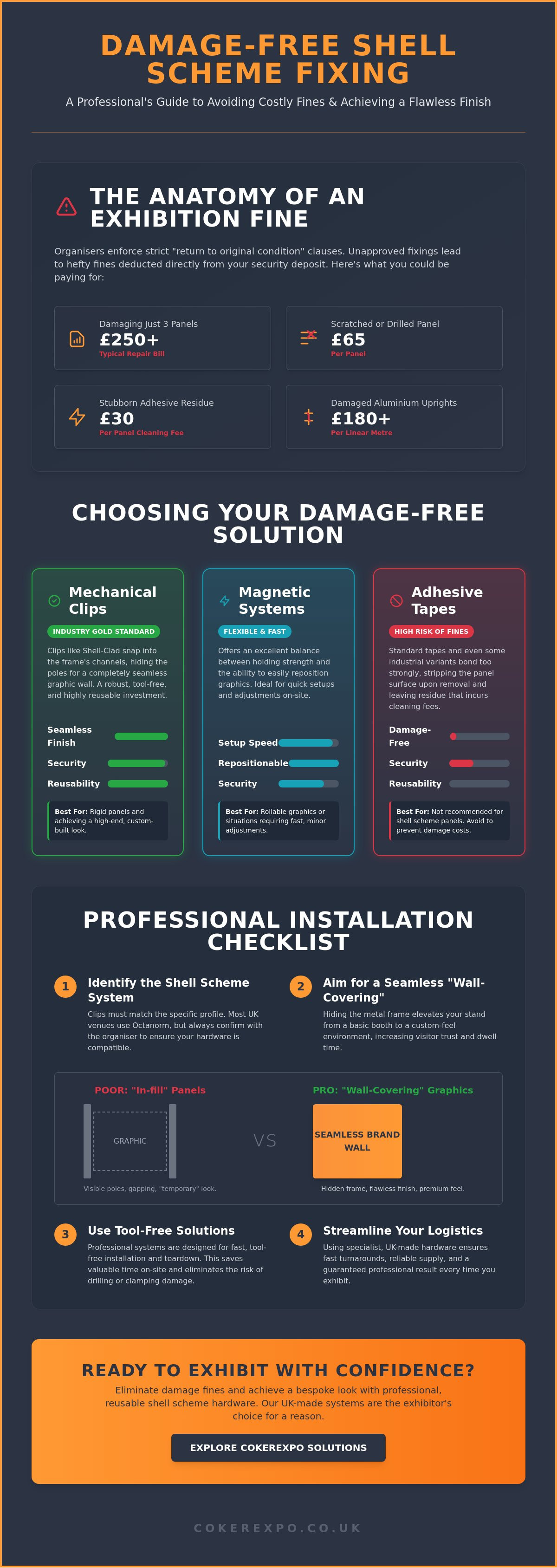
Industry data for 2026 indicates that damage charges have risen significantly. Replacing a single scratched or drilled infill panel now averages £65, while removing stubborn adhesive residue can trigger a cleaning fee of £30 per panel. If you damage the aluminium uprights by over-tightening clamps or drilling holes, costs can exceed £180 per linear metre. This makes damage-free shell scheme graphic fixing a financial necessity rather than a preference.
Exhibitors must distinguish between "In-fill" panels and "Wall-covering" graphics. In-fill panels sit inside the aluminium frame, exposing the metal poles. Wall-covering graphics sit in front of the poles to create a continuous, hidden-fix appearance. Both styles require a strategy that avoids mechanical damage. Residue-free application is just as vital as avoiding holes; modern industrial tapes often bond too strongly to the PVC coating of the panels, stripping the surface during the high-pressure breakdown phase.
Understanding the Shell Scheme "Fine" Culture
Organisers conduct rigorous inspections during the breakdown phase. They look for tape residue, screw holes, and bent aluminium frames caused by heavy cantilevered displays. Fines are often deducted directly from your security deposit before you've even left the hall. Damage-free is a mandatory compliance standard for UK venues to avoid post-event dilapidation claims. Using the wrong adhesive or a "quick fix" tool can turn a successful show into a loss-making exercise once the invoices for panel replacements arrive.
The Aesthetic Advantage of Non-Invasive Fixings
Professional fixings ensure your graphics sit perfectly flush against the substrate. When panels bow or lean due to poor attachment, it creates shadows that break the visual flow of your brand. A seamless, flat surface projects a high-end, bespoke feel that increases visitor trust. This precision is central to the CokerExpo shell scheme graphic panels philosophy. We focus on hardware that secures your brand without compromising the venue's infrastructure. Non-invasive fixings don't just save money; they eliminate the "temporary" look of a basic booth, making your 3x3 metre space feel like a custom-built environment.
Comparing Damage-Free Methods: Clips, Magnets, and Adhesives
Selecting the correct damage-free shell scheme graphic fixing is a decision that impacts both your setup speed and the final visual impact of your stand. Professional exhibitors avoid permanent alterations to hired hardware to prevent costly damage charges from venue contractors. The choice usually falls between mechanical clips, magnetic systems, or specialist adhesives, each offering different levels of structural integrity.
Mechanical clips, such as the Shell-Clad system, remain the industry gold standard for creating a seamless, over-the-pole look. These clips snap directly into the recessed channels of aluminium uprights. It's a tool-free process that hides the metal structure entirely, transforming a basic shell into a continuous graphic wall. Data from the Center for Exhibition Industry Research indicates that professional booth presentation significantly influences attendee dwell time, making the seamless finish a high-ROI choice for serious brands.
Shell-Clad and Modular Clip Systems
Precision is vital when using clips. You must ensure your clips match the specific profile of the shell scheme provided by the organiser. While Octanorm is the most common in UK venues like the NEC or ExCeL, others use Sodem or Burkhardt Leitner. These systems are designed for high reusability across multiple show seasons, making them a sustainable investment. They provide a robust mechanical bond that supports heavier rigid panels without the risk of slipping under the intense heat of hall lighting.
Magnetic vs. Adhesive Solutions
Magnetic tape offers an excellent balance between strength and easy repositioning. Most aluminium shell schemes aren't naturally magnetic, so you'll need to apply a steel-based adapter strip to the frame first. When selecting magnets, match the grab strength to your material. A 1.5mm thick magnetic strip provides ample support for lightweight PVC, but rigid 3mm Foamex panels require high-pole density magnets to stay secure throughout a three-day event.
Hook and loop fasteners remain a versatile choice for lightweight in-fill panels that sit inside the frame. For fabric graphics, specialist low-tack adhesives are becoming more common. Don't use industrial-grade tapes; these often bond too permanently and leave a sticky residue that results in cleaning fines. If you're unsure which fixing suits your specific panel weight, you can view our range of exhibition hardware to find a compatible solution. Always test a small area first to ensure the bond is secure yet fully removable without a trace.
Material Compatibility: Matching Your Graphic to the Fixing
Selecting the right substrate is the first step toward a successful display. Your choice of material dictates the damage-free shell scheme graphic fixing method required to ensure a professional, secure finish. Rigid panels offer durability and impact, while fabrics provide a seamless, modern aesthetic that's easy to transport. Understanding how these materials interact with the aluminium frame prevents common onsite issues like panel slippage or adhesive failure. It's about finding the balance between weight, aesthetics, and the specific restrictions of the venue.
Fixing Rigid Foamex Panels
Foamex remains a staple for UK exhibitors because it's cost-effective and lightweight. To achieve a high-end "floating" wall effect, use hidden plastic clips that slot directly into the shell scheme uprights. For a standard 2.4m high panel, we recommend four to six fixings per square metre to distribute weight evenly. This prevents the panel from sagging or shifting during the event. In high-heat environments like the NEC or Excel London, rigid plastics can expand slightly. Leaving a 2mm expansion gap between panels helps you avoid the "bowing" effect that occurs when graphics are packed too tightly. Following best practices for exhibit graphics ensures your rigid boards remain flat and secure throughout the show.
Tension Fabric: The Tool-Free Revolution
By 2026, over 60% of national B2B exhibitors have transitioned to TFS systems for their primary branding. These systems use a Silicone Edge Graphic (SEG) mechanic where a thin silicone strip sewn into the fabric edge tucks into a dedicated aluminium channel. It's a completely tool-free process that creates a drum-tight, crease-free surface every time. Because the fabric is lightweight and foldable, it eliminates the bulk and potential damage associated with traditional panels. It's the ultimate damage-free shell scheme graphic fixing solution because the hardware integrates with the shell scheme without needing aggressive adhesives or mechanical drilling.
Eco-friendly substrates like recycled polyester (rPET) are now the preferred choice for sustainable exhibiting. These materials require specific tension settings to avoid over-stretching during installation. When planning for 2026 sustainability targets, ensure your chosen clips or rails are compatible with PVC-free alternatives. While rollable PVC graphics are still used for smaller budgets, they require high-bond hook-and-loop tapes to prevent edge curling. Always verify the weight of your substrate before arrival. A 3mm Dibond panel is significantly heavier than a 5mm Foamex board; it requires heavy-duty magnetic strips or specialist mechanical brackets to stay upright and safe.
Installation Masterclass: Achieving a Seamless Finish
Executing a professional display requires more than just high-quality print. It demands a methodical approach to damage-free shell scheme graphic fixing to ensure your brand looks permanent rather than temporary. Follow this five-step protocol to transform a standard 3x3 metre booth into a high-impact brand space.
- Step 1: Identify the Profile: Most UK venues use Octanorm or Sodem systems. Check the groove width and pole diameter before you arrive, as this determines which clips or magnetic strips are compatible.
- Step 2: Surface Preparation: Use a 70% isopropyl alcohol wipe to remove dust and grease from the aluminium frame. This ensures maximum grab for adhesives or suction fixes without corroding the powder-coated finish.
- Step 3: The "Level First" Technique: Don't start at the corner. Start with the central panel of your longest wall. Use a spirit level to ensure this anchor panel is perfectly vertical, as even a 2mm tilt will cause significant gaps by the time you reach the third panel.
- Step 4: Managing Corners: For a custom look, use pillar wraps or flexible PVC panels that curve around the uprights. This hides the industrial metalwork and creates a continuous visual flow.
- Step 5: Post-Show Audit: During breakdown, peel graphics away at a 45-degree angle. Check every pole for residue; if any remains, use a dedicated citrus-based adhesive remover to leave the frame in its original condition.
The Secret to Hiding Aluminium Uprights
Standard shell schemes often leave silver uprights visible between panels, which breaks the continuity of your message. You can solve this by using "over-the-pole" clips. These specialized fixings allow your graphics to sit proud of the frame, effectively bridging the gap. To achieve this, your artwork must include a specific bleed, typically 15mm to 20mm on each side, to cover the pole width. To measure shell scheme apertures precisely, use a steel tape measure to record the distance between the inner grooves of the vertical poles, accounting for the 4mm depth where the panel edge rests.
Tool-Free Assembly Best Practices
In the high-pressure environment of a 60-minute setup, tools are often a liability. Hand-tightened fixings are superior because they prevent the over-torqueing that strips threads on expensive modular systems. Organise your fixing kit into a clear, labeled technician's bag containing spare clips, spirit levels, and non-marking tape. Safety is paramount when dealing with 2.4-metre high panels. Always secure the top header first; this ensures that top-heavy panels remain stable while you align the bottom edges. This approach guarantees a damage-free shell scheme graphic fixing that satisfies both your marketing goals and the venue's strict dilapidation rules.
Ready to upgrade your exhibition presence with professional-grade hardware? Explore our range of tool-free display solutions at Coker Expo and ensure your next show is seamless.
CokerExpo Solutions: Professional Shell Scheme Infrastructure
CokerExpo positions itself as the practical specialist for UK exhibitors who require high-performance hardware without the complexity of traditional construction. We focus on providing tool-free systems that ensure your damage-free shell scheme graphic fixing remains secure throughout the event. Our hardware range is engineered to bypass the need for adhesives or screws, utilizing precision-engineered clips and brackets that interface directly with the aluminium uprights found in standard UK shell schemes.
Our custom-printed panels are produced in-house to meet the specific requirements of UK venues like the NEC, ExCeL, and Olympia. We understand that a millimetre of difference can be the gap between a seamless wall and a visible frame. By manufacturing locally, we maintain strict quality control over panel thickness and rigidity, ensuring they fit perfectly into our specialized fixing systems. For exhibitors looking to move beyond flat graphics, we provide lightboxes that offer an illuminated, freestanding alternative. These units create a high-impact focal point that requires zero physical contact with the shell scheme walls, completely eliminating the risk of damage charges.
Beyond the Panel: Integrated Stand Features
Modular flexibility is the core of a successful exhibition strategy. You can easily expand your footprint by adding folding display boards to your setup. These boards provide additional surface area for information-heavy displays and can be configured in minutes. We also offer integrated lighting solutions that clip directly onto the top rail of the shell scheme. This method provides professional-grade illumination without the need for drilling or permanent modifications. Because our equipment is designed for UK venue standards, you won't encounter the compatibility issues often found with imported, generic hardware.
Your Next Steps for a Stress-Free Show
Preparation is the most effective way to ensure a smooth build day. Before you head to the venue, follow this essential checklist for damage-free shell scheme graphic fixing compliance:
- Confirm the Shell Scheme Type: Ask the organiser if the system is Octanorm, Sodem, or another specific brand.
- Check Panel Dimensions: Verify if you need "in-fill" panels that sit between poles or "overlay" panels that cover them.
- Test Your Hardware: If you're unsure about a specific clip or bracket, request a sample from our team to test against your graphic material.
- Review Venue Regulations: Ensure your fixing method aligns with the specific site rules of the exhibition hall.
Don't leave your brand's presentation to chance. Our team at CokerExpo is ready to help you design a bespoke, tool-free structure that simplifies your logistics and protects your budget from unnecessary damage fines. Contact us today to discuss your next project or to request technical specifications for our fixing hardware.
Secure a Flawless Exhibition Stand Today
Achieving a professional finish at your next trade show doesn't require complex tools or the risk of expensive damage charges. By prioritising damage-free shell scheme graphic fixing, you protect your budget from unexpected repair fees often levied by UK venues. Whether you select modular clips or high-strength magnets, the focus remains on a seamless, robust aesthetic that reflects your brand's quality. It's about combining technical precision with practical ease of use.
At Coker Expo, we've spent over 25 years refining the infrastructure of successful events. Our UK-based production facility ensures a fast turnaround on all orders, providing the reliability marketing managers need under tight deadlines. We specialise in tool-free, modular systems that simplify the build process without compromising on visual impact. You're not just buying hardware; you're investing in a stress-free exhibition experience backed by decades of technical authority.
Explore our Range of Shell Scheme Graphic Panels at cokerexpo.co.uk to find your perfect fit. Your next impactful display is only a few clicks away.
Frequently Asked Questions
Can I use standard double-sided tape on a shell scheme?
You shouldn't use standard double-sided tape on a shell scheme because it leaves a permanent adhesive residue that leads to cleaning fees. Most UK venues, like the NEC or ExCeL London, charge exhibitors between £25 and £50 per panel for adhesive removal. Instead, choose professional damage-free shell scheme graphic fixing solutions like hook and loop fasteners or specialized low-tack tapes designed specifically for exhibition environments.
What is the best way to hide the metal poles in my exhibition stand?
The most effective way to hide metal uprights is by using a seamless graphic system or over-the-pole adapters. These clips allow you to mount rigid Foamex or PVC panels directly over the aluminium structure; this creates a continuous visual surface across your stand width. By eliminating the visible 50mm vertical poles, your brand message remains uninterrupted and looks like a custom-built stand rather than a modular one.
Will magnetic tape work on all shell scheme systems?
Magnetic tape doesn't work on all systems because most shell scheme frames are made of aluminium, which isn't magnetic. To use magnets, you must apply a self-adhesive steel tape to the aluminium uprights first; this creates a metal-to-magnet bond. However, always check if the venue allows adhesive steel tape, as 90% of exhibition organisers require its complete removal before you vacate the site at the end of the show.
How do I know which shell scheme system the venue is using?
You can find the specific system details in your online Exhibitor Technical Manual provided by the event organiser. Common UK systems include Octanorm, Sodem, or Burkhardt Leitner. If the manual doesn't specify the brand, contact the official shell scheme contractor listed in the services section. They'll confirm the profile dimensions so you can order the correct clips or graphic panels for your specific stand space.
Are shell scheme clips reusable for different exhibitions?
Yes, high-quality shell scheme clips are designed for multiple uses across different shows. As long as you're using the same aluminium profile system, such as Octanorm, you can reuse the same hardware for years. This makes them a cost-effective choice for frequent exhibitors. We recommend keeping a small kit of 20 to 30 spare clips to account for any lost during the high-pressure breakdown period at the venue.
What happens if I accidentally damage the shell scheme wall?
You'll be liable for replacement costs if you damage the 3mm or 4mm thick infill panels. Contractors typically charge between £40 and £85 per damaged panel depending on the specific system type. Common damage includes holes from screws or surface peeling from high-tack adhesives. Using a dedicated damage-free shell scheme graphic fixing ensures you avoid these unexpected post-show invoices and maintain a professional reputation with site contractors.
Can I hang heavy items like TVs using damage-free fixings?
You can't hang heavy items like 50-inch LED TVs using standard damage-free fixings or adhesive tapes. Standard shell scheme panels are thin and lack the structural integrity to support weights exceeding 2kg or 3kg. For screens or heavy shelving, you must use a specialized internal support bracket that clamps directly to the aluminium uprights or opt for a free-standing floor mount to ensure safety and stability.
Is velcro allowed by all UK exhibition organisers?
Most UK organisers allow the use of hook and loop fasteners like Velcro, provided you remove all traces after the event. It's a standard industry practice for fixing lightweight 3mm Foamex panels. Always use the hook side on your graphic and the loop side on the shell scheme wall. This prevents the abrasive hooks from catching on the fabric of neighboring stands or clothing during the busy build-up phase.
Laisser un commentaire