

Foamex Signs: The Professional Guide to PVC Display Boards for Exhibitions
Why would you invest upwards of £3,500 on a premium stand space at the NEC only to risk your brand’s reputation with warped boards that fail a basic site inspection? You understand that in the high-stakes environment of a UK trade show, your hardware needs to do more than just look good; it has to be compliant and durable. If your display arrives damaged or looks budget next to a competitor, you have lost the room before the first lead walks past. Using professional foamex signs is the most reliable way to ensure your branding remains impactful and flat throughout the entire event.
We'll help you secure that professional edge by selecting high-grade PVC display boards that balance portability with a premium finish. You will learn exactly how to choose between 3mm and 5mm thicknesses for specific stand types and how to ensure your graphics meet the Class 1 fire ratings required by major UK venues like ExCeL London. This guide provides a technical breakdown of design best practices, transport solutions to prevent transit damage; and step-by-step installation methods for a seamless, robust result that you can reuse for years.
Key Takeaways
- Learn how to select the optimal board thickness-3mm, 5mm, or 10mm-to prevent warping and ensure your display remains perfectly flat throughout the event.
- Understand the aesthetic and cost differences between PVC, Correx, and Dibond to choose the most cost-effective, high-impact material for your trade show budget.
- Master the professional installation process for shell scheme stands while ensuring full compliance with UK exhibition safety regulations.
- Discover how high-resolution UV printing and CNC cutting can transform standard foamex signs into bespoke, custom-shaped displays that capture visitor attention.
- Identify the essential toolkit required for a seamless setup, from heavy-duty Velcro to magnetic strips, ensuring a secure and level finish every time.
What are Foamex Signs and Why are They the Industry Standard?
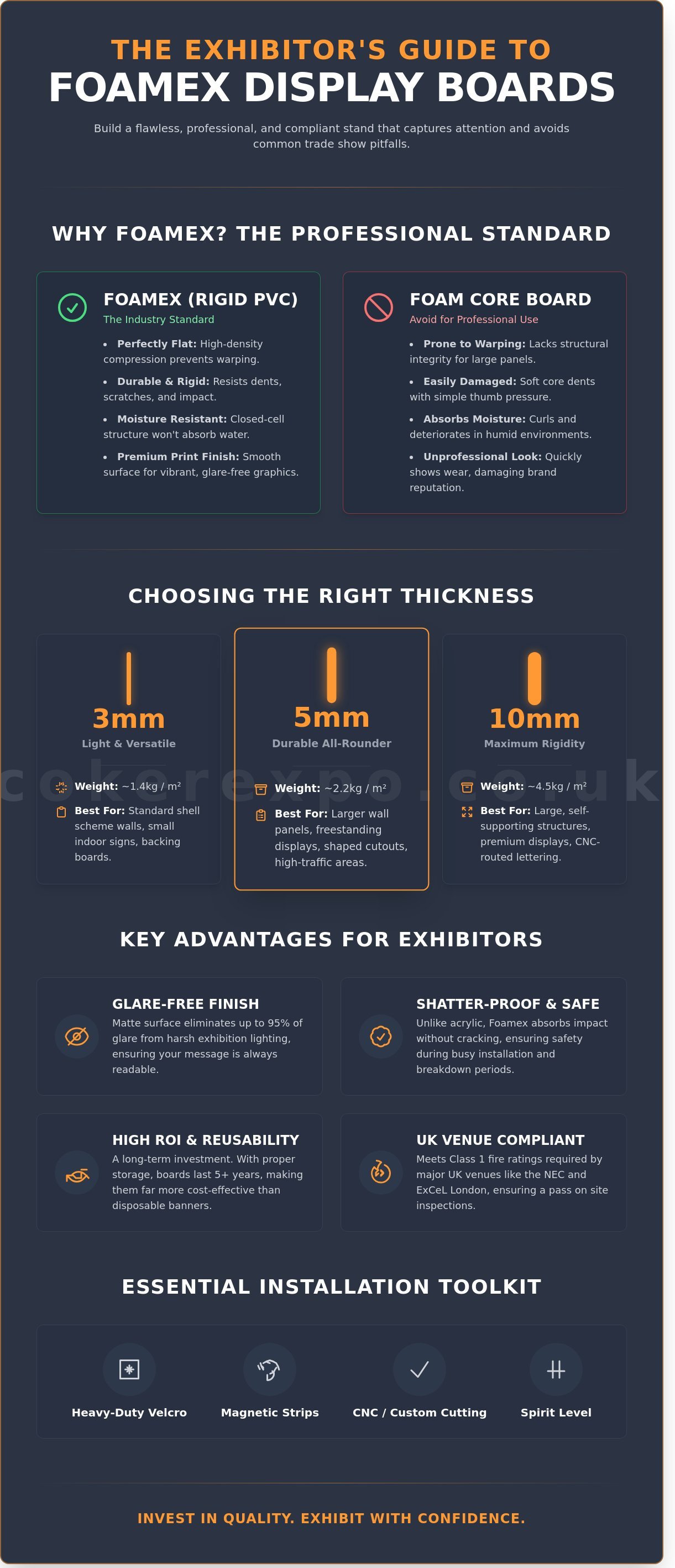
Foamex isn't just a generic term; it's a specific brand of high-grade, compressed PVC foam board that has set the benchmark for professional exhibition graphics. It's vital to distinguish this material from soft foam-centred boards, often called Kapa or foam core. While soft boards dent under the slightest thumb pressure, Foamex is a rigid, hard-wearing plastic. To understand the technical classification of this material, you can explore What are Foamex Signs? and how they differ from standard plastics. At CokerExpo, we rely on this material because its high-density compression creates an exceptionally flat surface. This flatness is the secret behind a superior print finish, as it allows UV-stable inks to bond perfectly without the "orange peel" texture seen on lower-quality substrates.
The manufacturing process involves expanding PVC into a liquid state before compressing it into dense sheets. This results in a board that's remarkably lightweight. A standard 3mm panel weighs approximately 1.4kg per square metre, making it easy for a single person to handle during a busy build at the NEC or ExCeL London. Unlike traditional paper posters that curl at the edges or tear under tension, foamex signs remain perfectly flat and dimensionally stable. They offer a professional presence that fabric displays can't always match, especially when you need a rigid, self-supporting structure for shell scheme panels or standalone directional signage.
The Material Science: PVC vs. Foam Core
The technical edge of Foamex lies in its closed-cell structure. This microscopic arrangement ensures the board doesn't absorb moisture, which is a common failure point for paper-based displays in humid environments or outdoor marquees. It's also effectively shatter-proof. While acrylic or glass panels can crack into dangerous shards if dropped during a frantic event breakdown, Foamex simply absorbs the impact. For exhibitors working under harsh overhead lighting, the smooth, matte finish of these boards is a massive advantage. It eliminates 95% of glare, ensuring your marketing message remains legible from every angle across the hall. We typically recommend 3mm thickness for wall-mounted panels and 5mm or 10mm for free-standing displays that require extra structural integrity.
Sustainable Signage: Reusability and Longevity
Investing in foamex signs is a strategic move for any business with a recurring event calendar. If you store them flat and keep them away from extreme heat, these boards can last for 5 years or more. This longevity makes them far more cost-effective than disposable alternatives. A single £60 panel can be used across dozens of trade shows, whereas cheaper vinyl banners often look tired after just two outings. From a sustainability perspective, PVC-based boards are recyclable. Many specialised UK facilities now process used Foamex, grinding the material down to create new industrial products. This reduces the carbon footprint of your exhibition presence while maintaining a high-impact visual standard that reflects your brand's quality. It's a pragmatic solution that balances aesthetic power with long-term financial sense.
Choosing the Right Thickness: 3mm, 5mm, or 10mm?
Selecting the correct substrate thickness is a structural decision that dictates the lifespan and professional finish of your display. While 3mm is often the default for budget-conscious projects, larger foamex signs require additional depth to maintain their form. A 1200mm x 2440mm sheet of 3mm foamex lacks the internal tension to support its own weight without bowing. This warping risk increases in environments with fluctuating temperatures, such as glass-fronted foyers or drafty exhibition halls. Thicker boards, specifically 10mm options, create a premium visual weight that suggests permanence and high-end craftsmanship.
To plan your logistics effectively, use these approximate weight-per-square-metre estimates:
- 3mm Foamex: Approximately 1.4kg per m²
- 5mm Foamex: Approximately 2.2kg per m²
- 10mm Foamex: Approximately 4.5kg per m²
Knowing these figures prevents overloading portable display stands and helps you calculate shipping costs accurately. Safety is also a critical factor in public spaces. All materials used in high-traffic zones must comply with UK Exhibition Regulations, ensuring your signage meets BS 476 Part 7 Class 1 or EN 13501-1 fire ratings. If you are unsure which thickness suits your specific stand layout, our team provides bespoke advice on rigid substrates to ensure your graphics remain perfectly flat throughout the event.
3mm Foamex: The Shell Scheme Specialist
This thickness is the industry standard for shell scheme graphics. Its 3mm profile is designed to slide directly into the aluminium extrusions of standard 2.4m high exhibition stands. It offers enough flexibility to wrap around gentle curves or follow the contour of a slightly bent wall. It's the perfect choice for small-scale point-of-sale signs or lightweight wall panels where weight is a primary concern for transport.
5mm Foamex: The All-Rounder
We recommend 5mm for 75% of our free-standing display projects. It provides the necessary rigidity to prevent bowing when you use Velcro or magnetic tape for fixing. This thickness is the perfect middle ground for header boards and directional foamex signs. It remains light enough for easy transport but has the structural integrity to stay flat over larger surface areas, such as 2m tall wall graphics or rigid kiosks.
10mm Foamex: Structural Rigidity
Choose 10mm for heavy-duty retail displays or outdoor monoliths where durability is paramount. The 10mm depth creates a distinct block effect, allowing for 3D architectural elements or thick cut-out letters that stand proud of a surface. These boards weigh significantly more than the 5mm version. They require robust mounting solutions like stand-off bolts or heavy-duty adhesive. If you need a permanent feel for a high-traffic area, 10mm is the professional choice for structural impact.
Foamex vs. Correx vs. Aluminium Composite (Dibond)
Selecting the right substrate isn't just about the budget. It's about how your brand survives the chaos of a busy exhibition hall. Foamex signs are the industry standard for a reason. They offer a smooth, matte finish that eliminates glare from overhead spotlights, which is vital for photography and readability. In contrast, Correx features a distinct fluted texture that can distort high-resolution graphics, while Aluminium Composite (Dibond) provides a premium, metallic rigidity suited for high-end architectural displays.
For a typical three-day UK trade show at a venue like the NEC Birmingham, the cost-to-benefit ratio heavily favours Foamex. A standard 3mm Foamex panel costs approximately 40% less than a Dibond equivalent but provides 90% of the visual impact. In high-traffic areas where 2.1 million annual visitors might bump into your stand, impact resistance is non-negotiable. Foamex absorbs minor knocks without permanent denting, whereas thinner plastics might crack. All materials used must comply with UK exhibition safety regulations, ensuring they meet fire-retardancy standards like BS 476 Part 7 Class 1.
- Foamex: Best for high-quality wall panels, shell scheme liners, and mid-term indoor displays.
- Correx: Best for short-term directional signage, outdoor bollard covers, and lightweight ceiling hangs.
- Dibond: Best for permanent outdoor signage, heavy-duty construction site hoardings, and premium retail branding.
When to Choose Correx Over Foamex
Correx is a twin-wall polypropylene sheet, most recognisable as the material used for estate agent "For Sale" signs. It's an ultra-low-cost solution, often priced 50% lower than Foamex. You'll choose this when weight is the primary constraint. Because it's 25% lighter than solid PVC, it's the safest choice for large "Exit" or "Danger" signs suspended from ceiling gantries. However, the visible internal ribs make it unsuitable for high-resolution exhibition branding. If your graphic contains small text or detailed photography, the "corrugated" look of Correx will compromise the professional finish you need.
Foamex vs. Aluminium Composite (Dibond)
Dibond consists of a polyethylene core sandwiched between two thin aluminium sheets. It's the definitive choice for permanent outdoor installations because it doesn't warp. While foamex signs can expand or bow when exposed to direct sunlight and temperatures exceeding 35°C, Dibond remains perfectly flat. For indoor exhibitions, however, Foamex wins on practicality. It's easier to trim on-site with a standard craft knife and weighs significantly less, making transport to London's ExCeL or the Olympia much simpler for your logistics team. Unless you're building a structural stand element that requires the torsional strength of metal, stick with the versatility of Foamex for your 72-hour event cycle.
The decision usually comes down to the duration of the event and the physical environment. For a standard UK trade show, 3mm or 5mm Foamex provides the most professional aesthetic for the lowest logistical effort. It's a reliable workhorse that looks expensive without the Dibond price tag.
Installation and Safety: Meeting UK Exhibition Regulations
Installing foamex signs on a standard 2.4m high shell scheme requires precision and the right hardware to ensure a professional finish. You'll need a specific toolkit to handle the job on-site. This includes heavy-duty Velcro (hook and loop), magnetic strips for metal-framed systems, and a 600mm spirit level. Don't rely on your eyesight alone; even a 2mm misalignment at the top of a panel becomes a glaring gap at floor level. Start by cleaning the shell scheme aluminium uprights with isopropyl alcohol to ensure the adhesive bonds correctly. Apply the hook side to the frame and the loop side to the back of your panel. This allows for slight adjustments during the hang.
Design specifications are just as vital as the physical installation. For large-format PVC graphics, always include a 3mm to 5mm bleed in your artwork files. This extra margin accounts for the slight movement of the industrial guillotines during the trimming process. Without it, you risk thin white slivers appearing at the edges of your foamex signs, which ruins the visual impact of a continuous wall graphic. Ensure all critical text stays at least 20mm away from the trim line to avoid being obscured by the shell scheme's vertical poles.
Fire Safety: Class 1 and Class 0 Ratings
UK venues like ExCeL London and the NEC Birmingham enforce strict fire safety protocols under the 2024 Association of Event Venues (AEV) eGuide. You must ensure your rigid graphics meet British Standard BS 476 Part 7. A Class 1 rating means the material resists the surface spread of flame, while Class 0 indicates limited combustibility. Most high-quality 3mm and 5mm PVC foam boards carry these certifications. Always request a PDF fire certificate from your supplier before the event. If a floor manager or fire inspector visits your stand, you'll need to produce this document instantly to avoid having your graphics dismantled.
Mounting Techniques for a Professional Finish
While Velcro is the industry standard for its "tool-free" speed, it can sometimes leave a small gap between the panel and the frame. If you want a perfectly flush, high-end appearance, consider split battens. This method involves a hidden interlocking timber or aluminium rail system that allows the panel to sit flat against the wall. To achieve a seamless look across multiple panels, use butt-joints. This involves precisely squaring the edges so they meet with zero overlap. If you need to secure panels to a wooden traditional build stand, use a high-speed drill bit to create pilot holes. This prevents the compressed PVC from cracking or splintering under the pressure of the screw head.
Ready to upgrade your display with professional-grade materials? Explore our range of durable exhibition graphics to find the perfect fit for your next event.
Bespoke Foamex Solutions from Coker Exhibition Systems
Coker Exhibition Systems Ltd (CokerExpo) specialises in high-resolution UV printing directly onto Foamex substrates. Our flatbed printing technology delivers 1440dpi resolution, ensuring that every gradient and fine detail in your brand's artwork remains crisp. We use UV-cured inks that bond instantly to the plastic surface. This creates a waterproof and fade-resistant finish suitable for both indoor trade shows and outdoor events. For exhibitors, this durability is vital. Your foamex signs will withstand the rigours of transport and repeated handling without the surface chipping or peeling. We handle standard sheet sizes up to 3050mm by 1525mm, providing the scale needed for impactful backdrops.
Custom Shapes and CNC Routing
Standard rectangular boards often fail to capture the imagination of a busy trade show crowd. Our digital CNC routing service allows you to move beyond the rectangle. We use high-speed oscillating knives and router bits to cut Foamex into virtually any shape. This precision technology creates 3D logos, life-size standees, and complex interlocking display elements with 0.1mm accuracy. A custom-shaped sign can increase booth dwell time by up to 40% as it creates a more tactile and interesting environment. Whether you need a 2-metre tall mascot or a series of intricate wall-mounted icons, our digital cutting ensures clean, professional edges that require no manual finishing.
The CokerExpo Promise: Fast Turnaround and Reliability
Based in Hampshire, our 10,000 square foot production hub is perfectly positioned for rapid distribution across the UK. We recognise that event planning is a deadline-driven discipline. A delay of even a few hours can jeopardise a major product launch. We’ve structured our operations to offer a standard 3 to 5 working day turnaround, with express options available for urgent projects. Our logistics team coordinates national delivery to major venues like the NEC, ExCeL, and Manchester Central, ensuring your kit arrives exactly when the build window opens.
We don't just provide the boards; we provide the infrastructure. Our foamex signs are specifically engineered to integrate with our range of tool-free assembly systems. You can slide 3mm or 5mm panels directly into our modular aluminium frames or secure them to gantry systems using simple hook-and-loop fasteners or magnetic tape. This focus on the user experience means your team spends less time struggling with tools and more time engaging with potential clients. We act as a practical specialist, taking the technical stress out of your exhibition presence.
Secure Your Professional Presence with High-Impact Displays
Selecting the right display material shouldn't be a guessing game. High-quality foamex signs provide the essential balance between lightweight portability and professional durability required for modern trade shows. Whether you opt for 3mm panels for easy transport or 10mm boards for maximum rigidity, these PVC displays ensure your brand meets strict UK exhibition fire safety standards. We've seen how the right substrate choice prevents bowing and ensures a seamless finish across your entire stand.
At Coker Exhibition Systems, we've spent over 25 years perfecting the art of display. From our production centre in Hook, Hampshire, we specialise in creating bespoke solutions that prioritise tool-free assembly and fast turnaround times. We understand the high-pressure environment of event planning; that's why our hardware is designed for rapid deployment without compromising on visual impact. You can rely on our British-made quality to provide the robust infrastructure your business needs to stand out. Our team is ready to turn your specifications into a tangible, professional reality.
Browse our range of professional Foamex and exhibition display boards
We look forward to helping you make a lasting impression at your next event.
Frequently Asked Questions
Is Foamex waterproof and suitable for outdoor use?
Yes, Foamex is fully waterproof and highly resistant to British weather conditions. Since it's manufactured from compressed PVC, the material doesn't absorb moisture or swell like timber products. You can expect a standard outdoor lifespan of 24 months before any significant fading occurs. It's a robust solution for permanent exterior signage or temporary event directional boards.
What is the difference between Foamex and foam board?
Foamex is a solid, high-density PVC sheet, whereas foam board consists of a lightweight polystyrene core sandwiched between two paper liners. Foamex is significantly more durable and impact-resistant. While foam board is prone to denting and is strictly for short-term indoor use, foamex signs are built to withstand the rigours of busy exhibition environments and repeat transport.
Can I print on both sides of a Foamex sign?
Yes, we offer double-sided printing on all Foamex thicknesses using high-definition UV inks. This is a practical choice for hanging displays or floor-standing units where 360-degree visibility is required. We typically recommend a 5mm thickness for double-sided panels to ensure the board remains opaque. This prevents any show-through from the reverse side under bright exhibition hall lighting.
How do I clean and maintain my Foamex display boards?
Clean your boards using warm soapy water and a soft microfibre cloth to remove dust or fingerprints. Don't use solvent-based cleaners or abrasive scouring pads, as these will damage the printed surface. For stubborn marks, a solution of 10% isopropyl alcohol is effective and safe. Regular maintenance ensures your foamex signs retain their professional finish over multiple show cycles.
What is the largest size a single Foamex sheet can be?
The maximum dimensions for a single, seamless Foamex sheet are 3050mm by 1550mm. If your design exceeds these measurements, we produce the graphic across multiple panels with precision-cut joins. For large-scale wall coverings, we use 10mm thick sheets to provide extra stability. This modular approach allows us to create backdrops for stands exceeding 10 metres in width.
Will Foamex signs warp in the sun?
Foamex can expand or bow if it's exposed to direct sunlight where temperatures exceed 55°C. Darker colours absorb more heat, which increases the risk of thermal movement. To prevent warping, we suggest using 5mm or 10mm boards for south-facing outdoor displays. Installing the panels with mechanical fixings every 400mm allows the material to expand and contract without distorting the image.
How do I fix Foamex panels to a shell scheme wall?
Use 25mm wide heavy-duty hook and loop tape for a fast, tool-free installation on standard shell scheme panels. Apply the hook side to the wall and the loop side to the back of your graphic for a secure bond. This method allows a single person to install a full 3-metre stand in under 20 minutes. It's a reliable way to ensure your display remains flush and professional.
Are Foamex signs fire-rated for UK exhibition halls?
Yes, our Foamex products carry a Class 1 fire rating in accordance with BS 476 Part 7 safety standards. This certification is a strict requirement for major UK venues such as the NEC Birmingham and Manchester Central. We provide the relevant safety documentation with your order to satisfy site manager inspections. This ensures your installation is fully compliant with current UK fire regulations.
Laisser un commentaire