

Motorised Turntables for Product Photography: The Professional B2B Guide (2026)
Over 60% of high-volume e-commerce sellers now use 360-degree spin photography for at least half of their inventory. This isn't just a trend; it's a baseline requirement for professional digital storefronts in 2026. If you've tried to capture these visuals with entry-level gear, you know the frustration of jerky rotations or motors that stall the moment you place a heavy item on the platform. Matching your lighting to a moving subject often feels like a losing battle against your post-production schedule.
Investing in a professional motorised turntable for product photography eliminates these logistical bottlenecks by providing the precision and load capacity your studio demands. You'll learn how to master the technical specifications and strategic workflows that turn simple rotations into high-impact interactive displays. This guide breaks down the essential hardware requirements, software integrations, and lighting setups needed to scale your content production without sacrificing quality.
Key Takeaways
- Understand how high-precision rotation builds buyer confidence and enhances digital trust through interactive, 360-degree product visuals.
- Learn to calculate real-world load capacities to ensure your motorised turntable for product photography operates reliably under the weight of heavier commercial goods.
- Discover the technical partnership between turntables and exhibition lightboxes to eliminate shadows and significantly reduce your post-production editing time.
- Master variable speed and RPM settings to synchronise product movement with camera frame rates for smooth, professional-grade video output.
- Explore how to leverage your studio equipment as a dynamic focal point on trade show floors using branded display plinths to increase engagement.
Understanding Motorised Turntables for 360-degree Product Photography
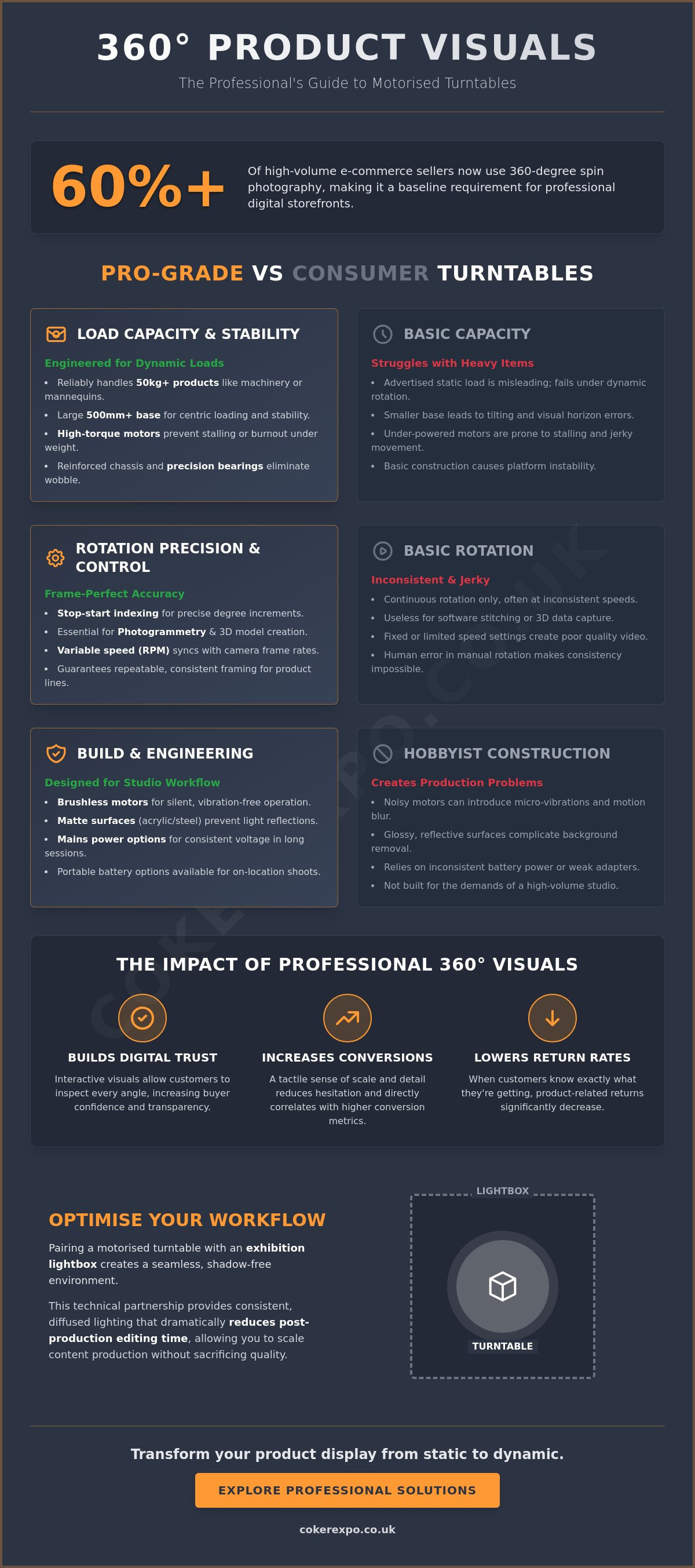
A motorised turntable for product photography is a precision instrument, not a simple revolving stand. While hobbyist units might suffice for a retail window display, professional content creation requires high-torque motors capable of maintaining consistent RPM under heavy load. Inconsistent rotation speeds lead to jerky video playback. This destroys the illusion of a seamless 360-degree view and signals a lack of quality to potential B2B buyers who expect technical excellence.
The core distinction between decorative units and professional hardware lies in the motor engineering. Photography-grade models use high-precision gears to ensure every stop is frame-perfect. This accuracy is vital for Photogrammetry, the science of extracting 3D data from 2D images. If the platform wobbles or slips during the rotation, the entire dataset becomes useless for software stitching. Professional units provide the stability needed to create clean, usable assets every time.
Manual rotation is a liability in a high-volume studio. Human error ensures that no two rotations are identical, making it nearly impossible to maintain consistent framing across a product line. A motorised unit guarantees repeatability. This allows you to reshoot specific frames or update product versions with identical alignment. Automation lets your photographer focus on lighting and composition instead of manually nudging a platform every few degrees. It's a fundamental shift from manual labour to an efficient, scalable workflow.
The Role of 360-Degree Content in 2026
Buyer expectations have moved toward interactive experiences. Static galleries are no longer enough to secure high-value contracts or reduce consumer hesitation. 360-degree photography acts as the bridge between 2D images and virtual reality, providing a tactile sense of scale that static photos cannot match. By allowing customers to inspect every angle of a product, you build immediate trust. This transparency directly correlates with lower return rates and higher conversion metrics in competitive e-commerce environments.
Anatomy of a Professional Motorised Unit
The build quality of your hardware dictates the quality of your output. Professional units prioritise resilience and ease of use through specific design choices:
- Brushless Motors: These provide silent operation and eliminate micro-vibrations that cause motion blur in high-resolution shots.
- Matte Surfaces: Using matte acrylic or powder-coated steel prevents unwanted light reflections. This makes it easier to remove backgrounds during post-production.
- Power Options: Mains-powered units offer the consistent voltage required for long studio sessions. Battery-powered options provide the portability needed for capturing content directly at events or remote locations.
Key Technical Specifications: Pro-Grade vs. Consumer Units
Selecting the right hardware requires looking past headline-grabbing weight limits. Many entry-level units advertise a high static load, but they struggle once dynamic movement begins. When a motorised turntable for product photography starts to rotate, centrifugal force and friction change the torque requirements. Professional units are engineered for these real-world conditions, ensuring that a 50kg product rotates with the same fluid consistency as a 5kg item.
Weight Capacity and Centric Loading
Managing substantial items like industrial machinery or full-sized mannequins demands a platform with a 500mm+ base. Without professional-grade bearings, these heavier loads cause the platform to tilt or wobble during rotation. This misalignment ruins the visual horizon of your shot. High-torque motors in pro units prevent burnout, which is a common failure point in under-powered consumer models. Keeping the centre of gravity aligned is significantly easier when the hardware features a reinforced internal chassis and precision bearings.
Rotation Precision and Stop-Motion Capability
There's a critical difference between continuous rotation and stop-start indexing. Continuous rotation works well for standard video, but high-end interactive HTML5 displays require precise indexing. This is where the motor stops at exact degree increments, triggers the camera shutter, and then moves to the next position. The accuracy of the motor's stopping position directly determines how seamlessly your software can align overlapping frames during the stitching process. This level of precision is what creates the impact of interactive 3D images that modern B2B buyers now expect.
Variable speed control is another non-negotiable feature for professional workflows. Different camera frame rates and shutter speeds require specific RPM settings to avoid motion blur or stutter in the final edit. Advanced units offer remote control or automated software triggers for perfect shutter sync, allowing for a completely hands-off capture process. If you're building a dedicated studio environment, choosing high-performance display turntables ensures your infrastructure can handle the pressure of high-volume content production.
Optimising Your Setup for Professional 360-degree Visuals
Hardware is only half of the equation for high-end results. To achieve a truly professional finish, you must control the environment surrounding your motorised turntable for product photography. Standard studio lighting often fails during a 360-degree rotation because shadows shift as the object turns. This creates a flickering effect in the final video that looks amateurish. A controlled, predictable lighting environment is the only way to ensure every frame remains consistent.
Lighting Environments for Rotating Subjects
Standard overhead lights often create harsh hotspots on rotating subjects, particularly those with reflective surfaces. Integrating exhibition lightboxes into your studio setup provides a consistent, wraparound glow. These units act as large-scale diffusers, softening reflections on metallic or glass surfaces during a full rotation. To eliminate "ground shadows" completely, use a bottom-lit acrylic plate on the turntable surface. This allows light to pass through the base, making the product appear to float in a clean, infinite white space.
Backgrounds and Seamless Integration
Seamless integration depends on your choice of backdrop. Tension Fabric Systems (TFS) are an excellent choice for creating an infinite curve background that hides the horizon line. By matching the turntable's surface material to the fabric, you create a unified visual field. This attention to detail is a core principle of effective Exhibition Stand Design, ensuring your digital assets maintain the same brand authority as your physical displays. A cohesive look across your photography reduces the need for expensive post-production masking.
Technical stability is the final piece of the puzzle. Use a heavy-duty tripod and a longer focal length, such as 85mm or 105mm, to avoid lens distortion and keep the product's proportions accurate. Cable management is equally vital. If you're tethering your camera to a laptop, route all leads away from the rotating platform. This prevents snags or equipment damage during the capture process. If you need to build a professional-grade environment quickly, our range of high-performance lightboxes provides the reliable infrastructure required for consistent, shadow-free results.
Integrating Turntables into Your Exhibition and E-commerce Strategy
Maximising your return on investment requires hardware that performs beyond the confines of the photography studio. A motorised turntable for product photography is a dual-purpose asset. While its primary role is creating high-conversion digital content, it also serves as a high-impact mechanical display on the trade show floor. This versatility ensures that a single piece of infrastructure supports both your online sales and your face-to-face marketing efforts.
Transitioning from the studio to a live event demands industrial-grade durability. Consumer units often feature plastic components that crack under the pressure of constant transport. Professional B2B units utilise reinforced casings and high-torque motors designed for continuous operation over multiple days. This reliability is critical when you're managing tight event schedules where equipment failure isn't an option.
The Turntable as an Exhibition Magnet
Motion is a powerful psychological trigger in a crowded exhibition hall. A rotating product naturally attracts footfall by breaking the visual monotony of static displays. To achieve a professional look, place your units on branded display plinths to elevate the product to eye level. This setup keeps the mechanical components out of sight while presenting your product as a dynamic focal point. Safety is paramount in public spaces; ensure all power cables are neatly routed and units are secured on stable surfaces like folding display boards to prevent accidental tipping.
Customisation allows the hardware to blend into your brand identity. Many professional units allow for interchangeable tops or fabric covers that match your corporate colours. This level of detail transforms a technical tool into a bespoke marketing fixture. By using the same motorised turntable for product photography at events that you use in the studio, you maintain visual consistency across every customer touchpoint.
Logistics and Reliability for UK Events
Investing in professional-grade hardware provides long-term value that disposable alternatives can't match. UK-based businesses benefit significantly from local support and accessible spare parts, which are vital for time-sensitive event circuits. When you choose equipment built for the rigours of the professional sector, you alleviate the logistical stress of equipment failure during a major launch. Reliability is the foundation of a successful exhibition strategy.
Explore our range of professional display turntables to find the right infrastructure for your next project.
Scaling Your Visual Strategy with Professional Hardware
Mastering the technical requirements of a motorised turntable for product photography is the first step toward transforming your digital presence. By prioritising high-torque motors and precision indexing, you eliminate the jerky rotations that undermine buyer trust. These units aren't just studio tools; they're resilient assets built for the UK event circuit, providing a reliable bridge between your e-commerce gallery and your exhibition stand. Investing in pro-grade hardware ensures your workflow remains efficient and your visual output stays frame-perfect.
Since 1999, we've provided the essential infrastructure for high-impact professional displays. Our hardware features high-torque motors suitable for both delicate retail items and heavy industrial machinery, ensuring total reliability under demanding conditions. With national delivery available for all exhibition hardware, we help you maintain a competitive edge in a deadline-driven industry. We're ready to handle your bespoke requests and support your growth through every product launch.
View Our Professional Display Turntables and Plinths to start building your interactive product ecosystem today.
Frequently Asked Questions
How much weight can a motorised photography turntable hold?
Weight capacity varies significantly between consumer and industrial models. While entry-level units often fail with loads exceeding 10kg, professional-grade hardware is engineered to support much heavier items. High-torque units can comfortably manage products ranging from 50kg to over 400kg. It's vital to check the dynamic load rating, as the motor must overcome friction and inertia to maintain a smooth rotation under weight.
Do I need special software to use a motorised turntable for 360 photography?
The software requirement depends on your final output. If you're recording a simple video, no special software is needed beyond your standard editing suite. However, creating interactive 360-degree spins requires stitching software to align individual frames into a single module. Many professional units feature integrated triggers that synchronise with your camera's shutter to automate this capture process efficiently.
Can I use a display turntable for video as well as still photos?
Yes, provided the unit features a high-quality brushless motor. A professional motorised turntable for product photography is designed for continuous, fluid motion, which is essential for high-definition video. Cheaper alternatives often produce micro-vibrations or "stutter" that becomes highly visible in the final edit. Smooth RPM control is the key to ensuring your video looks professional and seamless.
What is the best way to light a product on a rotating stand?
The most effective setup involves a wraparound, diffused lighting environment. Using exhibition lightboxes or backlit fabric backgrounds ensures that the light remains consistent as the product turns. This prevents shadows from "chasing" the object, which is a common issue with standard overhead studio lights. A bottom-lit acrylic plate is also recommended to eliminate ground shadows and create a clean, floating effect.
How do I stop the product from wobbling while the turntable is moving?
Wobbling is usually a result of off-centre loading or poor-quality internal bearings. You must align the product's centre of gravity perfectly with the turntable's central axis. Professional units utilise heavy-duty bearings and a reinforced chassis to maintain stability even when the load is slightly asymmetrical. If the base is too small for the product, the centrifugal force will cause a visible tilt during rotation.
Are motorised turntables noisy enough to affect video recording?
Industrial-grade units are designed for silent operation. While hobbyist stands often produce a noticeable mechanical hum, professional hardware uses brushless motors that are virtually silent. This is a critical feature for modern marketing content where high-quality ambient audio or voiceovers are recorded simultaneously with the product sweep. Reliability in a studio environment means the motor shouldn't interfere with your audio production.
Laisser un commentaire