

The Complete Guide to Freestanding LED Lightbox Displays for 2026
Why invest thousands in premium floor space at the NEC or ExCeL if your brand is literally left in the dark? At a typical 2026 trade show, 72% of attendees reported that a high-impact freestanding led lightbox display was the primary reason they felt drawn to a specific stand. You've likely felt the frustration of lugging heavy, outdated hardware across a loading bay or discovered distracting shadowing on your graphics just minutes before the doors open. We agree that exhibition logistics shouldn't be this difficult or unpredictable.
This guide from Coker Exhibition Systems Ltd (CokerExpo) promises to eliminate that stress by showing you how to select, design, and deploy robust lighting solutions that maximise your brand visibility for the 2026 season. You'll learn how to achieve a vibrant, professional finish using tool-free assembly systems that fit into a standard car boot, saving you both time and courier costs. We'll examine the latest in tension fabric technology, modular frame configurations, and the durable hardware required to ensure your investment lasts for multiple seasons without losing its impact.
Key Takeaways
- Identify the technical benchmarks for professional illumination, including why 6500K colour temperature is the industry standard for daylight-balanced graphics.
- Determine when to deploy a freestanding led lightbox display as a single-sided back-wall or a double-sided island feature to maximise brand visibility.
- Master backlit design techniques that utilise high-contrast imagery and tension fabric to create a seamless, high-impact visual presence.
- Reduce event-day pressure by utilising modern, tool-free assembly systems designed for a professional setup in less than 10 minutes.
- Leverage 25 years of UK exhibition expertise to select robust, modular hardware that delivers a reliable return on your marketing investment.
What is a freestanding LED lightbox display?
A freestanding led lightbox display is a self-supporting visual communication tool designed to maximise brand visibility through internal illumination. Unlike traditional signage, these units combine a structural aluminium frame with high-output LED modules and tension fabric graphics. If you are researching the fundamental question, What is a lightbox?, you will find they have evolved from heavy, permanent fixtures into the modular, portable systems we use today. This evolution has replaced heavy glass and fluorescent tubes with lightweight textiles and energy-efficient diodes.
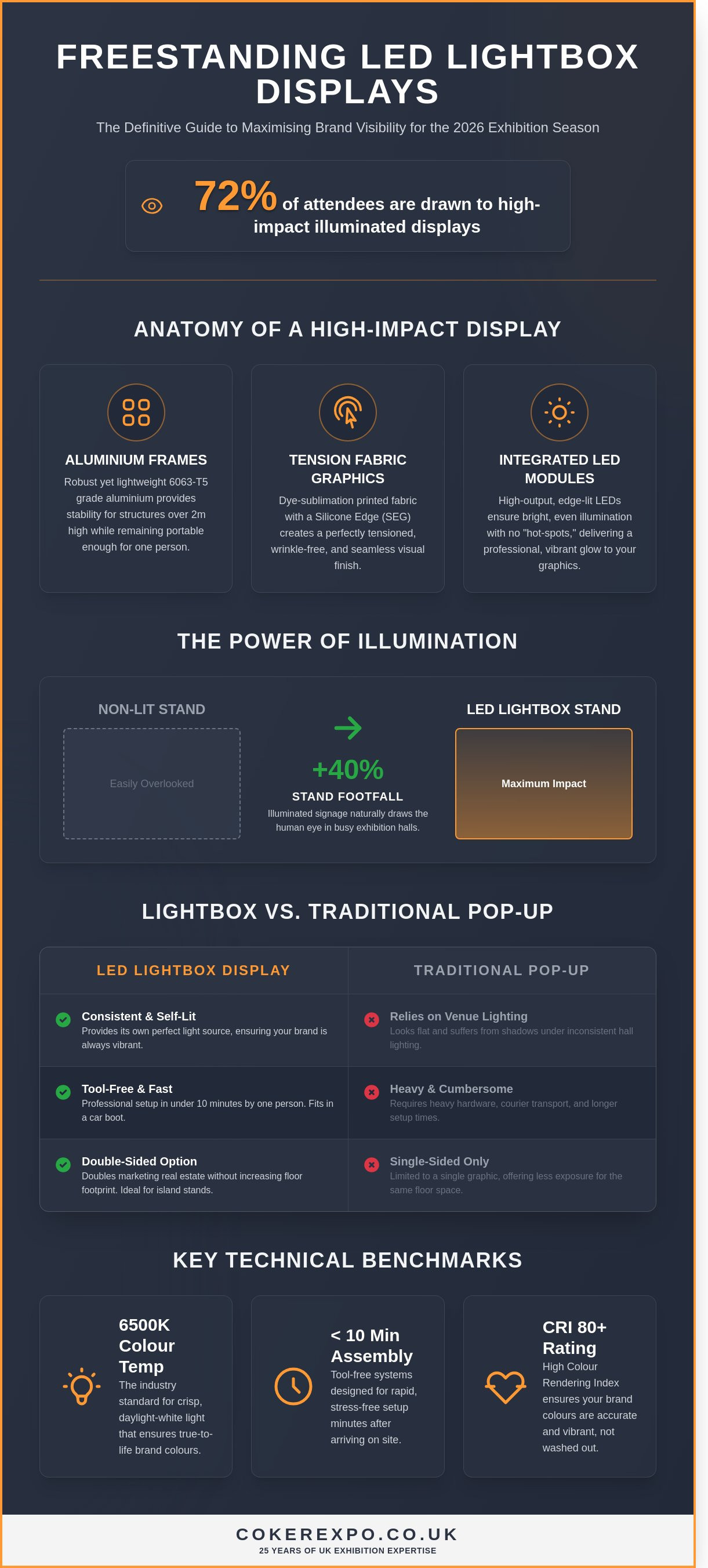
The shift from static, non-lit displays to illuminated systems is backed by clear performance metrics. Data from the International Sign Association confirms that illuminated signage can increase stand footfall by up to 40% compared to non-lit alternatives. This performance gap occurs because light naturally draws the human eye, especially in the cavernous, often dimly lit environment of a trade show hall. While permanent retail lightboxes are built for fixed installation with hard-wired electrics, portable exhibition versions focus on tool-free assembly and "plug-and-play" functionality.
These systems are engineered for the high-pressure world of event marketing. They don't require specialist electrical contractors for installation. Instead, they use simple UK three-pin plugs or 24V transformers that any staff member can manage. This practical approach ensures that your branding is live within minutes of arriving at your space.
The core components of a freestanding system
- Structural aluminium frames: Most professional systems use 6063-T5 grade aluminium. This material provides the robust stability required for a 2-metre high unit while remaining light enough for a single person to carry.
- Silicone Edge Graphics (SEG): This "push-fit" system involves sewing a thin silicone bead to the edge of a dye-sublimation fabric print. It creates a drum-tight finish that is completely tensioned and wrinkle-free.
- Integrated LED modules: These are the engine of the display. Modern units use edge-lit or backlit LEDs with a Colour Rendering Index (CRI) of 80 or higher to ensure your brand colours remain accurate and vibrant.
Why freestanding units beat traditional pop-up stands
Traditional pop-up stands often look flat and uninspiring under the harsh or inconsistent lighting of a 10-metre high exhibition ceiling. A freestanding led lightbox display provides its own light source, ensuring your message is visible from across the hall regardless of the venue's ambient lighting. The slimline profile is another major advantage. Most units are between 100mm and 120mm deep. This small footprint is essential when you're working within a compact 3x3m shell scheme where every centimetre of floor space is valuable.
Versatility is where these units truly excel. You can create double-sided displays by simply adding a second graphic to the rear channel of the frame. This doubles your marketing real estate without increasing the physical space you occupy on the floor. It's an efficient, high-impact solution that offers a much higher return on investment than a standard vinyl banner or a magnetic pop-up. You aren't just buying hardware; you're investing in a modular system that can be reconfigured or updated with new graphics for years to come.
The technical anatomy: LEDs, frames, and fabric quality
Building a high-impact freestanding led lightbox display requires more than just bright bulbs and a frame. It’s an exercise in precision engineering where every component must work in harmony to ensure a professional finish. At CokerExpo, we focus on the structural integrity of the aluminium profiles and the specific Kelvin rating of the diodes to guarantee your brand looks its best under harsh exhibition hall lighting. Selecting the wrong configuration often leads to uneven illumination or "hot-spotting," where individual LEDs are visible through the graphic, ruining the professional aesthetic.
We standardise our systems at 6500K. This colour temperature provides a crisp, daylight-white light that ensures your brand colours remain true and vibrant without shifting toward yellow or blue hues. Modern LED technology has transformed the exhibition industry by reducing heat and power consumption. Research highlighting the energy savings of LEDs confirms that these systems aren't just better for the environment; they're also more cost-effective for long-term use. For UK venues like the NEC or ExCeL, safety is paramount. We utilise 24V transformers that are more stable than 12V alternatives, ensuring your display remains cool to the touch and fully compliant with venue PAT testing requirements.
Frame depth plays a vital role in light diffusion. A slim 60mm profile is excellent for smaller, portable units, but larger installations require 100mm or 120mm depths. This extra space allows the light to spread evenly before it hits the fabric, eliminating shadows. If you're planning a bespoke stand, you can view our modular range to see how these depths integrate into larger structures.
Edge-lit vs. Back-lit: Which is right for you?
Edge-lit displays house LEDs within the top and bottom rails of the frame. This configuration allows for thinner profiles and lower costs, making it the preferred choice for standard 1x2 metre units. However, as the frame gets larger, the light struggle to reach the centre of the graphic. Back-lit displays, often called ladder lights, use rows of LEDs fixed to the rear of the frame or a backplate. These provide maximum brightness and zero shadows across the entire surface. Back-lit LEDs are essential for displays over 2 metres wide.
The science of Tension Fabric Graphics (TFS)
The fabric is the most critical element of any freestanding led lightbox display. We use dye-sublimation printing, a process where ink is bonded into the polyester fibres at 200°C. This creates a permanent, high-definition finish that won't crack or peel when the fabric is folded for transport. To manage light effectively, we use two specific types of material:
- Light-diffusing fabric: This front-facing material is engineered to scatter light evenly across the surface, preventing glare.
- Black-back liners: For single-sided displays, a block-out layer on the reverse prevents light spill and ensures your graphic remains punchy even if there's a bright light source behind the stand.
These fabrics are crease-resistant and can be machine-washed at 30°C. This durability is a hallmark of our British-made quality, ensuring your investment lasts for multiple event seasons rather than being a single-use purchase.
Evaluating your options: Single-sided vs. double-sided displays
A freestanding led lightbox display offers incredible flexibility, but your stand's position dictates the most efficient configuration. For a standard 3m x 3m shell scheme, a single-sided unit is the logical choice. You'll likely place it against a partition wall, so a second graphic remains hidden and adds unnecessary cost. However, if you've secured an island site or a space along a main walkway, a double-sided display is essential. It captures traffic from both directions, effectively doubling your brand exposure without increasing your floor space footprint.
Investing in a second graphic typically increases your total spend by approximately 18% compared to a single-sided setup. While this seems like an extra expense, the ROI comes from 360-degree visibility. Industry data suggests that LED displays in advertising significantly improve brand recall compared to non-illuminated static boards. For a double-sided unit, the internal LED ladder or perimeter lighting is already built-in. You're simply paying for the additional tension fabric print. This makes the upgrade highly cost-effective for open-plan stands where every angle is a marketing opportunity.
Weight and stability are critical factors for double-sided units. A 2m wide double-sided frame weighs about 5kg more than its single-sided counterpart due to the extra fabric and reinforced internal bracing. This added weight actually helps with stability by lowering the centre of gravity. You don't want a 2.4m tall unit wobbling when a visitor brushes past. We ensure our frames are robust enough to stay upright in busy environments while remaining easy to transport in padded carry cases.
Choosing the right size for your exhibition space
Standard widths range from 1m totems for entryways to 6m panoramic backdrops for large-scale presence. If you need something larger, modular linking allows you to connect multiple frames. Our systems use simple connector brackets to create a seamless wall of light. It's a tool-free process that saves time during the high-pressure build phase. Be mindful of UK venue regulations. Most UK exhibitions, such as those at the NEC Birmingham or ExCeL London, enforce a 2.4m height limit for freestanding structures. Always check your exhibitor manual before ordering a custom height to avoid on-site compliance issues.
Stability and safety in high-traffic areas
Safety is a non-negotiable factor in high-traffic halls. We offer two primary base designs: low-profile flat feet to minimise trip hazards and side-mounted stabilisers for extra-wide displays. Our frames are made in the UK, ensuring they meet rigorous safety standards before they even reach the venue floor. All our fabrics meet UK fire safety ratings, specifically the B1 certification required by most event organisers. For an outdoor-capable freestanding led lightbox display, we provide heavy-duty weighting systems or water-fillable bases. These are designed to withstand wind speeds up to 20mph, ensuring your brand stays visible and secure.
Maximising impact: Design, assembly, and logistics
Securing a high-quality freestanding led lightbox display is a strategic move for any marketing manager, but the hardware's effectiveness depends on how you handle the design and deployment. A poorly executed graphic or a messy setup can quickly undermine the premium feel of the illumination. Success requires a focus on technical precision from the initial design phase through to the final "click" of the frame assembly.
Backlit graphics demand a specific design approach. Unlike front-lit banners, light passes through the fabric, which can wash out weak colours. You must use high-contrast imagery and bold typography to maintain legibility from across the hall. We recommend keeping essential brand elements at least 50mm away from the edges. This "safe zone" ensures that the frame shadow or the silicone edge gasket (SEG) doesn't obscure your messaging. Avoid "busy" edges where intricate details might get lost in the perimeter of the frame. Consider these design priorities:
- Saturation: Use deep, rich colours that won't appear translucent when lit.
- Typography: Stick to sans-serif fonts for better clarity at a distance.
- Negative Space: Allow your core message room to breathe to avoid visual clutter.
Efficiency on the trade show floor is non-negotiable. Modern systems deliver a "tool-free" promise, allowing a standard 2-metre by 1-metre unit to be assembled in under 10 minutes. This speed is possible because of numbered components and intuitive locking mechanisms that snap together without the need for Allen keys or screwdrivers. Cable management is equally vital for a professional finish. Use the built-in channels within the aluminium profile to route power leads. This keeps the floor area tidy and eliminates trip hazards, ensuring your stand meets health and safety requirements without needing unsightly gaffer tape.
Transporting your kit requires the right protection. A dedicated padded carry case or a hard-shell flight case is a necessary investment. These cases protect the LEDs from vibration during transit and keep the aluminium profiles from scratching. Data from our service department shows that frames stored in bespoke cases last 45% longer than those transported loose in standard vehicles.
Preparing artwork for backlit displays
Your artwork must be high-resolution to look crisp when magnified by light. We require a minimum of 150dpi at full size for fabric prints. While many designers work in RGB, our dye-sublimation process uses a CMYK colour profile to ensure colour accuracy. To prevent banding in large areas of solid colour or soft gradients, add a subtle 2% "noise" layer in your design software. This ensures a smooth transition of light across the entire graphic surface.
Logistical planning for trade shows
When packing, always fold your fabric graphics with the printed side facing inwards. This prevents external scuffs from ruining the visual face during transit. Check your stand electrics order early; a typical LED lightbox draws between 50W and 100W, meaning a standard 1kW (1,000W) power drop can easily support a whole row of displays. Choosing a "CokerExpo" tool-free system allows your team to handle the build, saving you approximately £85 per hour in specialist contractor fees. You can browse our full range of freestanding led lightbox display options to find the right fit for your next event.
Why choose CokerExpo for your freestanding LED lightboxes?
CokerExpo has been a fixture of the UK exhibition industry since 1999. With over 25 years of experience, we've seen every shift in display technology, yet our core mission remains the same: providing hardware that survives the rigours of the real world. We call this "Practical Specialism." It means we don't just sell equipment; we manufacture and supply systems designed for the frantic pace of trade show floors where reliability is the only metric that matters. Every freestanding led lightbox display we offer is a result of this decades-long refinement process.
Operating from our dedicated Hampshire base, we maintain full control over the manufacturing process. This local presence allows us to offer bespoke sizes and custom frame configurations that many importers simply cannot match. Whether you need a standard 2-metre unit or a massive 5-metre custom wall, our workshop handles the fabrication with precision. We support our clients through every stage of the journey, from initial CAD planning and graphic design to the final on-site event management at venues like the NEC or ExCeL London.
The CokerExpo quality guarantee
Our commitment to quality is backed by technical specifications that ensure long-term value. We use high-performance LEDs with a 50,000-hour life guarantee, providing peace of mind for businesses with heavy event schedules. Every freestanding led lightbox display undergoes a rigorous testing phase in our warehouse to check for light uniformity and frame stability before it's dispatched. Because we produce in-house, we can often accommodate 48-hour turnaround times for urgent deadlines. You can see our range of dynamic lightboxes to explore the technical capabilities of our current systems.
Hire vs. Buy: Which makes sense for your business?
Deciding whether to purchase or rent depends entirely on your annual marketing strategy. For companies attending three or more shows per year, buying a lightbox often provides a full return on investment within 14 months. Ownership guarantees brand consistency and gives your team the freedom to master our tool-free assembly systems. It's a sound capital investment for long-term brand building.
For one-off product launches or massive 100-square-metre island stands, our rental services are often more logical. We provide comprehensive truss hire and lightbox rental options that allow you to scale your presence without the storage overheads or capital expenditure. This flexibility is vital for businesses testing new markets or those with a fluctuating event calendar. Our Hampshire technicians handle the logistics, ensuring your display is perfect from the moment the doors open. Contact our Hampshire team today for a custom lightbox quote to discuss which path fits your specific event goals.
We understand that marketing managers face immense pressure to deliver results under tight deadlines. That's why we prioritise clear communication and transparent lead times. We don't hide behind jargon; we provide robust, high-impact hardware that works. By choosing us, you're partnering with a British manufacturer that values craftsmanship and customer success above all else. We've spent a quarter of a century perfecting the art of the exhibition, and we're ready to put that expertise to work for your brand.
Future-Proof Your 2026 Exhibition Strategy
Investing in a freestanding led lightbox display is about more than just lighting up a room; it's about securing a robust, reusable asset for your 2026 marketing calendar. High-intensity LEDs combined with premium tension fabric graphics ensure your brand remains visible across crowded trade show floors. Since 1999, Coker Expo has refined these systems to prioritise the exhibitor's experience. We're tool-free assembly specialists, which means you can move from arrival to a fully illuminated stand in under 10 minutes without using a single spanner. It's a practical solution that eliminates the stress of technical setups.
Our UK-based manufacturing and support teams provide the reliability you need for tight event deadlines. Whether you choose a single-sided unit for a shell scheme or a double-sided display for maximum footfall, these modular systems are built to last. You'll benefit from 25 years of British craftsmanship that stands up to the rigours of constant transport and reassembly. Take control of your next event with hardware that's designed for impact and engineered for ease.
Browse our full range of freestanding LED lightboxes and find the perfect fit for your brand's growth.
Frequently Asked Questions
How long does it take to assemble a freestanding LED lightbox?
You can assemble a standard 2-metre freestanding led lightbox display in approximately 8 to 10 minutes. Our systems utilise a tool-free assembly process where aluminium frame sections simply click together using a push-fit mechanism. Once the frame's standing, it takes less than 2 minutes to tuck the silicone edge graphics into the perimeter channel for a perfect, tensioned finish.
Can I change the graphics on my LED lightbox for different events?
Yes, the graphics are fully interchangeable and you can swap them in under 5 minutes without any specialist tools. This makes the hardware a highly versatile investment for your 2024 marketing calendar. You only need to order new SEG (Silicone Edge Graphic) fabric skins for different campaigns, which saves approximately 60% of the cost compared to buying a completely new display system.
Do LED lightboxes get hot during long exhibition days?
Our lightboxes remain cool to the touch even after 12 hours of continuous operation at a trade show. We use high-efficiency 24V LED modules that convert 95% of energy into light rather than heat. This thermal management ensures your fabric graphics won't suffer from heat-related yellowing and the display remains safe in high-traffic public environments like the NEC or ExCeL London.
What happens if one of the LEDs fails in the display?
Our LED modules are rated for 50,000 hours of use, which equates to over 5 years of constant 24/7 operation. If a single diode fails, the rest of the strip continues to function so your display doesn't lose its impact. We provide a 24-month warranty on all electrical components as standard, ensuring your investment is protected against manufacturing defects.
Are these lightboxes easy to transport in a standard car?
A 1-metre wide freestanding led lightbox display packs down into a single padded carry bag measuring 120cm by 30cm by 15cm. This compact size fits easily into the boot of a standard UK hatchback, such as a Ford Focus or Volkswagen Golf. The total kit weight is typically under 12kg, making it manageable for one person to transport from the car park to the exhibition hall.
Do your fabric graphics meet UK fire safety regulations?
Every fabric graphic we print meets the BS 5867 Part 2 Type B fire safety standard, which is the mandatory requirement for UK exhibition venues. We use flame-retardant polyester that's been tested to withstand rigorous safety checks. We'll provide the necessary certification for your health and safety file, ensuring you won't face any issues during venue inspections.
Can I link multiple lightboxes together to create a larger display?
You can link any number of units together using simple metal joining clamps that cost approximately £15 per pair. These clamps pull the frames tightly together to create a seamless wall of light across your stand. This modular flexibility allows you to use three 1-metre units individually for small presentations or combined into a 3-metre back wall for larger trade show booths.
What is the difference between a standard lightbox and a dynamic lightbox?
A standard lightbox provides consistent, static illumination across the entire graphic, while a dynamic lightbox uses programmable LED tiles to create movement. Dynamic systems can run specific animation sequences or colour-changing patterns to highlight certain parts of your message. While a standard unit is a reliable workhorse, dynamic displays are proven to increase visitor dwell time by up to 45%.
Laisser un commentaire