

Display Turntables for Retail, Exhibitions & Events: The 2026 Buying Guide
With strong visual merchandising strategies capable of driving sales increases of up to 37%, a static display is no longer enough to capture attention in a competitive marketplace. Selecting the right display turntables for retail, exhibitions & events is the difference between a high-impact presentation and a logistical headache. You've likely felt that spike of anxiety when imagining a motor stalling during a live product launch or cables becoming a tangled mess on the floor. It's a common concern for decision-makers who need total reliability when the spotlight is on their brand.
This guide will help you master the technical specifications and visual strategies needed to select the perfect display turntable for your next high-impact presentation. We'll break down load capacities, explain how slip rings solve your power wiring problems, and help you calculate the exact RPM required for maximum visual impact. By the end, you'll have the knowledge to build a professional, smooth-rotating setup that safely supports your product and keeps the focus exactly where it belongs.
Key Takeaways
- Understand how rotational movement acts as a psychological trigger to increase dwell time and ensures your product is visible from every angle.
- Learn to calculate the critical difference between static and dynamic loads to ensure your display turntables for retail, exhibitions & events provide a smooth, stutter-free rotation.
- Explore versatile mounting configurations, including ceiling-mounted aerial displays that integrate seamlessly with existing lighting truss systems.
- Solve the challenge of powered display wiring by utilizing slip ring technology to maintain a professional aesthetic with completely hidden cables.
- Identify the most efficient hardware for your specific environment, from rapid-deployment battery units to heavy-duty floor-mounted plinths.
The Psychology of Motion: Why Display Turntables are Essential for Retail and Events
Human biology dictates how we perceive space. Our peripheral vision is exceptionally sensitive to motion; it's a survival trait that now serves as a powerful marketing tool. In a crowded exhibition hall or a busy high street, a static display often blends into the background. By contrast, display turntables for retail, exhibitions & events leverage this hardwired response to grab attention without being intrusive. Movement signals the brain to investigate, turning a casual passerby into an engaged prospect.
The 360-degree advantage ensures that premium products are viewed from every angle without any effort from the customer. While the history of the turntable began with simple domestic convenience, modern industrial units are precision-engineered to provide a smooth, consistent rotation. This constant motion allows viewers to appreciate the full form and function of a product, which is particularly vital for items where detail is a key selling point. It shifts the experience from passive viewing to active engagement, as the viewer stays longer to see the 'full reveal' of the rotation.
Integrating motion into your exhibition stand design creates a focal point that anchors the rest of your messaging. It isn't just about the movement itself; it's about the psychological impact of seeing a product presented as a dynamic, high-value asset. This strategy increases visitor dwell time by providing a visual narrative that a static plinth simply cannot match.
Maximising Impact in Retail Windows
Speed matters when positioning a brand. A slow rotation of 1-2 RPM is widely considered the gold standard for luxury merchandising. This deliberate pace creates a sense of elegance and allows the eye to track complex textures or the way light hits premium materials. High-end jewellery and electronics brands frequently use this technique to highlight craftsmanship that static lighting often misses. It forces a slower tempo for the viewer, increasing dwell time and brand recall.
Stand Engagement at Trade Shows
Trade shows are high-pressure environments where you have seconds to stand out from a row of uniform shell schemes. Combining display turntables for retail, exhibitions & events with exhibition lightboxes creates a multi-sensory stand that is impossible to ignore. This setup allows the product to 'sell itself' from every perspective, reducing the immediate need for floor staff to rotate or demonstrate the item manually. It ensures your most important asset is always performing, even when your team is occupied with other visitors.
Key Specifications: Matching Capacity to Your Display Requirements
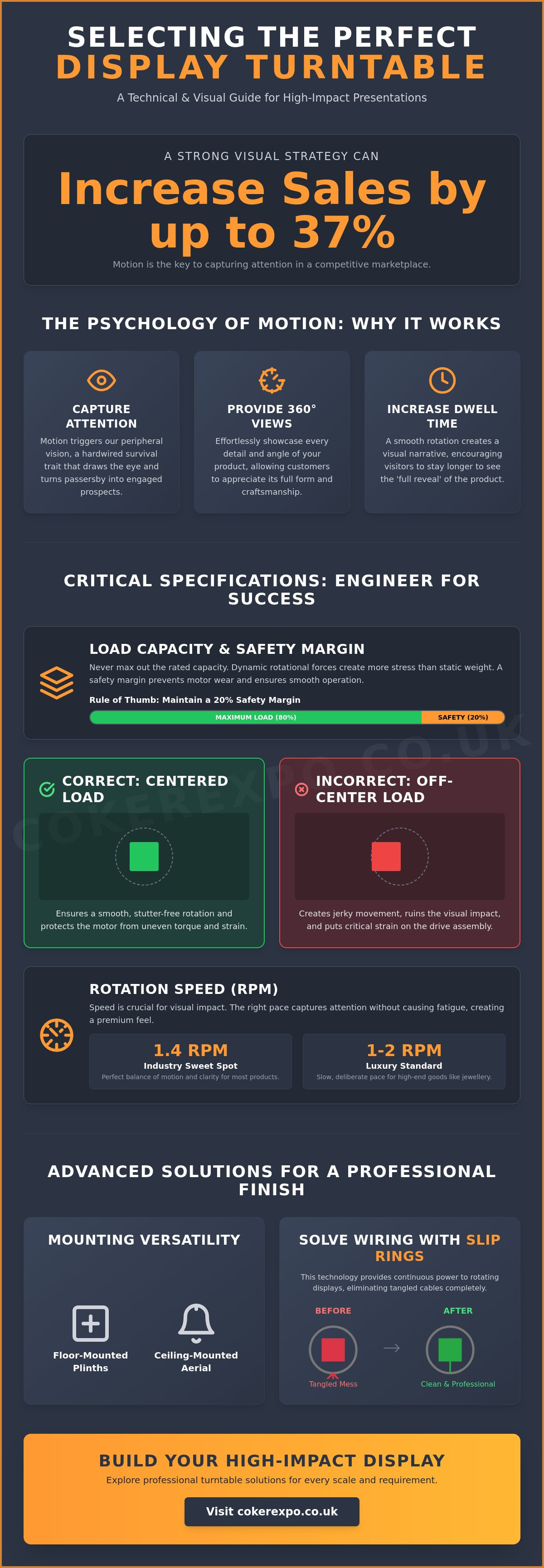
Selecting the right display turntables for retail, exhibitions & events requires a clear understanding of your product's physical footprint. A common mistake is selecting a unit based solely on its maximum weight limit without accounting for the difference between static and dynamic loads. While a turntable might safely hold a 50kg weight when stationary, the mechanical stress of initiating and maintaining rotation means you should never max out its rated capacity. We recommend leaving a 20% safety margin to prevent premature motor wear and ensure a smooth start-up.
Load centring is equally critical for a professional finish. If your product is placed off-centre, it creates uneven torque demands on the drive assembly, resulting in visible "stuttering" rotation. This jerky movement ruins the visual impact and puts unnecessary strain on the internal gears. For maximum stability, the motor's torque must be precisely calibrated to overcome the leverage created by the specific diameter of the display platform.
Speed is the final technical hurdle for most exhibitors. In professional product showcases, 1.4 RPM has become the industry standard. This speed provides a pace that is fast enough to show all angles within a visitor's typical dwell time, yet slow enough to maintain a sense of premium quality. It's the ideal balance for capturing the eye without causing visual fatigue.
Load Capacity Categories
- Lightweight (2kg - 10kg): These units, such as the T1TT and TT100 models, are specifically engineered for footwear, small electronics, and high-impact point-of-sale displays.
- Medium Duty (20kg - 100kg): This range is the workhorse of the industry. It's ideal for mannequins, large appliances, or showcasing folding display boards in a dynamic format.
- Heavy Duty (200kg - 500kg+): For furniture, motorbikes, or heavy industrial hardware, professional-grade units like the CEU5000 provide the necessary structural integrity.
If you're unsure which weight class fits your specific inventory, you can view our full range of professional display hardware to compare detailed technical data sheets.
Power Source: Battery vs. Mains
Choosing your power source often depends on the physical constraints of your venue. Battery-powered units, like the CBO40, are the best choice for remote plinths or window displays where trailing cables create a trip hazard for staff and customers. They offer rapid deployment for pop-up events but require a consistent charging schedule to avoid downtime.
Mains-powered units are essential for multi-day exhibitions where constant 24/7 rotation is required to maintain a brand presence. These systems often include a current converter. This component allows you to adapt the unit for adjustable speeds and ensure compatibility with global electrical standards, which is vital for international exhibitors who don't want to worry about local voltage differences.
Mounting Options and Advanced Features: Floor, Ceiling, and Slip Rings
The physical placement of your hardware dictates the visual narrative of your stand. Most display turntables for retail, exhibitions & events are floor-mounted, providing a stable foundation for plinths, counters, and promotional islands. This configuration is particularly effective when integrated with shell scheme graphic panels. By placing a rotating element in front of a high-quality fabric backdrop, you create a sense of depth that draws the eye away from neighbouring competitors. It transforms a standard booth into a dynamic environment where the product remains the primary focus.
For more ambitious installations, speed regulation becomes a critical tool. While standard units often have fixed speeds, using a manual regulator allows you to fine-tune the motor's pace. This level of control is essential when you need to match the rotation to specific lighting conditions or ensure that video teams can capture clear, blur-free footage of the moving product. Precision control reflects a professional setup and prevents the "fairground" look of a display that rotates too quickly for its environment.
Understanding Slip Rings and Powered Rotation
A slip ring is the technical solution to a common logistical headache: rotating an illuminated item without tangling power cables. It acts as a rotary electrical interface, allowing current to pass safely from a stationary power source to a rotating platform. If you intend to showcase a rotating lightbox or a product that requires its own internal power, a slip ring is non-negotiable. Comparing a standard model to the CSWDHG200P (which features integrated slip rings) highlights the difference; the latter allows for 360-degree rotation of powered hanging signs with zero risk of cable failure.
Ceiling Mounting Safety and Logistics
Ceiling-mounted units, such as the CSWDHG range, allow you to create "aerial theatre" by suspending products directly from truss systems. This approach frees up valuable floor space and creates a high-impact visual that is visible from across the exhibition hall. However, safety requirements for inverted use are stringent. Ceiling weight ratings are often lower than floor ratings because the motor and bearings must work against gravity. You must ensure secure attachment points and account for the "pendulum effect" caused by high airflow in large event halls, which can cause suspended displays to sway if not correctly balanced.
To ensure your next presentation is both safe and visually stunning, browse our full range of professional display turntables and mounting accessories.
Selecting Your System: Standout Turntable Solutions for Every Scale
Choosing the right hardware is a matter of matching logistical reality with visual ambition. For the majority of UK exhibitors, the "All-Rounder" range of 20kg to 50kg represents the ideal sweet spot. These units provide enough torque to handle standard retail mannequins and medium-sized appliances while remaining compact enough for easy transport and assembly. They offer the reliability needed for multi-day events without the footprint of industrial-grade machinery.
When rapid deployment is the priority, the "Portable Pro" category of battery-operated display turntables for retail, exhibitions & events is the superior choice. These units allow for quick setup in pop-up shops or temporary event spaces where power access is limited or cable management would be a safety risk. For heavy-duty requirements, such as furniture or industrial equipment, investing in an "Industrial Powerhouse" like the CEU5000 ensures maximum reliability. These 500kg+ units are built for high-load endurance and smooth, continuous operation under significant stress.
Before finalizing your selection, run through this final checklist to ensure a seamless installation:
- Power Availability: Confirm if your stand has dedicated mains power or if you require the flexibility of battery units.
- Weight Distribution: Account for the 20% safety margin to prevent motor strain and ensure the load is centred.
- Height Clearance: Ensure the total height of your product plus the turntable base fits within your plinth or shell scheme limits.
Top Recommendations from the CokerExpo Collection
- Best for Small Items: The battery-powered CBO40 (4kg) is ultra-portable and features a simple switch-operated design for instant use.
- Best for Mannequins: Our mains-powered 50kg or 100kg units provide the smooth, continuous motion required for high-end retail environments.
- Best for Hanging Signs: The CSWDHG200 (20kg) is a professional ceiling-mounted solution designed specifically for high-visibility branding from overhead truss.
Next Steps: Implementation and Support
Success involves more than just the hardware. You can easily combine your turntable with branded plinths and custom graphics to create a cohesive brand experience. To maintain peak performance, keep the ball race radial bearings clean and free of debris. This simple maintenance step ensures silent, smooth operation throughout the life of the unit. If you're ready to elevate your display, you can browse the full range of 65+ display turntables here to find the exact match for your project requirements.
Elevate Your Next Presentation with Precision Motion
Success in high-pressure environments depends on hardware that performs without fail. By understanding the physics of load centring and the psychological impact of rotational speed, you can transform a static product into a dynamic focal point. Whether you're integrating movement into a retail window or suspending a rotating sign from a truss system, the right choice of display turntables for retail, exhibitions & events ensures your brand stands out for the right reasons. Reliability isn't just a technical requirement; it's the foundation for total confidence during your live event.
Our team provides the essential infrastructure for your success. With over 65 specialized models in stock and UK-based technical support, we offer solutions that safely support everything from 2kg delicate electronics to 1500kg industrial hardware. We're here to help you navigate technical specifications and bespoke requirements with ease. Explore our collection of 65+ professional display turntables today to find the perfect system for your next high-impact project. Your vision deserves the craftsmanship and resilience of professional-grade hardware.
Frequently Asked Questions
What is the maximum weight a display turntable can hold?
Capacity varies significantly across our range, with models designed to support loads from 2kg up to 1500kg. It's vital to select a motor that matches the specific load physics of your product to ensure a smooth rotation. We always advise leaving a safety margin rather than running a unit at its absolute maximum rated capacity to preserve the life of the motor.
Can I adjust the rotation speed of my display turntable?
Yes, many professional models offer speed adjustment through the use of manual regulators or current converters. While 1.4 RPM is the industry standard for most product showcases, the ability to fine-tune the pace is essential for specific lighting conditions or video capture. This flexibility allows you to create a bespoke visual impact that matches the tempo of your brand presentation.
How long do battery-powered turntables last during an exhibition?
Runtimes depend on the load weight and the specific battery capacity, but most professional units are engineered to last a full event day on a single charge. For multi-day exhibitions, we recommend charging the units overnight or choosing mains-powered models to ensure uninterrupted 24/7 rotation. This approach eliminates the risk of a static display during peak foot traffic hours.
What is a slip ring and why do I need one for my rotating display?
A slip ring is a rotary electrical interface that allows power to pass from a stationary base to a rotating platform without tangling cables. You require this feature if your display includes internal lighting or electronic components that need constant power while in motion. It's the only safe method to maintain a professional aesthetic for powered display turntables for retail, exhibitions & events.
Are ceiling-mounted turntables safe for use in public exhibition halls?
Yes, provided the hardware is specifically rated for inverted use and securely attached to a structural truss or ceiling point. These units are designed to account for gravity and the potential for sway in high-airflow environments common in large event halls. Using professional-grade hardware ensures that your suspended display remains stable and safe for the duration of the event.
Can I use a display turntable outdoors for promotional events?
Standard display turntables are typically designed for indoor environments and must be protected from moisture and dust. If your event is outdoors, the unit should be housed within a weather-resistant plinth or used under a protective cover. Direct exposure to the elements can lead to mechanical failure or electrical hazards if the hardware isn't specifically rated for external conditions.
Einen Kommentar hinterlassen