

Lighting Truss Hire for Tradeshows: The Professional Guide to High-Impact Rigging
Your brand's footprint on the tradeshow floor is only half the battle. The real competition for attention happens ten feet above the heads of the crowd. It's a common frustration for exhibitors to invest heavily in floor graphics, only to see their stand disappear within a cavernous, poorly lit hall. Securing a professional lighting truss hire for tradeshows is the most effective way to reclaim that vertical space and dominate the visual landscape of the event. A well-engineered truss system acts as the skeletal architecture for your brand, providing the height and illumination necessary to stand out in a saturated environment.
We recognize that the logistics of rigging often feel overwhelming, especially with the recent introduction of the IEC 63494-1:2026 safety standards for electro-mechanical interfaces. You need a solution that balances high-impact branding with total regulatory compliance and structural integrity. This guide provides a practical roadmap for mastering your overhead infrastructure. We'll examine the structural advantages of industry-standard 6061-T6 aluminum alloys, break down the complexities of modern rigging regulations, and show you how to integrate lighting and fabric systems seamlessly. You'll gain the technical knowledge required to manage a hassle-free installation that draws visitors from across the hall while avoiding the hidden costs of last-minute assembly.
Key Takeaways
- Maximise hall visibility by utilising vertical space to elevate your brand above the crowded tradeshow floor.
- Choose the optimal lighting truss hire for tradeshows by evaluating the load-bearing capacity and aesthetic profile of square versus triangular aluminum systems.
- Streamline your installation process by pre-calculating working heights and power requirements against specific venue rigging regulations.
- Enhance your stand's impact by mounting large-format fabric graphics and lightboxes directly onto the truss for a fully integrated display.
The Strategic Role of Lighting Truss in Modern Tradeshow Design
A lighting truss is a modular aluminium framework designed to support heavy equipment safely and efficiently. In the context of a busy exhibition, it serves as the essential infrastructure for modern stage and event lighting. While many exhibitors focus solely on floor-level displays, professional designers understand that verticality is the most effective tool for capturing attention. A truss system allows you to lift your brand assets into the clear sightlines above the crowd, bypassing the visual noise of neighbouring stands. It's the difference between being a participant and being a landmark.
There's a significant psychological difference between an open floor space and one anchored by a truss gantry. A perimeter truss creates a defined "zone" that feels exclusive and high-end. It signals to attendees that they're entering a curated brand environment rather than just walking past a table. Whether you opt for a simple goalpost configuration for a small booth or a complex multi-level gantry for a large island site, lighting truss hire for tradeshows provides the structural foundation to transform a standard plot into a high-impact destination. These systems are incredibly versatile; they can be scaled up or down to match your exact floor dimensions, ensuring your setup always looks intentional and professional.
Maximising Stand Visibility and Footfall
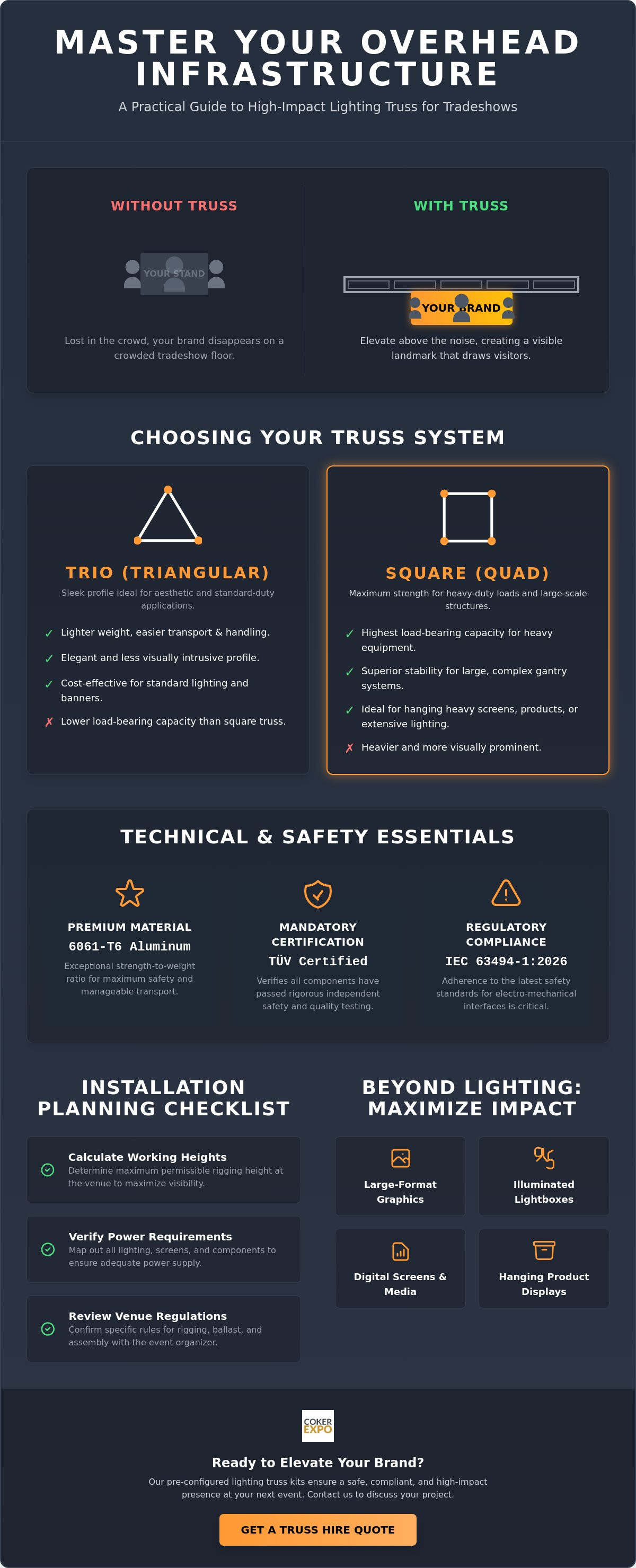
Visibility starts at the hall entrance. When visitors first scan the room, they look for landmarks to orient themselves. A truss system creates a high-level anchor point for your presence. By mounting illuminated logos or large-format banners at the maximum permissible rigging height, you ensure your brand is visible from every aisle. This overhead presence acts as a beacon, guiding footfall toward your stand before visitors even reach your specific row. It effectively expands your branding footprint without requiring additional, expensive floor space.
Beyond Lighting: Structural Creative Uses
The utility of a truss extends far beyond supporting lamps. These systems are engineered from high-grade aluminium alloys, allowing them to support significant weight. This makes them ideal for hanging heavy product prototypes, digital screens, or complex aerial signage that would be impossible to secure to a standard shell scheme. When you integrate these structural elements into your broader exhibition stand design, the truss becomes a functional part of the aesthetic. It can be used to create internal rooms for private consultations or to support tension fabric systems that wrap the entire framework in seamless brand graphics, creating a cohesive and immersive environment.
Technical Essentials: Understanding Truss Types and Safety Standards
Selecting the right hardware is a matter of structural necessity rather than just aesthetics. Professional lighting truss hire for tradeshows relies on high-performance aluminium alloys, typically 6061-T6 or 6082-T6. These materials are chosen for their exceptional strength-to-weight ratio, ensuring that the framework remains manageable for transport while providing the rigidity required for overhead suspension. Every component should carry TUV certification, which verifies that the equipment has undergone rigorous independent testing for safety and quality. When you're dealing with overhead loads in a public space, using uncertified or generic hardware is a risk that decision-makers cannot afford to take.
Stability is the first priority for any floor-standing gantry. This is achieved through a combination of heavy-duty base plates and, where necessary, additional ballast or weighting. A properly engineered system uses load-bearing calculations to account for the "tipping point" of the structure, especially when supporting offset loads like cantilevered monitors or heavy lighting fixtures. For those planning a complex layout, selecting a pre-configured lighting truss kit ensures that all connectors and spacers are compatible, significantly reducing the risk of assembly errors during the high-pressure build phase of an event.
Trio vs. Square Truss: Which Should You Hire?
The choice between Trio (triangular) and Square (quad) truss depends on your specific payload and visual goals. Trio truss is often preferred for its sleek profile and lighter weight. It's an excellent choice for supporting standard lighting packages or lightweight fabric banners where the overall aesthetic needs to remain minimalist. However, if your stand design incorporates heavy LED video walls or massive overhead signage, Square truss is the industry standard. Its four-point construction provides maximum torsional rigidity and a significantly higher load-bearing capacity, making it the safer investment for complex, heavy-duty rigging.
Rigging Safety and UK Regulations
Compliance is a legal requirement, not an optional extra. In the UK, all overhead structures must adhere to the Lifting Operations and Lifting Equipment Regulations (LOLER). This involves regular inspections and the use of certified lifting accessories. While international standards like the OSHA safety standards for rigging provide a global benchmark for equipment integrity, local venue rules often demand additional safeguards. One critical requirement is the use of secondary safety bonds. These steel wire ropes act as a redundant fail-safe for every piece of suspended equipment, ensuring that even if a primary clamp fails, the hardware remains securely attached to the truss.
Planning Your Truss Layout: Logistics, Height, and Power
Successful planning begins with a precise translation of your floor plan into a three-dimensional layout. When you book a 3m x 4m stand, your gantry must be engineered to sit comfortably within these boundaries. It's a mistake to assume that a 4m truss length will fit a 4m space without accounting for base plate footprints or the thickness of the uprights. Professional lighting truss hire for tradeshows involves selecting kits designed specifically for these standard exhibition plots, ensuring you don't encroach on neighbouring stands or public aisles. This meticulous approach prevents last-minute adjustments that can delay your build.
Height management is equally critical. You must distinguish between the "total height" of the structure and the "working height." The total height must clear the venue's lowest obstructions, such as air conditioning ducts or fire sprinklers. The working height is the actual clearance beneath the horizontal beams, which dictates the placement of your furniture, counters, and staff. Most venues enforce strict height limits, often capped at 4m or 6m. Exceeding these without prior written permission can lead to a forced dismantle during the build phase. You can streamline your setup by choosing a pre-configured lighting truss kit that is already optimised for these standard venue restrictions.
Cable management is the final detail that separates an amateur setup from a professional one. High-impact rigging often requires complex looms for power and data. You should use the internal framework of the truss or discreet cable ties to hide wiring, preventing a cluttered appearance that detracts from your brand's aesthetic. Coordinating with the venue's electrical team early ensures that overhead power drops align perfectly with your truss uprights, making the entire system self-contained and clean.
Venue Liaison and Floor Management
You must determine whether your stand requires a self-supporting ground-support system or can utilise the venue's overhead rigging points. Ground-support systems are often more cost-effective as they avoid expensive venue rigging fees and the need for specialized hoist operators. However, they do consume a small portion of your floor space for the uprights and base plates. Always verify your footprint against the hall's fire exit routes to ensure your base plates don't create a trip hazard in the aisles.
Efficient Assembly and Transport
Speed is the primary requirement during a tradeshow move-in. Professional hire packages arrive in wheeled flight cases, allowing for rapid transport from the loading bay to your stand location. For exhibitors who need to transport and install heavy machinery or large industrial components alongside their display, Silver Knight Haulage & Machineries Ltd provides specialist logistics to ensure everything is positioned correctly. Modern systems use conical couplers rather than traditional nut-and-bolt sets. This "spigot and pin" method allows for a much faster assembly time, typically taking two people less than 60 minutes to construct a standard 6m x 4m gantry. This efficiency allows your team to focus on the more intricate tasks of product display and graphic installation.
Maximising Brand Impact: Integrating Graphics and Lightboxes
The structural integrity of your gantry is only as valuable as the brand impact it supports. Once the framework is secure, the focus shifts to the visual layer. Professional lighting truss hire for tradeshows provides a robust mounting point for large-format graphics that would otherwise require expensive custom-built walls. You can attach high-tension banners directly to the aluminium tubes using heavy-duty clips or bungee systems, ensuring your brand message is perfectly taut and professional. To soften the industrial aesthetic of the metal, many exhibitors use "scrims" or fabric sleeves. These fire-retardant fabric covers slide over the truss legs, creating a clean, monolithic look that blends seamlessly with the rest of your stand furniture.
Luminosity is the final component of a high-impact stand. By integrating exhibition lightboxes into your truss layout, you create a high-intensity anchor that is visible even in the most brightly lit halls. These lightboxes can be suspended within the truss frame to create a floating effect or mounted to the uprights to provide eye-level illumination. Correct positioning of LED track lighting is essential here; lights should be angled to eliminate shadows on your graphics and products, ensuring every inch of your stand feels open and inviting.
Synergy with Tension Fabric Systems (TFS)
Tension Fabric Systems (TFS) allow you to wrap large areas of your truss in seamless, high-definition graphics. This approach is particularly effective for creating "halo" banners, which are circular or square structures suspended from the top of the gantry. These overhead beacons provide 360-degree visibility, ensuring your logo is seen from every possible approach angle. Tension Fabric Systems (TFS) and truss truss work together to create a custom-build feel that combines structural rigidity with seamless, high-definition branding. This combination allows you to build internal "rooms" or private meeting zones that feel like permanent architecture rather than a temporary rental.
Professional Exhibition Lighting Techniques
Effective lighting design requires a balance between "wash" and "spot" techniques. Wash lighting uses wide-angle LED bars mounted to the truss to flood the entire stand with a consistent, even light, removing dark corners. Spot lighting, conversely, uses narrow beams to highlight specific products or key brand messages. Modern LED bars are the preferred choice for truss mounting because they're lightweight, energy-efficient, and produce very little heat, which is vital for the comfort of your staff and visitors. Before the hall opens, use this final checklist to ensure your setup is optimised:
- Check that all light fixtures are securely double-bonded with safety wires.
- Verify that lightboxes are powered and all LED segments are functioning.
- Adjust spot lamps to ensure no glare is directed into the eyes of visitors in the aisles.
- Ensure all fabric graphics are tensioned correctly with no visible ripples.
- Confirm that all power cables are neatly tucked within the truss or hidden by scrims.
Elevate Your Next Exhibition Presence
Transitioning from a standard floor-level display to a multi-dimensional brand environment is a strategic investment in visibility. By mastering the technical requirements of aluminium grades and the logistics of venue rigging, you ensure your stand is both a visual landmark and a compliant structure. Integrating high-performance illumination and tension fabric systems transforms the industrial framework into a sophisticated platform for your brand. This combination of height and luminosity is what captures attention in a crowded hall and drives significant footfall to your space.
Securing a reliable lighting truss hire for tradeshows shouldn't be a source of logistical stress. We bring over 25 years of UK exhibition experience to every project, providing pre-configured kits delivered in protective wheeled cases for rapid assembly. With national delivery and optional event management support, we handle the essential infrastructure so you can focus on your visitors. View our professional lighting truss hire kits for your next tradeshow and build your presence with total confidence.
Frequently Asked Questions
Do I need a professional rigger to set up a hired lighting truss?
You don't always need a specialist rigger for simple, ground-supported kits. These systems are designed for rapid assembly by exhibition staff using intuitive conical couplers. However, any suspended or overhead rigging that attaches directly to the venue's ceiling structure must be installed by a qualified professional. This ensures total compliance with LOLER and the latest safety benchmarks, such as the IEC 63494-1:2026 standard for electro-mechanical interfaces.
What is the difference between ground-supported and suspended truss?
Ground-supported truss stands on its own legs and heavy-duty base plates. It's a self-contained structure that doesn't require any attachment to the building. Suspended truss is hung from the ceiling using motorized or manual hoists. While suspended systems free up valuable floor space, ground-support is often more cost-effective for lighting truss hire for tradeshows because it avoids expensive venue rigging fees and specialized hoist hire.
Can I attach heavy LED screens to a standard exhibition gantry?
You can attach LED screens, but you must use square truss for its superior torsional rigidity. Triangular truss is generally insufficient for the heavy, offset weight of digital displays. You should always verify your total equipment weight against the manufacturer’s load chart. If your screen is particularly large, you'll likely need a heavy-duty square aluminum truss made from 6061-T6 alloy to ensure the structure remains stable.
How much weight can a typical 3m or 4m aluminium truss section hold?
A standard square aluminum truss section can typically support several hundred kilograms across a 4m span. However, the exact capacity depends on whether the weight is a single "point" load or a "distributed" load across the beam. You must consult the specific load-bearing table for your kit before assembly. Professional hire kits include these technical specifications to ensure your setup stays well within safe operating limits.
Are there standard height restrictions for truss in UK exhibition centres?
Most UK venues enforce a standard height limit of 4m for smaller stands and up to 6m for larger island sites. Locations like the NEC or ExCeL have specific "working height" rules that include any suspended signage or lighting. You should always check the exhibitor manual for your specific hall. Exceeding these limits without prior written approval can lead to a safety inspector halting your build on-site.
Is it better to hire or buy a lighting truss for annual tradeshows?
Hiring is generally the more practical choice for most businesses. Lighting truss hire for tradeshows removes the burden of long-term storage, transport logistics, and mandatory annual safety inspections. When you hire, you receive certified, TUV-tested hardware that's maintained to professional standards. It also allows you to scale your stand size up or down for different events without requiring a massive capital investment in fixed assets.
Einen Kommentar hinterlassen