

Event lighting truss hire in Hampshire
Your event's overhead infrastructure is the physical backbone of your brand's credibility. When you're responsible for suspended AV equipment and complex lighting rigs, the margin for error is nonexistent. We know the logistical stress of rigging safety and venue compliance can quickly overshadow your creative vision. Securing a reliable lighting truss hire Hampshire service isn't just about renting hardware; it's about ensuring structural integrity and total peace of mind for your team and your visitors.
This article provides the technical clarity you need to manage high-impact event structures without the typical assembly headaches. We'll cover the essential safety frameworks, including LOLER and PUWER regulations, while exploring how modular aluminium systems reduce transport complexity. You'll learn how to balance load-bearing requirements with aesthetic design to create a professional environment that stays secure from the first build to the final breakdown. This guide offers a clear roadmap for a seamless, safe, and visually commanding event presence.
Key Takeaways
- Understand how modular aluminium structures provide the necessary load-bearing capacity for high-end AV equipment and spatial definition.
- Learn to select between Ladder, Triangular, and Square truss profiles based on your specific span requirements and weight distribution.
- Master essential UK safety protocols for lighting truss hire Hampshire, including the "Secondary Safety" rule and the legal necessity of competent person supervision.
- Discover how integrating structural truss with professional exhibition stand design creates a seamless, high-impact environment that meets venue regulations.
- Streamline your event logistics by choosing lightweight, modular systems that simplify transport and speed up on-site assembly.
Understanding the Utility of Lighting Truss for Event Infrastructure
Professional event infrastructure relies on a robust foundation that balances structural engineering with aesthetic flexibility. A lighting truss is a modular aluminium structure specifically engineered for high load-bearing capacity. While often associated with concert stages, its role in the B2B exhibition sector is far more diverse. It serves as the essential skeleton for supporting heavy AV equipment, suspending large-format graphics, and defining spatial boundaries within a busy hall. For many businesses, securing a reliable lighting truss hire Hampshire service is the first step in transforming a flat floor space into a multi-dimensional brand experience.
The industry has seen a significant shift from purely functional rigging toward what we call "truss architecture." Modern stands no longer treat truss as a hidden necessity. Instead, they integrate it into the stand's visual identity. By Understanding Stage Lighting and its structural demands, designers can use these aluminium frames to create immersive environments that draw the eye upward, maximizing a brand's vertical footprint. This approach is particularly effective for suspending lighting truss hire Hampshire systems that must safely support both technical hardware and high-impact branding elements.
The Anatomy of a Professional Truss System
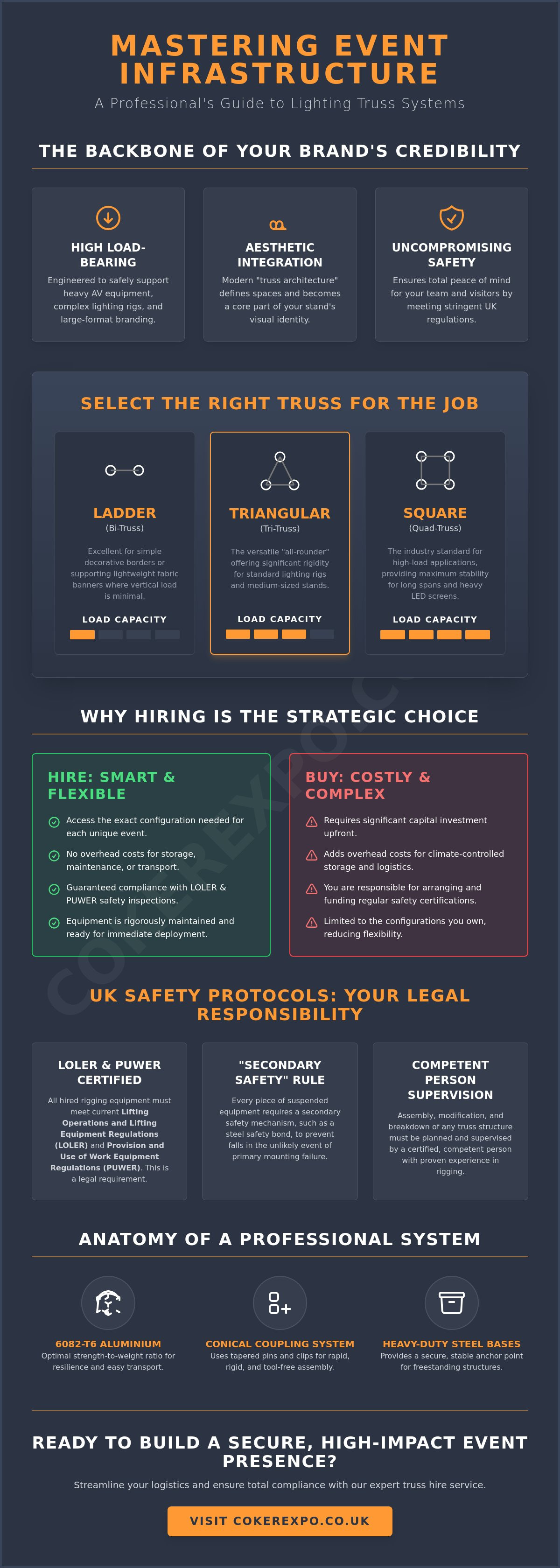
Quality truss systems are typically manufactured from 6082-T6 aluminium alloy. This specific grade provides an optimal strength-to-weight ratio, ensuring the structure is light enough for easy transport but resilient enough to handle significant overhead loads. Assembly speed is managed through a conical coupling system. This design uses tapered pins and clips to create a rigid, seamless connection between sections without the need for complex tools. For freestanding structures, heavy-duty steel base plates are used to ensure stability on varied venue surfaces, providing a secure anchor point for the entire rig.
Why Hire is the Strategic Choice for UK Exhibitors
Choosing to hire rather than purchase trussing is a pragmatic business decision for most exhibitors. Aluminium sections are bulky and require climate-controlled storage to prevent oxidation and damage, which adds significant overhead costs. Hiring allows you to access the exact configuration needed for a specific event, whether you're building a compact 4m x 3m stand or a sprawling 8m x 6m pavilion. Most importantly, hire equipment is subject to rigorous maintenance. Every component provided through professional lighting truss hire Hampshire channels must meet current LOLER and PUWER safety inspections. This ensures your equipment is fully compliant with UK health and safety laws, removing the burden of inspection and certification from your internal team.
Selecting the Right Truss Configuration for Your Exhibition Stand
Choosing the correct configuration for your stand is a technical decision that dictates both the safety of your rig and the visual impact of your branding. While many exhibitors focus solely on the dimensions of their footprint, the structural profile of the aluminium itself determines how much weight you can safely suspend. Professional lighting truss hire Hampshire services provide access to various profiles, each suited to specific mechanical demands and spatial requirements. It's essential to match the hardware to your equipment list to avoid structural overreach.
Comparing Ladder, Triangular, and Square Truss
- Ladder Truss (Bi-Truss): This profile consists of two main tubes. It's an excellent choice for simple decorative borders or supporting lightweight fabric banners where vertical load is minimal. It's the most compact option for transport and storage.
- Triangular Truss (Tri-Truss): Often considered the versatile "all-rounder," the triangular profile offers significantly more rigidity than ladder truss. It's ideal for standard lighting rigs and medium-sized stands. Its shape allows sections to nest together, which optimizes vehicle space during logistics.
- Square Truss (Quad-Truss): As the industry standard for high-load applications, square truss provides maximum stability. If your stand design requires long horizontal spans without central support legs, or if you're suspending heavy LED screens, this is the necessary choice for professional environments.
Calculating Span and Load Capacity
Structural integrity depends on understanding the relationship between span length and load distribution. As the distance between support points increases, the weight capacity of the aluminium decreases. You must distinguish between a "Point Load," such as a single heavy projector, and a "Uniformly Distributed Load" (UDL), like a series of par cans spaced evenly along a run. Failing to calculate these values correctly leads to "deflection," or visible sagging, which compromises safety and venue compliance. Adhering to professional standards for live event riggers ensures that every component is used within its engineered limits.
Beyond the horizontal rig, consider the aesthetic finish. Natural silver aluminium is the standard, but powder-coated black finishes are increasingly popular for high-end tech environments where the rigging should blend into the background. For a more dynamic setup, vertical "Truss Plinths" allow you to mount moving head lights at eye level, creating a layered lighting effect that draws visitors into your space. If you're unsure which profile fits your equipment list, our team can help you select the right lighting truss hire Hampshire package for your next exhibition.
Safety Protocols and Rigging Standards for UK Events
Rigging safety is the most critical aspect of any event build. When you utilize lighting truss hire Hampshire, you aren't just renting metal; you're investing in a structural system that must protect staff and attendees. The primary concern for any event manager is the risk of structural failure. This is why UK law mandates that a "competent person" must supervise all overhead rigging activities. This individual ensures that load calculations are accurate and that the assembly strictly follows manufacturer specifications to maintain total structural integrity.
One non-negotiable industry standard is the "Secondary Safety" protocol. Every piece of equipment, from moving heads to speakers, must have a secondary safety bond or wire. This steel cable acts as a fail-safe; it ensures that if the primary clamp or coupler fails, the item remains securely suspended. For many Hampshire venues where ceiling height or roof loading capacity is restricted, ground support systems are the preferred solution. Unlike "flown" structures suspended from the roof, ground support rigs rely on heavy steel base plates and structural ballast to maintain stability. Understanding floor loading limits is essential to prevent damage to the venue floor while ensuring the rig remains perfectly upright throughout the event.
A 5-Step Rigging Safety Checklist
- Step 1: Verify the total weight of all suspended items, including lights, cables, and banners, against the specific truss profile's load table.
- Step 2: Inspect all couplers, pins, and R-clips for signs of wear, hairline cracks, or deformation before beginning the assembly.
- Step 3: Ensure base plates are correctly sized and weighted for the height and span of the structure, particularly for freestanding stands.
- Step 4: Use a calibrated torque wrench for any bolted connections to ensure they meet the manufacturer's specified tension.
- Step 5: Conduct a final visual inspection of all safety bonds once the rig is raised to its working height.
Venue Compliance and Risk Assessments
Navigating the "Site Rules" of major UK venues like the NEC, ExCeL, or Olympia requires meticulous documentation. You must provide a comprehensive Method Statement and Risk Assessment (RAMS) alongside proof of Public Liability Insurance. For bespoke or complex builds that deviate from standard configurations, a Structural Engineer’s report is often a mandatory requirement for venue approval. If you need assistance with compliance or technical documentation, you can consult our team for professional lighting truss hire advice and support to ensure your next event is both safe and compliant.
Streamlining Your Event Logistics with CokerExpo
Managing the physical infrastructure of an exhibition requires more than just hardware; it demands a logistical partner who understands the pressure of build days. CokerExpo operates as a specialist provider of lighting truss hire Hampshire and across the UK. We provide a standard 5-day hire window as part of our core service. This timeframe allows your team ample opportunity for a controlled setup and a stress-free breakdown, eliminating the frantic rush often associated with short-term rentals. Our "Truss Truss" philosophy focuses on providing structures that are as simple to assemble as they are structurally resilient, ensuring your staff can focus on attendee engagement rather than struggling with complex tools.
Beyond the Aluminium: Complete Stand Solutions
A professional stand is a cohesive unit where structure and branding work in tandem. By integrating TFS tension fabric systems directly into the truss frame, you create seamless, large-format graphics that hide the mechanical components. You can further enhance this draw by adding dynamic lightboxes to the structure, ensuring your brand remains visible from across the hall. To complete the attendee journey, we offer a range of promotional counters and branded plinths. These elements turn a basic rig into a high-impact exhibition stand design that functions as a professional business environment.
Expert Support from Hook, Hampshire to Nationwide
Our operations are based in Hook, Hampshire, allowing our team to manage national logistics with precision. We understand the tight deadlines of the event industry and prioritize speed of fulfillment for every project. Beyond equipment supply, our event management and planning services are available to assist with complex rigging layouts and venue approvals. We act as your knowledgeable partner, providing the essential infrastructure for your success. It's about more than just a rental; it's about total reliability. Contact CokerExpo for a bespoke truss hire quote today to secure reliable, professional hardware for your next event.
Securing Your Event's Infrastructure for Maximum Impact
A professional event structure is more than just a frame; it's the mechanical foundation of your brand's presence. By selecting the correct profile, whether triangular or square, and adhering to strict UK safety protocols like the secondary safety rule, you eliminate the risks associated with overhead rigging. Our lighting truss hire Hampshire service provides access to industry-standard 50mm aluminium systems designed for rapid assembly and total structural reliability. This allows your team to focus on delivering a high-impact experience rather than managing logistical bottlenecks.
With over 25 years of event infrastructure expertise, we provide the technical knowledge and comprehensive event management support required for complex builds. We've designed our systems to be as resilient as they are easy to transport, ensuring a seamless transition from build-up to breakdown. Don't leave your structural integrity to chance. Explore Professional Lighting Truss Hire Options to secure a robust, compliant, and visually striking skeleton for your next exhibition or live event. We're ready to help you build something exceptional.
Frequently Asked Questions
How much does it cost to hire a lighting truss for a standard exhibition stand?
Pricing for lighting truss hire Hampshire depends on the complexity of your configuration and the duration of the event. A 5-day hire for a compact 5.5m x 4m footprint is priced differently than a large-scale 8m x 5m pavilion rig. Additional components like LCD mounts, specialized corners, and heavy-duty base plates also influence the final quote. We provide bespoke pricing based on your specific equipment list and logistical requirements to ensure you only pay for the infrastructure you need.
Do I need a professional rigger to set up a hired truss system?
UK health and safety regulations require a competent person to supervise any overhead rigging activity. While modular aluminium systems are engineered for straightforward assembly, professional supervision ensures that load calculations are accurate and that every light has a secondary safety bond. This expertise is essential for venue compliance and public safety. Having a professional oversee the build-up guarantees that the structure meets all LOLER and PUWER standards before the event opens to the public.
What is the difference between 35mm and 50mm diameter truss tubes?
The 50mm diameter tube is the industry standard for professional exhibition rigging, offering significantly higher load-bearing capacity and resilience. It's compatible with a vast range of standard clamps and AV hardware. 35mm tubes are typically reserved for lightweight decorative borders or small retail displays where heavy equipment isn't required. For a secure lighting truss hire Hampshire solution that can safely support moving heads and large banners, the 50mm system is the necessary choice for structural integrity.
Can I hang heavy LED video walls from a standard lighting truss?
You can suspend LED video walls, but you must use a high-capacity Square (Quad) truss profile to handle the significant weight. LED panels exert a high "Point Load" that can quickly exceed the limits of lighter triangular systems. It's vital to calculate the total weight of the panels and cabling against the manufacturer’s load tables for your specific span. In many cases, a ground-support system with weighted base plates is the most stable method for supporting these heavy visual elements.
What is the maximum span a truss can reach without needing middle support legs?
The maximum span varies based on the truss profile and the weight of the load it's carrying. A heavy-duty square truss can often span 10 to 12 meters for lightweight banners, but this distance decreases as you add heavy AV equipment. Exceeding the safe span causes deflection, or sagging, which compromises the structure's stability. Always refer to the specific load-to-span ratio tables provided with your hire equipment to ensure the rig remains within its safe engineered limits.
Are there specific fire safety regulations for banners attached to a truss?
All fabric graphics and banners attached to your structure must be fire-retardant to satisfy UK venue regulations. Materials must typically meet B1 or M1 fire safety standards, and you'll need to provide a valid fire certificate during the risk assessment process. Venues like the NEC or ExCeL won't permit the use of non-certified textiles that could pose a fire risk. Ensuring your branding materials are compliant is a mandatory step in securing approval for your stand design.
Einen Kommentar hinterlassen