

Aluminium Truss Weight Capacity Guide: Safe Loading for Exhibitions
Imagine standing beneath a 6 metre gantry span at the NEC Birmingham, only to realize your new 4K LED screens and high output lighting rig exceed the manufacturer's point load limit by 15%. It is a high pressure scenario that no marketing manager wants to face during a build. You understand that a visually impactful stand is only as good as its structural integrity. Meeting the rigorous health and safety standards of UK venues is non negotiable for any professional brand.
This aluminium truss weight capacity guide provides the technical framework you need to calculate equipment weight and choose between ladder, triangular, or quad truss systems with total confidence. We've simplified the process of reading manufacturer load tables so you can focus on the end result. We will break down the crucial differences between point and distributed loads while clarifying the UK safety margins that keep your exhibition stand robust and secure.
Key Takeaways
- Understand the critical distinction between safe operating limits and structural failure to ensure your exhibition stand remains secure and compliant.
- Learn to differentiate between Uniformly Distributed Loads (UDL) and Point Loads to correctly position heavy equipment like LED screens and lighting.
- Discover how truss geometry and profile selection dictate the specific load-bearing limits of your gantry system.
- Master the "Plan, Check, Verify" rigging protocol to account for environmental factors like indoor draughts and floor stability at UK venues.
- Utilise this aluminium truss weight capacity guide to confidently integrate high-impact displays and counters into a robust, professional stand design.
Understanding Aluminium Truss Weight Capacity and Safety
Load capacity defines the maximum weight an aluminium truss span can support before structural compromise occurs. This aluminium truss weight capacity guide focuses on the 6082-T6 structural alloy, which is the benchmark for high-quality UK exhibition gantries. This material offers an exceptional strength-to-weight ratio; it's roughly 66% lighter than steel while maintaining the integrity needed for heavy rigging. Before you begin planning your stand, it's essential to understand What is a Truss? and how its triangular engineering principles ensure stability under pressure. Aluminium is also naturally resistant to corrosion, making it a durable investment for repeated use across different UK event environments.
In the UK, safety is governed by manufacturer-certified load tables that provide specific data for point loads and uniformly distributed loads (UDL). These tables aren't just suggestions; they're critical documents that ensure your installation complies with the Construction (Design and Management) Regulations 2015. You must always refer to the specific load table provided for your truss model, as capacity varies significantly based on the span length and the tube diameter.
The Consequences of Overloading
Exceeding certified limits leads to structural deflection. Deflection is the degree to which a structural element is displaced under a load. While a small amount of flex is expected in any metal structure, visible bending is a critical warning sign that the metal is reaching its yield point. Overloading doesn't just risk hardware damage; it compromises public safety in high-traffic areas. UK exhibition venues, such as Birmingham’s NEC or London’s ExCeL, require strict compliance with health and safety regulations. If a floor manager suspects your structure is overloaded, they have the authority to shut down your stand until a structural engineer verifies the setup.
Dead Load vs. Live Load in Exhibitions
Safe rigging requires a clear distinction between different types of weight. The Dead Load includes all permanent hardware that stays on the structure throughout the event. This covers the weight of the truss itself and fixed assets like TFS tension fabric systems or integrated shelving. You must calculate these weights precisely using the manufacturer's spec sheets.
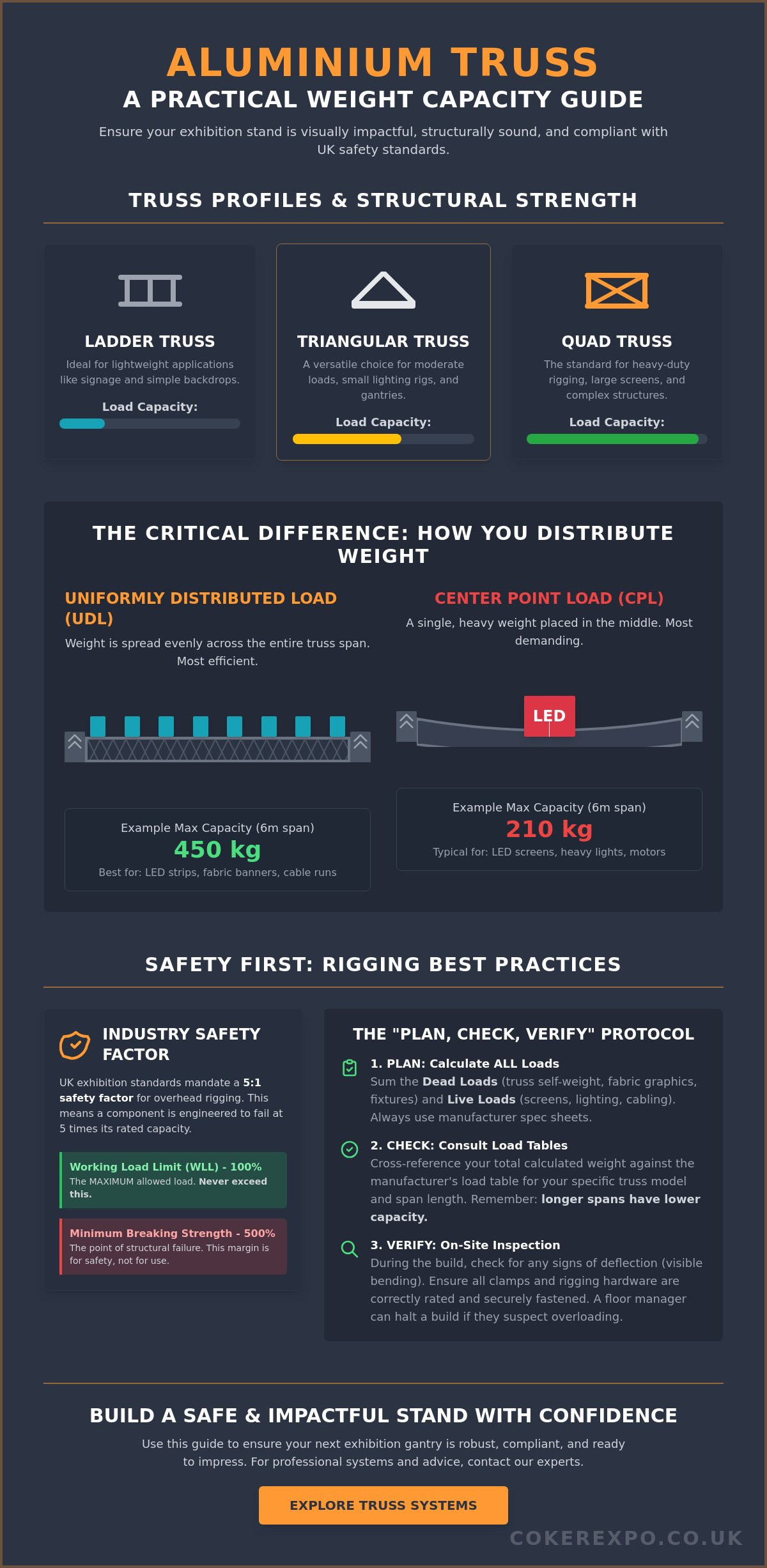
Live Loads refer to temporary or dynamic forces. In an exhibition context, this includes heavy cabling, hoist motors, and large-format branding elements added during the build. To account for unforeseen stress or minor installation errors, the industry relies on "Safety Factors," typically 5:1 or 10:1 for overhead rigging. A 5:1 safety factor means the component is engineered to fail at five times its rated load, but you must never intentionally exceed the rated 1:1 capacity. Using this aluminium truss weight capacity guide ensures you maintain these margins, keeping your staff and the public safe while delivering a high-impact display.
Types of Truss Loads: UDL vs. Point Loads
Understanding your aluminium truss weight capacity guide starts with one simple truth: the way you distribute weight is just as critical as the total mass itself. A truss that safely supports 400kg of LED tape might buckle under a 200kg motor if it's positioned incorrectly. To keep your exhibition stand safe, you need to distinguish between how different loads affect the structural integrity of the aluminium.
Uniformly Distributed Load (UDL) refers to weight spread evenly across the entire span. This is the most efficient way to load a truss and is the standard configuration for hanging long tension fabric banners or continuous LED strips. Because the weight is shared across every centimetre of the span, the truss can handle its maximum rated capacity without excessive deflection.
Center Point Load (CPL) is the most demanding configuration you'll encounter. This involves placing a single, heavy asset directly in the middle of a span. It creates a concentrated stress point that forces the metal to work much harder. For more complex rigs involving multiple screens or projectors, professionals use Third-Point or Quarter-Point calculations to manage several hanging assets across the beam while maintaining a safe equilibrium.
How to Read a Truss Load Table
Every professional truss system comes with a load table that lists span length against allowable weight. You'll see that as the span increases, the weight capacity drops significantly. It's also vital to account for "Self-Weight." If your 3m section of truss weighs 18kg, you must subtract that mass from the table's total capacity before adding your equipment. To maintain high safety levels, ensure your rigging hardware aligns with OSHA Rigging Safety Standards to prevent component failure. Load tables assume the truss is supported at both ends unless specified as a cantilever.
Comparing Loading Scenarios
The difference between UDL and CPL is stark. In almost every engineering specification, the CPL rating is roughly 50% of the total UDL capacity. This is because a central load exerts double the bending moment on the aluminium tubes compared to a distributed load.
| Span Length | UDL Capacity (kg) | CPL Capacity (kg) |
|---|---|---|
| 3 Metres | ~600kg | ~300kg |
Think about this in practical terms for your next show. Hanging a single, heavy lightbox directly from the centre of a crossbeam is far more taxing on the system than hanging a row of ten spotlights spaced 30cm apart. If you're unsure about your specific configuration, you can always consult with our team at Coker Expo to verify your calculations before the build begins.
Truss Profiles and Their Structural Strength
The geometry of a truss system is the primary factor in determining its load-bearing potential. While the material remains constant, the arrangement of the chords and bracing determines how the structure distributes tension and compression. This aluminium truss weight capacity guide highlights that choosing the wrong profile can lead to structural failure, even if the material grade is high. Engineering physics dictates that the more points of contact and planes of bracing a truss has, the more resistant it is to deflection and twisting.
- Ladder Truss: This consists of two main chords. It is a lightweight, flat solution perfect for mounting light banners or simple aesthetic framing. It lacks the lateral stability required for heavy rigging.
- Triangular Truss: With three main chords, this profile offers a balance of visual appeal and medium-duty strength. It is significantly more rigid than ladder truss and is often used for lighting rigs where floor space is at a premium.
- Quad (Box) Truss: The four-chord design is the professional standard for heavy-duty exhibition gantries. Its square cross-section provides maximum torsional rigidity, making it the most reliable choice for supporting large LED screens and complex rigging.
Choosing the Right Profile for Your Stand
Ladder truss has strict limits. You should never use it for overhead rigging of heavy screens or heavy moving head lights. It is designed for vertical support or simple horizontal spans where the load is minimal. For complex exhibition stand design, box truss is the go-to solution. Its versatility allows for spans exceeding 10 metres without significant bowing, provided the point loads are calculated correctly.
When using triangular truss, the orientation is critical. The "Apex Down" configuration is generally preferred for load stability. This setup places two chords at the top to handle compression and a single chord at the bottom to manage tension. Reversing this to "Apex Up" can change the distribution of forces and may reduce the effective weight capacity of the span.
Material Grades: 6082-T6 Aluminium
In the UK event industry, 6082-T6 aluminium is the structural benchmark. This alloy provides the highest strength of the 6000 series alloys. The "T6" refers to the tempering process, which involves solution heat treatment and artificial ageing to ensure the metal can withstand the rigours of repeated assembly. When calculating your aluminium truss weight capacity guide requirements, always verify that your hardware meets the ANSI/ESTA Aluminum Truss Standard or the equivalent Eurocode 9.
The structural integrity relies on the "Chords" (the main longitudinal tubes) and the "Bracing" (the diagonal tubes). Bracing prevents torsional twisting, which is the most common cause of truss failure under uneven loads. You must differentiate between decorative "deco" truss and structural "lighting" truss. Decorative systems often have thinner wall thicknesses, sometimes as low as 1.5mm, whereas structural truss typically features a 3mm wall thickness to ensure safety under load.
Safety Factors and Rigging Best Practices
Safety in exhibition rigging follows a strict "Plan, Check, Verify" protocol. This isn't just about preventing equipment failure; it's about ensuring the stability of the entire environment. When you consult an aluminium truss weight capacity guide, you're looking at static load limits. However, real-world conditions introduce dynamic variables. In large UK venues like the NEC or ExCeL London, powerful HVAC systems can create internal draughts that apply lateral pressure to high-profile structures. For outdoor events, wind speeds exceeding 15mph require immediate recalculation of ballast and tethering to prevent the truss from acting like a sail.
Rigging involves more than just hanging a frame. Professional riggers use "Points" (the specific structural attachments in the venue ceiling) and "Bridling." Bridling uses two or more cables to create a central attachment point when the building's permanent steelwork doesn't align perfectly with your stand layout. Maintenance is the final pillar of safety. You must inspect your kit before every build. A dent in a main chord as small as 2mm can reduce the structural integrity of a section by 25%. Look specifically for hairline cracks in the "heat-affected zone" around welds, as these are the most common points of failure in overworked hardware.
5 Steps to a Safe Truss Setup
- Sum all component weights: Don't just count the lights. Include every kilogram of cabling, internal power distribution units, and heavy-duty clamps.
- Consult the manufacturer load table: Never guess. Ensure you're looking at the specific table for your exact truss model, whether it's ladder, triangle, or square profile.
- Check venue point-load limits: Every venue has a maximum weight limit per ceiling point. A truss that's safe on its own might still exceed what the roof can support.
- Use rated hardware: Only use CE or UKCA marked shackles, steel wire ropes, and half-couplers. Unrated "hardware store" carabiners have no place in a professional rig.
- Final pre-show inspection: A competent person must sign off the structure once it's flown to its final height, ensuring all safety steels are in place.
UK Rigging Standards and Insurance
In the UK, the Lifting Operations and Lifting Equipment Regulations 1998 (LOLER) govern how we handle overhead loads. Adhering to PLASA (Professional Lighting and Sound Association) standards is the best way to remain compliant. Using unrated or "generic" truss from unverified sources is a massive risk that can void your public liability insurance instantly. If an incident occurs and the hardware lacks a traceable TUV or equivalent certification, the financial and legal fallout rests on the exhibitor. It's vital to source equipment from trusted partners. All truss truss supplied by CokerExpo meets stringent safety certifications to ensure your peace of mind and full insurance compliance.
Ready to build a secure, professional stand? Browse our range of certified aluminium truss systems today.
Implementing Truss in Your Exhibition Strategy
Moving from technical calculations to a physical stand design requires a shift in focus from limits to possibilities. While the data in this aluminium truss weight capacity guide provides the safety framework, your strategy should focus on how that strength translates into brand impact. A well-engineered gantry allows you to reclaim floor space by elevating heavy equipment, creating an open and inviting environment for visitors. It's about using the vertical volume of your stand to stand out in a crowded hall.
Successful exhibition stands often combine heavy-duty structural elements with versatile communication tools. You can easily integrate folding display boards within a truss perimeter to provide detailed product information at eye level. Adding integrated counters and workstations creates a functional hub for lead capture. Every addition, from a 5kg monitor to a 20kg counter top, must be factored into your total load distribution to maintain the integrity of the structure. Balancing these practical components with overhead branding ensures a cohesive user experience.
Deciding whether to hire or buy depends on your event calendar. If your business attends four or more shows across the UK each year, investing in a modular system is usually the most cost-effective route. Ownership allows for rapid deployment and familiar assembly routines. For one-off product launches or annual flagship events, hiring provides access to premium, high-capacity hardware without the long-term storage and maintenance requirements. Most UK exhibitors find that a hybrid approach works best, owning a core kit and hiring specialist components for larger shows.
Bespoke Truss Structures
Standard rectangles are just the beginning. Modern modular systems allow for the creation of sophisticated arches, circular gantries, and multi-level booths that dominate the hall. We recommend tool-free assembly systems using conical couplers and tapered pins; these allow for fast-turnaround builds, which is vital during tight 48-hour move-in windows at venues like the NEC or ExCeL London. In a recent project, we designed a 6-metre quad-truss frame to support 180kg of dynamic LED lightboxes. When designing these custom shapes, referring back to an aluminium truss weight capacity guide is essential to ensure every junction is secure and the load is evenly distributed across the footprint.
The CokerExpo Advantage
We simplify the complexity of exhibition logistics. Our team handles the rigorous load calculations and structural planning, ensuring your design meets all venue health and safety regulations. Whether you need a small lighting rig or a complex multi-tier installation, we provide UK-wide support for both hire and sales. We ensure every bolt and coupler is fit for purpose so you can focus on your visitors. Our expertise means you don't have to worry about the physics of your stand; we provide the infrastructure for your success.
Build a Safer, More Impactful Exhibition Stand
Designing a high-performance display requires more than an eye for design; it demands technical precision and an uncompromising approach to safety. This aluminium truss weight capacity guide outlines how to manage UDL and point loads effectively to ensure your rig remains stable throughout the event. Using hardware that meets BS EN 1999 standards isn't just a recommendation; it's a fundamental requirement for protecting your staff and your investment. Every kilogram matters when you're suspending expensive AV equipment over a crowded trade show floor.
With over 25 years of UK exhibition expertise, Coker Expo provides the robust, modular infrastructure needed for demanding event environments. We provide expert load-calculation support for every hire, ensuring your lighting and signage setups are perfectly balanced and secure. Our focus on British reliability and tool-free assembly means you can deploy complex gantry systems without the stress of technical uncertainty. We prioritize your peace of mind so you can focus on your brand's impact.
Explore our range of certified exhibition trussing and secure the foundation for your next successful event. We're here to help you turn technical specifications into seamless, professional results that stand the test of time.
Frequently Asked Questions
How much weight can a standard 290mm box truss hold?
A standard 290mm box truss typically supports between 600kg and 1,000kg over a 4-metre span, depending on the specific manufacturer's specifications. For example, a Prolyte H30V 4-metre span allows for a 948kg uniformly distributed load. It's vital to consult the specific aluminium truss weight capacity guide provided by the manufacturer before rigging any equipment. These capacities decrease rapidly as the span increases, so checking the exact loading chart is a non-negotiable safety step for every build.
What is the difference between a point load and a distributed load?
A point load refers to weight concentrated at one specific location, while a distributed load spreads weight evenly across the entire length of the truss. A 100kg moving head light hanging from a single clamp represents a point load. Conversely, a 100kg tension fabric banner spanning the whole beam is a distributed load. Distributed loads are generally safer for the structure. They don't create a single stress point that could cause the aluminium to buckle or fail under pressure.
Do I need a structural engineer for my exhibition stand truss?
You must involve a structural engineer if your exhibition stand design is complex, bespoke, or exceeds standard manufacturer load tables. While simple ground-supported gantries often rely on pre-certified charts, any suspended rigging in UK venues like the NEC or ExCeL usually requires signed-off RAMS and a structural report. Most venues mandate this for any structure over 4 metres high or those supporting heavy LED screens. This ensures the safety of both your staff and the general public.
Can I mix different brands of aluminium truss?
You shouldn't mix different brands of aluminium truss, even if the conical connectors appear to be identical. While a 290mm truss from one brand might look the same as another, slight variations in alloy composition, wall thickness, or welding standards can lead to catastrophic structural failure. Mixing components voids the manufacturer’s warranty and will likely invalidate your insurance. It's best to stick to a single, reputable system to ensure the integrity of your entire exhibition framework.
How does the span length affect the weight capacity?
Weight capacity decreases exponentially as the span length increases because the truss must support its own self-weight alongside the payload. For instance, a truss that holds 500kg over a 6-metre span might only support 150kg if extended to 12 metres. This relationship isn't linear; doubling the length often reduces the safe load by more than half. Always refer to your aluminium truss weight capacity guide to calculate the specific deflection limits and safe working loads for longer spans.
What safety factor should I use for overhead rigging?
A safety factor of 5:1 or 8:1 is standard for overhead rigging in the UK entertainment and exhibition industry. This means the hardware is rated to hold five to eight times the actual load you intend to hang. If your lighting rig weighs 200kg, your rigging points and truss should theoretically withstand at least 1,000kg. Using these high margins accounts for dynamic forces, such as vibrations or accidental knocks, keeping your event site secure and compliant with health and safety standards.
How often should aluminium truss be inspected for safety?
Aluminium truss requires a thorough visual inspection before every event and a formal lifting equipment inspection every 12 months. In the UK, the Lifting Operations and Lifting Equipment Regulations 1998 (LOLER) mandate these annual checks by a competent person. You should look for dents deeper than 1mm, cracked welds, or bent cords during your pre-build checks. If a section of truss shows any sign of structural compromise, you must decommission it immediately to prevent on-site accidents.
Is triangular truss stronger than ladder truss?
Triangular truss is significantly stronger and more stable than ladder truss because its three-chord geometry resists twisting and lateral forces. Ladder truss consists of only two chords and is primarily designed for decorative use or supporting very light banners. A standard 290mm triangular section can handle vertical loads that would cause a ladder section to fold. For heavy lighting rigs, wide spans, or any load-bearing application, the triangular or box configuration is the only professional choice for your stand.
Laisser un commentaire