

How to Attract Press to Your Exhibition Stand: The Professional Media Strategy
In a crowded exhibition hall, journalists hunt with their eyes long before they read a press kit. If you are struggling with how to attract press to your exhibition stand, you must recognize that media attraction is a technical challenge requiring broadcast-ready infrastructure rather than just a good story. It's frustrating to invest heavily in an event only to see competitors with larger PR budgets secure the interviews and front-page features you targeted. You need a stand that looks as professional in a trade publication's photography as it does on the show floor.
We understand the pressure of delivering a measurable return on investment through media coverage. You want your brand to be the one featured in post-show reports and high-quality interviews. This guide shows you how to transform your presence into a media magnet using strategic design and professional hardware like TFS tension fabric systems and high-impact exhibition lighting. We will detail a professional media strategy that combines proactive outreach with the physical infrastructure necessary to capture a journalist's attention instantly. You'll learn to build an environment that makes it easy for the press to choose your brand.
Key Takeaways
- Learn why trade media coverage provides a superior long-term ROI compared to standard footfall and how to align your pre-show PR outreach with your stand strategy.
- Identify the specific design principles for how to attract press to your exhibition stand by creating a "photo-ready" environment that looks professional in every publication.
- Discover how to build a functional "Press Hub" using branded exhibition counters and integrated technology to provide journalists with a necessary workspace.
- Master on-the-day engagement by briefing a dedicated Media Liaison and refining a concise elevator pitch that captures attention in seconds.
The Strategy of Media Attraction: Pre-Show Preparation
Press attraction is the deliberate, proactive alignment of your physical stand design with a rigorous Public Relations strategy. It's a technical discipline. While most exhibitors focus on immediate footfall, savvy managers understand that trade media coverage offers a significantly higher long-term ROI. A single high-quality mention in a post-show report provides digital authority and brand trust that lasts years after the floor tiles are packed away. This visibility acts as a permanent endorsement from industry experts.
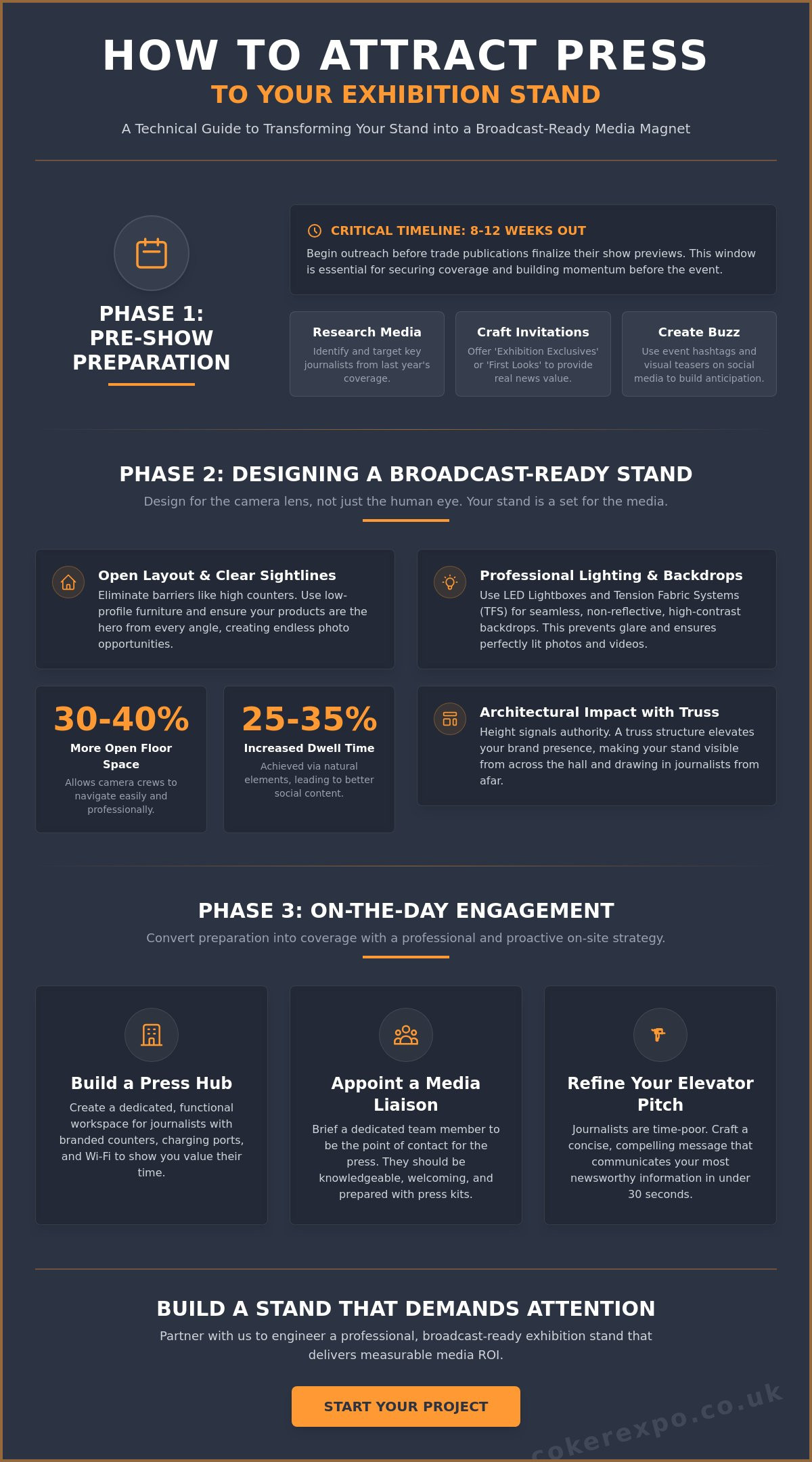
Understanding how to attract press to your exhibition stand requires a timeline that begins 8 to 12 weeks before the doors open. This window is critical because monthly trade publications often finalize their show preview editions months in advance. Start by researching the journalists, editors, and influential bloggers who cover the UK exhibition circuit. Review last year's coverage to identify who wrote the "Top Stands" articles or conducted video interviews. These are your primary targets. You aren't just looking for anyone with a press badge; you're looking for the specific voices that your target audience trusts.
Crafting the "Unmissable" Media Invitation
Generic press releases rarely cut through the noise of a busy editor's inbox. Your invitation must be personal and value-led. Focus on "Exhibition Exclusives" such as new product launches or live technical demonstrations. Offer high-tier trade publications "First Look" opportunities or exclusive interviews with your lead engineers. Journalists want a scoop, not a brochure. Providing them with a clear, time-sensitive reason to visit your stand makes their job easier and your brand more memorable.
Leveraging Social Media for Pre-Show Buzz
Social media acts as a bridge between your digital presence and the physical event. Use event-specific hashtags to enter the conversation early and tag journalists in your "behind-the-scenes" content. Visual teasers are particularly effective. Showcasing high-impact elements like dynamic lightboxes or complex TFS systems signals that your stand is a high-value visual environment. This pre-show visibility ensures that when the press walks the hall, they've already shortlisted your stand as a priority destination. They'll arrive looking for the features you've already teased, ensuring your most important hardware gets the spotlight.
Designing a Broadcast-Ready Exhibition Stand
Designing for the lens is different from designing for the eye. To solve how to attract press to your exhibition stand, you must create a visual hierarchy that works from fifty meters away. High-performance graphics should communicate your Unique Selling Proposition (USP) in under three seconds. This immediate clarity allows a photographer or video journalist to identify your brand as a story worth capturing without needing an explanation. Clear sightlines and an open layout are essential. Industry trends for 2026 show a shift toward 30% to 40% more open floor space, which creates a more inviting environment for camera crews to navigate without obstructing other visitors.
Professional exhibition stand design prioritizes the "shot." Eliminate physical barriers like high counters at the perimeter that block the view of your products. Instead, use low-profile furniture and branded plinths to ensure that every angle is a potential photo opportunity. Incorporating natural elements or wood textures can also increase visitor dwell time by 25% to 35%, according to January 2026 data from Storm Displays. This aesthetic appeal translates directly to better photography and more engaging social media content.
Illuminating Your Brand with LED Lightboxes
Backlit displays provide the crisp, high-contrast background that modern high-definition video requires. Using shell scheme graphic panels with a matte finish creates a seamless, non-reflective media backdrop. This is critical for preventing the glare that often ruins trade show photography. Our diffused LED technology ensures there are no "hot spots" or uneven lighting, providing a perfectly balanced canvas for interviews. These lightboxes are built for durability and ease of transport, making them a sound investment for any media-focused strategy. You can explore our range of professional lightboxes to see how they enhance visual clarity.
Architectural Impact with Exhibition Truss
Height signals authority. Utilizing truss structures allows you to claim the vertical space above your stand, making your brand visible from across the entire hall. These systems are designed for rapid assembly, ensuring your infrastructure is secure and professional without delaying your setup schedule. Beyond visibility, suspended lighting rigs allow you to control the environment. You aren't at the mercy of the venue's often unflattering overhead lights. This setup ensures your stand is "TV-ready" at all times, projecting a sense of scale and professionalism that naturally attracts major media outlets looking for high-quality B-roll footage. A well-executed truss system acts as a beacon for journalists seeking the most significant players on the floor.
Creating the Physical Media Infrastructure
Journalists at trade shows operate under intense deadline pressure. They require more than just a visual; they need a functional workspace to process their stories. Providing a "Press Hub" is a strategic move for any brand serious about how to attract press to your exhibition stand. This sanctuary on the trade floor offers journalists a place to recharge both their equipment and themselves. By integrating high-speed Wi-Fi and accessible charging points into your stand, you position your brand as a helpful partner rather than just another exhibitor. This hospitality encourages longer dwell times, which naturally leads to deeper conversations and more comprehensive reporting.
Physical organization is key. Use branded display plinths to present physical press kits or product samples in a structured, professional manner. These plinths act as localized focal points, guiding the media to the most critical information without cluttering the main demonstration areas. If you need to upgrade your stand’s professional infrastructure, you can view our full range of exhibition counters and plinths here.
The Dedicated Media Zone
Creating a quiet corner for interviews is essential for high-quality audio and video recording. TFS tension fabric systems allow you to build acoustic-friendly partitions that also serve as high-impact branded backdrops. Ensure your company logos are positioned at "head-and-shoulder" height. This specific placement guarantees that your branding remains visible in every close-up interview shot. Use promotional counters as dedicated reception points for media enquiries. This gives journalists a clear destination and prevents them from getting lost in general visitor traffic.
Digital and Physical Press Kits
The traditional USB stick has become a logistical burden for busy editors. Modern media strategies utilize QR codes printed directly onto folding display boards. This allows journalists to download high-resolution images, executive bios, and fact sheets instantly to their mobile devices. For tactile engagement, place physical samples on rotating display turntables. The constant movement catches the eye and provides a dynamic element for video B-roll. A well-stocked, digitally-accessible kit ensures the press has everything they need to file their story accurately and quickly.
On-the-Day Engagement and Post-Show Nurturing
Human execution is the final variable in how to attract press to your exhibition stand. While your hardware creates the professional environment, your team’s performance determines the quality of the resulting coverage. You must identify a dedicated Media Liaison. This individual’s sole responsibility is to facilitate journalists' needs, which is a distinct task from sales lead generation. While sales staff focus on volume, the liaison focuses on narrative clarity and access to key spokespeople. This distinction ensures that a busy editor isn't trapped in a sales pitch when they only have five minutes to find a story.
Journalists are chronically short on time. Your staff needs an "elevator pitch" that summarizes your exhibition exclusive in under thirty seconds. This pitch should highlight the industry impact or technical innovation rather than just listing product features. Use your lead-generation tools to categorize media contacts separately from general prospects. This data separation ensures your PR team can prioritize these high-value relationships immediately after the event doors close. Speed is a technical requirement in the news cycle.
Managing the Media Interview
Prepare your spokesperson with three media-friendly talking points. These should be concise, authoritative, and easy to quote. When an interview begins, use your stand’s professional lighting and acoustic-friendly TFS backdrops to your advantage. Controlling the physical environment ensures the final broadcast or photography reflects your brand’s authority. If a journalist visits unexpectedly, maintain poise. Having a prepared media kit ready on a nearby promotional counter allows you to provide immediate value without disrupting your stand's flow. Professionalism under pressure is a powerful brand signal.
The Post-Exhibition Media Nurture
The 24-hour rule is the most critical step in a professional media strategy. Send personalized notes to every journalist who visited, including a direct link to your digital press kit. Journalists often work on tight post-show deadlines; being the first to provide high-resolution images and fact sheets significantly increases your chances of a featured mention. Monitor trade publications and social channels for mentions. Once coverage is live, leverage it. Using "As Seen In" badges on your website and future marketing materials builds long-term credibility and validates your investment in professional stand infrastructure. This follow-up transforms a single interaction into a lasting industry asset.
Maximising Your Media Impact
Attracting press attention is a technical discipline that requires more than a good story. It demands a broadcast-ready environment and a functional infrastructure that respects the high-pressure news cycle. By integrating high-contrast LED lightboxes and authoritative truss systems, you provide the visual clarity and professional workspace that trade journalists require. This proactive alignment of design and outreach is the most effective method for how to attract press to your exhibition stand. It transforms your presence from a standard booth into a priority destination for editors and camera crews.
CokerExpo brings over 25 years of exhibition expertise to your project, specializing in high-impact LED and truss infrastructure. Our UK-based manufacturing ensures rapid turnaround times and the tangible quality required for professional environments. We provide the essential infrastructure that allows your brand to focus on delivering its message with total confidence. Reliability is the foundation of every successful media strategy.
Explore our range of media-ready lightboxes and truss systems at CokerExpo and build a presence that commands attention and delivers measurable results. We look forward to helping you secure the visibility your brand deserves.
Frequently Asked Questions
How do I find out which journalists are attending an exhibition?
Start by contacting the event organiser's press office directly. Most major UK trade shows maintain a list of accredited media and may share these contacts with exhibitors who provide a compelling reason. You should also monitor the event’s official hashtag on social media and review trade publications from the previous year to identify the specific reporters who consistently cover your sector.
Do I need a professional PR agency to attract press to my stand?
You don't strictly require an external agency if you have the internal capacity to manage outreach and infrastructure. Success depends on a technical understanding of how to attract press to your exhibition stand through broadcast-ready design and proactive scheduling. While agencies offer existing media relationships, a well-prepared manager using professional hardware like LED lightboxes can achieve significant impact by providing journalists with high-quality visual content.
What is the most important piece of stand equipment for media attraction?
High-quality lighting is the most critical technical component for media engagement. Professional video crews and photographers prioritize stands with diffused LED lightboxes or suspended lighting truss because they provide the consistent, glare-free environment needed for high-definition capture. Without proper illumination, even the most innovative products will fail to translate effectively into digital or print media reports.
How can I make my small shell scheme stand attractive to the press?
Focus on verticality and seamless branding to maximize a limited footprint. Use shell scheme graphic panels to create a professional, non-reflective backdrop that eliminates the unattractive appearance of standard booth walls. High-impact elements like dynamic lightboxes or branded display plinths can make a small space feel like a high-value destination. Clarity of message is your greatest asset when competing with larger island stands.
Is it worth hosting a press event on my exhibition stand?
Hosting a dedicated press event is highly effective if you have a significant announcement, such as a major product launch. Schedule these events for the first morning of the show when journalist energy and filing deadlines are most favourable. Ensure your stand infrastructure, including promotional counters and interview zones, is fully prepared to handle a concentrated group of media professionals without obstructing the general aisle flow.
How do I follow up with a journalist after the trade show ends?
Follow the 24-hour rule by sending a personalized email with a direct link to your digital press kit immediately after the event. Provide high-resolution images, executive bios, and a concise summary of your key talking points. Journalists often work on tight post-show filing deadlines. Being the most responsive exhibitor significantly increases your chances of securing a high-quality mention in their final report.
Laisser un commentaire