

How to Generate Leads at a Trade Show: The Professional UK Guide for 2026
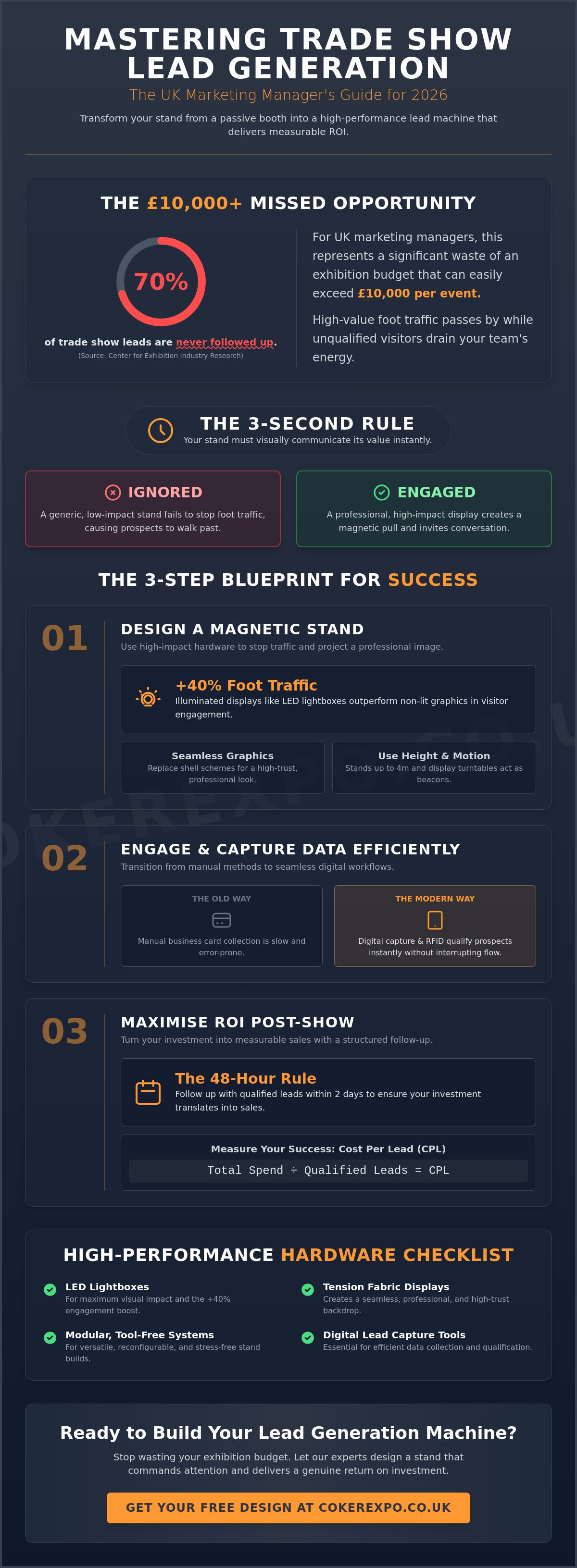
Did you know that 70% of trade show leads are never followed up, according to data from the Center for Exhibition Industry Research? For UK marketing managers, this represents a significant waste of an exhibition budget that can easily exceed £10,000 per event. You've likely experienced the frustration of watching high-value foot traffic bypass your stand while unqualified visitors drain your team's energy. It's a common struggle, but learning how to generate leads at a trade show effectively requires a shift from passive exhibiting to active, hardware-supported engagement.
We'll show you how to master the art and science of lead generation by combining high-impact display hardware with professional engagement techniques. This guide outlines how to use robust, tool-free modular systems and seamless tension fabric displays to command attention on a busy floor. We provide a clear framework for 2026 that covers everything from stand ergonomics to a structured follow-up process, ensuring your next UK event delivers a consistent flow of qualified prospects and a genuine return on investment.
Key Takeaways
- Discover why high-impact illuminated displays can increase foot traffic by up to 40%, acting as the primary visual hook for your brand in a crowded hall.
- Learn how to generate leads at a trade show by replacing standard shell schemes with seamless graphic panels that project a professional, high-trust image.
- Transition from manual business card collection to digital lead capture and RFID workflows to qualify high-intent prospects without interrupting the conversation.
- Master the "48-hour rule" for post-event follow-up to ensure your exhibition investment translates into measurable sales and long-term business ROI.
- Understand the essential hardware upgrades required to transform a basic stand into a high-performance lead generation machine for the 2026 UK event season.
The Fundamentals of Trade Show Lead Generation in 2026
Lead generation at a trade show is the strategic process of identifying and qualifying high-intent prospects within a live environment. It isn't just about collecting business cards; it's about filtering the crowd to find individuals ready to enter your sales funnel. To grasp the foundations of these events, exploring What is a Trade Show? helps explain why these venues are essential for industry growth. In the UK market, face-to-face interaction remains the most reliable way to build trust quickly. Digital ads can be ignored, but a personal conversation creates a lasting professional connection.
Your success is often decided by the 3-Second Rule. This principle dictates that a visitor evaluates your brand's relevance before you even say hello. If your display hardware doesn't communicate your value proposition instantly, the prospect will walk past. You need to set SMART objectives before the doors open. Don't just aim for "more traffic". Specify whether you're targeting brand awareness or hard lead capture. A 2025 survey of UK marketing managers showed that 72% of successful exhibitors set specific numerical targets for lead acquisition before the event began.
The ROI of In-Person Prospecting
In-person prospecting delivers a significant advantage because lead conversion costs are typically lower than cold outreach. You're meeting people who've already invested time and money to be there. To justify your investment in robust modular systems, you must calculate your Cost Per Lead (CPL). Take your total exhibition spend, including stand space and hardware, and divide it by the number of qualified leads. High-intent event audiences provide a concentrated pool of decision-makers that accelerates the B2B sales cycle through immediate, high-trust engagement.
Active vs. Passive Lead Generation
Passive lead generation involves setting up a high-quality display and waiting for the crowd to react. This strategy demands magnetic visual hardware, such as dynamic lightboxes, to stop foot traffic. Active lead generation requires your team to proactively engage and pull visitors into the space. Your stand layout is the most critical factor here. A seamless, open-fronted design removes the barrier to entry, while a closed-off counter can act as a deterrent. Learning how to generate leads at a trade show requires balancing these two approaches. Using versatile tension fabric displays ensures your brand looks professional while your team focuses on the human element. Mastering how to generate leads at a trade show starts with a layout that invites movement rather than creating a physical wall between you and your next client.
Designing a Magnetic Stand: Using Visuals to Stop Foot Traffic
Understanding how to generate leads at a trade show begins with the physical "stop" factor. Visuals act as your primary hook in a crowded exhibition hall. In a large UK venue like the NEC or ExCeL London, your stand competes with hundreds of other exhibitors for a visitor's limited attention. High-impact visuals aren't just about aesthetics; they're about psychological triggers that disrupt a visitor's walking pace.
The psychology of light is a powerful tool for any marketing manager. Research indicates that illuminated displays outperform standard non-lit graphics by up to 40% in terms of visitor engagement. Integrating exhibition lightboxes transforms a standard booth into a professional, high-end brand presence that commands attention. Beyond light, you must consider height to be seen from across the hall. While standard shell schemes often limit you to 2.4 metres, space-only plots frequently allow for structures up to 4 metres. Using this vertical real estate ensures your brand acts as a beacon, guiding traffic toward your team before they even reach your aisle.
The Power of Illumination and Motion
LED lightboxes offer technical advantages that standard banners can't match. They provide consistent, edge-to-edge illumination that makes colours pop, even in venues with poor overhead lighting. To further increase engagement, you should consider motion. The human eye is naturally programmed to detect movement in its peripheral vision. Leveraging display turntables to showcase physical products creates a dynamic element that stops people in their tracks. When designing these graphics, ensure your value proposition is readable in under two seconds. Use large, high-contrast text and avoid cluttering the space with too much technical data.
Seamless Branding with Tension Fabric
Tension Fabric Systems (TFS) provide a premium, built-in appearance for modular stands. These systems use a perimeter track to stretch fabric graphics tight, creating a seamless finish that looks like a permanent wall. A major benefit for busy teams is the tool-free assembly. Most TFS frames snap together, which can reduce setup time by 30% compared to traditional panel-and-pole systems. This allows your staff to stay focused on their lead generation strategy rather than technical build issues. Crease-free graphics are essential for building immediate visitor trust, as a wrinkled backdrop suggests a lack of attention to detail. When you are planning how to generate leads at a trade show, sourcing hardware from a UK display specialist ensures your stand is both impactful and compliant with local safety regulations.
Hardware for Engagement: Beyond the Standard Shell Scheme
The standard "table and cloth" setup is a lead generation killer. In 2026, exhibitors who rely on a basic folding table to shield themselves from the crowd are effectively invisible. This physical barrier discourages high-quality interactions and makes your brand look like an afterthought. To understand how to generate leads at a trade show effectively, you must treat your physical hardware as a tool for conversion, not just a place to sit. It's about removing friction between your staff and the visitor.
Upgrading your space starts with high-impact visuals. Standard aluminium uprights are unsightly and break the visual flow of your brand. By using shell scheme graphic panels, you can create a seamless, wall-to-wall environment that mimics a bespoke build at a fraction of the cost. This professional finish builds immediate trust with senior decision-makers. It signals that your business is established and serious about its presence.
Successful stands incorporate "Engagement Zones" to facilitate different conversation levels. You need a fast-track area for quick badge scans and a semi-private area for deeper technical discussions. Position your promotional counters at the front edge of your stand. These act as a professional "reception desk" where staff can qualify leads before inviting them further into the space. This layout prevents your stand from becoming a cluttered storage area and keeps the focus on the visitor experience.
Maximising Shell Scheme Potential
Modular hardware allows a standard 3x3m space to feel like a premium, custom environment. Strategic placement of counters controls visitor flow and prevents bottlenecks that turn people away. We recommend integrating AV units or tablets directly into your counters. This setup allows for immediate, digital data entry. It ensures your lead data is clean and ready for the sales team before the show even ends. Don't let your data collection be an afterthought; make it part of the furniture.
Using Truss and Gantry for Authority
For larger footprints, truss systems create a "destination" feel that commands attention. Utilising gantry for overhead lighting and elevated branding allows you to dominate the visual horizon of the hall. This architectural authority is essential for brands looking to establish market leadership. For national UK exhibition tours, hiring truss is often more cost-effective for one-off events, while buying offers a better long-term ROI for those attending three or more shows annually. Mastering your hardware layout is a critical step in learning how to generate leads at a trade show that actually convert into revenue.
Effective Data Capture: Strategies for Qualifying Prospects
Collecting business cards in a glass bowl is a passive tactic that fails 80% of the time because it lacks context. To master how to generate leads at a trade show in 2026, you must implement digital workflows that capture intent alongside contact details. High-performing UK exhibitors now use integrated systems to ensure every interaction is recorded with actionable data.
Modern UK venues like ExCeL London or the NEC frequently provide RFID smart badges. These allow your team to gather data without breaking eye contact or halting the conversation flow. When your staff uses hardware like demo stations or interactive screens, the data capture becomes a natural extension of the user experience rather than an administrative interruption.
The most efficient teams use the Three-Question Qualification method to filter the crowd quickly:
- What is your primary challenge with [industry-specific problem] right now?
- Are you looking to implement a solution within the next six months?
- Besides yourself, who else is involved in the final decision-making process?
Digital Lead Capture Tools
Choosing the right tool depends on your scale. For smaller UK exhibitions, simple QR codes linked to a secure landing page are cost-effective and easy to deploy. Larger stands benefit from dedicated lead retrieval apps that sync directly with your CRM. These tools must include "Qualifiers" where staff can tag a lead's budget, authority, and specific interests immediately. In the UK market, data security and GDPR compliance are non-negotiable; your capture system must include a clear, timestamped opt-in for marketing communications to remain legal and professional.
The Art of the "Soft Capture"
Data sharing should feel like a fair exchange of value. Offer digital brochures, whitepapers, or entry into a technical competition to incentivise the scan. You can use folding display boards to present quick-reference "pain point" checklists. These allow visitors to self-identify their needs, making it easier for your staff to approach with a relevant solution.
Transitioning from a casual chat to a formal scan requires a direct approach. Avoid being pushy by linking the scan to a specific benefit. A phrase like, "I have a detailed technical spec for that system; may I scan your badge so I can email it to you before the end of the day?" works effectively. It moves the relationship forward while respecting the visitor's time. This professional approach ensures you understand exactly how to generate leads at a trade show that actually convert into sales.
Ensure your team has the right infrastructure for success.
Browse our professional exhibition display range
Maximising ROI: Post-Show Conversion and Follow-Up
The final 48 hours after a UK trade show determine whether your investment yields a profit or a loss. While the event floor is where you capture data, the "fortune is in the follow-up." Statistics from the Center for Exhibition Industry Research (CEIR) indicate that nearly 80% of trade show leads are never followed up. This represents a massive waste of marketing budget. To ensure you understand how to generate leads at a trade show that actually convert, you must strike while the memory of your brand is fresh. Effective conversion starts with segmentation. Don't treat every scanned badge the same way. Categorise your data into three distinct tiers:- Tier 1 (Hot): Immediate requirements or requests for quotes. These require a phone call within 24 hours.
- Tier 2 (Warm): Interested prospects who fit your target profile but aren't ready to buy. These should enter a specific email nurture sequence.
- Tier 3 (Cold): General enquiries or students. These go into your long-term newsletter list for brand awareness.
The Immediate Follow-Up Sequence
Your first touchpoint should be a "Thank You" email sent within 24 hours of the show closing. Avoid generic templates. Reference specific conversations or the specific products shown on your stand. If you promised a whitepaper or a technical specification sheet, deliver it now. Concurrently, your team should connect with key decision-makers on LinkedIn. This multi-channel approach keeps your brand at the top of their inbox and their social feed simultaneously.
Evaluating Hardware Performance
Lead data tells you more than just who to call; it reveals how your hardware performed. Analyse which areas of your stand saw the most activity. Did your lightbox wall draw people in from the aisles, or was the demo counter the primary site for lead capture? If 60% of your leads came from a specific interactive zone, you know where to invest for your next event. Modular hardware is particularly beneficial here, as it allows you to iterate and improve your stand layout based on real-world traffic patterns. You can contact CokerExpo for a post-show consultation to discuss hardware upgrades or reconfigurations for your 2026 calendar. Our tool-free assembly systems make these adjustments simple, ensuring your next stand is even more efficient at showing you how to generate leads at a trade show.
Secure Your Competitive Edge for 2026
Success on the UK exhibition circuit requires a blend of high-impact visuals and disciplined data capture. By 2026, the competition for attention will be more intense than ever. It's vital to move beyond standard shell schemes and invest in displays that stop foot traffic. Understanding how to generate leads at a trade show starts with a robust infrastructure that allows your team to focus on conversations rather than logistics. You need hardware that delivers a seamless aesthetic while remaining practical for your staff during a busy event.
Coker Expo provides the foundation for this success with UK-made quality and a fast turnaround on all orders. Our systems feature tool-free assembly to ensure your build is stress-free, letting you prioritise prospect engagement. If you require additional support, our expert event planning and management services are available to handle the complexities of your presence. It's time to transform your stand into a high-performance lead generation engine.
Explore our range of high-impact exhibition hardware to boost your lead generation
Your next successful exhibition starts with the right equipment and a clear strategy.
Frequently Asked Questions
How do I attract visitors to my trade show booth?
High-impact visual displays like modular tension fabric backdrops and 4m gantry systems are essential for visibility in crowded halls. Use bright, high-resolution graphics that communicate your value proposition in under 3 seconds. Incorporate interactive elements like live product demonstrations or touchscreens to stop foot traffic. A well-lit stand using LED arm lights increases visibility by 30% in busy UK exhibition venues like the NEC or ExCeL London.
What is the best way to capture lead data at an exhibition?
Use a dedicated lead capture app or digital scanner integrated with your CRM for immediate data entry. This replaces manual paper forms which have a 20% higher risk of data loss or transcription errors. Modern UK events provide QR code scanning technology via exhibitor badges. Ensure your staff records specific notes on each interaction to personalise follow-up emails, as 70% of exhibitors fail to categorise leads effectively during the event.
How many staff should I have on my trade show stand?
Aim for one staff member per 4 square metres of floor space to ensure adequate coverage without overcrowding. For a standard 3x3m shell scheme, two people are sufficient to manage flow and capture data. This ratio ensures that 100% of visitors can be greeted within 30 seconds of entering your space. Having a backup team member allows for breaks, maintaining a high energy level throughout the 8 hour exhibition day.
What are the most effective lead magnets for trade shows?
High-value digital assets like industry white papers or exclusive 2026 market reports outperform cheap physical giveaways. Offer a show-only discount or a chance to win a high-ticket item worth over £250 to incentivise data sharing. While branded pens have a 5% retention rate, useful items like portable power banks or high-quality tote bags keep your brand visible. Ensure every magnet requires a scanned badge to track your return on investment effectively.
How do I qualify leads quickly at a busy event?
Implement the BANT framework, focusing on Budget, Authority, Need, and Timeline, to categorise prospects within the first 2 minutes of conversation. Ask open-ended questions like "What specific challenge brings you to the NEC today?" to gauge intent. This process is a vital part of how to generate leads at a trade show that actually convert into sales. Assign a hot, warm, or cold status immediately after the visitor leaves your stand.
What is a good number of leads to get at a trade show?
A successful UK exhibition typically yields 20 to 50 high-quality leads per day for a mid-sized stand. While quantity matters, focus on the 15% of leads that meet your ideal customer profile for better conversion rates. Industry benchmarks suggest that capturing 5% of total event attendees is a realistic target for established B2B brands. Tracking these metrics allows you to calculate a precise cost-per-lead against your total exhibition spend.
How should I follow up with trade show leads?
Send a personalised follow-up email within 24 to 48 hours of the event closing to maintain momentum. Mention specific details from your conversation to stand out from the 80% of exhibitors who send generic mass templates. Mastering how to generate leads at a trade show requires a multi-touch approach. Combine your initial email with a LinkedIn connection request and a phone call for high-priority prospects within 5 working days.
Laisser un commentaire