

How to Train Staff for an Exhibition: The Professional UK Guide for 2026
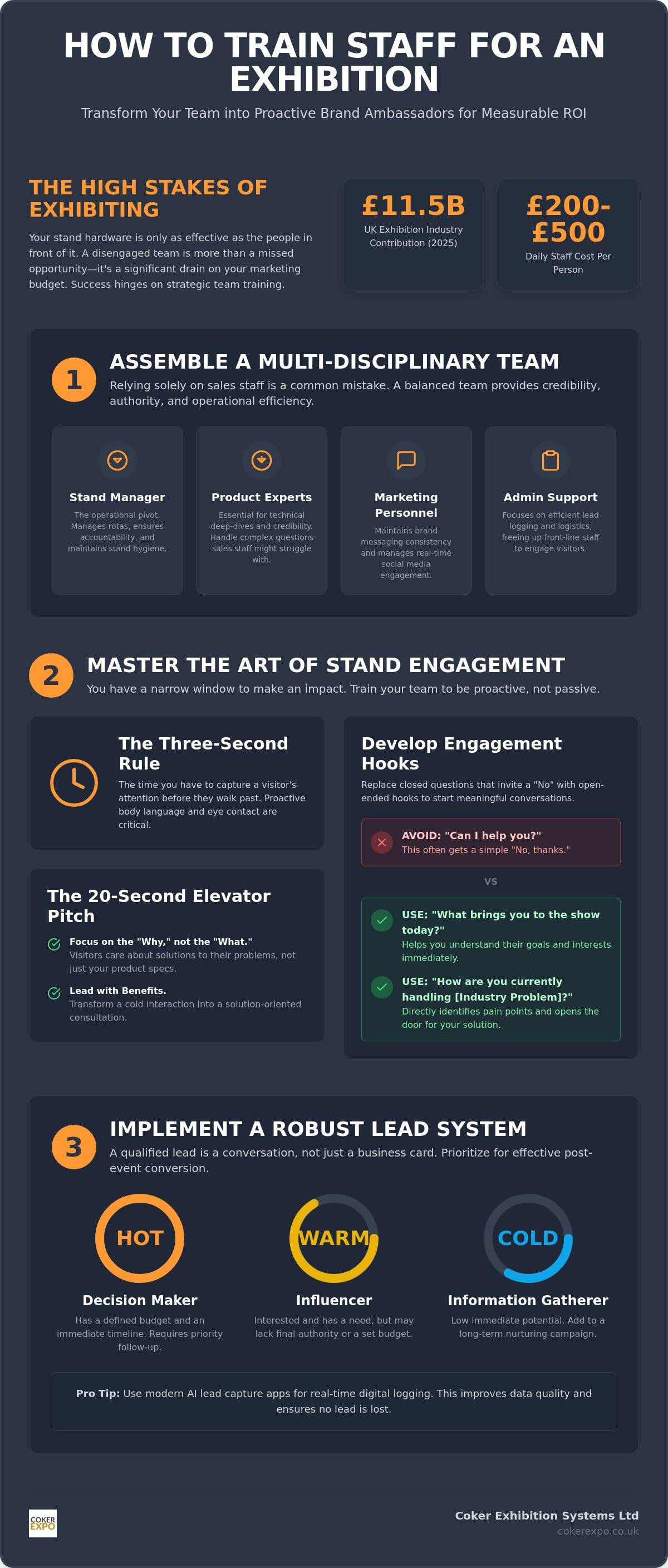
With the UK exhibition industry contributing £11.5 billion to the economy in 2025, the stakes for your next trade show have never been higher. It's a common sight at the NEC or ExCeL: staff members scrolling on phones or huddled in corners while potential leads walk past. When you're spending between £200 and £500 per person daily on staff costs alone, a disengaged team isn't just a missed opportunity; it's a significant drain on your marketing budget.
You've likely invested in high-impact tension fabric systems or dynamic lightboxes to draw a crowd, but your hardware is only as effective as the people standing in front of it. Mastering how to train staff for an exhibition is the only way to transform a passive group into a proactive team of brand ambassadors. We'll show you how to align your team's behavior with your professional infrastructure to drive measurable ROI.
This guide provides the essential techniques for 2026, including how to leverage AI lead capture apps and meet new legal requirements under the Terrorism (Protection of Premises) Act. We'll provide a structured framework to ensure every team member is confident, compliant, and focused on securing high-quality leads from the moment the doors open.
Key Takeaways
- Define measurable objectives and select a diverse team of technical and marketing experts to ensure booth credibility and brand authority.
- Master the "Three-Second Rule" and refine a 20-second elevator pitch that focuses on visitor solutions rather than just product specifications.
- Learn how to train staff for an exhibition by integrating high-impact hardware like lightboxes and display plinths into active physical demonstrations.
- Implement a robust lead management system using real-time digital capture and a clear "Hot, Warm, Cold" prioritisation strategy for post-event conversion.
Defining Exhibition Objectives and Selecting the Right Team
Successful exhibiting isn't a happy accident. It's the result of strategic alignment between your physical assets and your personnel. Before you step onto the hall floor, you must decide what success actually looks like. Training becomes aimless without a clear target. When considering how to train staff for an exhibition, the first step is always defining the mission. Is the priority raw lead volume, high-level brand awareness, or a specific product launch? Each goal requires a different mindset and a specific mix of talent.
You need a Stand Manager to act as the pivot point for your operations. This individual ensures accountability, manages the rota, and maintains stand hygiene. Without a designated leader, schedules slip and the stand's professional appearance can quickly deteriorate. Your team's energy must also match your exhibition stand design. A high-tech, minimalist stand requires a sleek, efficient persona, while an interactive demonstration area needs high-energy, hands-on facilitators.
Identifying Key Performance Indicators (KPIs)
Setting individual targets prevents the bystander effect where staff wait for others to initiate contact. A qualified lead isn't just a business card; it's a recorded conversation with a decision-maker who has a defined budget and timeline. Define these parameters early. Use KPIs to motivate staff during long, multi-day events. When the team knows exactly what data they need to capture, their confidence increases and the quality of your post-event CRM data improves significantly.
Assembling a Multi-Disciplinary Team
Relying solely on sales staff is a common mistake. Salespeople are excellent at closing, but they can sometimes appear overly aggressive in a trade show environment. A multi-disciplinary team provides essential balance. Integrating employee training and development principles into your pre-show briefing ensures everyone knows their specific lane. Consider the following roles for a well-rounded presence:
- Product Experts: Essential for handling technical deep-dives that sales staff might struggle with.
- Marketing Personnel: Best suited for maintaining consistent brand messaging and managing social media engagement.
- Administrative Support: Focuses on efficient lead logging and logistics, keeping the front-line staff free to engage.
Senior executives can provide gravitas for high-level meetings, but they shouldn't always be on the front line. Their time is often better spent in pre-arranged meetings away from the main bustle of the stand. By selecting the right mix of experts, you ensure your brand is represented with total authority and technical accuracy.
Mastering the Art of Stand Engagement and Professional Pitching
You have exactly three seconds to make an impact. This is the narrow window available before a visitor walks past your stand perimeter and onto the next exhibitor. In this high-pressure environment, your team must move beyond passive observation. When considering how to train staff for an exhibition, you must teach them to treat the stand as a high-performance stage. Staff shouldn't wait for a visitor to ask a question; they should initiate a connection through proactive body language and eye contact.
The 20-second elevator pitch is your most critical verbal tool. It shouldn't be a list of technical specifications. Instead, it must focus on the "Why" rather than the "What". Visitors care about how your solution alleviates their specific stress points. Citing highly effective tradeshow skills, the most successful teams are those that lead with benefits. This approach transforms a cold interaction into a solution-oriented consultation within seconds.
Not every person who stops is a viable prospect. Training your team to identify and politely disengage from "tyre kickers" is essential for maintaining efficiency. If a visitor doesn't meet your qualification criteria, staff should thank them for their interest and move on. This preserves their energy and availability for high-value leads who require deeper engagement.
Developing the Hook and Qualification Questions
Move away from closed questions like "Can I help you?", which invite a "No" response. Use open-ended hooks such as "What brings you to the show today?" or "How are you currently handling [Industry Problem]?". These questions allow staff to identify pain points within the first minute. By creating a verbal bridge between the visitor's challenge and your product, the pitch feels like a natural progression rather than a forced sale.
Exhibition Etiquette and Body Language
Your stand's physical layout is only as good as the people occupying it. Sitting, eating, or using mobile phones are "No-Go" zones that instantly kill stand traffic. Staff should be positioned to avoid blocking graphics or entrances, ensuring the path to your promotional counters remains clear. Maintaining energy is a logistical challenge, so implement a strict rotation schedule. A tired team is an ineffective team; regular breaks ensure that every visitor receives the same high-level professional greeting regardless of the time of day.
Practical Training on Stand Logistics and Hardware Interaction
A high-impact stand is only as effective as the team operating it. Your staff must view the physical infrastructure not as background decoration, but as a functional tool for engagement. When you plan how to train staff for an exhibition, you must include hands-on sessions with the specific hardware they will use. An employee who struggles to operate a display turntable or locate a brochure during a live pitch projects a lack of authority that can undermine your brand's credibility.
Your hardware serves as a visual anchor for every conversation. For instance, exhibition lightboxes should be used as active visual aids. Staff should be trained to guide a visitor’s eye toward specific illuminated graphics to reinforce key benefits. This physical coordination between the verbal pitch and the visual environment creates a more memorable experience for the prospect.
Maximising Impact with Dynamic Lightboxes and Turntables
Dynamic lightboxes use programmed sequences to draw attention. Train your team to time their introductions with these lighting changes, using the movement to highlight specific product features or calls to action. If you are using display turntables, staff must know how to safely reset or pause them to allow for a closer inspection of the product. Using illuminated exhibition counters as a central "reception desk" allows staff to keep lead capture tools organized and ready for immediate use during initial qualification.
Maintaining the Professional Environment
A cluttered stand is a repellent for high-value leads. Implement a strict "Clean Stand" policy that ensures shell scheme graphic panels remain unobstructed and storage areas stay hidden. Training should include a daily stand audit checklist to be completed before the doors open. This includes checking that all Tension Fabric Systems (TFS) are taut and free of creases, and ensuring that no personal items or empty boxes are visible to the public.
Emergency protocols are equally vital. Every team member needs to know the location of power points and how to perform basic troubleshooting if a light fails or a display stops rotating. Providing your team with this technical confidence ensures that minor logistical hiccups don't disrupt the flow of lead generation. If you need robust, reliable infrastructure that stands up to the rigours of a multi-day event, explore our range of professional exhibition counters and display systems.
Lead Management Systems and Post-Event Conversion
The final phase of preparation focuses on the transition from physical engagement to data acquisition. While high-impact hardware and professional pitching draw the crowd, your measurable ROI depends entirely on what happens after the visitor leaves the stand perimeter. When you plan how to train staff for an exhibition, you must treat lead capture as a core technical skill rather than an administrative afterthought. A lead that lacks context or is recorded incorrectly is a wasted investment.
Effective lead categorisation prevents your sales team from being overwhelmed by low-quality data. We recommend a "Hot, Warm, Cold" system. A "Hot" lead is a decision-maker with a defined budget and an immediate requirement. A "Warm" lead has a genuine interest but no current timeline, while a "Cold" lead is suitable for long-term brand nurturing. Staff must be trained to assign these categories during the conversation, ensuring that follow-up efforts are prioritised by potential value.
Accuracy is driven by the "Golden Hour" principle. This refers to the period immediately following a conversation when details are still fresh. Staff should enter contextual notes into your lead management system as soon as the visitor departs. Relying on memory at the end of a ten-hour show day results in data decay. Clear, specific notes about a visitor's pain points allow for a personalised follow-up that stands out from the generic automated emails sent by competitors.
Effective Use of Lead Capture Technology
In 2026, lead capture apps offer advanced features like AI data enrichment and real-time CRM synchronisation. Your team needs a step-by-step walkthrough on scanning badges and adding qualifiers. It's vital to maintain GDPR compliance during this process; staff must know how to clearly obtain and record digital consent. Instruct your team on how to handle technical issues, such as using offline functionality if the venue's Wi-Fi becomes unstable during peak traffic periods.
The Immediate Follow-Up Protocol
Every successful stand interaction ends with a defined "next step". Whether it's a scheduled site visit or a technical quotation, setting these expectations builds professional trust. How to train staff for an exhibition should include drafting follow-up templates that reference specific conversations held on the stand. We set a strict 48-hour deadline for the first post-show contact. This speed of response reinforces the sense of reliability and efficiency that your brand projected throughout the event.
Conclude the event with a structured post-show debrief. Review the volume and quality of captured leads against your initial KPIs. Discuss which engagement tactics worked and identify any logistical friction points. This feedback loop is essential for refining your training programme and hardware requirements for future exhibitions.
Driving Measurable Impact at Your Next Event
Success on the exhibition floor requires a seamless blend of high-performance infrastructure and a well-prepared team. By establishing clear KPIs and selecting a multi-disciplinary squad, you ensure that every interaction has a purpose. Training your staff to treat their physical stand as an active stage for engagement transforms passive observers into proactive brand ambassadors. When your team understands how to use dynamic lightboxes and display turntables as visual anchors, your brand's authority becomes undeniable.
Effective lead management is the final link in the chain. Implementing a disciplined capture workflow ensures that the energy spent on the hall floor translates into tangible business growth. Mastering how to train staff for an exhibition is a continuous process of refinement; however, starting with these professional-grade techniques will put you ahead of the competition in 2026.
Since 1999, we've provided the durable, professional-grade hardware and event management expertise that UK businesses rely on for success. Whether you need high-impact lightboxes or full-scale planning, our team is ready to support your goals. Explore CokerExpo’s Exhibition Solutions & Event Planning Services to provide your staff with the essential infrastructure they need to excel. With the right training and the right stage, your next exhibition will be your most successful yet.
Frequently Asked Questions
How long before an exhibition should I start staff training?
You should begin the training process at least four to six weeks before the event opening. This timeline allows for an initial briefing on objectives, followed by dedicated sessions on product knowledge and lead capture technology. A final onsite briefing is essential the day before the show to familiarise the team with the specific stand layout and hardware. This structured approach ensures every team member is confident and fully prepared.
How many staff members do I need for my exhibition stand?
A practical rule of thumb is to allocate one staff member for every three to five square metres of accessible floor space. Overcrowding your stand with staff can be as off-putting to visitors as an empty one. You must also account for a rotation schedule. Ensure you have enough personnel to cover lunch breaks and rest periods without leaving the stand understaffed during peak traffic hours.
Should I hire professional exhibition staff or use my own team?
Using your own team is generally superior for technical credibility and deep product knowledge. However, professional promotional staff can be effective for initial lead scanning and high-volume engagement if your internal team is small. If you choose to use your own employees, learning how to train staff for an exhibition becomes even more critical. Your team must balance their technical expertise with proactive engagement skills.
What is the best dress code for staff at a UK trade show?
The best dress code aligns with your brand persona and the expectations of your specific industry. While smart-casual is increasingly common, branded polo shirts or shirts provide a cohesive, professional look. Comfortable footwear is non-negotiable for staff who will be standing for eight hours or more. Avoid overly formal suits if they don't match the approachable nature of your stand design and promotional counters.
How do I motivate staff who are reluctant to work at an exhibition?
Motivation is best achieved through clear communication of the event's importance and the implementation of achievable KPIs. Offer incentives for high-quality lead generation and ensure the rota includes frequent breaks to prevent burnout. When staff understand how their performance directly impacts the company's ROI, they are more likely to engage. Providing high-quality infrastructure, such as dynamic lightboxes, also helps by giving them a professional stage they can represent with pride.
What are the most common mistakes staff make on an exhibition stand?
The most frequent errors include using mobile phones, sitting down, and forming "huddles" with colleagues. These behaviours create a barrier that prevents visitors from approaching. Other mistakes include eating on the stand or failing to record contextual notes in lead capture apps. Understanding how to train staff for an exhibition involves addressing these habits early. You must reinforce the importance of open body language and immediate data entry to ensure show success.
Laisser un commentaire