

Cost to Hire Lighting Truss for an Event: The 2026 UK Pricing Guide
Most organisers assume the cost to hire lighting truss for an event is a simple calculation of aluminium length, yet this oversight often leads to unexpected budget spikes. It's a common frustration when hidden delivery fees or confusion between triangular and square truss types derail your planning. You need a setup that's robust, impactful, and fully compliant with BS 7905 standards without the financial surprises. We understand that managing a corporate event in 2026 requires both technical authority and strict budget control to ensure a high-performance result.
We'll show you how to budget with precision, from individual Trio 222 sections starting at £10 per week to full 3m x 2.5m exhibition packages priced at £525. You'll gain a clear understanding of daily versus weekly rates and why professional installation is a sound investment for meeting LOLER 1998 and PUWER regulations. This guide provides the practical infrastructure you need to make a seamless impact at your next UK trade show, covering everything from wind loading for outdoor rigs to the logistical benefits of a managed setup. By the end, you'll have the data needed to secure a reliable quote and ensure your event is both safe and visually stunning.
Key Takeaways
- Avoid the "linear meter" trap by understanding why structural complexity, rather than simple length, dictates your total exhibition budget.
- Identify the true baseline cost to hire lighting truss for an event by comparing individual component rates against the practical efficiency of pre-configured modular packages.
- Evaluate the critical trade-off between dry hire and managed installation to ensure your project remains fully compliant with UK health and safety regulations.
- Account for essential logistical variables, including RAMS documentation and national delivery surcharges, to eliminate hidden costs from your final invoice.
- Maximise your trade show ROI by exploring how integrated hire solutions can combine robust structural gantry systems with high-impact branding.
Understanding the Variables of Lighting Truss Hire Costs
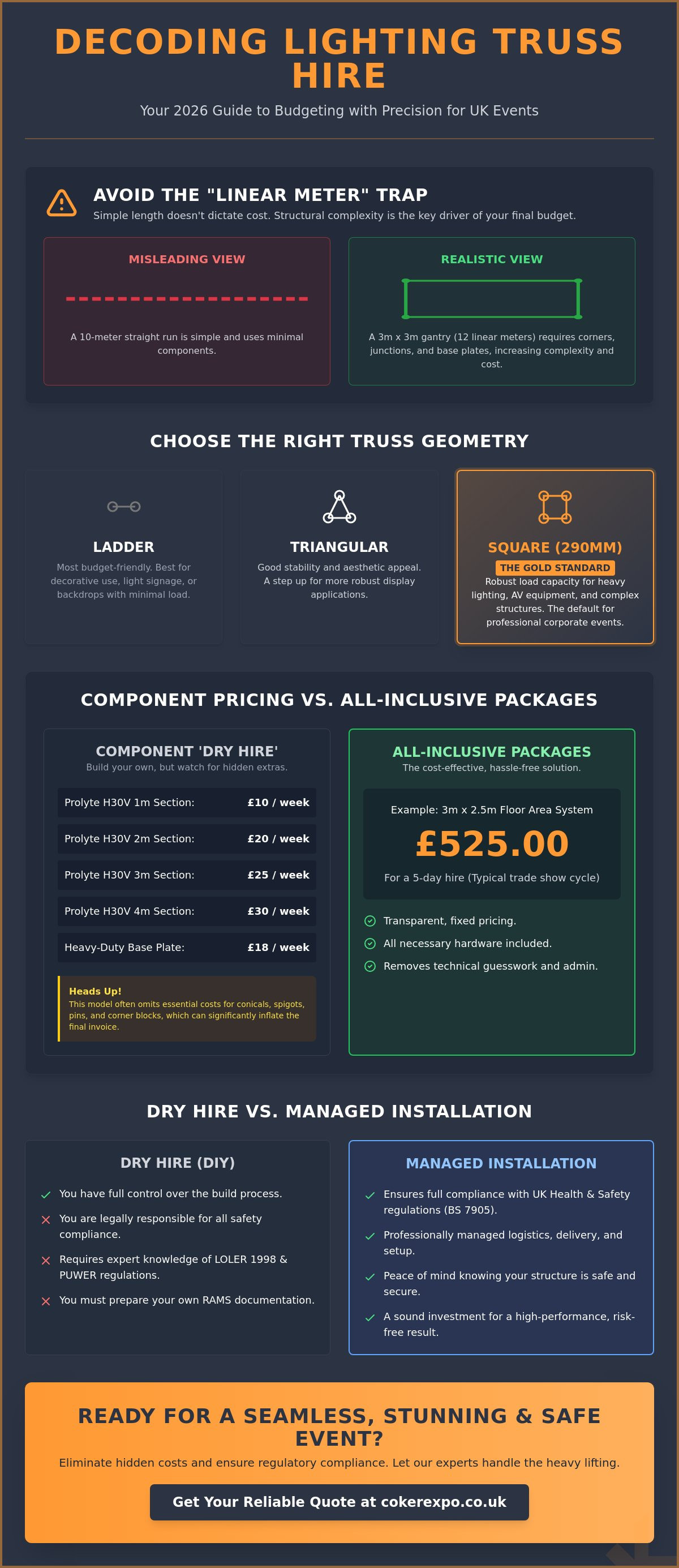
Lighting truss hire provides the essential skeleton for any professional display. It's a modular structural service that allows exhibitors to suspend branding, lighting, and AV equipment safely above their stand. While it's tempting to look for a flat price per meter, this metric is often misleading for exhibition planners. A structure is a complex assembly of straight sections, junctions, corners, and base plates. A 10-meter straight run requires far fewer components than a 3m x 3m square gantry. This means the total cost to hire lighting truss for an event is driven by the number of connections and the structural complexity rather than the linear length of the aluminium.
Truss Geometry and Load Capacity
The geometry of the truss you choose directly influences the price tier. Ladder truss, featuring two main chords, is the most budget-friendly option but is largely restricted to decorative use or light signage. Triangular truss offers a step up in stability and aesthetic appeal. However, for most corporate events, the 290mm square truss is the gold standard. It provides the robust load capacity required for complex stage lighting principles, where heavy moving heads and LED screens must be secured overhead. If your design includes aesthetic goalpost configurations or premium curved sections, expect a price increase. Curved aluminium requires specialised manufacturing and takes up more transport volume, which is reflected in the hire rate.
The Impact of Hire Duration on Your Budget
Timing is a critical factor when calculating the cost to hire lighting truss for an event. Standard UK hire windows typically fall into 24-hour, 3-day, or 7-day brackets. While a 1-day hire has the lowest absolute price, it often carries the highest daily rate due to the labour involved in prep and dispatch. For trade shows, a 5-day hire usually represents the best value. Most suppliers price this similarly to a 3-day rate to accommodate the typical exhibition cycle of build, three-day show, and breakdown. This approach helps hire companies manage their inventory and avoids lost opportunity costs, where equipment sits in transit rather than being active on a show floor. Planning your schedule around these standard windows ensures you don't pay a premium for late returns or short-notice extensions.
Component Pricing vs. Modular Package Costs
When researching the cost to hire lighting truss for an event, many planners fall into the "per meter" trap. Budgeting based solely on the length of aluminium ignores the essential hardware that makes a structure safe and functional. While some suppliers list a 1-meter section at a low entry price, they often omit the costs of conicals, spigots, and pins. These small but vital components are the difference between a pile of metal and a secure gantry. For a professional exhibition, you aren't just hiring hardware; you're hiring a structural solution that must adhere to industry best practices for rigging and safety.
The Component Price List
For those managing bespoke builds, understanding individual component rates is necessary. In 2026, typical weekly hire rates for industry-standard Prolyte H30V truss sections are structured by length. A 1-meter section typically costs £10, while 2-meter sections rise to £20. Longer 3-meter spans provide better value at £25, and 4-meter sections are available for £30. However, the structure requires more than just straight runs. Heavy-duty truss base plates, essential for ground-supported systems, cost approximately £18 per week. You must also factor in corner blocks and dado blocks, which can significantly increase the total if your design features multiple junctions or complex angles. If you're unsure which configuration fits your floor plan, you can view our full range of modular truss systems to see how these components integrate.
Why Pre-Designed Packages Save Money
Opting for a pre-configured kit is often the most cost-effective way to manage the cost to hire lighting truss for an event. These packages are designed around standard exhibition floor areas, removing the technical guesswork and administrative burden of itemising every pin and clip. For example, a 3m x 2.5m floor area truss system is available for a 5-day hire at a fixed cost of £525.00. This transparent pricing simplifies VAT and transport invoicing while ensuring you have every necessary connector for a tool-free assembly.
Choosing a truss truss package also provides a superior ROI for larger footprints. A 7m x 5m package might seem like a larger upfront investment, but the labour savings during the planning and build phases are substantial. These kits use standardised components that fit together seamlessly, allowing your team to focus on branding rather than structural engineering. By using a proven footprint, you eliminate the risk of missing components and the high courier fees associated with last-minute emergency deliveries to the venue.
Dry Hire vs. Managed Installation: Evaluating the Value
Choosing between dry hire and managed installation is a pivotal decision that impacts the total cost to hire lighting truss for an event. Dry hire is the most basic procurement model; you collect the hardware from a warehouse, handle the assembly yourself, and return it after the show. While this appears cheaper on paper, it shifts the entire burden of logistics and safety onto your team. Managed installation, or "wet hire," includes professional rigging, transport, and a safety sign-off. For many marketing managers, the added cost is a necessary investment to ensure the structure meets the rigorous demands of a high-traffic exhibition hall.
When is Dry Hire Appropriate?
Dry hire works best for low-level structures like floor-supported goalposts or simple backdrops where the risk is minimal. However, you must account for the logistical reality of transporting industrial hardware. A standard 3-meter aluminium section will not fit in a standard vehicle, often requiring the hire of a specialised long-wheelbase van. If your internal crew is experienced with tool-free assembly systems, dry hire can be efficient. If they are not, the time lost struggling with conicals and pins can quickly erase any initial savings. You must also confirm that your company's public liability insurance covers the assembly and use of structural rigging on a public trade show floor.
The Cost of Professional Rigging Services
Professional installation provides a level of "under control" reliability that DIY builds cannot match. Qualified riggers and exhibition technicians bring technical authority to the site, ensuring every connection is secure and load-bearing limits are respected. This is particularly important when following HSE guidance on temporary structures, which mandates that equipment must be fit for purpose and used by competent persons. Many prominent event venues throughout the UK require a formal Completion Certificate before they allow you to hang lighting or signage. A managed service includes this documentation, providing the essential safety sign-off that venue organisers demand.
For businesses debating whether to hire or buy, the frequency of your events is the deciding factor. If you attend more than three shows per year, purchasing may seem attractive. However, ownership introduces permanent costs for LOLER 1998 inspections, secure warehouse storage, and ongoing maintenance. Hiring ensures you always receive modern, inspected hardware without the long-term overheads. This flexibility allows you to scale the cost to hire lighting truss for an event based on the specific footprint of each show, ensuring you only pay for the infrastructure you actually use.
Beyond the Aluminium: Calculating Logistics and Safety Costs
Budgeting for the hardware is only one half of the equation. To accurately calculate the cost to hire lighting truss for an event, you must account for the logistical and regulatory framework that surrounds it. These "soft costs" are non-negotiable for professional UK exhibitions. Ignoring transport surcharges or safety documentation requirements leads to last-minute budget inflation and potential venue access issues. We take a no-nonsense approach to these variables, ensuring your infrastructure is as reliable as the hardware itself.
Logistics: Getting the Truss to the Venue
National delivery costs vary significantly based on vehicle requirements and venue access timing. Because a standard 3-meter truss section requires a long-wheelbase vehicle, transport fees are higher than standard courier rates. Exhibition venues like the NEC or ExCeL London operate on strict timed delivery slots. If your vehicle misses a 30-minute window, you may face significant wait-time charges or be denied entry until a new slot opens. Handling fees also apply to the weight of the system. Heavy-duty base plates, which are essential for stability and often weigh 18kg or more, add considerable mass to a shipment. This influences fuel surcharges and the labour required for unloading at the loading bay.
Safety Compliance and Documentation
Safety is a legal obligation, not an optional extra. For complex rigs or suspended gantries, venue organisers often demand structural calculations to prove the system can handle the intended load. You must also ensure your public liability insurance specifically covers the use of temporary demountable structures. A critical component of any hire contract is the RAMS. A Risk Assessment and Method Statement (RAMS) is a mandatory document that details exactly how the truss will be safely installed, used, and dismantled to mitigate site-specific hazards. Failing to provide this can result in an immediate stop-work order from the venue's health and safety officer.
Integrating stage lighting adds another layer to your budget. While you might hire the truss from a structural specialist, the lights themselves often come from a separate AV supplier. This split requires coordination to ensure the truss load capacity matches the total weight of the fixtures. Post-event costs are another area where planners often get caught out. While our systems are designed for robust use, equipment returned with excessive adhesive residue from gaffer tape or structural damage will incur cleaning or repair fees. Late return fees are also strictly enforced to prevent lost opportunity for the next client. To avoid these pitfalls and secure a transparent quote, contact us for a comprehensive hire assessment that includes all logistical and safety variables from the outset.
Securing the Best ROI with CokerExpo’s Hire Solutions
Maximising your trade show ROI requires more than just structural integrity; it demands a partner that understands how hardware translates into leads. Coker Exhibition Systems Ltd (CokerExpo) balances technical authority with competitive hire rates by offering infrastructure that is specifically engineered for the high-pressure exhibition environment. By leveraging our local UK production and extensive stock, you benefit from a fast turnaround that accommodates the fluid nature of event marketing. Our solution-oriented approach aims to alleviate the stress of event planning, projecting a sense of reliability that ensures your build is impactful and safe from the moment the hall doors open. We don't just provide metal; we provide the foundation for your business investment to flourish.
Integrated Display Solutions
The true efficiency of a single-source partner lies in the seamless integration of structural hardware and high-impact branding. You can combine our robust gantry systems with shell scheme graphic panels to create a hybrid stand that offers both structural height and high-definition messaging. For maximum brand impact, we also provide options to mount dynamic lightboxes or tension fabric systems directly within the truss frame. This integrated approach ensures your hardware isn't just a skeleton, but a functional part of your marketing strategy. You can even enhance the visitor experience by incorporating promotional counters or display turntables into the footprint, creating a versatile environment that captures attention from every angle of the exhibition hall.
Requesting Your 2026 Quote
To calculate the final cost to hire lighting truss for an event, our technical team needs specific site data to provide an accurate estimate. Please have your floor dimensions, venue height restrictions, and the total weight of your intended lighting rig ready when you get in touch. Coker Exhibition Systems Ltd (CokerExpo) operates as a Practical Specialist, providing transparent budgeting that eliminates the hidden fees often found with less experienced hire firms. Our systems are designed for tool-free assembly where possible, prioritising the user experience and portability for the exhibitor. This focus on ease of use reduces labour time on-site, allowing your team to focus on engagement rather than engineering. Contact our team for a tailored truss hire quote today to ensure your next UK exhibition is supported by industry-leading craftsmanship and expert event management.
Build Your Next Event on a Secure Foundation
Navigating the technicalities of structural rigging in 2026 requires a balance of safety compliance and budget precision. As we've explored, the total cost to hire lighting truss for an event is shaped by structural geometry and the logistical demands of major UK venues like the NEC or ExCeL London. Opting for modular packages and professional rigging ensures you meet BS 7905 standards while avoiding the hidden expenses of specialised transport and last-minute RAMS documentation. By prioritising a managed solution, you secure the necessary safety sign-offs and structural calculations that venue organisers demand for high-traffic public shows.
Coker Exhibition Systems Ltd (CokerExpo) has been the trusted partner for marketing managers since 1999, bringing decades of exhibition expertise to every project. We provide the robust infrastructure required for high-impact displays, featuring practical, tool-free assembly options and comprehensive event management services. Our solution-oriented approach ensures that your hardware is not just a structural necessity, but a sound business investment that's built for durability and ease of use. View our range of professional truss hire packages to find a system that fits your specific floor plan and load requirements. We're ready to help you project a sense of total reliability at your next trade show.
Frequently Asked Questions
Is it cheaper to hire or buy a lighting truss?
Hiring is more cost-effective for businesses attending fewer than three exhibitions annually. While buying gives you ownership, it introduces ongoing costs for LOLER 1998 inspections, secure storage, and transit logistics. Hiring ensures you receive modern, inspected hardware tailored to your specific stand footprint. This flexibility helps you manage the cost to hire lighting truss for an event without the long-term overhead of maintaining a permanent inventory.
What is the average daily rate for a standard 3m truss section in the UK?
A standard 3-meter Prolyte H30V truss section typically costs £25 per week in the UK market. Daily rates are rarely offered as standalone units because the labour involved in prep and dispatch is the same regardless of duration. Most suppliers use a 3-day bracket as their minimum hire period. For longer exhibitions, a 5-day hire often provides the best value for money for corporate exhibitors.
Do I need a structural engineer to hire a truss for an indoor event?
You don't usually need a structural engineer for standard ground-supported gantry systems. However, for complex suspended rigs or bespoke structures, venue organisers at locations like the NEC often require structural calculations. These documents prove the system can handle the intended load and comply with safety standards. We provide the technical authority to ensure your setup is compliant without the need for external consultants for standard builds.
Can I transport hired truss in a standard van?
You cannot transport a standard 3-meter truss section in a standard short-wheelbase van. These industrial components require a long-wheelbase (LWB) vehicle or a flatbed truck to avoid damage and comply with road safety laws. If you choose dry hire, factor in the cost of hiring a specialised vehicle. This is why many clients prefer our managed delivery service, which uses dedicated transport designed for structural hardware.
Are there extra costs for hiring curved or circular truss?
Curved and circular truss sections carry a price premium due to their specialised manufacturing process and transport requirements. These components don't stack as efficiently as straight sections, which increases the volume they occupy in a delivery vehicle. If your design requires these aesthetic features, expect the hire rate to reflect the additional logistical complexity. Straight sections remain the most budget-friendly choice for standard goalpost or square gantry configurations.
What happens if the hired truss is damaged during the event?
If equipment is damaged, the hirer is typically responsible for repair or replacement costs. We recommend checking your public liability insurance to ensure it covers hired-in plant and equipment. Minor wear is expected, but structural damage or excessive adhesive residue from gaffer tape will incur cleaning or refurbishment fees. Our team inspects every component upon return to ensure the next user receives hardware in professional, safe condition.
Does the hire cost include lighting fixtures and cabling?
No, the cost to hire lighting truss for an event specifically covers the aluminium structural components and connectors. Lighting fixtures, data cabling, and power distribution are separate AV requirements. While the truss provides the essential skeleton for your display, you will need to coordinate with an electrical contractor or AV supplier to provide the fixtures. This separation allows you to choose the exact technical specifications for your brand's visual impact.
How far in advance should I book my truss hire for a major UK exhibition?
You should aim to book your truss hire at least 6 to 8 weeks before a major UK exhibition. High-demand periods, such as the spring and autumn trade show cycles, see inventory levels drop rapidly. Booking early ensures you secure the specific lengths and junctions required for your stand design. It also allows sufficient time for the production of RAMS and other mandatory safety documentation required by venue health and safety officers.
Laisser un commentaire