

Edge-lit vs Backlit Fabric Lightboxes: The Professional Guide to Choosing Your Exhibition Display
A high-quality tension fabric graphic is a wasted investment if the lighting behind it fails to perform. You've likely felt the stress of arriving at a trade show only to find distracting "hotspots" or shadows ruining your brand's aesthetic. It's a common pain point for marketing managers who need a seamless, professional look but worry about the weight and assembly time of large-scale displays. Whether you're aiming for the sleek, slim profile of an edge-lit system or the powerful, uniform punch of a backlit array, making the right choice is critical for your ROI.
This professional guide settles the edge-lit vs backlit fabric lightboxes debate by breaking down the technical specifications and practical trade-offs you need to consider. We'll show you how to achieve maximum visual impact while ensuring your hardware remains easy to transport and assemble without tools. You'll also learn about essential UK safety regulations, including BS 7671 compliance, so your stand is as reliable as it is impactful. We'll compare the portability of edge-lit frames with the superior luminance of backlit arrays to help you select the perfect infrastructure for your next event.
Key Takeaways
- Understand the fundamental hardware differences and why backlit systems provide superior, uniform illumination for large-scale graphics.
- Compare profile depths and weights to determine how edge-lit vs backlit fabric lightboxes impact your transport logistics and on-site handling.
- Apply the "2-metre rule" to decide which lighting technology ensures your exhibition stand remains free from distracting shadow gaps or hotspots.
- Evaluate when to prioritize the cost-efficiency of slim edge-lit frames versus the high-impact visual ROI of a deep-profile backlit display.
- Discover the advantages of UK-made, tool-free assembly systems and how dynamic lighting can elevate your brand visibility.
Understanding the Core Technology: How Edge-lit and Backlit Systems Differ
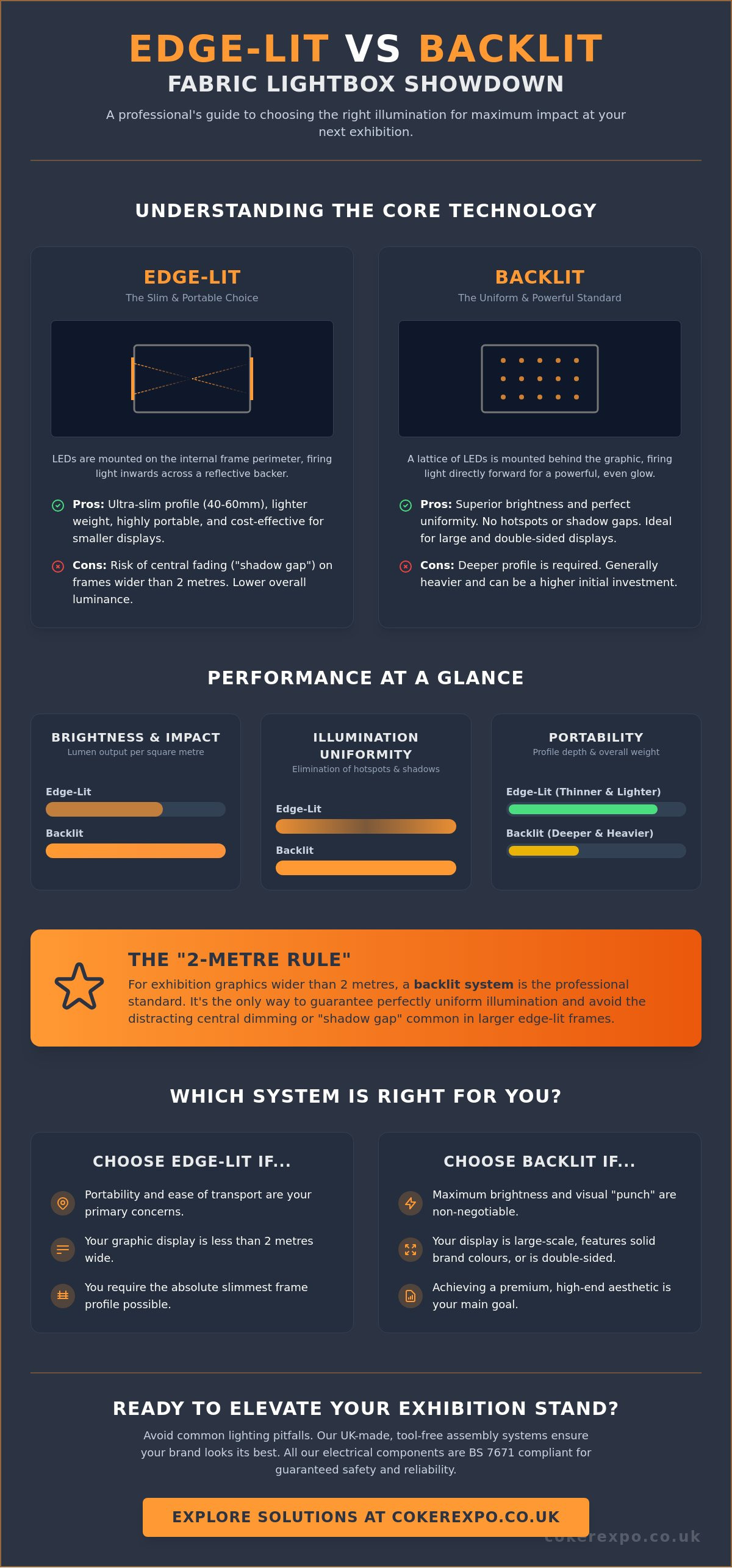
Choosing the right illumination for your exhibition stand isn't just about brightness; it's about the underlying engineering. The decision between edge-lit vs backlit fabric lightboxes dictates how your branding will actually perform under harsh trade show lights. At its core, an edge-lit system uses LEDs mounted to the internal perimeter of the frame. These fire light inward towards a reflective backer. Conversely, a backlit system uses a lattice or ladder of LEDs mounted to a backplate or internal struts, firing light directly forward. Understanding the Core Technology is the first step in ensuring your graphics don't just sit there, but actually command attention.
Before diving into the mechanics, you need to be familiar with a few industry terms. Most modern lightboxes use a Tension Fabric System (TFS), where your graphic is finished with a Silicone Edge Graphic (SEG) bead. This bead tucks into the frame for a drum-tight, seamless finish. The goal of any setup is high luminance, which is the measure of light emitted from the surface of your display. If the luminance is uneven, your brand's impact is diluted. Professional exhibitors prioritise consistent luminance to ensure their colours remain vibrant and their text stays legible from across the hall.
The Mechanics of Edge-lit Perimeter Lighting
Edge-lit systems are the go-to choice when portability and a slim aesthetic are the priorities. Because the LEDs are tucked into the frame's edge, these systems can achieve ultra-thin profiles, often as shallow as 40mm to 60mm. The light is directed inward across a reflective backing or a specialised panel that bounces the photons forward through the fabric. It's an efficient design for smaller displays. However, physics presents a challenge as frames get larger. Light naturally dissipates as it travels. In frames wider than two metres, you might notice "fading" in the centre where the perimeter LEDs simply can't reach with enough force. This can leave your central messaging looking dull compared to the bright edges.
The Lattice Approach of Backlit Fabric Frames
When you need maximum punch and total uniformity, the lattice approach of a backlit frame is the professional standard. By mounting LEDs in a grid directly behind the graphic, the system provides direct, powerful illumination. The key here is the "pitch," or the spacing between individual LEDs. When the pitch is correct, the light from each bulb overlaps with its neighbour, creating a solid wall of light. This eliminates the risk of dark patches or "shadow gaps." Backlit systems are also the only reliable choice for double-sided displays, as they can house two separate LED ladders to illuminate graphics on both the front and back of the frame without any interference or loss of intensity.
To make either system work, a diffuser is essential. In fabric systems, the diffuser layer sits between the LEDs and the graphic. It scatters the light to prevent "hotspots," which are those distracting bright points where the individual LED bulbs are visible through the fabric. It turns raw electrical output into a professional, soft glow that makes your colours pop and your stand look like a premium brand destination.
Performance Comparison: Brightness, Uniformity, and Visual Impact
Visual performance at a trade show isn't just about being bright; it's about being consistently visible under the aggressive overhead lighting of an exhibition hall. When evaluating edge-lit vs backlit fabric lightboxes, the most immediate difference is the "glow" factor. While edge-lit systems are efficient, backlit arrays provide a significantly higher lumen output per square metre. This raw power ensures that your dye-sublimation graphics maintain their intended colour vibrancy, preventing the washed-out look that can occur when external hall lights overpower your display.
A frequent frustration for exhibitors using large-format edge-lit frames is the "Shadow Gap" or "vignette" effect. Because light must travel from the perimeter to the centre, the middle of the graphic often appears dimmer than the edges. Backlit systems solve this by providing a constant wall of light. This uniformity is vital for maintaining brand integrity, especially when your design features large areas of solid colour or high-contrast photography. To ensure your hardware meets professional standards, you should consider Structural and Performance Considerations regarding light distribution and energy efficiency before making a final investment.
Consistency is also a matter of colour temperature, measured in Kelvin. If you're using multiple lightboxes across a single stand, they must match. A "cool white" lightbox next to a "warm white" one will make your graphics look mismatched and unprofessional. We ensure all our LED components are batch-tested for colour consistency so your stand remains cohesive. If you're looking for a reliable setup, our range of professional lightboxes is designed to deliver this exact level of uniformity.
Achieving Seamless Uniformity with Backlit Arrays
Backlit arrays are the non-negotiable choice for graphics with expansive white backgrounds or deep, dark tones. These designs are the most sensitive to lighting irregularities. By using a dense lattice of LEDs, you eliminate the risk of dark patches, ensuring a flat and punchy image. This level of precision is a cornerstone of effective exhibition stand design, where the goal is a seamless, high-end appearance that reflects your brand's quality. It's the difference between a display that looks like a poster and one that looks like a high-definition architectural feature.
Maximising Luminance in High-Glare Environments
Exhibition halls are notorious for high-glare environments that can swallow up standard retail lighting. You need "stopping power" to attract foot traffic from twenty metres away. Backlit systems provide the necessary punch to cut through ambient light, making your graphics pop even in the brightest venues. Lux is the measurement of light reaching the fabric surface. By maximising lux through direct backlighting, you ensure your message remains legible and impactful regardless of the venue's own lighting setup. This superior luminance is what converts a passive passerby into an engaged lead.
Structural Considerations: Depth, Weight, and Portability for UK Exhibitors
Physical logistics often dictate the success of an exhibition stand as much as the graphics themselves. When weighing up edge-lit vs backlit fabric lightboxes, the structural footprint is a primary deciding factor for UK marketing teams. Edge-lit frames offer a compact profile, typically ranging from 40mm to 60mm in depth. In contrast, backlit systems require a deeper cavity, usually 80mm to 120mm, to allow for proper light diffusion and to prevent hotspots. This depth difference isn't just about aesthetics; it directly impacts how much floor space your display occupies in a crowded venue.
The choice of LED backlighting technologies influences the overall weight of the system. While backlit arrays contain more LEDs, modern ladder systems are designed to be lightweight and modular. This shift has revolutionised the hire market, moving away from heavy, fixed-frame boxes to 'pack-flat' solutions that reduce shipping costs and drayage fees. At Coker Expo, we prioritise tool-free assembly across our range, ensuring that even complex backlit systems can be built in minutes by a single person. Speed on-site is non-negotiable when you're working against strict hall breakdown deadlines.
The Ultra-Slim Profile Advantage of Edge-lit Frames
Edge-lit frames excel in tight shell schemes where every centimetre of floor space is a premium. Their shallow profile creates a modern, minimalist 'iPad look' that integrates seamlessly into contemporary stand designs. If you intend to wall-mount your graphics or recess them into existing architecture, the slim nature of edge-lit hardware makes it the superior choice for a flush, professional finish. It provides a sleek, non-intrusive way to add illumination without the bulk of traditional frames.
Managing Logistics: Weight and Assembly for Trade Shows
There's a common myth that any backlit lightbox is inherently heavy and difficult to manage. Modern engineering has largely solved this. By using high-performance aluminium and foldable LED ladders, these systems now offer exceptional portability. Durability is another key factor. While edge-lit LEDs are protected within the frame, our backlit arrays are designed to withstand the rigours of national exhibition circuits, with LEDs securely mounted to prevent damage during transit. The setup time for our modular backlit frames is often comparable to perimeter-lit versions, thanks to our commitment to tool-free connectors and logical component numbering.
Selection Framework: Which Lightbox Suits Your Specific Exhibition Goals?
Choosing the right hardware is a balance of scale, budget, and intended impact. When evaluating edge-lit vs backlit fabric lightboxes, size is your most reliable guide. A professional rule of thumb is to avoid edge-lit systems for any graphic exceeding two metres in width or height. Beyond this point, the physics of light travel makes it difficult to maintain a punchy, uniform glow in the centre of the frame. For large-format displays that need to act as a focal point, the investment in a backlit array is non-negotiable to avoid a flat, unprofessional appearance.
Safety and compliance are equally critical for UK exhibitors. Every component of your stand must meet strict venue regulations, including the 18th Edition of the IET Wiring Regulations (BS 7671). Beyond the electrics, your fabrics must carry B1 or M1 fire retardancy certifications. This is especially vital when integrating lighting into shell scheme graphic panels, where space is tight and heat dissipation is a factor. We ensure all our systems meet these rigorous standards, providing the necessary peace of mind for event organisers and health and safety officers.
Consider the longevity of your investment. While LED life cycles are generally long, the ease of maintenance varies. Backlit systems with modular LED ladders allow for the simple replacement of individual strips if a fault occurs. Edge-lit systems, while robust, often require more complex disassembly if an internal perimeter strip fails. If you plan to use your display across a high-frequency event calendar, the modularity of a backlit system often provides better long-term ROI. To find the right balance for your next show, explore our full range of professional exhibition displays.
When to Choose Edge-lit for Retail and Small Stands
Edge-lit lightboxes are the ideal solution for high-frequency graphic changes and smaller promotional footprints. They are particularly effective for portable promotional counters or text-heavy graphics where absolute edge-to-edge uniformity is less critical than ease of transport. For short-term pop-up events or retail environments where floor space is at a premium, these slim frames provide a cost-effective way to add illumination without the logistical overhead of deeper backlit units. They offer a sleek, modern aesthetic that works perfectly for smaller, targeted messaging.
Why Backlit is Essential for High-End Space Only Stands
For "Space Only" stands where you need to create a 'beacon' effect, backlit arrays are the industry standard. These systems provide the intensity required to cut through the visual noise of a large exhibition hall. They are also the preferred choice for integrating into large-scale truss truss structures, where they can be used to create massive, glowing architectural features. Luxury brands almost exclusively choose backlit tension fabric because it delivers a premium, high-definition finish that edge-lit alternatives simply cannot match at scale.
Beyond the Basics: Dynamic Lightboxes and Tool-Free Innovation at CokerExpo
While the technical debate between edge-lit vs backlit fabric lightboxes often centres on static images, the industry is moving toward more interactive, high-engagement solutions. Dynamic lightboxes represent the next evolution of the backlit system. By using programmable LED arrays instead of standard static ladders, these displays can simulate movement within a fixed fabric graphic. This allows you to animate specific brand elements, such as flowing liquid or flickering light, providing a level of depth that a standard frame cannot replicate.
Our approach at Coker Expo is grounded in British craftsmanship and practical engineering. We manufacture our frames in the UK, which allows us to maintain strict quality control over every component. One of our most significant innovations is tool-free tensioning. Achieving a drum-tight finish is essential for a professional look, and our modular systems are designed to make this process intuitive. You don't need a specialist installation team to achieve a high-end result; our hardware is built for the exhibitor who values independence and speed on-site.
Sustainability is also a core focus of our design philosophy. We've shifted toward modular, replaceable LED components to extend the life of your hardware. Instead of replacing an entire unit, you can simply swap out individual strips or drivers. When combined with our recyclable tension fabric graphics, these systems offer a more responsible choice for brands looking to reduce their environmental footprint without sacrificing visual impact.
Introducing Dynamic LED Animation for Maximum Engagement
Dynamic LED animation is a powerful tool for cutting through the noise of a busy trade show. In an environment filled with static messaging, movement is a natural magnet for the human eye. Some industry reports suggest that moving displays can capture up to 400% more attention than static alternatives. Our HueBox systems are designed as plug-and-play solutions, allowing marketing teams to deploy complex visual effects and sound integration without the need for advanced technical training or complex coding.
Professional TFS Solutions with Tool-Free Assembly
Reducing stand-build stress is at the heart of our modular frame systems. Our professional TFS solutions are engineered for tool-free assembly, using high-performance connectors that ensure structural integrity. This allows you to focus on your event strategy rather than hardware logistics. We specialise in customisation, adapting both edge-lit and backlit technology to meet unique brand requirements, from bespoke curved frames to massive architectural installations. Explore our full range of exhibition lightboxes and find your perfect match.
Selecting the Perfect Infrastructure for Your Next Exhibition
Choosing between edge-lit vs backlit fabric lightboxes is a strategic decision that directly affects your stand's visibility and your team's on-site efficiency. You've seen that while edge-lit frames offer a sleek, slim profile for smaller displays, backlit arrays provide the essential punch and uniformity required for large-format graphics in high-glare environments. Prioritising tool-free assembly and UK safety compliance ensures your display remains a reliable business asset rather than a source of event-day stress.
Coker Expo has been trusted by national brands for over 25 years to provide high-performance display solutions. We specialise in tool-free, fast-turnaround systems that are designed and manufactured right here in the UK. Our team provides expert support to help you navigate technical specifications and bespoke requirements with confidence. Maximise your stand impact with CokerExpo's professional lightbox range and ensure your brand stands out for all the right reasons. We're ready to help you build a stand that delivers real results at your next show.
Frequently Asked Questions
Is an edge-lit lightbox cheaper than a backlit one?
Edge-lit systems are usually more affordable for smaller applications because they require fewer LED components. However, for larger formats, the cost gap narrows. The primary investment in a backlit system goes into the high-density LED ladder, which provides the superior luminance needed for high-impact branding. When evaluating edge-lit vs backlit fabric lightboxes, you're paying for the "punch" and uniformity that a perimeter-lit frame cannot achieve at scale.
Can I use the same fabric graphic for both edge-lit and backlit frames?
You can technically use the same dye-sublimation graphic if the dimensions and SEG bead match. It's important to check the fabric density, though. Backlit frames require a slightly thicker material or a dedicated diffuser layer to prevent the individual LED bulbs from being visible. Edge-lit systems are more forgiving with thinner fabrics but may not show the colours as vibrantly as a direct-lit setup.
What is the maximum size for an edge-lit fabric lightbox before it loses brightness?
We recommend a maximum size of two metres for any edge-lit display. Beyond this dimension, physics takes over and the light intensity drops off significantly in the centre. When comparing edge-lit vs backlit fabric lightboxes for a large-scale stand, anything over 2m should always be backlit to ensure your brand message remains clear and professional across the entire surface of the graphic.
Do backlit lightboxes get hot during long exhibition days?
Modern LED technology is designed for long-term use without overheating. Even during a busy three-day trade show, our lightboxes remain cool to the touch. The aluminium frame acts as a natural heat sink, and the low-voltage LEDs are highly efficient. You don't have to worry about damage to your fabric graphics or safety risks on a crowded exhibition floor during ten-hour show days.
How do I assemble a large backlit lightbox without professional tools?
Assembly is straightforward with our tool-free modular systems. The frame components simply click together using spring-loaded buttons or integrated locking mechanisms. For large backlit units, the LED ladders are designed to roll out and clip into the internal struts. It's a logical, fast-paced process that allows your team to focus on marketing and lead generation rather than struggling with complex hardware logistics.
Are LED lightboxes energy efficient for 3-day trade shows?
LED lightboxes are the most energy-efficient option available for trade shows. They consume a fraction of the power required by older lighting technologies. Most of our systems run comfortably on a standard 230V UK supply and are compatible with the RCD protection required by major venues. This efficiency helps you stay within your venue's power limits while maintaining a bright, impactful stand.
What happens if a single LED bulb fails in a backlit array?
If a single LED fails, your display will continue to function. Our backlit ladders are engineered so that one faulty bulb doesn't break the entire circuit. Because our systems are modular and made in the UK, we can easily provide a replacement LED strip if needed. You don't have to replace the whole frame, making it a sustainable and cost-effective long-term investment for your business.
Which lighting type is better for double-sided exhibition displays?
Backlit systems are the professional standard for double-sided displays. They provide independent illumination for both graphics, ensuring that neither side looks dim or washed out. Edge-lit frames struggle with double-sided tension because the light has to be shared across a wider space, often leading to central shadows. For a freestanding island stand, a backlit array is the only way to achieve maximum visual impact from every angle.
Laisser un commentaire