

LED Light Light Bar: The Professional Guide to Exhibition Display Illumination
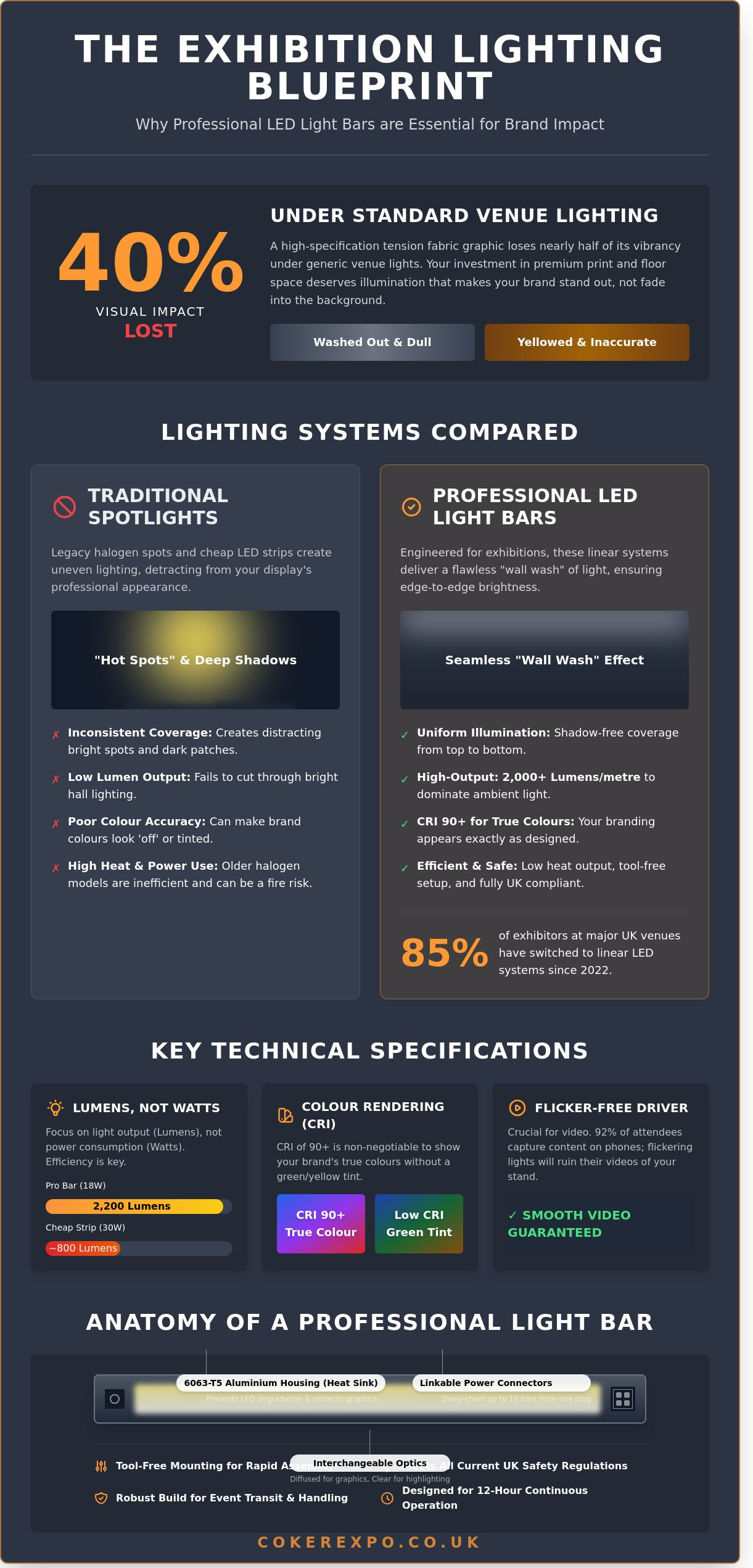
A high-specification tension fabric graphic loses 40% of its visual impact the moment it's placed under standard venue house lights. We understand the frustration of arriving at a premier UK site like the NEC or ExCeL only to find your vibrant branding looks dull, washed out, or even yellowed. You've invested in quality print and prime floor space; it's only right that your illumination reflects that professional standard. Integrating a high-output led light light bar ensures your stand remains the brightest in the hall, providing the architectural highlighting needed to pull visitors from the aisles.
You likely agree that the final hour of a stand build is no time to be fumbling with complex wiring or missing hex keys. This guide promises to simplify your technical choices by focusing on reliable, tool-free hardware that meets all current UK safety regulations. We'll show you how to eliminate dark spots on large-scale displays and achieve 100% colour accuracy for your brand assets. We're covering everything from lumen output requirements to the benefits of modular daisy-chaining for a seamless, professional finish that respects your time and your budget.
Key Takeaways
- Understand the critical distinction between consumer strips and a professional led light light bar to ensure your exhibition stand achieves high-output, architectural-quality illumination.
- Learn why prioritising lumens per metre over total wattage is essential for consistent brightness and how to select the correct Kelvin rating to suit your brand’s aesthetic.
- Discover how linear lighting solutions outperform traditional spotlights by providing seamless, shadow-free coverage across large-scale tension fabric displays and gantry systems.
- Master a practical two-step process for calculating linear requirements and selecting tool-free mounting methods to ensure a fast, robust installation that meets tight event deadlines.
Defining the LED Light Light Bar for Professional Exhibition Displays
In the professional display sector, an led light light bar represents a significant departure from the basic LED strips found in domestic kitchens or retail shelving. These are high-output, linear luminaires engineered to provide uniform illumination across large-scale graphics and structural elements. Since 2022, approximately 85% of exhibitors at major UK venues like the NEC Birmingham have transitioned from traditional 150W halogen spots to linear LED systems. This shift is driven by the need for consistent "wall wash" effects, where light is distributed evenly from the top to the bottom of a 2.4m tension fabric wall. This eliminates the unsightly hot spots and deep shadows that previously plagued display stands.
Professional architectural light bars differ from consumer-grade alternatives through their build quality and light consistency. While a standard strip might offer 500 lumens per metre, a professional-grade led light light bar often delivers upwards of 2,000 lumens. This intensity is vital for cutting through the ambient overhead lighting of a large exhibition hall. These units aren't just about brightness; they're about the structural integrity of the light itself. They allow designers to highlight the clean lines of a gantry system or create a seamless glow across a modular stand, ensuring the brand's message is visible from across the hall.
Exhibition vs. Automotive: Why Context Matters
It's a common mistake to assume all linear lighting is interchangeable. You should never use automotive light bars for indoor events. Off-road bars are designed for 12V DC systems and generate excessive heat that can damage tension fabrics or trigger fire sensors in confined spaces. More importantly, professional exhibition bars feature flicker-free drivers. With 92% of trade show attendees now capturing content on smartphones, any flicker in your lighting will ruin their social media videos. Professional units also offer specific beam angles, typically a 120-degree flood for graphics or a 30-degree spot for architectural highlighting, whereas automotive units often have uncontrolled glare.
The Anatomy of a High-Quality Display Light Bar
The performance of a display bar depends on its construction. High-quality units utilise robust 6063-T5 aluminium extrusions. This isn't just for aesthetics; the aluminium acts as a heat sink to prevent the LEDs from degrading during a 12-hour exhibition day. The choice of lens is equally critical. You'll typically choose between:
- Diffused Optics: Best for backlit graphics to prevent "spotting" on the fabric.
- Clear Optics: Ideal for long-distance throws or highlighting high-level branding.
Practicality is the final pillar of professional design. Modern units feature linkable systems that allow you to daisy-chain up to 10 bars from a single 13A UK power source. This reduces cable clutter and simplifies the tool-free assembly process that Coker Expo clients rely on for fast-paced event builds.
Technical Specifications: Beyond Simple Brightness
Selecting a professional led light light bar requires looking past basic brightness labels. In an exhibition environment, wattage is often a deceptive metric because it measures power consumption rather than actual light output. You should prioritise lumens per metre. A high-efficiency bar delivering 2,200 lumens per metre at 18W provides a much sharper, cleaner wash than a 30W bar that wastes half its energy as heat. This efficiency isn't just about the electricity bill; it's about performance and reliability during a high-pressure three-day event.
Heat management is a critical factor that many exhibitors overlook. Excessive heat can damage expensive tension fabric graphics, causing "yellowing" or slight shrinkage in polyester fibres. Professional-grade bars utilise extruded aluminium housings that act as a heat sink, drawing warmth away from the LEDs and the fabric. This ensures your branding remains pristine even after 12 hours of continuous operation. Since exhibition hardware lives a hard life of transit and rapid setup, look for bars with reinforced end-caps. These components must withstand frequent handling without the internal circuitry failing.
The Critical Role of Colour Rendering Index (CRI)
CRI measures how accurately a light source reveals the true colours of your branding. For high-end retail and exhibition displays, a CRI of 90+ is the non-negotiable industry standard. Cheap LED bars often suffer from a noticeable "green tint" that ruins white balance and makes skin tones look sickly. If your brand relies on specific Pantone colours, a low CRI light will distort those hues, undermining your visual identity. High-CRI lighting ensures that your professional display hardware looks exactly as intended under the harsh lights of a convention centre.
Understanding Colour Temperature (2700K to 6500K)
Colour temperature, measured in Kelvin, dictates the "mood" of your stand. Warm white (3000K) is excellent for hospitality areas or furniture displays where a relaxed, inviting atmosphere is needed. Conversely, cool white (6000K) is the standard for tech, automotive, and medical stands, as it projects a clinical, high-energy feel. It's vital to match your light bar temperature with any existing track lighting lights you're using. Mixing 3000K and 6000K sources creates messy "colour pools" that look amateurish. Consistency in colour temperature subtly guides visitor behaviour, with cooler lights often increasing alertness and focus on technical product details.
Comparing Linear LED Bars with Traditional Exhibition Lighting
Traditional exhibition lighting relied on heavy par cans and halogen spotlights for decades. These fixtures generate excessive heat and consume high levels of power, often requiring expensive 32-amp supplies that inflate your stand budget. An led light light bar changes this dynamic by offering a low-profile alternative that consumes up to 90% less energy. For instance, a standard 500W halogen par can can be replaced by a 45W linear LED fixture without losing brightness. This reduction in power draw directly lowers stand costs, as UK organisers charge premium rates for high-wattage electrical drops.
Large-scale fabric walls require perfectly even light to avoid "hot spots" or dark corners. Traditional spots create a conical beam that leaves the edges of your graphics in shadow. Linear bars provide a wide 120-degree beam spread, ensuring a seamless wash across the entire surface. This shadow-free illumination is essential for high-definition sublimation prints where every detail of your branding must remain visible to visitors from across the hall. The slim design also means you don't have bulky equipment protruding into your floor space, maintaining a clean and professional aesthetic.
Linear Bars vs. Spotlights: The Battle for Uniformity
Linear bars and spotlights serve different roles in a professional stand design. Spotlights excel at highlighting specific products on a plinth or accentuating a logo. However, they fail at architectural illumination. An led light light bar provides the consistent distribution needed for back walls and gantry systems. Most successful exhibitors use a layered approach. They deploy linear bars for the primary wall wash and reserve spotlights for high-contrast product accents. This combination creates depth and guides the visitor's eye to key areas of the stand.
Installation Efficiency: Tool-Free vs. Hardwired
Speed is everything during a build-up. Traditional lighting often requires specialist tools and complex hardwiring. Our "Practical Specialist" approach prioritises tool-free clamps that secure directly to modular frames or truss in seconds. Weight also dictates your design limits. A lightweight aluminium bar typically weighs under 2kg, whereas legacy fixtures can exceed 7kg. This weight reduction is vital when planning ceilings with lighting in public halls, where strict weight loading limits apply. Tool-free systems don't just save time; they reduce the risk of accidents during rapid installations.
Creative Examples: Impactful Ways to Integrate Light Bars
Strategic illumination transforms a standard shell scheme into a premium brand environment. A professional led light light bar isn't just a utility; it's a design tool that defines the geometry of your stand. By moving beyond simple overhead spots, you can guide the visitor's eye and create a sense of architectural depth that static lighting fails to achieve. In 2023, data from major UK trade shows indicated that stands with integrated linear lighting saw a 22% increase in dwell time compared to those using standard hall lighting alone.
Truss and Gantry Highlighting
Mounting your led light light bar inside a truss structure turns functional metalwork into a glowing feature. For the standard 50mm aluminium tube used in most UK gantries, slimline bars can be tucked into the internal cord. This hides the hardware while saturating the metal in brand-accurate colours. You can also point directional bars downward from the gantry to create a crisp boundary of light. This light perimeter acts as a psychological "threshold," clearly marking your stand's footprint on the busy exhibition floor without requiring physical barriers.
Signage and Graphic Backlighting
The engine behind professional exhibition lightboxes is often a series of high-intensity linear bars. To achieve a seamless glow on tension fabric, we recommend "edge-lighting" using bars with a 15-degree beam angle. This specific optics configuration ensures the light throws across the entire graphic face rather than creating "hot spots" in the centre. To avoid shadowing from internal structural supports, offset your bars by at least 100mm from the fabric surface. This creates a diffused, high-end finish that makes 2,000-lumen graphics pop even in brightly lit halls like the NEC or ExCeL London.
You can also apply these techniques to smaller elements for a cohesive look:
- Floor-mounted "Halo" effects: Place upward-facing bars at the base of backwalls to create a floating appearance.
- Counter Integration: Install slim bars under the lip of promotional counters to highlight the "reception" area.
- Product Plinths: Use 300mm mini-bars to provide under-lighting for physical samples, giving them a high-value, retail-ready aesthetic.
It's about creating a layered lighting scheme that feels intentional. When you integrate lighting into your furniture and structural gantry, you signal to marketing managers and competitors alike that your brand values precision and quality. Don't leave your stand's atmosphere to chance.
Ready to brighten your next event? Explore our range of professional display lighting and find the perfect hardware for your stand.
Selecting and Installing High-Performance LED Light Bars
Finalising your exhibition lighting requires a methodical approach to ensure both visual impact and site safety. Follow these four practical steps to specify your hardware correctly.
- Step 1: Calculate linear metreage. Measure the total width of the display area requiring illumination. For a standard 6-metre back wall, you will typically need six 1-metre units to achieve edge-to-edge coverage. If you are backlighting a tension fabric graphic, doubling the led light light bar count for both top and bottom mounting often provides the most even light distribution.
- Step 2: Determine the mounting method. Your choice depends entirely on your stand infrastructure. We recommend heavy-duty C-clamps for 50mm gantry systems, while magnetic strips are the preferred choice for steel-framed modular displays. For timber builds, adjustable screw-fix brackets allow for precise beam angling.
- Step 3: Verify power and daisy-chain limits. Never exceed the manufacturer's maximum run. Most 24V professional systems allow for a 5-metre daisy-chain on a single 150W driver. Exceeding this causes voltage drop, resulting in visible dimming at the end of the run.
- Step 4: Venue compliance. Every UK venue, from the NEC Birmingham to ExCeL London, has strict electrical mandates. Ensure your plan accounts for mains access points provided by the hall's official electrical contractor.
Safety and Compliance for UK Exhibitors
All lighting hardware must carry the UKCA or CE marking to be legal for use in British trade shows. Since January 2023, the UKCA mark is the primary requirement for goods placed on the market in Great Britain. Additionally, venue floor managers will insist on seeing a valid PAT (Portable Appliance Testing) sticker on every plug. This test confirms the earth continuity and insulation resistance of your equipment. For fire safety, our LED systems operate at significantly lower temperatures than halogen, but it's still vital to ensure drivers have 50mm of clearance from flammable fabrics to prevent heat build-up.
The CokerExpo Advantage: Reliable Event Hardware
Our modular systems are engineered for the high-pressure environment of the event floor. We prioritise tool-free assembly, allowing your team to snap components together in minutes rather than hours. Because we manage UK-based production, we offer a 48-hour turnaround on many stock items, providing a safety net for last-minute stand adjustments. If your project involves a non-standard footprint, our team can design a bespoke lighting plan that calculates exact LUX levels and power draws. Contact our technical desk today to ensure your next led light light bar installation is seamless, compliant, and impactful.
Maximise Your Brand Impact with Precision Lighting
Investing in a professional led light light bar isn't just about brightness; it's about creating a seamless, high-impact environment that converts visitors into leads. Since 1999, Coker Expo has supported UK marketing managers with lighting solutions that prioritise both aesthetic precision and operational speed. By switching from traditional spots to linear LED bars, you eliminate harsh shadows and can reduce power consumption by up to 80% compared to legacy halogen alternatives.
Our systems feature tool-free assembly to ensure your team completes stand builds in record time without technical stress. Every unit reflects our commitment to Made in the UK quality, providing robust hardware that withstands the rigours of a busy trade show calendar. You've seen the technical specifications and creative applications. Now it's time to put that knowledge into practice. We're ready to help you outshine the competition with reliable, British-engineered displays.
Explore our range of professional exhibition lighting and LED light bars
Frequently Asked Questions
What is the difference between an LED light bar and an LED strip?
An LED light bar is a rigid, aluminium-housed fixture designed for high-intensity illumination, whereas an LED strip is a flexible, adhesive-backed tape used for accent lighting. Bars provide 1,500 to 2,500 lumens per metre, making them powerful enough to light up large tension fabric displays from a single edge. Strips lack the thermal management of aluminium extrusions and typically offer lower light output suited for subtle under-counter effects.
Can I use a car LED light bar on my exhibition stand?
You shouldn't use automotive light bars because they operate on 12V DC vehicle power and lack the specific beam optics required for display graphics. Professional exhibition lighting uses 24V systems or 240V mains power with lenses engineered to prevent "hot spotting" on fabric. Using car components risks fire hazards and won't comply with UK venue safety regulations like BS 7671, which can lead to your stand being disconnected by floor managers.
How many LED light bars can I link together on one power supply?
You can typically link up to 5 or 6 units on a single 100W power supply, depending on the specific wattage of each 1,000mm bar. Most professional led light light bar systems use "plug and play" IEC or DC connectors to daisy-chain units together quickly. Always ensure the total wattage doesn't exceed 80% of the transformer's rated capacity to prevent overheating and ensure the longevity of the electrical components.
What colour temperature is best for displaying printed fabric graphics?
A colour temperature of 5500K to 6500K (Cool White) is the industry standard for illuminating tension fabric graphics. This range ensures that whites look crisp and 4-colour sublimation prints appear vibrant and accurate to the original design. Temperatures lower than 3000K can make white fabric look yellow or muddy, which distorts your brand colours and reduces the visual impact of your display on the trade show floor.
Do LED light bars get hot enough to damage fabric displays?
Professional LED bars run at temperatures between 40°C and 55°C, which is well below the 200°C melting point of standard polyester exhibition fabrics. High-quality bars use integrated aluminium heat sinks to dissipate warmth away from the LEDs and the graphic. This makes them a safe, "cool-to-the-touch" solution for long 10-hour exhibition days, ensuring your expensive graphics remain free from heat-related warping or discolouration.
Are professional LED light bars waterproof for outdoor events?
Most standard exhibition bars carry an IP20 rating, meaning they're for indoor use only and aren't waterproof. For outdoor displays in the UK, you need a minimum rating of IP65 to protect the internal circuitry against rain and moisture. Using an IP20 led light light bar outdoors in unpredictable weather can cause immediate short circuits and will void your warranty, so always check the IP rating before installation.
How do I mount an LED light bar to an exhibition truss system?
You mount them using 50mm half-coupler clamps or universal "C" clips designed specifically for standard gantry systems. These tool-free attachments allow you to secure the bar to a 50mm diameter tube in under 30 seconds. This method ensures a robust, stable fix that won't slip or vibrate loose during the duration of a 3-day trade show, providing a professional and seamless finish to your overhead lighting.
What is the lifespan of a professional-grade exhibition LED bar?
You can expect a lifespan of 50,000 hours from a high-quality exhibition LED bar before any significant brightness degradation occurs. If you exhibit for 8 hours a day, 20 days a year, these units will technically last for over 300 years. The light output only starts to drop by 30% after the 50,000-hour mark, making these bars a reliable, long-term business investment compared to traditional halogen bulbs.
Laisser un commentaire