

Lighting Truss Buying Guide: Choosing the Right System for Your Event in 2026
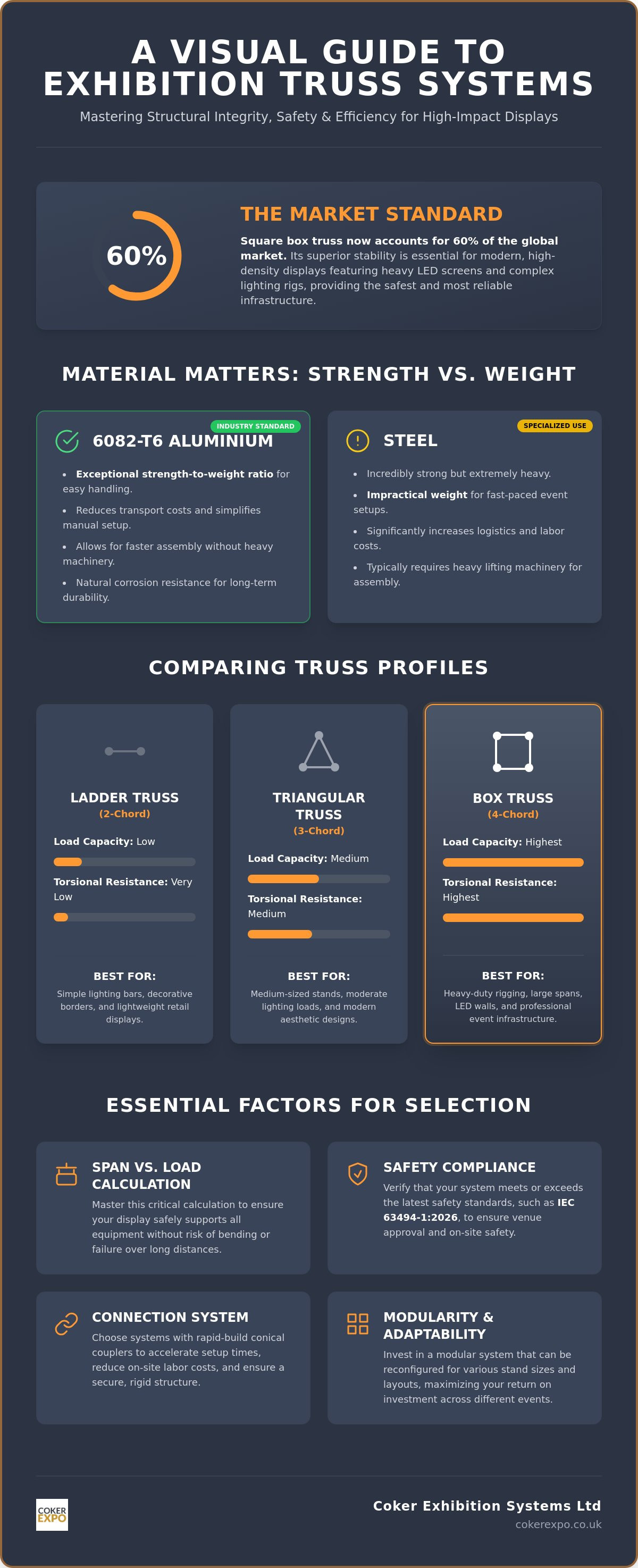
Did you know that square box truss now accounts for 60% of the global market because it provides the essential stability required for modern, high-density displays? If you've ever felt the logistical strain of a complex assembly or questioned the load-bearing safety of your rig, you aren't alone. Choosing the right lighting truss is no longer just about hanging lamps; it's about creating a reliable, professional infrastructure that meets the latest IEC 63494-1:2026 safety requirements.
We understand that your priority is a high-impact presentation that doesn't blow your budget on labor or setup time. This guide will help you master the technical specifications and structural options of modern systems to ensure your next exhibition is both safe and efficient. We'll examine the practical differences between ladder, triangular, and square profiles, explain why 6082-T6 aluminum alloy is the non-negotiable choice for heavy loads, and provide a clear framework for matching truss types to your specific stand dimensions.
Key Takeaways
- Move beyond basic pop-up stands by utilizing modular aluminum frameworks that offer superior structural integrity and professional brand presentation.
- Identify the ideal profile for your event by comparing the functional advantages of ladder, triangular, and box lighting truss configurations.
- Master the "Span vs. Load" calculation to ensure your display safely supports heavy equipment while remaining compliant with 2026 safety regulations.
- Accelerate your setup times and reduce on-site labor costs by selecting systems featuring rapid-build conical coupler connections.
- Discover how to adapt modular components into bespoke layouts that maximize visual impact for trade shows, corporate events, and aerial displays.
Understanding Lighting Truss: Why Your Exhibition Layout Needs a Professional Frame
A lighting truss is a modular aluminium framework engineered for high structural integrity and aesthetic impact. While entry-level exhibitors often rely on basic pop-up stands, professional brands utilize truss systems to create a more permanent, architectural presence. This transition is driven by the need to support heavier equipment while reclaiming valuable floor space. By shifting your branding and hardware overhead, you clear the aisle-facing area for better visitor flow and more natural engagement.
The truss serves as the structural skeleton for your entire display. It provides the necessary rigging points for high-impact elements like exhibition lightboxes, tension fabric graphics, and overhead signage. Without this frame, your ability to scale vertically is severely limited. A well-planned truss layout allows you to dominate the eyeline of the venue, ensuring your brand is visible from across the hall.
The Role of Truss in Professional Event Infrastructure
Truss systems provide a secure mounting point for heavy LED screens and high-output lighting. This capability is essential for modern event design, where visual density often dictates the level of attendee engagement. Beyond the technical utility, there's a significant psychological impact. A built environment suggests authority and stability, making your brand feel like a destination rather than a temporary stop. Because these systems are modular, they offer an excellent return on investment. You can reconfigure the same components for a small shell scheme or a large, bespoke island stand depending on your requirements.
Aluminium vs. Steel: Why Material Choice Matters
Aluminium is the industry standard for exhibition truss because of its exceptional strength-to-weight ratio. While steel is incredibly strong, its weight makes it impractical for the high-pressure, fast-paced world of event setup. Using aluminium reduces transport costs and simplifies manual handling for your crew. It allows for faster assembly without the need for heavy lifting machinery in most indoor environments. High-grade aluminium alloys also offer natural corrosion resistance, ensuring your lighting truss maintains its professional, industrial aesthetic over years of intensive use and frequent transport. For permanent architectural projects requiring similar high-performance materials, CFRP structural strengthening UK offers an advanced solution for reinforcing building frameworks.
Comparing Truss Profiles: Ladder, Triangular, and Box Systems
The geometry of your lighting truss is the most critical factor in determining its load-bearing capacity and aesthetic profile. Every system relies on a specific "chord" count, which refers to the main longitudinal tubes that provide structural rigidity. As you move from two chords to four, the system's ability to resist bending and twisting increases significantly. Understanding this "form vs. function" trade-off helps you select a system that manages your equipment weight without adding unnecessary bulk to your transit logistics.
While standard configurations work for most, the adaptability of truss truss systems allows for bespoke stand designs that break away from traditional boxy layouts. Whether you're planning a curved aerial display or a multi-level structure, the chord count directly impacts your maximum span. For instance, a box truss can often bridge gaps exceeding 10 metres, whereas a ladder truss might reach its safe limit much sooner.
Ladder and Triangular Truss: Lightweight Versatility
Ladder truss (2-chord) is the most portable option, making it ideal for simple lighting bars, decorative borders, or retail window displays where space is at a premium. It's easy to store and requires minimal effort for manual handling. Triangular truss (3-chord) offers a significant step up in stability while providing a distinct "apex-up" or "apex-down" look that many designers prefer for its modern aesthetic. It's the ideal balance for medium-sized exhibition stands where you need to support a moderate amount of exhibition lighting without the visual weight of a full box frame.
Box Truss: The Heavy-Duty Standard
Box truss (4-chord) is the definitive choice for professional rigging and large-scale event displays. Its square profile is designed to resist torsional forces, ensuring the structure doesn't twist under uneven loads. This is vital when hanging heavy LED walls or moving head fixtures. Because it offers the highest load-bearing capacity per metre, it's the only viable option for spans reaching across large venue floors. When planning these complex rigs, always consult professional rigging safety factors to ensure your hardware choices align with the physical demands of your equipment. If you're unsure which profile fits your specific footprint, you can view our full range of truss solutions to find the right match for your next project.
Essential Factors to Evaluate Before You Buy
Selecting a lighting truss requires a precise understanding of the "Span vs. Load" relationship. This is a fundamental engineering principle where the weight-bearing capacity of a beam decreases as the distance between its supports increases. Before you commit to a system, you must calculate the total weight of your fixtures, cabling, and branding. Overestimating your needs leads to unnecessary transport costs, while underestimating them creates a significant safety risk on the show floor.
Future-proofing is equally important for your business investment. A modular system allows you to start with a basic goalpost rig and expand into complex, multi-tiered structures by adding standard junctions and corners. You should also consider the transportability factor. Professional systems are designed in manageable lengths that fit comfortably into standard commercial vans, reducing the need for specialized logistics and keeping your overheads low.
Connection Systems and Assembly Speed
The conical coupler system is the gold standard for rapid, secure assembly. Unlike older bolted connections that require multiple tools and significant time, conical couplers use a spigot and tapered pins to create a rigid, rattle-free joint. This tool-free approach is a major advantage for exhibition teams working under tight deadlines. It ensures that the structural integrity of the frame is maintained throughout the event, regardless of how many times the system is struck and rebuilt.
Safety, Compliance, and Rigging Standards
Safety is non-negotiable in a professional environment. Every component in your inventory should carry TUV certification to prove it meets international load-bearing standards. When planning your rig, you must distinguish between two types of weight distribution:
- Point Load: The weight of a single heavy item, like a large LED screen, concentrated at one point on the truss.
- Uniformly Distributed Load (UDL): The total weight of multiple smaller items, such as a row of par cans, spread evenly across the span.
In the UK, suspended event structures must comply with strict rigging regulations to ensure public safety. Regular maintenance inspections are essential to check for dents, weld cracks, or bent chords that could compromise the system's strength. If you need assistance with technical specifications or load calculations, you can contact our expert team for professional rigging advice to ensure your setup is both safe and compliant.
Selecting Your Lighting Truss Solution from CokerExpo
Choosing the right lighting truss is a strategic investment in your brand's physical presence. CokerExpo provides hardware that adapts to the specific pressures of concerts, trade shows, and high-level corporate events. Our aluminium finishes offer a high-performance aesthetic that stays resilient through years of heavy use. You don't just get hardware; you get a modular infrastructure that evolves with your business needs. Success in a high-pressure event environment depends on having a system you can trust to perform every time it's assembled.
Configuring a complex layout requires more than just a list of parts. It requires a clear strategy. When planning exhibition stand designs, the structural frame must align with your broader marketing goals. Our team provides the technical expertise needed to ensure your configuration maximizes visibility and floor space without compromising safety. We focus on the practicalities of the build so you can focus on the impact of your presentation.
Standout Truss Configurations for Exhibitors
- Modular Box Truss Kits: These all-in-one solutions are pre-configured for standard 3x3m and 6x3m stand footprints. They remove the guesswork from ordering and ensure you have every coupler and pin required for a complete build.
- Suspended Lighting Truss: In venues with available rigging points, going overhead creates a landmark display visible from across the hall. This approach clears your floor area completely for visitor engagement.
- Custom Junctions: Utilize T-junctions and 90-degree corners to move beyond simple squares. These components allow you to create multi-level structures and dedicated branding zones within a single footprint.
Why Partner with CokerExpo for Your Event Infrastructure?
We bring UK-based expertise and a no-nonsense approach to B2B equipment supply. Unlike generic vendors, we understand how a lighting truss acts as the backbone for your entire display. Our systems are engineered to integrate seamlessly with our range of lightboxes and TFS tension fabric systems. This creates a unified, professional environment where the graphics and the structural frame work in perfect harmony. We prioritize speed of fulfillment and ease of assembly to help you meet even the tightest event deadlines.
Explore our full range of Lighting Truss systems to illuminate your next event.
Elevate Your Next Event with Professional Infrastructure
Selecting a professional lighting truss is a strategic commitment to both safety and brand authority. You've seen how the right chord configuration and connection type can drastically reduce your setup times while supporting high-impact visual hardware. By prioritizing TUV-certified components and modular flexibility, you create an infrastructure that grows alongside your exhibition goals. It's about more than just hanging lights; it's about building a reliable foundation for your commercial success.
We maintain 79 high-performance truss products in stock, offering the specific hardware needed for every event scale. Our systems utilize durable aluminium construction to ensure maximum ROI and long-term resilience through years of intensive use. If you're facing a complex rigging layout or tight venue deadline, our expert UK-based technical support is ready to provide practical, no-nonsense solutions. We don't just sell hardware; we provide the essential framework for your brand's most important moments.
Shop the Lighting Truss Collection at CokerExpo to secure a system that balances technical excellence with logistical ease. Your next display deserves a framework that's as ambitious as your brand.
Frequently Asked Questions
What is the difference between 290mm and 390mm truss?
The primary difference between 290mm and 390mm truss is the overall width and load-bearing capacity of the profile. 290mm is the industry standard for most exhibition stands and medium-duty rigs. 390mm is a heavy-duty alternative designed for longer spans and higher weight requirements. If your layout requires spans exceeding 12 metres or supports large-format LED screens, the 390mm system provides the necessary structural rigidity to prevent sagging.
Can I mix different brands of lighting truss together?
You shouldn't mix different brands of lighting truss together. Even if the external dimensions appear identical, manufacturers use different aluminium alloy grades and welding techniques. Small tolerances in conical couplers or spigots can lead to structural failure under load. Stick to a single brand for your entire inventory to ensure safety certifications remain valid and the connections remain perfectly flush.
How do I calculate the load capacity for my lighting rig?
To calculate load capacity, you must refer to the manufacturer's specific load table for your truss model. Identify your total span length and check the corresponding Uniformly Distributed Load (UDL) or Point Load ratings. Subtract the weight of the truss sections themselves from these values. Always ensure your total equipment weight, including all cabling and clamps, remains well within the certified safety limits.
Do I need a professional rigger to set up a ground-supported truss?
A professional should oversee the configuration of any ground-supported structure to ensure stability and public safety. While trained teams can often assemble simple goalposts, it's essential that a competent person signs off on ballast and rigging for complex builds. Most venues mandate specific certification for structural builds to comply with site-specific health and safety regulations.
What is the best way to clean and maintain aluminium truss?
The best way to maintain aluminium truss is to clean it with a mild detergent and a non-abrasive cloth after every event. This prevents the buildup of venue dust and adhesive residue from tape. Regularly inspect the chords for dents and check the welds for any signs of stress or cracking; to understand the high standards required in specialized metal fabrication, learn more about Global Montage ApS. Proper maintenance preserves the professional industrial aesthetic and ensures the long-term ROI of your hardware.
Can lighting truss be used outdoors for events?
Aluminium lighting truss is suitable for outdoor events because the alloy is naturally resistant to corrosion. However, outdoor builds require a specific engineering plan to account for wind loads and uneven ground. You must use heavy-duty base plates and appropriate ballast, such as water tanks or concrete weights, to secure the structure. Never ignore the wind speed limits specified by the manufacturer for outdoor configurations.
Laisser un commentaire