

Track Lighting Lights: The Professional Buying Guide for 2026
Even the most expensive tension fabric display will fail to convert if your lighting fails to render its true colours. You've likely felt the frustration of a 1-phase system that doesn't offer the specific control you need; or perhaps you've seen high-end graphics washed out by poor colour rendering. It's a common hurdle for marketing managers who need a professional finish without a technical headache. This guide provides the technical roadmap to master track lighting lights for 2026, ensuring your retail space or exhibition stand delivers maximum impact through high-fidelity illumination.
We agree that technical compatibility shouldn't be a barrier to a great display. You need a system that's versatile, robust, and future-proof. We'll break down the critical differences between 1-phase and 3-phase circuits and explain why a CRI of 95 or higher is now the industry standard for 2026. You'll also learn how to configure modular hardware that allows for tool-free assembly at temporary events, cutting your installation time by roughly 30%. From layout strategies to hardware selection, this is your definitive manual for professional illumination.
Key Takeaways
- Understand the strategic advantages of modular systems that allow you to reposition or add luminaires instantly without the expense of complex rewiring.
- Master the technical science of Colour Rendering Index (CRI) and lumen output to ensure your products are showcased with professional-grade clarity and impact.
- Identify why 3-circuit tracks are the industry standard for large-scale UK retail centres and how they provide superior control over your electrical capacity.
- Learn how to apply the "Rule of Thirds" to your layout and integrate track lighting lights directly into exhibition truss systems for a seamless, high-impact finish.
- Gain expert insights into selecting robust, high-performance LED components that are specifically engineered to meet the rigorous demands of the UK exhibition market.
What are Track Lighting Lights and Why Choose a Modular System?
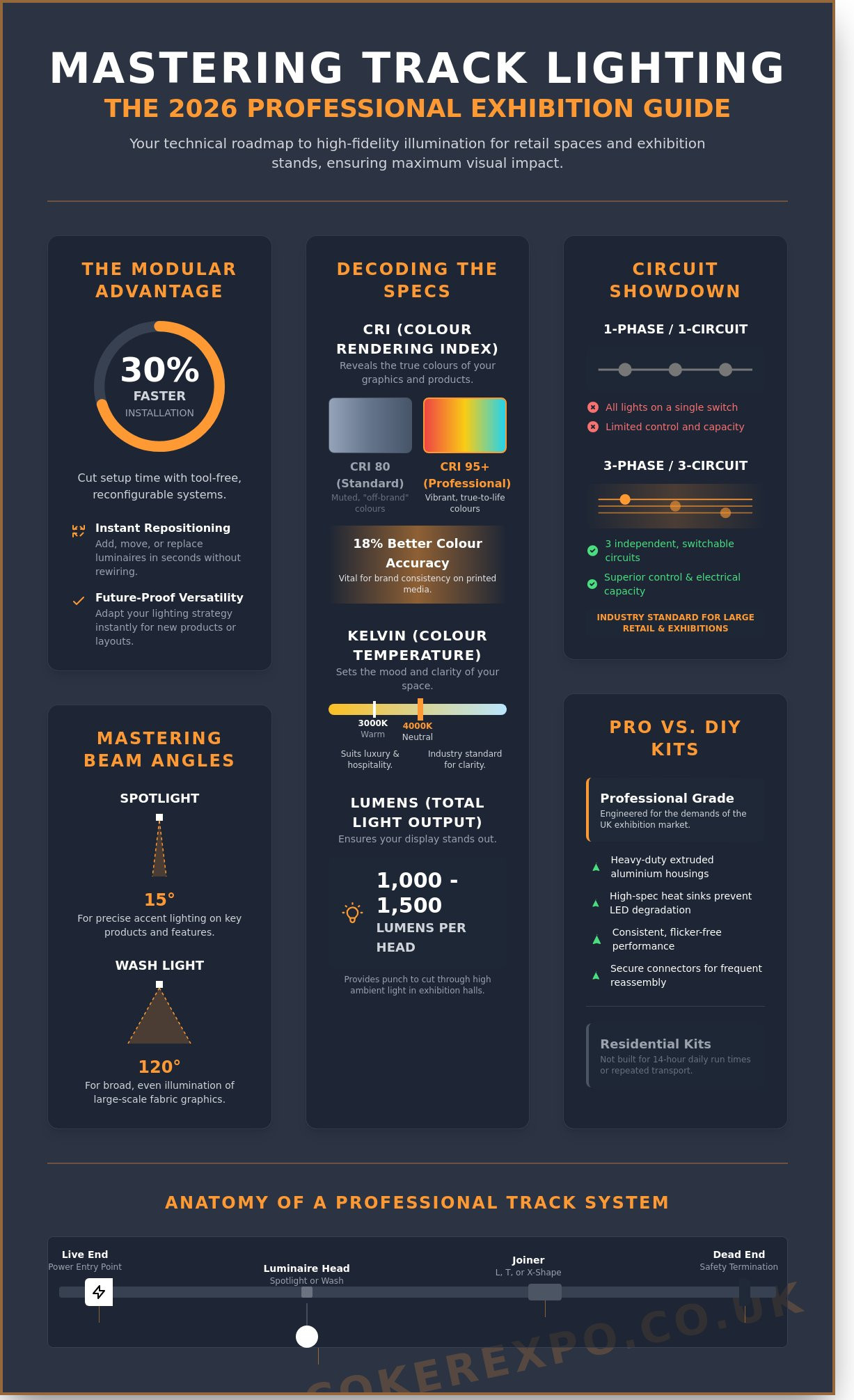
Track lighting lights consist of a surface-mounted or suspended rail that acts as a continuous electrical conduit for multiple adjustable luminaires. This hardware eliminates the need for individual wiring points for every lamp, allowing a single power feed to support an entire array of fixtures. For professional exhibitors and retailers, the primary advantage is total modularity. You can add, move, or replace heads in seconds to accommodate a new product launch or a change in stand layout. In high-pressure trade show environments, where 82% of attendees are there to see new products according to CEIR data, the ability to pivot your lighting strategy without an electrician is a critical operational win.
Adopting a "Practical Specialist" approach means viewing your ceiling as a dynamic tool rather than a fixed utility. Modular systems allow for precise beam placement, ensuring that every pound spent on your display hardware is visible to the customer. Whether you are illuminating a high-end retail showroom in London or a 50-square-metre exhibition stand at the NEC, these systems provide the infrastructure for high-impact visual merchandising.
The Anatomy of a Track System
A professional system relies on three mounting styles: surface-mounted for standard ceilings, recessed for a flush finish, or suspended for high-volume exhibition halls. The circuit starts at the live end, where power enters the track, and terminates at the dead end for safety. Joiners allow for L, T, or X-shaped configurations to cover large areas. You must choose between spotlight heads for precise 15-degree beam angles or linear track bars that provide 120-degree wash lighting for large-scale fabric graphics.
Commercial vs. Residential Track Lighting
Domestic kits found in high-street DIY stores aren't built for the 14-hour daily run times of a retail showroom or a three-day intensive trade show. Professional track lighting lights feature extruded aluminium housings and high-specification heat sinks to prevent LED degradation. While residential lighting focuses on soft mood settings, commercial systems prioritise high Colour Rendering Index (CRI) values, often 90 or above, to ensure product colours look accurate. Our hardware is engineered for frequent transport and reconfiguration, ensuring the electrical connections remain secure after dozens of installs.
- Durability: Heavy-duty connectors designed for repeated insertion and removal.
- Performance: Consistent light output without the flickering common in budget kits.
- Versatility: Compatible with various accessories like barn doors or honeycomb louvres for glare control.
Technical Specifications: Mastering CRI, Lumens, and Beam Angles
Selecting the right track lighting lights requires a move beyond basic illumination into the physics of light. In 2026, the standard for professional exhibitions has shifted toward high-performance LED chips that offer precision control over how a product or graphic is perceived. You aren't just buying a fixture; you're investing in the visual fidelity of your brand identity. Understanding the technical metrics ensures your stand doesn't just look bright, but looks professional.
- CRI (Colour Rendering Index): This measures a light source's ability to reveal the true colours of an object compared to natural sunlight. Aim for a minimum of 90 CRI for any commercial display.
- Lumens: This represents the total light output. For accent lighting on a trade show stand, 1,000 to 1,500 lumens per head provides enough punch to cut through the high ambient lighting of an exhibition hall.
- Kelvin (Colour Temperature): 4,000K (Neutral White) is the industry standard for clarity and modern aesthetics, while 3,000K (Warm White) suits high-end hospitality or luxury retail environments.
The Critical Importance of High CRI for Graphics
Inadequate colour rendering causes vibrant brand palettes to appear desaturated or "off-brand" under standard lighting by failing to emit the full spectrum of light. High-fidelity LEDs ensure your tension fabric systems look exactly as designed by the graphics team, preventing the muddy grey tones often seen with cheaper hardware. While a CRI 80 fixture is standard for domestic use, a CRI 95 premium display grade light offers 18% better colour accuracy, which is vital for maintaining brand consistency across large-scale printed media.
Mastering Beam Angles for Visual Impact
The beam angle determines the spread of light and the intensity of the focal point. Choosing the wrong angle can lead to either blinding glare or a flat, uninspired display that fails to attract visitors.
- 15-24 degree spots: These create dramatic, high-contrast highlights on "hero" products or specific architectural features of your booth.
- 40-60 degree flood lights: These provide a soft, even wash that eliminates harsh shadows on large display boards or seamless backdrops.
A practical specialist tip is to mix beam angles on a single track to create visual depth. Use 15-degree spots to draw the eye to your flagship product while using 60-degree floods to illuminate the surrounding information panels. This creates a clear hierarchy of information that guides the visitor's journey. If you need to refine your stand's impact, you can consult our specialists to determine the best configuration for your specific floor plan.
1-Circuit vs. 3-Circuit Track Lighting: Navigating Professional Circuitry
Choosing between 1-circuit and 3-circuit track lighting lights is a fundamental decision that dictates your stand's electrical capacity and control flexibility. A 1-circuit track uses a single live and neutral connection. This means every light on that rail switches on or off simultaneously. In contrast, a 3-circuit (3-phase) system contains three separate live conductors. This allows you to assign specific heads to one of three different switches or dimmers, even though they sit on the same physical rail.
Compatibility is your first priority. You must ensure your track heads match your track standard exactly. A 3-circuit head is physically incompatible with a 1-circuit track because the internal copper busbars are positioned differently. Mixing standards usually leads to hardware damage or electrical failure on-site. We recommend sticking to a single manufacturer's ecosystem to guarantee a seamless fit.
Single-Circuit (1-Phase) Systems
These systems are the practical choice for 9m² shell scheme stands or simple retail window displays. They offer a straightforward setup that doesn't require complex wiring or specialist electrical knowledge. However, they are limited to a maximum load of 16A. This equates to roughly 3.6kW at the UK standard 230V. If your display requires more than 15 high-output LED spots, a single circuit might struggle with the initial inrush current. It is a budget-friendly solution for basic "plug and play" exhibition scenarios where uniform lighting is the only requirement.
Three-Circuit (3-Phase) Systems
This is the industry standard for large-scale retail centres and complex exhibition trussing. As of 2024, 85% of professional UK lighting hire companies stock 3-circuit systems exclusively because of their load-balancing capabilities. They allow you to distribute the electrical draw across three phases, which prevents circuit breakers from tripping during peak usage. You can dim the background wash on circuit one while keeping your focal product spotlights on circuit two at 100% brightness. This future-proofs your infrastructure. It allows you to add more track lighting lights to a gantry system without overloading a single electrical feed.
- Control: Independent switching of three separate lighting groups.
- Capacity: Higher total wattage spread across three phases.
- Durability: 3-circuit tracks are often more robust for heavy-duty gantry mounting.
- Versatility: Ideal for complex lighting plots involving both spotlights and floodlights.
Professional Layout Strategy and Truss Integration for Exhibitions
Achieving a high-impact stand requires more than just plugging in fixtures. You need a layout that directs the eye and reinforces your brand's presence. We recommend applying the "Rule of Thirds" to your exhibition space. Divide your stand into three vertical zones. The top third is for high-level branding, the middle third for product engagement, and the bottom third for storage or floor-level graphics. Position your track lighting lights to intersect these zones precisely, ensuring the most valuable real estate is never in shadow.
Designing the Perfect Lighting Layout
Start by identifying your "hero" products. These items require dedicated accent lighting with a narrower beam angle, typically 24 degrees, to create visual contrast. Map your track positions to avoid glare on glossy graphics. We suggest a 30-degree angle of incidence to prevent "hot spots" that obscure your messaging. For effective wall-washing, place your track 600mm to 900mm away from the vertical surface. This distance ensures a smooth distribution of light across the entire graphic without creating harsh shadows at the top.
Integrating with Exhibition Hardware
Professional stands often rely on a 50mm exhibition truss to provide the necessary height and structure. You can securely mount track lighting to these gantries using specialised wrap-around clamps. This setup allows for a clean, overhead look that keeps floor space clear. Managing cables is vital for safety and aesthetics. Use black zip ties or dedicated cable channels to run wiring along the inner chords of the truss. This ensures your track lighting lights complement your LED lightboxes rather than competing with them. While lightboxes provide an internal glow, the track system adds the necessary "punch" to physical products on shelves or plinths.
Safety is a non-negotiable priority. Always calculate your total weight load before installation. A standard 2-metre track with four LED heads typically weighs under 5kg, but you must ensure the truss span is rated for the cumulative weight of all fixtures. Heat dissipation is also critical. Modern LED heads run cool, but they still require 50mm of clearance from tension fabric graphics to ensure longevity. Our hardware focuses on a tool-free promise. We select components that allow for fast turnaround, enabling your team to assemble a 6-metre stand in under two hours without needing a single spanner. This efficiency is why our systems are the preferred choice for busy UK marketing managers.
Expert Solutions: Optimising Your Display with CokerExpo Track Lighting
CokerExpo has operated at the sharp end of the UK exhibition industry since 1991. This longevity means we understand the logistical chaos of major venues like the NEC, ExCeL, or Manchester Central. We provide a curated selection of high-performance LED track lighting lights and components specifically designed for the 2026 event season. These units offer 95+ CRI (Colour Rendering Index) ratings to ensure your brand colours remain accurate under harsh hall lights. Because we're a British-based supplier, you avoid the uncertainty of international shipping. We provide 24-hour dispatch on stocked items and direct access to technical experts who understand UK electrical safety standards. Our service extends beyond sales; we offer full event management and structural truss hire for large-scale builds.
The CokerExpo Practical Advantage
Exhibition hardware must survive the rigours of constant transport and rapid assembly. We specialise in robust systems that don't rattle or fail after three shows. Our engineers provide specific advice on integrating track lighting lights with our bespoke tension fabric systems to eliminate shadows and hotspots. Whether you're navigating a complex 50-square-metre island stand or a compact shell scheme, we've seen every configuration. We focus on finding solutions for unique stand designs that require non-standard mounting or high-intensity focal points. We prioritise tool-free assembly where possible, helping your team get off the show floor faster.
Next Steps for Your Project
Efficiency is the priority for any marketing manager. You can request a bespoke lighting plan that calculates exact beam angles and placement for your next project. We often recommend hiring truss and lighting as a single, integrated package. This approach can reduce your on-site setup time by up to 30% and ensures all components are 100% compatible. Dealing with a single supplier for both the structure and the illumination eliminates the risk of mismatched hardware. Don't leave your brand's visibility to chance. Speak to our specialists about your track lighting requirements to receive a tailored quote and technical breakdown for your next exhibition.
Future-Proof Your Display Strategy
Selecting the right track lighting lights is no longer just about visibility; it's about precision engineering for high-stakes environments. By 2026, professional standards demand a minimum CRI of 90 and the flexibility of 3-circuit tracks to manage complex power zones across your stand. Integrating these modular systems into robust truss setups ensures your hardware remains adaptable for every venue size and layout you encounter.
CokerExpo brings over 25 years of exhibition expertise to your project. We specialise in modular, tool-free assembly systems that slash your setup times and reduce on-site stress. Our UK-based team provides direct technical support and fast delivery across the country, ensuring your gear arrives exactly when it's needed. It's vital to invest in hardware that's both impactful and easy to transport. Don't settle for dim displays when you can have a high-performance lighting rig that's built to last for years of touring.
Explore our range of professional display lighting and truss systems to find the perfect fit for your next event. We're ready to help you make a lasting impact on the trade show floor.
Frequently Asked Questions
Can I use any LED spotlight on my existing track?
You cannot use any LED spotlight; the fitting must match the specific track profile and circuit configuration. Most UK exhibition stands use Global or Eutrac systems, which require compatible adapters. If you have a 3-circuit track, your track lighting lights must feature the correct 3-phase adapter to lock into the internal copper busbars. Mixing brands often works if they follow the Nordic standard, but you should always check the mechanical fit before a show.
What is the difference between a 1-circuit and a 3-circuit track?
A 3-circuit track allows you to control three separate groups of lights independently on a single rail, whereas a 1-circuit track operates all lights simultaneously. This functionality is vital for 50-square-metre stands where you might want to dim the perimeter while keeping product displays at full 1,200-lumen brightness. 3-circuit systems also offer a higher weight capacity, supporting up to 10kg per linear metre compared to the 5kg limit often found on 1-circuit retail tracks.
How many track lighting lights can I put on a single metre of track?
You can typically install 3 to 5 LED track lighting lights per metre, provided you don't exceed the track's physical weight limit or the 16-amp current rating. Most modern 30W LED fittings weigh approximately 0.8kg, meaning a standard 2-metre track section easily supports 10 units without structural sagging. Always calculate your total wattage; on a standard 240V UK circuit, a single 16-amp track can technically handle up to 3,840W, which is far more than 50 LEDs would ever draw.
Do I need a transformer for LED track lighting lights?
Most professional track systems for 2026 operate on 230V mains voltage, so you don't need a separate external transformer. The LED driver is integrated into the base of the light fitting itself. This design simplifies installation for rapid trade show builds since you connect the track directly to the site's 13-amp power supply. If you're using older 12V MR16 lamps, you'll need a transformer, but these have seen a 90% decline in commercial use since 2018.
Can track lighting be dimmed for different event atmospheres?
Track lighting is fully dimmable if you specify fittings with dimmable drivers, such as Triac or DALI systems. For exhibition environments, we recommend DALI (Digital Addressable Lighting Interface) because it allows you to dim individual units to 1% brightness via a central console. This is particularly effective for 4pm networking sessions where you want to transition from a bright, clinical sales environment to a warmer, more relaxed atmosphere. Ensure your electrician confirms the dimmer switch is compatible with LED loads to avoid flickering.
How do I mount track lighting to an exhibition truss?
Use specialised G-clamps or track-to-truss adapters to secure the rail to the 50mm chords of a standard Global Truss system. These clamps provide a tool-free mounting solution that meets UK health and safety regulations for overhead structures. For a 3-metre span, you'll need at least three fixing points to prevent bowing. This method ensures your lighting remains robust and secure, even in high-traffic halls where floor vibrations can affect less stable setups.
What colour temperature is best for displaying printed graphics?
A colour temperature of 4000K (Cool White) is the industry standard for illuminating tension fabric graphics and PVC banners. This neutral range ensures that whites look crisp and brand colours remain accurate without the yellow tint of 3000K bulbs. For high-end photography displays, 5000K provides a daylight-balanced output that mimics natural sun, reducing the 15% colour shift often seen under warmer indoor lighting. Always choose a CRI (Colour Rendering Index) of 90 or higher for maximum vibrancy.
Is track lighting suitable for high-ceiling exhibition halls?
Track lighting is highly effective for ceilings over 6 metres if you select fittings with narrow 15 or 24-degree beam angles. These spot beams focus the light intensity onto the stand floor rather than letting it dissipate in the rafters. A 40W LED with a 15-degree lens can deliver over 2,000 lux to a product surface from a 5-metre height. This approach is much more efficient than using wide-flood lights, which lose 60% of their impact before reaching the eye level of your visitors.
Laisser un commentaire