

Common Mistakes by First-Time Exhibitors: The Practical Guide to Trade Show Success
What if your biggest trade show expense isn't the floor space, but the £1,500 you'll lose on avoidable logistical errors and technical oversights? You've likely spent months planning your debut, yet the pressure of meeting UK fire safety regulations and complex venue RAMS can feel overwhelming. It's natural to worry about looking like an amateur next to seasoned veterans with seamless modular displays. As the 2024 UK exhibition season approaches, avoiding common mistakes by first-time exhibitors is the difference between a high-ROI event and a stressful, expensive lesson.
You'll learn how to master the logistics, hardware, and strategy used by UK professionals to ensure your first exhibition is both professional and profitable. This guide provides a clear roadmap to manage technical requirements at major venues like the NEC or ExCeL London. We'll examine how to select robust, tool-free assembly systems that eliminate the need for expensive on-site contractors. From understanding tension fabric dimensions to perfecting your lead capture, we cover the essential steps to guarantee a smooth, successful event.
Key Takeaways
- Establish clear, measurable objectives and realistic lead times for graphic production to ensure your stand is ready for a high-impact debut.
- Learn to distinguish between "cheap" and true value by selecting robust, modular hardware and professional lighting that stands out against the competition.
- Navigate complex technical logistics and UK Fire Safety regulations to avoid the common mistakes by first-time exhibitors that lead to on-site compliance issues.
- Transition from passive stand presence to active lead generation by mastering professional body language and deploying efficient digital lead capture systems.
- Maximise your event ROI by implementing a structured follow-up process and conducting a post-show debrief within 48 hours of the doors closing.
The Planning Phase: Why First-Time Exhibitors Fail Before the Show Starts
Success at an event is engineered months before the doors open to the public. One of the most common mistakes by first-time exhibitors is treating the preparation phase as a secondary task rather than a strategic operation. To truly understand what is a trade show? in a commercial context, you must view it as a high-stakes lead generation engine that requires precise calibration. Arriving with a "see what happens" attitude is the fastest way to drain your marketing budget without seeing a return.
Defining Success Beyond 'Getting Noticed'
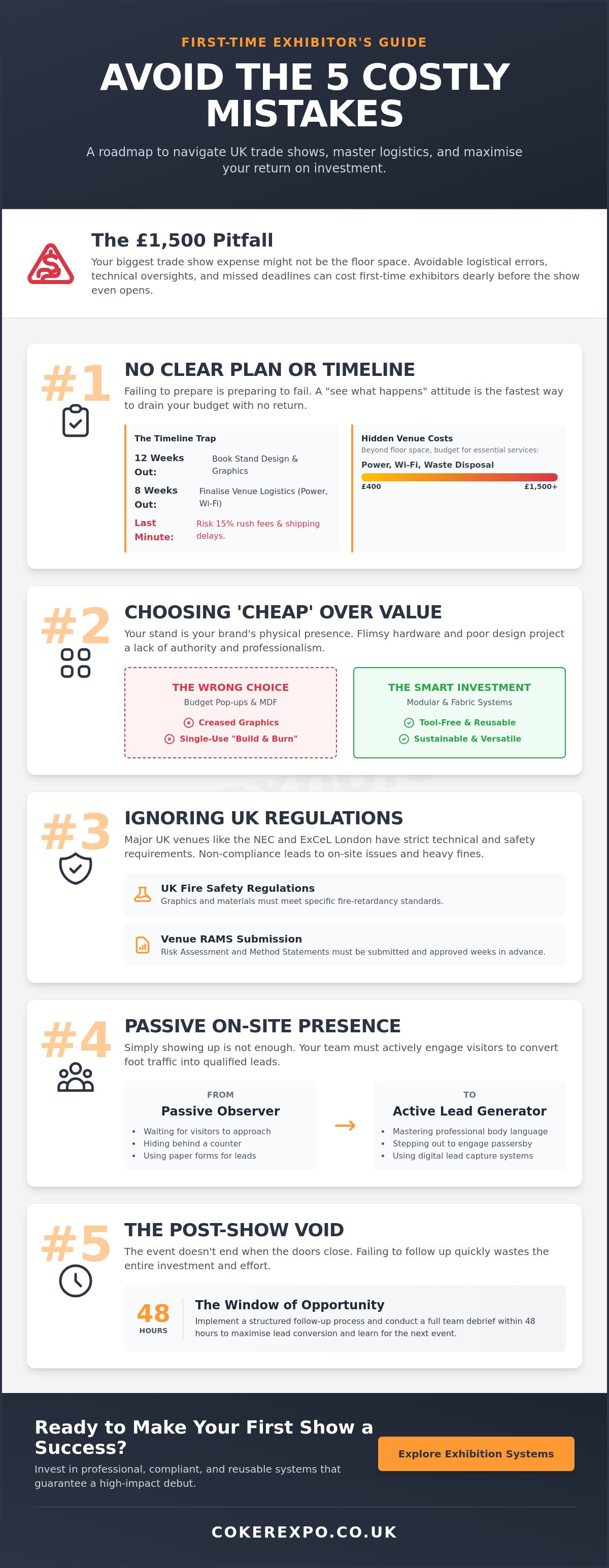
Vague goals lead to vague results. You must set SMART objectives that differentiate between brand awareness and direct lead generation. For example, aim to secure 50 qualified leads or book 10 follow-up consultations during the three-day event. Budgeting is another area where novices stumble. Beyond the floor space, you must account for hidden venue service charges. In the UK, electrical mains, dedicated Wi-Fi, and waste disposal services can add between £400 and £1,500 to your total expenditure if not booked during the early-bird window.
Exhibition ROI is the ratio of total revenue generated to the initial hardware investment, where the cost-per-show decreases every time the modular system is reused across its multi-year lifespan.
The Timeline Trap: Managing Your Lead Times
You should book your exhibition stand design at least 12 weeks out from the event date. This lead time is essential for structural proofing, high-resolution graphic production, and pre-build testing in a controlled environment. Last-minute orders often trigger 15% rush fees and increase the risk of shipping delays that leave you with an empty shell scheme.
The "Fail to Prepare" trap is most evident when exhibitors ignore the official manual. Venues have strict deadlines for rigging, health and safety RAMS, and power requirements. Missing these dates often results in heavy surcharges or a stand that lacks the necessary infrastructure to function. Coordinating with contractors for internet and power is a logistical priority that should be finalised 8 weeks before the build-up begins.
Future-Proofing for 2026: Sustainability and Modularity
As we approach 2026, UK trade shows are enforcing stricter environmental regulations regarding waste and single-use materials. First-time exhibitors should avoid "build and burn" stands made from cheap MDF. Instead, prioritise modular systems and tension fabric graphics. These solutions offer several advantages:
- Tool-free assembly: Reduces the need for specialist labour on-site.
- Versatility: Modular frames can be reconfigured to fit a 3x3m or a 6x3m space.
- Durability: High-quality aluminium gantry or fabric systems are designed for years of repeated use.
- Fast turnaround: UK-made hardware ensures reliable delivery without international customs delays.
Investing in robust, reusable hardware is a practical business decision that aligns with the industry's shift toward sustainability while protecting your long-term margins.
Design and Hardware Selection: Choosing the Wrong Stand Type
Many new businesses fall into the trap of equating the lowest price with the best value. A budget pop-up stand might save you £200 upfront, but it often fails to project the professional image required to compete on a crowded floor. These units frequently arrive with creased graphics or flimsy frames that struggle to stay straight under intense hall lighting. Investing in hardware that looks "flat" or "cheap" is one of the most common mistakes by first-time exhibitors, as it immediately signals a lack of authority to potential partners.
Design errors also extend to the content on your displays. You have approximately three seconds to catch a visitor's eye before they move on. If your panels are covered in paragraphs of text, people will simply keep walking. Your stand should function as a visual hook rather than a technical brochure. You must also consider the physical flow of your space. Placing a large counter right at the front creates a psychological barrier that prevents people from entering. It is a common hurdle identified in any comprehensive first-time exhibitor checklist, where the focus is on creating an inviting, open environment that encourages interaction.
Modular vs. Custom: The Rookie's Best Friend
Modular systems provide the infrastructure for growth without the waste of single-use custom builds. For those starting in a standard booth, high-quality shell scheme graphic panels offer a seamless, professional finish that hides the utilitarian aluminium poles of the organiser’s framework. Tension Fabric Systems (TFS) are now rapidly replacing traditional PVC banners because they are lightweight, machine-washable, and eliminate the glare often caused by overhead hall lights. These systems allow you to swap graphics for different shows while keeping the same robust frame.
The Power of Illumination
Lighting is rarely an afterthought for successful brands. Integrating an exhibition lightbox can increase footfall by up to 30% because the human eye is naturally drawn to the brightest point in a room. You can choose between static backlit units or dynamic lightboxes that use programmed LEDs to create subtle movement. Just ensure your lighting plan aligns with your booked power drop. A frequent error involves ordering a 500W supply for a setup that requires 1000W; this leads to tripped fuses and a dark stand during peak hours.
If you are unsure which hardware suits your specific floor plan, our team can help you select versatile display systems that scale as your business grows.
Technical Logistics and UK Regulations: The Compliance Pitfall
Arriving at the NEC or ExCeL London only to find your stand hardware is missing a vital 5mm hex key is a stressful rite of passage you should avoid. One of the most common mistakes by first-time exhibitors is treating technical logistics as an afterthought. Beyond the physical assembly, UK venues operate under strict Health and Safety executive guidelines that don't allow for "winging it" on the day. If you haven't accounted for the 2.4-metre height limit on a standard shell scheme, or if you've failed to submit a Risk Assessment and Method Statement (RAMS), you might find your build halted before it starts.
Storage is another frequent oversight. A 3x3 metre plot feels spacious until you add three staff members, two chairs, and five boxes of brochures. Without a dedicated storage solution or a lockable counter, your high-impact brand presence quickly becomes cluttered with coats and laptop bags. Planning for these functional "dead zones" is essential for maintaining a professional appearance throughout the event.
Navigating UK Event Safety Standards
UK fire regulations are non-negotiable. Every fabric graphic or display panel must meet specific flame retardancy standards, typically the B1 rating under DIN 4102-1 or the BS 5867 standard. Venue floor managers often conduct spot checks; if you can't produce a certificate proving your tension fabric is fire-rated, they can demand its removal. We recommend looking for hardware and textiles vetted by the Event Supplier and Services Association (ESSA) to ensure compliance. Additionally, complex installations like truss systems require professional sign-off if you're planning overhead rigging. It's not just about aesthetics; it's about structural integrity and the safety of every visitor on the floor.
The 'Tool-Free' Revolution
You don't want to spend four hours wrestling with a complex gantry system while your competitors are already networking. Modern modular hardware has moved toward tool-free assembly, using intuitive "twist and lock" or "push-fit" mechanisms. This shift is a game-changer for smaller teams. When selecting your kit, prioritise systems that fit into a standard estate car or a small van to avoid the high costs of specialized couriers. Every exhibitor should also carry a 'Show Kit' containing:
- High-grade gaffer tape: For securing cables to prevent trip hazards.
- Multi-plug extensions: Venues often charge £50 or more for extra sockets, so make the most of your ordered power drop.
- Microfibre cloths: To remove fingerprints from glossy panels or screens.
- Spare fixings: Because a single lost thumb-screw shouldn't ruin your display.
By choosing robust, UK-made systems designed for rapid deployment, you reduce the risk of assembly errors and ensure your team stays focused on lead generation rather than troubleshooting hardware.
On-Site Execution: Common Mistakes During the Event
Even with a high-impact stand design, poor execution on the day can ruin your return on investment. One of the most frequent common mistakes by first-time exhibitors is treating the stand as a rest area rather than a professional stage. Sitting down, scrolling through phones, or eating in full view of attendees creates a psychological barrier. It signals that your team is unavailable or uninterested. A staff member on a phone is a closed door to a potential client.
The "Ghost Stand" is another critical error. Leaving your space unmanned during peak hours, typically between 10:00 and 15:00, is a wasted opportunity. If a visitor sees an empty space, they won't wait for your return; they will simply move to your competitor's stand. You must also avoid the passive approach. Simply standing and waiting for someone to speak to you doesn't work in a busy hall. You need an active "hook" or a demonstration to stop passers-by. A specific question about their industry challenges is far more effective than asking "Can I help you?".
Staff Training for Trade Show Success
Consistency across your team is vital for brand representation. Every team member needs a clear "Stand Protocol" document that outlines how to greet visitors and how to qualify a lead. You should rotate staff every 2 to 3 hours to maintain high energy levels. Exhibition fatigue is real, and it leads to slumped shoulders and missed opportunities. Branded clothing is a non-negotiable requirement. Cohesive, professional attire makes your team easily identifiable in a crowded hall, which increases the likelihood of delegates approaching you by approximately 15%.
Effective Lead Capture Strategies
Relying on a bowl of business cards is a high-risk strategy that often leads to failure. Cards get lost, and vital context is forgotten within hours. Digital lead capture systems are superior because they allow for instant data entry and immediate categorisation. You should label leads as Hot, Warm, or Cold on-site to ensure your sales team can prioritise follow-ups within the critical 48-hour post-show window.
Practicality on the stand also aids lead capture. Using folding display boards provides a versatile way to keep technical specs or price lists within easy reach for staff. These boards act as a quick-reference guide, allowing your team to answer complex questions without leaving the visitor's side. This keeps the conversation flowing and ensures no data is missed during the heat of the event. Avoiding these common mistakes by first-time exhibitors ensures your presence is professional and your data collection is robust.
Ensure your team has the right infrastructure for success by browsing our range of professional exhibition displays.
The Post-Show Void: Forgetting the Follow-Up
The trade show floor closes, the lights dim, and most exhausted teams head straight for the nearest exit. This is where the final, and often most expensive, of the common mistakes by first-time exhibitors happens. Closing the stand isn't the end of the campaign; it's the start of the conversion phase. If you wait more than 48 hours to contact a prospect, lead warmth drops by roughly 80%. By day four, you're effectively a stranger again, and your competitors have likely already made their move.
Skipping the post-show debrief is another missed opportunity for growth. You need to sit down with your sales and marketing teams within 72 hours to discuss what worked and what failed. During this meeting, calculate your Cost-Per-Lead (CPL) immediately. If your total investment, including stand space and hardware, was £5,000 and you secured 50 qualified leads, your CPL is £100. Comparing this against your standard digital marketing CPL provides the hard data needed to justify next year's budget. Without these numbers, you're just guessing at your ROI.
Mastering the 48-Hour Follow-Up
Speed is your greatest asset in a B2B environment. Create pre-written email templates before the event begins so you're ready to hit send on Monday morning. Don't just send a generic "thanks for visiting" note. Personalise your outreach by referencing specific conversations or problems mentioned on-site. Use LinkedIn to connect with key visitors while the interaction is fresh; this keeps the momentum alive and moves the needle toward a sale. It's about turning a brief encounter into a professional relationship.
Hardware Maintenance and Storage
High-quality hardware is a long-term business investment. One of the most frequent common mistakes by first-time exhibitors is packing away equipment while it's damp or folding graphics incorrectly. When handling custom wallpaper or tension fabric graphics, always roll them with the print side facing out to avoid permanent creasing.
Avoid the temptation to shove everything into a damp office basement. Professional storage services or climate-controlled environments prevent frame corrosion and fabric mould. Our modular systems are designed for durability, but they still require basic care to maintain their professional finish. Proper maintenance ensures your kit looks as sharp at your fifth show as it did at your first, protecting your brand's physical image for years to come.
Ready to plan your first show? Contact CokerExpo for expert guidance and hardware to ensure your next event is a seamless success.
Master Your Next Event with Professional Infrastructure
Avoiding common mistakes by first-time exhibitors requires a shift from reactive planning to technical precision. Success on the trade show floor depends on two critical factors: selecting compliant, high-impact hardware and executing a lead recovery plan within 48 hours of the doors closing. Many newcomers struggle with complex UK fire safety regulations or assembly delays, yet these risks are easily managed with the right equipment. Our UK-made hardware is designed for fast turnaround and tool-free assembly, ensuring your team stays focused on visitors rather than struggling with a toolkit.
With over 25 years of exhibition expertise, Coker Expo provides the robust, portable systems needed to transform a stressful debut into a repeatable success. We specialize in tool-free, modular systems that meet strict venue standards while maximizing your brand's visual impact. Don't let technical oversights or poor logistics undermine your marketing budget. It's vital to choose a partner that understands the high-pressure, deadline-driven nature of the UK circuit.
Explore our range of professional, easy-build exhibition stands
You've done the hard work of securing your space; now let's ensure your hardware delivers the professional presence your business deserves.
Frequently Asked Questions
What is the most common mistake first-time exhibitors make with their budget?
The most frequent budget error is failing to account for hidden operational costs, which typically consume 25% of your total spend. These expenses include electrical main connections, Wi-Fi access, and lead retrieval scanner rentals. Many businesses focus solely on the floor space and the hardware, leaving them short when the venue service manual arrives with mandatory fees.
Do I really need a professional stand builder for my first exhibition?
You don't always need a professional builder if you invest in modular, tool-free assembly systems designed for DIY setup. These portable solutions allow you to bypass expensive contractor fees while maintaining a professional look. However, if your design involves complex rigging or bespoke timber construction, a professional team ensures you meet strict UK Health and Safety regulations.
How do I ensure my exhibition stand graphics meet UK fire safety standards?
To meet UK fire safety standards, your graphics must be printed on materials with a Class 1 or Class 0 rating according to BS 476 Part 7 or the European equivalent, EN 13501-1. Most UK venues require a physical fire certificate for every fabric or PVC display you bring on-site. We provide these certificates with our tension fabric systems to ensure you pass venue inspections without delay.
What should be in a first-time exhibitor's 'emergency kit'?
A practical emergency kit should contain heavy-duty gaffer tape, spare Velcro, a multi-tool, and extra HDMI cables. One of the common mistakes by first-time exhibitors is forgetting basic hardware for minor on-site repairs. Include a pack of universal power adapters and a portable steamer to remove transit creases from fabric graphics before the show opens.
How much text should I actually put on my exhibition stand graphics?
Your exhibition stand graphics should follow the 60/40 rule, where at least 40% of the space remains blank to avoid visual clutter. Limit your main headline to fewer than 10 words and ensure it's positioned at eye level, roughly 1.5 metres from the floor. Attendees usually spend less than 3 seconds scanning a stand before deciding to stay or walk past.
Is it better to hire or buy exhibition equipment for a first-time show?
Hiring is cost-effective for a single event, but buying your equipment usually pays for itself after just 2 or 3 shows. Modular hardware is a sound business investment because it's versatile enough to fit different floor plans. Buying also gives you the freedom to practice your build in-house, which significantly reduces stress on the event morning.
How can I attract people to my stand if I have a small shell scheme space?
Maximise a small shell scheme by using high-output LED lighting and tall, vertical branding to increase visibility across the hall. Since 45% of trade show visitors are attracted by visual appeal alone, a backlit fabric display can make a 3m x 2m space feel premium. Avoid placing a large desk at the front, as this creates a physical barrier that discourages entry.
What is the 'Rule of Three' in exhibition stand design?
The 'Rule of Three' dictates that your stand must convey its message in 3 seconds, from 3 metres away, using no more than 3 key points. This design principle helps avoid common mistakes by first-time exhibitors who try to communicate too much information at once. Clear, high-performance visuals ensure your brand is understood instantly in a high-pressure, fast-paced exhibition environment.
Leave a comment