

Heavy-Duty Rotating Display Turntables: The Professional Guide for 2026
What if the centerpiece of your next exhibition becomes your biggest liability because of a single overlooked safety clutch? You know that a 360-degree view is the most effective way to showcase a high-value asset, but rotating a 500kg product is an engineering challenge that requires more than a standard motor. The pressure of a live event is high enough without worrying about motor failure or tangled power cables. With the Bureau of Labor Statistics reporting that machinery-related accidents account for nearly 15% of all workplace fatalities, choosing a reliable heavy-duty rotating display turntable is a critical safety decision.
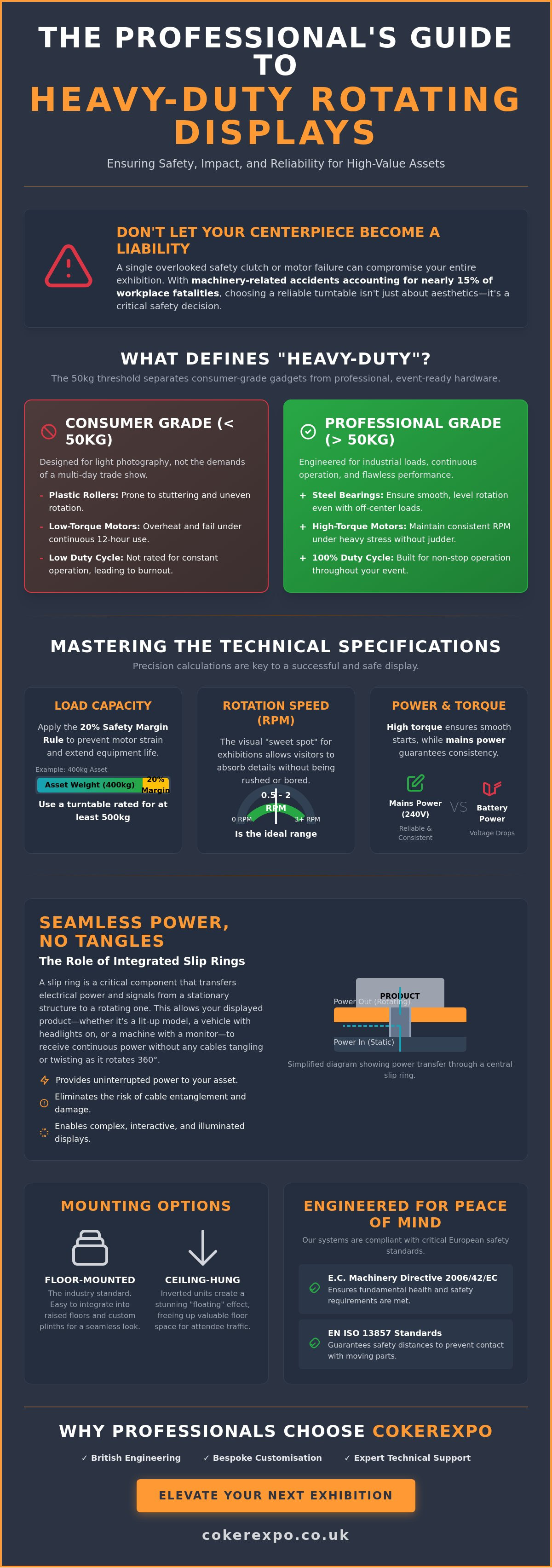
Mastering the technical requirements and safety standards for high-capacity units will allow you to elevate your exhibition impact without the stress of mechanical failure. This guide provides the professional framework you need to ensure your display is both impactful and compliant with the E.C. Machinery Directive 2006/42/EC. We'll examine how to balance torque for loads up to 3000kg, integrate slip rings for continuous power, and implement the EN ISO 13857 standards that guarantee a secure, seamless 360-degree experience.
Key Takeaways
- Identify the 50kg threshold that separates professional hardware from consumer stands to ensure your motor handles the stress of a full event.
- Apply the 20% safety margin rule when calculating load capacity to protect your investment and maintain consistent RPM.
- See how integrated slip rings allow a heavy-duty rotating display turntable to provide seamless power to your assets without the risk of cable entanglement.
- Evaluate the practical differences between floor-mounted and inverted ceiling-hung units to choose the right infrastructure for your specific display impact.
- Leverage British engineering and bespoke technical support to customize your system with specific plate sizes or variable speed controls.
What Defines a Heavy-Duty Rotating Display Turntable?
The distinction between a standard display stand and a heavy-duty rotating display turntable isn't just about size; it's about the mechanical capacity to handle stress. In the exhibition industry, the professional threshold begins at the 50kg mark. Below this weight, you're often looking at consumer-grade photography equipment that relies on plastic rollers and low-torque motors. These light-duty units frequently stutter or overheat when subjected to the 12-hour duty cycles common at major trade shows. A heavy-duty turntable is an industrial-grade motorised platform engineered for loads exceeding 50kg with constant torque.
Tracing the history of the vehicle turntable reveals how these systems evolved from simple railway swaps to the sophisticated exhibition hardware we use in 2026. While early versions were purely functional, modern units prioritize a seamless aesthetic and precision control. Professional models utilize high-performance steel bearings rather than plastic components. This industrial construction ensures the platform remains level even when the weight isn't perfectly centered. In 2026, we see these robust systems moving beyond automotive showcases into industrial machinery launches and interactive kinetic art installations where reliability is non-negotiable.
High-torque motors are the heart of these systems. Unlike cheaper alternatives that slow down as weight increases, a professional motor maintains a consistent RPM under significant pressure. This consistency is vital for maintaining the visual impact of your display. If a motor struggles, the resulting "judder" ruins the professional look of the exhibit and risks damaging the internal drive gears. Using steel housings and reinforced drive chains ensures the system survives the rigours of transport and frequent assembly.
The Engineering Behind the Rotation
Professional exhibition units are designed for continuous use. This means the motor's duty cycle must be rated for 100% operation throughout the event's opening hours. Weight distribution is a critical factor that engineers prioritize; a 200kg load concentrated on one edge creates more strain than 500kg centered perfectly. We focus on low-profile designs that sit close to the floor. This makes it easier to build a custom plinth or raised floor around the unit, creating the illusion that your heavy asset is rotating on the stand surface itself.
When to Scale Up from Standard to Heavy-Duty
You'll know it's time to scale up when your asset's weight reaches 80% of a standard motor's limit. Operating at peak capacity for extended periods is the primary cause of motor burnout. You must also assess the centre of gravity. Tall or irregular assets, like industrial robots or vertical turbine components, exert leverage on the central spindle. If your display is top-heavy or has a wide footprint, the robust bearing sets found in heavy-duty units provide the necessary lateral stability to prevent tipping or mechanical grinding.
Technical Specifications: Load Capacity, RPM, and Torque
Selecting the right heavy-duty rotating display turntable requires precise calculation. You can't simply match the weight of your asset to the maximum rating of the machine. We recommend the 20% safety margin rule. If your display weighs 400kg, you should utilize a unit rated for at least 500kg. This buffer prevents the motor from running at its absolute limit, which extends the life of the drive system and ensures the rotation remains smooth. Operating at 100% capacity often leads to increased heat and potential failure during a multi-day event.
RPM (Revolutions Per Minute) is the most overlooked specification. For most trade show assets, the visual "sweet spot" is between 0.5 and 2 RPM. Anything faster makes it difficult for attendees to process fine details; anything slower fails to attract the eye. The physics of Conservation of Angular Momentum dictates how your load distribution affects rotation stability. If you have a wide, heavy asset, you need higher torque to overcome initial inertia. High-torque motors provide that essential start-stop smoothness, preventing the jerky movements that can make a premium product look unstable.
Mains power is the only reliable choice for heavy-duty applications. Battery-operated units often suffer from voltage drops as the charge depletes, leading to inconsistent speeds or total stalls. A constant 240V supply ensures your display maintains its impact from the moment the doors open until the last visitor leaves. It's about providing a consistent, worry-free experience for the duration of your show.
Matching Weight to Motor Power
The 100kg capacity heavy-duty rotating display turntable is the undisputed workhorse of the UK exhibition industry. It's versatile enough for most high-end retail products and smaller industrial components. When you scale up to 500kg or 750kg displays, you're entering the territory of vehicle engines and large-scale machinery. These larger units often require variable speed controllers. Having the ability to fine-tune the rotation speed on-site allows you to adapt to the specific lighting and floor space of your venue. You can view our range of high-capacity turntables to find the exact match for your project requirements.
Durability and Longevity in High-Traffic Environments
Reliability comes from the internal architecture. While light-duty stands use a simple central spindle, professional turntables employ steel ball-bearing races. This design distributes the load across a wider surface area, reducing friction and wear. For long-term retail installations, maintenance is minimal but necessary. A simple check of the drive belt and lubrication of the bearings every six months ensures years of service. For the fast-paced trade show environment, our systems prioritize tool-free assembly. You don't have time to hunt for specialized wrenches when you're on a tight build schedule. Our hardware is designed for quick deployment, letting you focus on the presentation rather than the mechanics.
The Role of Slip Rings in Powered Displays
A common failure point in complex exhibition stands is the "cable knot." If you're rotating a product that requires internal illumination or an active digital screen, a standard heavy-duty rotating display turntable without a slip ring will eventually snap its power leads. This happens when the cable twists beyond its physical limit during 360-degree rotation. To solve this, professional units utilize a slip ring. A slip ring is an electromechanical device that allows the transmission of power and electrical signals from a stationary to a rotating structure.
Safety is paramount when running 240V power through a rotating joint. Industrial-grade slip rings use high-quality conductive brushes that maintain a constant connection with rotating rings. This prevents arcing and ensures that your display remains powered without flickering. While some exhibitors try to use internal battery packs, these often fail mid-event. A mains-powered slip ring provides the reliability needed for high-traffic environments, ensuring your asset stays lit from the first morning of the show until the final evening.
Choosing between internal and external power sources depends on your asset's design. An internal power source, like a battery, avoids the need for a slip ring but introduces the risk of downtime. An external source, delivered through a slip ring, provides a seamless, continuous flow of energy. This is essential for high-impact displays that include lightboxes, digital screens, or internal product lighting that must remain active for the duration of the event.
Integrating Electronics with Motion
Combining motion with light creates a powerful visual magnet. Many clients now integrate their turntables with exhibition lightboxes to ensure their branding is visible from every angle. This setup requires the turntable to deliver power to the lightbox's LED array while rotating under the weight of the display. If you're using smart display units or digital screens, you must account for signal interference. Shielded slip rings are necessary to prevent the motor's electromagnetic field from disrupting the video signal or data feed.
Specifying the Right Slip Ring Capacity
Not all slip rings are equal. You must match the amperage of the ring to the power draw of your asset. A standard 5-amp slip ring is sufficient for most LED lighting, but high-powered machinery or large-scale digital walls may require 10 or 20-amp connectors. We also see a growing demand for data transfer through rotating platforms. While running standard HDMI or Ethernet cables through a slip ring is technically challenging due to signal loss, specialized high-frequency rings can maintain data integrity for 4K video feeds. Always specify your data requirements early in the design phase to ensure the hardware can handle the throughput.
Mounting Options: Floor-Standing vs. Ceiling-Hung
Floor-mounted turntables are the backbone of high-capacity displays, particularly for automotive showcases and heavy industrial machinery. These units sit directly on the venue floor or within a recessed plinth, providing maximum stability for loads that can reach 3000kg. By placing the center of gravity low, you minimize the risk of lateral movement. This is the most practical choice for the majority of exhibitors because it simplifies the build process and complies easily with standard venue regulations.
Inverted rotation offers a different psychological hook. When you suspend a heavy-duty rotating display turntable from a gantry, you transform a static product into kinetic art. This overhead movement catches the eye from across the exhibition hall, drawing visitors toward your stand before they even see your graphics. While floor units handle the heaviest loads, wall-mounted rotation remains a niche application. It's typically reserved for vertical signage or lightweight branding elements where the torque requirements are lower but the mounting hardware must be exceptionally rigid to prevent sagging.
Calculating the "pull-out" force is the most critical step for any overhead installation. This technical calculation determines the amount of force required to pull the fixings out of the mounting surface. For inverted displays, you must account for the weight of the turntable, the asset, and the dynamic forces generated during rotation. We always insist on secondary safety fixings, often called safety bonds or wire rope lanyards. These act as a fail-safe to prevent the unit from falling in the unlikely event of a primary fixing failure.
Safety Standards for Inverted Displays
Safety is non-negotiable when suspending hardware over the public. You must use exhibition truss systems that are rated for the combined dynamic load of the motor and the asset. Ceiling-hung units often have lower weight limits than their floor-standing equivalents because the internal bearings are under constant tension rather than compression. Always verify that your rigging points are certified and that your secondary safety bonds are correctly tensioned to catch the load without a significant drop distance.
Choosing the Right Orientation for Your Stand Design
Your choice of mounting significantly impacts your floor space management and visitor flow. Floor-mounted units require a clear perimeter to ensure visitor safety, which can consume valuable square footage. Conversely, overhead rotation keeps the floor clear, allowing for a more open exhibition stand design that encourages movement. If you're looking to maximize your ROI, moving your primary attraction to the ceiling can free up space for promotional counters or meeting areas. Explore our range of floor and ceiling-mounted turntables to find the best configuration for your next event.
British Engineering: Why Professionals Choose CokerExpo
CokerExpo understands that the UK exhibition industry moves at a relentless pace. When you invest in a heavy-duty rotating display turntable, you aren't just buying a motor; you're securing a partnership with technical experts. Based in Hampshire, our team provides the rapid turnaround and local support that international suppliers often struggle to match. Whether you need a 24-hour response to a technical query or a bespoke modification like a custom top plate, we ensure your hardware arrives ready for the trade show floor. We've built our reputation on providing the infrastructure for your success.
We offer both rental and purchase options to suit your specific business model. For marketing managers testing a new concept at a single event, our hire service provides access to industrial-grade equipment without a long-term storage commitment. For permanent retail environments or frequent exhibitors, purchasing a robust system is a sound investment in craftsmanship. Every unit is engineered to withstand the rigours of transport and the high-pressure environment of the UK's largest venues. We don't just sell equipment; we provide peace of mind.
Bespoke requests are a core part of our service. We can adjust rotation speeds or modify mounting plates to fit irregular assets, ensuring your display looks exactly as you envisioned. This flexibility is what sets British engineering apart. We prioritize the user experience of the exhibitor, making sure every component is functional and durable. You can rely on our hardware to perform consistently, allowing you to focus on engaging with your customers rather than troubleshooting mechanics.
Reliability on the Trade Show Floor
Our commitment to tool-free assembly isn't just a marketing slogan. It's a design philosophy. We know that build days are stressful and time-sensitive. You don't want to be searching for a specialized wrench when you have a 750kg machine to position. Our turntables are designed for intuitive setup without sacrificing the strength needed for heavy machinery. We've seen clients rotate everything from full-sized EVs to industrial printing presses with absolute precision; similarly, those who explore Rational iCombi Pro solutions from Island Catering Equipment Co. for hospitality expos rely on this level of engineering. This reliability comes from our Hampshire-based team's expert advice and our focus on high-performance components.
Complementary Hardware for a Complete Display
A rotating asset is only as effective as the environment surrounding it. You can use folding display boards to create a clean, professional perimeter that guides the visitor's eye toward the motion. For larger stands, integrating shell scheme graphic panels provides a high-impact branded backdrop. This ensures your message remains clear even when the asset is in its 180-degree position. Before your next UK exhibition, use this final checklist to ensure a seamless experience:
- Verify the total weight of the asset including its own packaging or base.
- Confirm the power supply availability at your specific stand location.
- Test the slip ring connection with your lighting or digital hardware before transport.
- Ensure you have the required safety bonds for any ceiling-mounted components.
- Plan your cable management to keep the area around the heavy-duty rotating display turntable clear for visitors.
Secure Your Competitive Edge with Precision Motion
Choosing a heavy-duty rotating display turntable is a commitment to reliability and professional impact. By applying the 20% safety margin for load capacities and utilizing integrated slip rings for powered assets, you eliminate the technical risks that often plague live events. You've now mastered the framework to select between floor-mounted stability and the visual drama of ceiling-hung kinetic art while ensuring full compliance with the E.C. Machinery Directive 2006/42/EC.
With over 25 years of UK exhibition expertise, CokerExpo provides hardware engineered for loads up to 750kg. We back our robust systems with fast UK-wide delivery and direct technical support from our Hampshire-based team. This ensures your display remains impactful and safe throughout its entire duty cycle. Explore our range of heavy-duty rotating turntables and request a quote today to start planning your most dynamic exhibition yet. Your next trade show success is built on the right infrastructure.
Frequently Asked Questions
How much weight can a heavy-duty display turntable actually hold?
Our professional range supports loads starting at 50kg and scales up to 3000kg for industrial applications. It's vital to choose a unit that provides a 20% safety margin above your asset's total weight. This buffer ensures the motor operates within its optimal torque range and prevents mechanical strain during long exhibition days at high-traffic venues.
Do I need a slip ring for my rotating display?
You require a slip ring if your display includes electrical components like LED lightboxes or digital screens that need constant power while rotating. Without this electromechanical device, your power cables will tangle and eventually snap after only a few rotations. Slip rings allow for continuous 360-degree movement while maintaining a secure electrical connection for 240V mains power or data signals.
Can I mount a heavy-duty turntable to the ceiling?
Yes, we provide specific models designed for inverted ceiling mounting to create "floating" kinetic displays. These units feature specialized bearing sets to handle tension loads rather than compression. You must use secondary safety bonds and ensure your gantry or truss system is rated for the dynamic pull-out force of the motor and the suspended asset combined.
What is the standard rotation speed for a display turntable?
Most professional units operate at a "sweet spot" between 0.5 and 2 RPM (revolutions per minute). This speed is fast enough to attract attention from across the hall but slow enough for visitors to see product details clearly. We offer models with variable speed controllers if your specific installation requires a customized rotation pace for a heavy-duty rotating display turntable.
Are these turntables suitable for outdoor events in the UK?
Standard turntables are engineered for indoor use within exhibition halls or retail spaces. If you plan an outdoor event, the unit must be housed within a weatherproof plinth and protected from moisture to prevent electrical failure. We recommend consulting our technical team before any outdoor deployment to ensure the motor and slip ring assembly remain dry and functional in variable conditions.
What happens if the load is not perfectly centred on the turntable?
An off-centre load places uneven stress on the drive gears and bearings, which can cause the rotation to "judder" or stall. While our heavy-duty units use robust steel ball-bearing races to mitigate some imbalance, you should always aim for a central centre of gravity. For irregular assets, we can provide custom top plates to help distribute the weight more effectively across the platform.
Do display turntables require special electrical installation?
Most of our heavy-duty rotating display turntable models operate on a standard UK 240V mains supply and come fitted with a 13-amp plug. They don't require specialist electrical installation beyond ensuring your exhibition stand has a dedicated power point. For units with high-amperage slip rings, we provide clear wiring specifications so your on-site electrician can connect your assets safely and quickly.
Can I rent a heavy-duty turntable instead of buying one?
Yes, we offer a flexible hire service for exhibitors who only need a turntable for a single event or a short-term promotional tour. This allows you to access industrial-grade hardware without the long-term storage requirements. Our rental units are maintained to the same high standards as our sales stock and include the same technical support and fast UK-wide delivery you expect from CokerExpo.
Leave a comment