

How to Make a Shell Scheme Stand Out: The 2026 Exhibitor’s Guide
A standard shell scheme isn't a constraint; it's a blank canvas that most brands unfortunately leave blank. If you're one of the 70% of exhibitors who feel invisible behind a row of identical grey aluminium poles, it's time to change your strategy. Learning how to make a shell scheme stand out is the difference between being a background participant and a high-traffic destination. You don't need a £20,000 custom build to dominate the trade show hall in 2026.
We understand the frustration of strict venue rules and the struggle to mount graphics without damaging the hired frame. You want a professional, seamless aesthetic that looks like a permanent installation but packs down into a single wheeled case. This guide provides the exact hardware strategies and graphic techniques to transform your standard exhibition box into a high-impact destination. We'll explore modular tension fabric systems, tool-free assembly methods, and the latest UK-made display tech that ensures your next event is your most profitable yet.
Key Takeaways
- Discover how Tension Fabric Systems (TFS) mask standard aluminium uprights to provide a seamless, high-end finish that mimics a bespoke build.
- Learn how to make a shell scheme stand out by incorporating modular trussing to add structural depth and dominant overhead branding.
- Understand why standard venue lighting fails and how to implement professional illumination strategies that boost foot traffic and visitor engagement.
- Streamline your exhibition presence with tool-free hardware and "dry run" assembly techniques designed for maximum efficiency on the UK trade show circuit.
- Move beyond the "sea of sameness" by applying a professional strategy that turns a basic modular grid into a high-impact brand destination.
What is a Shell Scheme and Why Does it Need a Strategy?
A shell scheme is the standard modular exhibition stand system provided by event organisers. It consists of a basic aluminium frame, vertical uprights, and horizontal cross-beams that hold infill panels in place. While this setup provides the essential infrastructure for your trade show presence, it creates a "Sea of Sameness" across the hall. Research into visitor behaviour suggests that 90% of exhibitors fail to get noticed because they rely on the default configuration. To understand how to make a shell scheme stand out, you must stop viewing the 3x3m or 2x3m space as a restrictive box and start seeing it as a high-impact branding canvas.
Applying professional exhibit design principles is the highest ROI investment you can make. With floor space in UK venues often costing upwards of £400 per square metre, leaving your presentation to chance is a costly mistake. A strategic approach ensures that your hardware, lighting, and graphics work together to break the visual monotony of the grid, turning a generic cubicle into a destination that commands attention.
Understanding the Anatomy of Your Stand
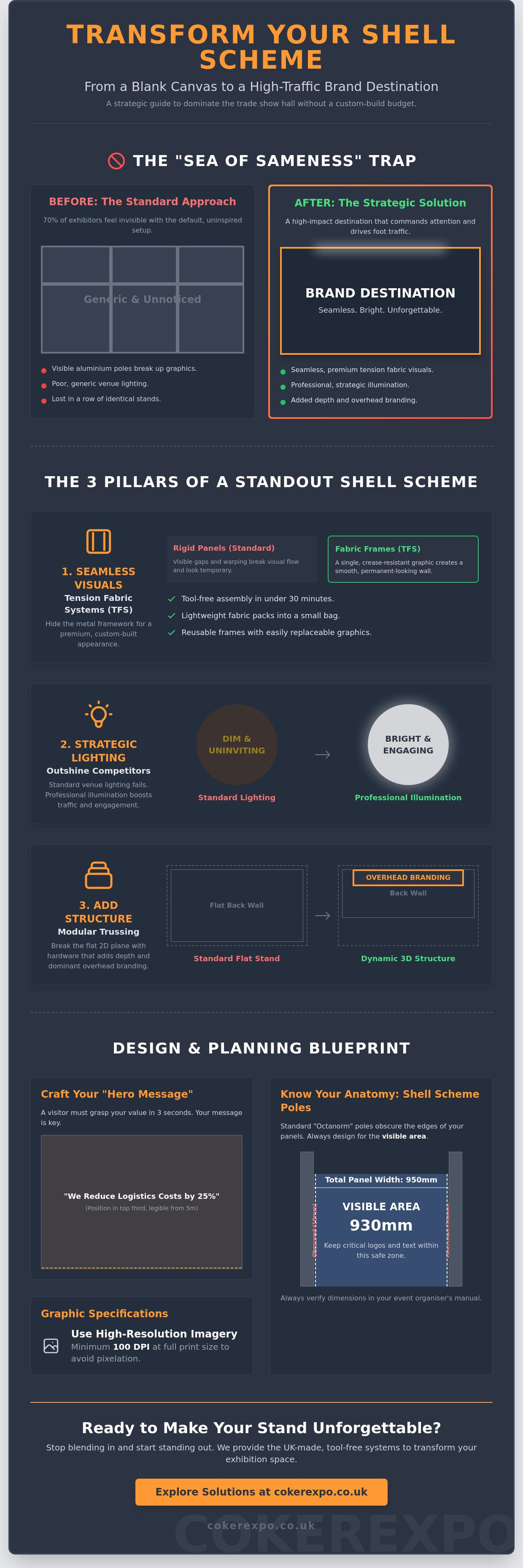
Before you design any graphics, you must grasp the technical constraints of the modular system. The vertical uprights and horizontal beams are the skeleton of your stand. You'll likely encounter the Octanorm system, which is the industry standard in the UK. It's vital to distinguish between the "internal" and "external" panel dimensions. For instance, a standard panel might be 950mm wide, but the visible area between the aluminium poles is often only 930mm. If you don't account for this 20mm gap, your text or logos will be obscured by the frame. Always verify the specific system type in your organiser's manual to ensure your display fits perfectly.
Setting Clear Goals Before Designing
Your stand's layout should be a direct reflection of your primary objective. If you're focused on lead generation, you need an open floor plan that invites visitors in and a dedicated counter for data capture. If you're launching a new product, you'll require more wall space for high-resolution imagery and perhaps integrated shelving or plinths. Every successful stand relies on a "Hero Message" that tells a visitor exactly what you do. This single sentence must be positioned in the top third of your back wall and be clearly legible from 5 metres away. For example: "We reduce your logistics costs by 25% with tool-free modular packaging." If a passerby can't grasp your value proposition in three seconds, they won't stop.
Seamless Visuals: Using Tension Fabric Systems (TFS)
Traditional shell schemes rely on visible aluminium poles. These divide your message and look utilitarian. Understanding how to make a shell scheme stand out starts with eliminating this visual noise. Tension Fabric Systems (TFS) allow you to cover the entire wall in a single, seamless graphic. By wrapping a continuous piece of dye-sublimation printed fabric over a frame, you hide the aluminium uprights. This creates a premium, custom-built appearance without the bespoke price tag. It is the most effective way to use shell scheme graphic panels in 2026. The fabric is lightweight and crease-resistant; you can fold a 3-metre wall graphic into a small bag for easy transport across the UK. Most systems use a silicone edge graphic (SEG) that pushes into a frame channel. It's a tool-free process that one person can complete in under 30 minutes.
Fabric Frames vs. Rigid Panels
Fabric frames offer a more professional finish than standard PVC panels. Rigid boards often warp or show gaps at the joins, which breaks the visual flow. In contrast, fabric provides a smooth, tensioned surface that looks like a permanent wall. The cost-effectiveness of this system is high because you reuse the aluminium frames for years. You simply order new fabric skins for different campaigns. While custom wallpaper is an excellent choice for permanent showroom installs, TFS is the superior choice for the fast-paced exhibition circuit. It provides a level of versatility that rigid modular panels cannot match.
Maximising Your Graphic Impact
Visual hierarchy determines how long a visitor stays at your stand. Apply the Rule of Thirds to your exhibition walls. Keep your logo and primary call-to-action at eye level, typically between 1.5 and 2.2 metres from the floor. High-resolution imagery is non-negotiable for large-format printing. Files should be at least 100 DPI at full size to avoid pixelation. To effectively stand out at your next trade show, use bold, contrasting colours that define your brand zone. A 2023 industry study found that exhibitors using high-contrast visuals saw a 33 percent increase in booth traffic compared to those using muted tones. If you need a custom configuration for your next event, speak with our technical team to find the right frame for your space.
Lighting Strategies to Outshine Competitors
Standard venue spotlights often fail to deliver the impact needed for a high-traffic trade show. These basic fixtures frequently create harsh shadows or produce a yellow tint that distorts your brand colours. To truly understand how to make a shell scheme stand out, you must treat lighting as a structural element rather than an afterthought. Lighting isn't just about visibility; it's a psychological tool. Data from industry events shows that strategically lit displays can increase visitor dwell time by 21% compared to stands relying on ambient hall light. By implementing these trade show exhibition tips, you transform a flat wall into a focal point that pulls attendees from the aisles.The Power of Exhibition Lightboxes
Integrating lightboxes into your shell scheme is the most effective way to ensure uniform brightness. Our LED systems use high-efficiency diodes to provide edge-to-edge illumination without the hotspots common in cheaper alternatives. For 2026, dynamic lightboxes are becoming the industry standard. These units use programmed LED matrices to create subtle movement within the graphic, such as a flowing water effect or a pulsing logo. This movement captures the peripheral vision of passersby, making it a critical tactic when considering how to make a shell scheme stand out in a crowded hall. Most of our lightbox solutions feature tool-free assembly, allowing you to go from flat-pack to fully illuminated in under 15 minutes.Creative Lighting Placement
Adding Depth with Modular Hardware and Trussing
A standard shell scheme is essentially a flat, two-dimensional box. To truly understand how to make a shell scheme stand out, you must break that 2D plane and build into the vertical space. Modular hardware transforms a basic 3x3 metre footprint into a multi-layered environment that commands attention from across the hall. High-impact structures don't just look better; they define your territory and provide the structural integrity needed for professional AV equipment.
Utilising a truss truss system allows you to create overhead gantries or branding towers that sit inside the shell scheme walls. This setup provides a safe, robust framework for mounting heavy LED screens or complex lighting rigs without relying on the flimsy structure of the organiser's panels. For physical products, integrating a display turntable offers a dynamic way to showcase hardware from every angle, ensuring no detail is missed by passing trade.
Truss Systems for Impact and Utility
Modular gantry systems create a stand-within-a-stand effect, which is a proven strategy for 2026 exhibitors looking to differentiate themselves. These systems are engineered for tool-free assembly; this means a two-person team can build a professional rig in under 30 minutes. This speed is vital when build-up windows are narrow. By moving your branding to an overhead gantry, you free up floor space for visitor movement while ensuring your logo is visible from 50 metres away.
Functional Accessories for Visitor Engagement
The transition from a visitor to a lead often happens at a physical touchpoint. Replacing a standard table and cloth with a professional branded counter creates an immediate reception point that signals authority. While folding display boards are excellent for supplementary technical data or secondary messaging, they're most effective when paired with digital kiosks. Integrating tablet stands allows for instant lead capture and interactive product demos, reducing the friction of data entry. A 2024 industry survey noted that stands with dedicated reception counters saw a 22% increase in high-quality lead conversations compared to those using basic furniture.
Ready to upgrade your exhibition presence? Explore our range of modular hardware and trussing systems to build a stand that delivers results.
Planning and Building Your Stand for Maximum Efficiency
Success at a 2026 trade show depends on the seamless transition from a digital proof to a physical structure. Knowing how to make a shell scheme stand out involves more than just aesthetics; it requires a flawless technical execution. If your graphics are creased or your hardware is missing a vital connector, the most creative concept will fail to impress. Practicality is the foundation of high-impact exhibiting.
A "dry run" is your most effective insurance policy. Assembling your entire stand at your premises at least 10 days before the event ensures every component is present and functional. This practice allows you to identify graphic misalignments or hardware issues while there is still time for a fast turnaround from your supplier. Most on-site stress stems from simple, avoidable errors that a 30-minute pre-build would have caught.
Modern UK exhibitors now treat tool-free assembly as the gold standard. We design modular systems that use intuitive locking mechanisms rather than requiring a full toolbox. This approach reduces the need for expensive on-site contractor support and speeds up your build time significantly. Efficiency is also a matter of logistics. High-performance stands should be portable enough to fit into a standard estate car or a small van like a VW Caddy. This eliminates the reliance on heavy haulage and gives you total control over your schedule. Bridging the gap between a conceptual sketch and a high-performance reality often requires professional exhibition stand design services to ensure your vision is structurally sound and easy to transport.
The 4-Week Countdown Checklist
- Week 4: Finalise all high-resolution artwork. Confirm your panel or tension fabric specifications with your supplier to ensure a perfect fit for the specific shell scheme dimensions provided by the organiser.
- Week 2: Order your furniture and confirm electrical requirements. Verify that your chosen lighting won't exceed the power limit of your shell scheme package.
- Week 1: Perform a full assembly test. Check all graphics for spelling errors or scuffs and ensure all LED components are functioning correctly.
On-Site Setup and Finishing Touches
Managing your arrival slot is critical. Exhibition loading bays are high-pressure environments, so have your vehicle pass and stand number ready to avoid delays. Once you're at your plot, clean the shell scheme aluminium poles before applying any graphics. Dust or grease can prevent adhesives from sticking or stain expensive tension fabrics.
Applying graphics seamlessly is an art. For PVC or foam panels, work from the top down to ensure a bubble-free finish. If you're using fabric, ensure the silicone edge is pushed fully into the channel for a drum-tight look. Final checks should focus on the details that visitors notice. Hide all cable runs using clips or gaffer tape, test your AV loops, and ensure your literature is stocked and neatly aligned. These small steps are essential when learning how to make a shell scheme stand out as a professional, reliable brand.
Transform Your 2026 Exhibition Strategy
Success on the trade show floor requires moving beyond basic posters and tape. You've seen that how to make a shell scheme stand out depends on high-impact Tension Fabric Systems and strategic lighting that cuts through hall glare. Integrating modular trussing adds the structural depth needed to command attention in a crowded venue. Efficiency is just as critical as aesthetics. Choosing systems designed for rapid, tool-free assembly ensures your team spends time networking rather than struggling with complex hardware during the build.
CokerExpo provides the infrastructure for your success with over 25 years of exhibition expertise. Our UK-based manufacturing facility delivers high-performance displays with fast turnaround times, ensuring you're ready for every 2026 event deadline. We specialise in robust, professional hardware that transforms a standard 3m x 3m space into a bespoke brand environment. Our systems are engineered for durability, making them a sound investment for your long-term marketing calendar.
Discover our range of high-impact shell scheme solutions at CokerExpo and start planning your most successful show yet. We look forward to helping you dominate the event floor.
Frequently Asked Questions
Can I attach my own graphics to a shell scheme stand?
You can attach your own graphics to a shell scheme using Velcro hook and loop tape or magnetic strips, provided you don't damage the organiser's panels. Most UK venues, such as the NEC or ExCeL London, strictly prohibit the use of nails, screws, or permanent adhesives on the hired structure. For a professional finish that shows how to make a shell scheme stand out, we recommend using rollable PVC panels or tension fabric systems that sit flush against the frame.
How do I hide the aluminium poles on my shell scheme?
You hide aluminium poles by using specialized plastic clips that snap into the upright grooves or by installing a freestanding tension fabric wall in front of the shell. A standard 3x3m shell scheme typically has 10 to 12 visible uprights that break up your branding. Overlaid graphics or shell-clad systems create a seamless, continuous wall that covers the metalwork entirely, transforming the modular look into a custom-built appearance.
What is the standard size for shell scheme graphic panels in the UK?
The standard size for a single shell scheme panel in the UK is typically 950mm wide by 2340mm high, though this varies by system type like Octanorm or Sodem. You must check your specific exhibitor manual for the visible area versus the cut size of the infill panels. In 2024, approximately 85% of UK trade shows use these dimensions, but even a 5mm discrepancy can prevent a panel from fitting correctly into the frame.
Do I need tools to set up a shell scheme stand?
You don't need tools to set up most modern shell scheme upgrades, as these systems are designed for rapid, manual assembly. High-quality modular displays use thumb-screws, twist and lock connectors, or silicone edge graphics that press into channels by hand. This tool-free approach reduces your setup time by 40% and ensures your team doesn't need technical training or heavy equipment on the show floor during the busy build-up period.
How much does it cost to make a shell scheme look custom?
Costs for upgrading a shell scheme vary based on whether you choose simple graphic infills or a full fabric wrap. According to the 2023 Exhibition Industry Research report, exhibitors typically allocate 20% to 30% of their total event budget to stand design and graphics. Investing in reusable modular hardware provides a better long-term ROI than one-off wooden builds, as the hardware often lasts for 5 to 10 years of regular use.
Can I use LED lightboxes on a standard shell scheme?
You can use LED lightboxes on a standard shell scheme, and they are one of the most effective ways regarding how to make a shell scheme stand out in a crowded hall. Freestanding lightboxes are 100mm deep and require a dedicated 500-watt power socket from the venue's electrical contractor. These units use high-output LED modules to achieve a brightness of 2,000 to 5,000 lumens, ensuring your graphics remain vibrant even under harsh overhead venue lighting.
What are the fire safety regulations for exhibition graphics?
All exhibition graphics in the UK must meet Class 1 fire retardancy standards, specifically BS 5867 or the European EN 13501-1 (B1) rating. Venue floor managers at sites like Olympia London require certificates of conformity for all fabric and PVC materials before the show opens. You'll face immediate removal of your display if materials fail to meet these safety protocols, so always verify the fire rating with your print supplier before production.
How do I transport a 3-metre wide fabric display?
You transport a 3-metre wide fabric display by collapsing the modular aluminium frame into a single wheeled transit case that fits into a standard estate car. These cases typically weigh between 15kg and 25kg when fully loaded with a tension fabric graphic and frame. Because the fabric is dye-sublimated, you can fold it without causing permanent creases, making it significantly easier to handle than traditional rigid panels that require a dedicated delivery van.
Leave a comment