

Illuminated Fabric Display Cost: The 2026 UK Buyer’s Guide to ROI and Pricing
A cheap lightbox is often the most expensive mistake a marketing manager makes during the 2026 exhibition season. When you analyze the illuminated fabric display cost, the initial price tag only tells 40% of the story. You might save £200 on a budget import today, but you will likely spend double that on specialized shipping or replacement frames when the hardware fails after just two shows. It is a common frustration to find yourself stuck with a system that is difficult to assemble or features graphics that simply don't fit the frame correctly.
You want a display that works as hard as your sales team without the stress of hidden fees for replacement graphics or technical support. This guide provides a clear framework to help you choose a robust system that lasts for multiple event cycles. We will break down the difference between hardware and graphic costs, explain why tool-free assembly is a non-negotiable for ROI, and show how professional UK-made systems deliver a seamless brand presence that justifies every penny of your marketing spend.
Key Takeaways
- Understand the three technical pillars—frame engineering, LED density, and print quality—that determine your total illuminated fabric display cost in the 2026 UK market.
- Learn to distinguish between one-time hardware investments and recurring graphic costs to maximize the 10-year lifespan of your exhibition infrastructure.
- Identify the most cost-effective display format for your specific requirements, from portable retail units to modular systems for large-scale trade shows.
- Uncover often-overlooked expenses like power consumption and storage to ensure your exhibition budget remains accurate and your long-term ROI is protected.
- Discover the logistical advantages of UK-based support, including bespoke sizing and rapid graphic turnaround times to meet demanding event deadlines.
Understanding the Investment: What Influences Illuminated Fabric Display Cost?
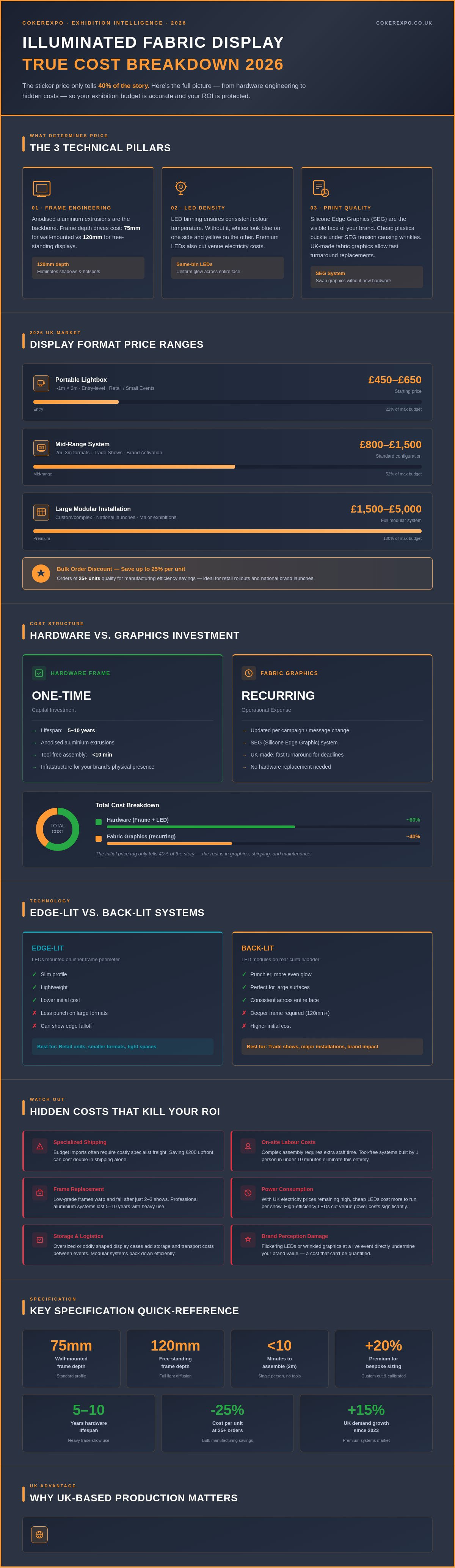
An illuminated fabric display combines high-strength Tension Fabric Systems (TFS) with advanced LED technology to create a vibrant, backlit graphic that commands attention. For UK marketing teams planning their 2026 event calendar, the illuminated fabric display cost is determined by three specific pillars: frame engineering, lighting density, and print quality. Since 2023, the UK exhibition market has seen a 15% increase in demand for premium systems. This shift happens because professional-grade hardware offers better longevity and a lower total cost of ownership over multiple show cycles.
Choosing "cheap" alternatives often leads to hidden expenses. Low-grade LEDs tend to flicker or fail during live events, and flimsy frames can warp under the tension of the fabric. Within the strategic framework of visual merchandising, these technical failures directly damage brand perception. Modern exhibitors now prioritise sustainable, reusable aluminium frames. These systems are designed for circularity, allowing you to swap graphics for different campaigns without replacing the underlying hardware. It's a pragmatic approach that turns a one-off purchase into a long-term marketing asset.
The Anatomy of a Professional Lightbox
A professional system consists of three core elements: heavy-duty aluminium extrusions, LED arrays, and Silicone Edge Graphics (SEG). Frame depth is a primary cost driver. While 75mm profiles work for wall-mounted units, 120mm depths are the standard for free-standing displays. This extra depth ensures perfect light diffusion, which eliminates the shadows or "hotspots" found in thinner, budget frames. We focus on tool-free assembly because it's a major factor in reducing on-site labour costs. A single team member can build a standard 2-metre display in under 10 minutes without a toolkit.
Market Price Ranges for 2026
Current industry data for 2026 suggests that entry-level portable lightboxes (approx. 1m x 2m) typically start between £450 and £650. Large modular installations or complex custom configurations often range from £1,500 to £5,000 depending on the scale of the LED integration. Bespoke dimensions usually carry a premium of roughly 20% over standard sizes. This is due to the custom cutting and calibration required at our UK production facilities. However, for retail rollouts involving bulk orders of 25 units or more, the illuminated fabric display cost per unit can drop by up to 25% through manufacturing efficiencies. It's a scalable solution that fits both boutique setups and national brand launches.
Hardware vs. Graphics: A Detailed Price Breakdown
Calculating the illuminated fabric display cost involves separating the initial capital investment from the ongoing operational expenses. Your frame is a long-term asset. A professional-grade system should last between 5 to 10 years, even with heavy use on the UK trade show circuit. You aren't just buying a sign; you're investing in the infrastructure of your brand's physical presence. While the hardware is a one-time purchase, the fabric graphics are recurring costs that you'll update as your marketing messages evolve. UK-based production offers a significant advantage here. It allows for rigorous quality control and ensures that replacement parts or new graphics are available on a fast turnaround, which is critical when event deadlines loom.
The choice between edge-lit and back-lit technology dictates much of the initial price point. Edge-lit systems use LEDs mounted on the inner perimeter of the frame, which keeps the profile slim and the weight low. Back-lit systems place LED modules on a rear curtain or ladder, providing a punchier, more even glow across large surface areas. High-quality hardware avoids the "false economy" of cheap imports that often fail after three builds. Investing in robust frames means your only future expense is the fabric itself.
Frame Materials and LED Engineering
Professional displays rely on anodised aluminium. It's lightweight but offers the structural integrity required to maintain tension. Cheap plastic frames often buckle under the pressure of the silicone edge graphic (SEG), leading to unsightly wrinkles. LED binning is another hidden cost factor. Premium displays use LEDs from the same "bin" to ensure consistent colour temperature. Without this, your white background might look blue on one side and yellow on the other. High-efficiency LEDs also cut venue power costs. With UK electricity prices remaining high, using low-energy components can reduce your stand's utility bill by 20% compared to older lighting technology.
The Cost of Premium Fabric Printing
Dye-sublimation is the gold standard for backlit displays. It creates vibrant, wash-fast images by gassing ink directly into the polyester fibres. To achieve the high-contrast look seen in 2026 exhibition industry trends, a double-strike print process is required. This applies a heavier ink load so blacks remain deep and saturated when the lights are turned on. Investing in high-quality double-strike printing ensures your illuminated fabric display cost delivers the best visual ROI over the life of the hardware. If you're focusing on sustainability, recycled fabrics made from plastic bottles are now widely available. These typically carry a 15% price premium over standard polyester but help companies meet their ESG targets. You can explore our range of modular lightboxes to see how these elements come together.
Comparing Display Formats: From Portable to Modular Systems
The environment where you deploy your hardware dictates the initial illuminated fabric display cost and its long-term ROI. A retail installation in a London flagship store involves different structural requirements than a modular stand designed for a three-day trade show at the NEC. Retail units often prioritise slim profiles and permanent power integration, whereas exhibition systems must withstand the rigours of transit and repeated assembly. For a deep dive into technical specifications for these environments, consult our Ultimate Guide to Exhibition Lightboxes.
Choosing a double-sided display typically adds a 30% to 45% premium to the hardware cost. This increase covers the additional LED arrays required for even illumination on both faces and the second tension fabric graphic. While the upfront investment is higher, the ROI is often superior in high-traffic exhibition aisles where visibility from both directions is critical. Single-sided units are better suited for perimeter wall placements where the back of the frame is never visible to the public.
Logistics represent a significant portion of the total cost of ownership. Heavier modular systems may require palletised shipping, which can cost between £60 and £150 per unit for domestic UK delivery. Lightweight portable frames can often be transported in a standard estate car, eliminating courier fees entirely. You must balance the visual impact of a heavy-duty system against these recurring transport expenses.
Freestanding vs. Wall-Mounted Units
Freestanding units require robust steel or weighted aluminium base plates to ensure stability in public spaces. These components add weight and cost but are essential for health and safety compliance at UK venues. Wall-mounted frames are more cost-effective because they lack these heavy bases. They use simpler perimeter profiles that fix directly to a substrate. Choose wall-mounted for permanent office branding where floor space is limited; choose freestanding for flexible event layouts where you need to guide visitor footfall.
The Price of Portability: Tool-Free Assembly
Traditional lightboxes often rely on hex-key connectors. These are reliable, but they're slow to build. Modern tool-free "click" systems represent a higher initial illuminated fabric display cost but offer massive savings in labour. If a marketing team of two can assemble a stand in 15 minutes instead of 90 minutes, the saving on staff time across a five-show circuit can reach hundreds of pounds. Investing in high-quality protective transit cases is also vital. A damaged frame ruins your professional image and forces expensive last-minute repairs. Cases protect your ROI by ensuring the hardware survives years of courier handling.
Beyond the Sticker Price: Hidden Costs and Long-Term ROI
Your initial illuminated fabric display cost represents only the first phase of your investment. To calculate a true 2026 ROI, you've got to account for the operational expenses that often surprise exhibitors. UK venues like the NEC or ExCeL London charge separate fees for mains power hookups. These can range from £150 to £450 depending on your wattage requirements and the duration of the event. Professional exhibition stand design plays a critical role here; a well-engineered frame ensures your hardware survives a decade of use rather than just a few shows. This longevity significantly lowers your cost-per-event over time.
UK safety regulations are non-negotiable. All fabric displays must meet BS5867 or European B1 fire certifications to be permitted on the show floor. While Coker Expo hardware and textiles include these certifications as standard, budget imports often don't. This can lead to costly last-minute on-site testing or even stand closure by venue fire marshals. Adopting a 'circular' display model where you retain the aluminium frame and only update the tension fabric skin reduces environmental waste and slashes future capital expenditure by up to 65%.
Replacement Graphic Costs
New SEG (Silicone Edge Graphic) prints typically cost between 25% and 40% of the original total purchase price. This makes the system incredibly cost-effective for brands running multiple campaigns annually. You can swap graphics in minutes without tools, allowing for different messaging at a trade show on Tuesday and a corporate lobby on Friday. We recommend sticking to standard modular dimensions. Custom-sized frames often require bespoke finishing for every new print, which typically adds a 20% premium to future graphic orders.
Transport and Storage Considerations
- Portable Lightboxes: These fit into standard courier networks like DPD or UPS. UK next-day delivery usually costs between £20 and £45.
- Modular Systems: Larger setups require palletised freight. Costs start at £85 and scale based on the number of pallets and delivery distance.
- Hardware Durability: High-grade 6063-T5 aluminium frames are essential for repeated transit. They resist the warping and corner damage that ruins cheaper, thin-walled alternatives during handling.
Volumetric weight is a pricing calculation used by couriers that multiplies the length, width, and height of a package and divides it by a set factor to determine a billable weight based on the space the box occupies rather than its actual mass.
Ready to invest in a display that pays for itself? View our modular illuminated range to find your perfect fit.
Choosing the Right System: Maximising Impact with CokerExpo
Investing in exhibition hardware is a strategic decision that affects your brand's physical presence for years. CokerExpo acts as a technical partner for businesses requiring high-performance, durable infrastructure rather than disposable displays. Choosing a UK-based specialist ensures you have access to immediate support, whether you need urgent graphic reprints for a new campaign or technical advice on structural stability. Local production means turnaround times are often measured in days, not weeks, which is vital when event deadlines are fixed.
For those seeking a seamless look across large spans, Tension Fabric Systems (TFS) offer the most professional finish. These systems eliminate the visible joins found in traditional panel displays, creating a flat, vibrant surface that carries light evenly. When you calculate your total illuminated fabric display cost, you must factor in the longevity of the frame. A robust aluminium system from a UK supplier can be reused across dozens of shows, significantly lowering the cost per event compared to cheaper, flimsier alternatives.
Custom Requirements and Bespoke Sizing
Standard off-the-shelf sizes like 2x2m or 3x2m work for many, but they don't always maximise the available floor space at premium venues. If your stand has unique pillars, low ceilings, or requires a curved focal point, bespoke sizing is necessary. CokerExpo handles the engineering for oversized lightboxes and custom shapes that require specific structural reinforcement. Getting expert advice during the design phase prevents expensive errors, such as ordering graphics that don't account for the necessary bleed or tension requirements of a custom frame.
Why Quality Over Cheap Imports Wins
Low-cost imported systems often suffer from "hot-spotting," where individual LED bulbs are visible through the fabric, creating an uneven and distracting glow. Professional systems use high-output LEDs with diffusion lenses to ensure the light is edge-to-edge and perfectly consistent. Reliability is another factor. UK-manufactured hardware typically includes comprehensive warranties and, more importantly, a ready supply of spare parts. If a single connector or power transformer is lost or damaged during transit to a show, a local partner can courier a replacement immediately. With an import, a minor part failure often renders the entire system useless.
Professional brand representation requires a balance between initial expenditure and long-term utility. A high-quality display ensures your illuminated fabric display cost delivers a genuine return through better lead generation and a more authoritative presence on the trade show floor. Don't let a small saving on hardware undermine a marketing budget worth thousands. Contact CokerExpo for a tailored quote on your next illuminated display and ensure your infrastructure is as professional as your brand.
Future-Proof Your 2026 Exhibition Strategy
Securing a high-impact presence for the upcoming exhibition season requires a strategic balance between initial capital and long-term durability. You now understand how hardware and graphic components split the total investment, and why tool-free, portable LED systems are essential for slashing on-site labour costs. Selecting a modular system ensures your display infrastructure remains versatile enough to adapt as your marketing goals evolve over the next three to five years.
Coker Expo provides over 25 years of UK exhibition expertise to help you navigate these technical choices. We're specialists in tool-free, portable LED systems that prioritise the user experience, ensuring your team isn't bogged down by complex assemblies. Our in-house UK graphic production facility guarantees a fast turnaround and the precise, seamless finish required for premium brand representation. Calculating your specific illuminated fabric display cost depends on your unique scale and frequency of use, but the ROI of a robust, professional system is clear. We're ready to help you make a lasting impression without the technical headaches.
Request a custom quote for your illuminated fabric display today and take the first step toward a stress-free trade show season. We look forward to helping your brand shine.
Frequently Asked Questions
How much does a standard 1x2m freestanding illuminated fabric display cost?
A standard 1x2m freestanding illuminated fabric display cost typically ranges from £450 to £750 in the UK market, depending on the frame depth and LED density. This price usually includes the aluminium frame, internal lighting components, and a single-sided silicone edge graphic. Premium units with higher lumen output or double-sided print options can exceed £850. Prices vary based on the specific extrusion profile used for stability.
Can I change the graphics on my illuminated display myself?
You can change the graphics on your illuminated display yourself in less than 10 minutes without any tools. The system uses a Silicone Edge Graphic (SEG) that tucks into a narrow channel on the frame. This allows your team to refresh marketing messages for different events or seasons. It's a key factor in reducing the long-term illuminated fabric display cost, as you only pay for new fabric skins rather than a whole new system.
Are LED lightboxes expensive to run at an exhibition?
LED lightboxes are remarkably cost-effective to operate, consuming approximately 80% less energy than traditional fluorescent lighting. A standard 2-square-metre display typically draws between 60 and 120 watts of power. Most UK exhibition venues charge for power based on 500W or 1kW sockets. Your lightbox will likely use less than 15% of a standard 500W supply, making it one of the most efficient ways to increase stand visibility.
What is the difference between edge-lit and back-lit fabric displays?
Edge-lit displays use LED strips mounted to the inner perimeter of the frame to push light across the graphic, while back-lit displays use LED modules fixed to a rear panel or ladder system. Edge-lit frames are often slimmer, typically 60mm to 80mm deep, making them ideal for smaller footprints. Back-lit systems provide more uniform illumination for larger spans over 3 metres, preventing the shadowing sometimes seen in the centre of very wide units.
Do illuminated fabric displays come with a warranty?
Most professional UK suppliers provide a 12-month or 24-month warranty on the LED components and a lifetime warranty on the aluminium hardware. It's standard practice to cover manufacturing defects such as driver failure or premature LED degradation. At Coker Expo, we ensure all power supplies are CE and UKCA certified. This gives you peace of mind that your investment is protected for multiple exhibition cycles across the UK and Europe.
How long does it take to get a custom-sized lightbox made in the UK?
Production for a custom-sized lightbox in the UK typically takes between 7 and 10 working days from artwork approval. We can often expedite this to 3 or 5 days for urgent requirements if the aluminium profiles are in stock. Local manufacturing avoids the 6-week shipping delays associated with overseas imports. This fast turnaround ensures you meet tight event deadlines without compromising on build quality or bespoke dimensions needed for your stand.
Are the fabric graphics fire-rated for UK exhibition venues?
All fabric graphics must be fire-rated to B1 or M1 standards to comply with UK venue regulations like those at the NEC or ExCeL London. We use polyester tension fabrics that are specifically treated to be flame retardant. You'll receive a fire certificate with your order, which stand managers often require during health and safety inspections. Using non-certified fabrics can lead to your display being removed from the show floor by organisers.
Can I use my illuminated display as a non-lit stand if needed?
You can use your illuminated display as a non-lit stand simply by leaving the power cable unplugged. The tension fabric graphic remains perfectly taut and professional even without the LEDs active. This versatility makes it a practical choice for venues where power access is restricted or too expensive. It's a robust piece of hardware that functions as a high-quality fabric wall regardless of whether you choose to illuminate it at a specific event.
Leave a comment