

Outdoor Event Lightbox Solutions: A Professional Guide to Weatherproof Displays
What if your outdoor branding could withstand a sudden downpour and still look as crisp as an indoor gallery wall? Achieving that level of reliability requires more than just a standard display; it demands specialized outdoor event lightbox solutions engineered for the rigors of the field. Many event managers struggle with the fear of equipment failure due to unpredictable weather, often feeling forced to sacrifice visual impact for basic durability.
We recognize that the logistical stress of transporting and assembling heavy hardware can quickly overshadow the goals of a high-profile exhibition. This professional guide will show you how to select and deploy high-impact, IP-rated displays that maintain maximum visibility even in direct sunlight. You'll discover how to optimize your setup for quick on-site assembly and ensure your brand remains a powerful focal point. We will break down the technical specifications and practical strategies needed to turn a challenging outdoor environment into a seamless, high-performance branding success.
Key Takeaways
- Understand why IP65 is the essential industry standard for protecting outdoor displays against dust and water ingress.
- Evaluate the performance differences between freestanding and dynamic outdoor event lightbox solutions to maximize brand impact in high-traffic areas.
- Learn to distinguish between water-resistant and truly weatherproof hardware to ensure long-term durability against UV exposure and heavy rain.
- Streamline your event logistics by selecting tool-free, modular systems that allow for rapid on-site assembly without specialized equipment.
- Discover how to maintain high-impact visual branding in direct sunlight by prioritizing specific brightness and tension fabric specifications.
Understanding Outdoor Event Lightbox Solutions for 2026
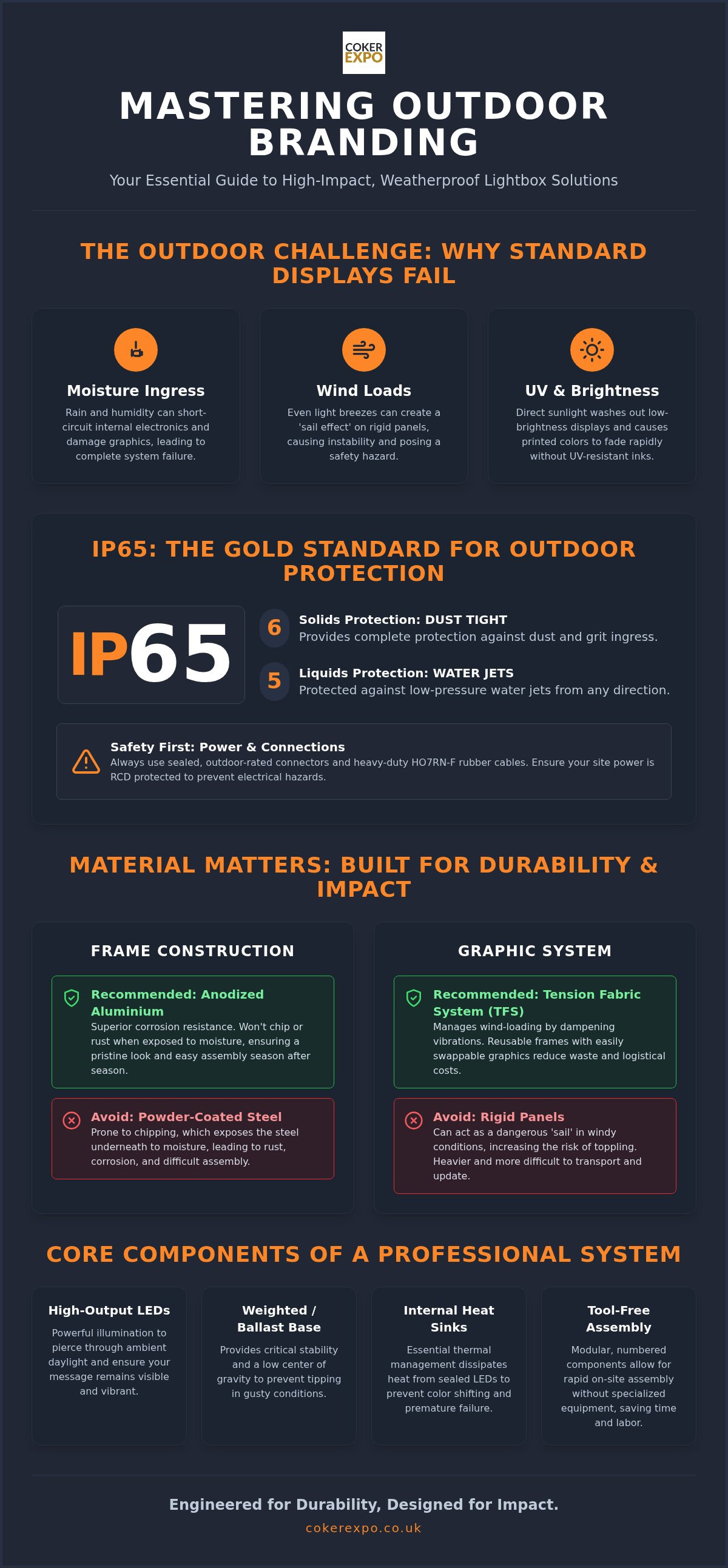
Outdoor lightboxes are not merely brighter versions of their indoor counterparts. They are specialized, weather-resistant hardware designed to protect internal electrical components while maintaining graphic integrity in harsh conditions. Understanding Outdoor Event Lightbox Solutions involves recognizing that these units must survive moisture, wind loads, and intense UV exposure that would cause standard indoor displays to fail within hours. Standard indoor units often lack the seals required to prevent short-circuiting or the structural reinforcement needed to withstand even a light breeze.
Modern outdoor event lightbox solutions utilize high-output LEDs to compete effectively with ambient daylight. These LEDs provide the necessary punch to ensure your brand message doesn't wash out under the midday sun. We're seeing a significant industry shift toward sustainable Tension Fabric Systems (TFS). These systems allow for reusable frames and easily swappable fabric graphics, reducing waste and logistical costs for multi-city event tours. This move toward modularity means you can update your campaign visuals without replacing the entire hardware investment.
Why Outdoor Visibility Demands More Than Just Brightness
Legibility in an open-air environment depends heavily on contrast ratios and graphic density. If the print quality isn't high enough, the backlighting will simply bleed through the fabric, making the text unreadable. Using UV-resistant inks is critical for multi-day events to prevent colors from fading under direct sunlight. Lux levels are a measurement of light intensity on a specific surface area, indicating how effectively a display can pierce through ambient outdoor brightness.
The Core Components of a Professional Outdoor Display
Stability is the primary engineering challenge for any external installation. While lightweight portable options exist for sheltered areas, professional-grade displays feature heavy-duty aluminum frames. These frames are designed to integrate with weighted bases or internal ballast systems to ensure the unit remains upright during sudden gusts of wind. For a deeper look at the fundamental technology behind these systems, consult The Ultimate Guide to Exhibition Lightboxes. This ensures your hardware represents a sound business investment that delivers results year after year.
Weatherproofing and Durability: Key Specifications to Check
Selecting professional hardware requires moving beyond marketing buzzwords like "waterproof" and examining verified technical specifications. For high-performance outdoor event lightbox solutions, the primary benchmark is the IP rating. While water-resistant equipment might survive a light drizzle, only truly weatherproof hardware is engineered for prolonged exposure to heavy rain and fluctuating humidity. Safety is paramount, and the design must account for wind-loading to prevent the display from becoming a hazard in gusty conditions.
Thermal management is another critical factor often overlooked by less experienced planners. LEDs generate heat. When these components are sealed inside an IP-rated casing, that heat must be dissipated to prevent premature diode failure. Professional-grade frames incorporate internal heat sinks that allow the system to remain cool even in direct summer sun. Without this engineering, the internal temperature can rise quickly, leading to color shifting or total electrical failure during your event.
IP Ratings Explained for Event Managers
The Ingress Protection (IP) system uses two digits to define a unit's resilience. The first digit (0 to 6) measures protection against solids like dust and grit. The second digit (0 to 9) measures protection against liquids. An IP65 rating is the recognized industry standard for events because it signifies the unit is dust-tight and protected against water jets from any angle. Failure usually occurs at connection points, so always use sealed, outdoor-rated connectors and HO7RN-F rubber cables. Before going live, verify that your site power is RCD protected to ensure the safety of both staff and attendees.
Material Science: TFS and Aluminium Resilience
Tension Fabric Systems (TFS) are ideal for external use because they manage wind-loading more effectively than rigid panels. The high-tension fabric dampens vibration and reduces the sail effect that can topple poorly designed stands. We prioritize anodized aluminium for frame construction because it provides superior corrosion resistance. Unlike powder-coated steel, anodized aluminium won't chip or rust when exposed to moisture. This material choice ensures the frame remains easy to assemble and looks pristine across multiple seasons. If you are planning a complex installation, investing in professional outdoor display hardware ensures your infrastructure can handle varying humidity levels without losing graphic tension.
Selecting the Right Solution: Freestanding vs. Dynamic Systems
Choosing between different outdoor event lightbox solutions depends on your specific site layout and audience flow. Freestanding lightboxes serve as ideal wayfinding tools or branding pillars for high-traffic walkways and entrance points. Their portability allows for strategic placement where they can guide attendees toward key activations. These units are built with stability in mind, often featuring weighted bases that prevent movement in high-wind zones.
For semi-permanent structures like gazebos or temporary pavilions, wall-mounted solutions provide an integrated look without consuming valuable floor space. If you need to command attention from a distance, integrating your displays with Exhibition Lighting Truss creates massive overhead impact that's visible across the entire event site. This combination of structural strength and brilliant illumination ensures your brand remains the focal point of the environment.
The Rise of Dynamic Outdoor Lightboxes
Movement is a powerful psychological trigger. Dynamic lightboxes use programmed LED sequences to create an illusion of motion within a static frame. This technology significantly increases dwell time at outdoor activations by catching the peripheral vision of passersby more effectively than static imagery. You can program custom sequences to match your brand identity, such as a pulsing logo or a flowing color gradient. It's vital to remember that large-scale dynamic displays have higher power requirements, so coordinate with your site electrician early in the planning phase to ensure adequate supply.
Tension Fabric Systems (TFS) for Outdoor Use
Professional outdoor displays increasingly rely on Tension Fabric Systems (TFS). These systems offer seamless, large-format graphics that eliminate the visible joins often found in rigid panel displays. For multi-day tours, the ease of graphic change-over is a major operational advantage. One crew member can swap a graphic in minutes without specialized tools. Fabric also offers sustainable advantages over traditional PVC panels. Many modern textiles are recyclable and take up far less volume during transport, which reduces your overall carbon footprint. To find the perfect fit for your next project, explore our full range of outdoor event lightbox solutions today.
Logistics and Setup: Ensuring Success on Site
Success with outdoor event lightbox solutions depends as much on the logistics of the move as the hardware itself. You must decide between modular systems and pre-assembled units early in the planning phase. Modular systems offer superior flexibility for national shipping and storage, while pre-assembled units can save time if your venue allows for direct vehicle access to the setup point. Choosing the right format ensures your team isn't overwhelmed by complex assembly tasks in a high-pressure environment.
For event crews working under tight deadlines, tool-free systems are the gold standard. These designs allow for rapid deployment without the risk of losing small components in the grass or mud. Stability in an open-air environment is non-negotiable. Depending on the ground surface, you should utilize ground anchors for soft turf or integrated ballast options for hard standing. Sandbags provide a practical secondary measure for stabilizing freestanding frames against sudden gusts, ensuring the safety of both staff and attendees.
Conduct a final inspection before the public arrives. You must verify that all IP-rated seals are seated correctly and that cables are routed away from foot traffic to prevent trip hazards. Ensure the graphic tension is uniform across the frame to maintain a premium aesthetic. A well-tensioned display not only looks better but also prevents the fabric from flapping, which can cause premature wear on the silicone edges.
Transport and Storage Considerations
Protecting your investment during transit is vital for long-term ROI. While padded carry bags work for local transport in company vehicles, heavy-duty flight cases are essential for national logistics involving third-party couriers. These cases protect sensitive LED components from the vibrations and impacts common in transit. Proper storage between events is equally important. Keep frames in a dry, climate-controlled environment and always roll graphics rather than folding them to prevent permanent creasing that could ruin the visual impact of your next activation.
Professional Event Support and Management
Deciding when to DIY and when to hire professional event managers depends on the scale of your activation. For single-site displays, your internal team can likely handle the setup with ease. However, large-scale multi-site rollouts often benefit from a national support network to ensure brand consistency and safety compliance across different regions. Leveraging expert support alleviates logistical stress and guarantees a high-impact result every time. Explore CokerExpo’s range of professional outdoor lightbox solutions to find the right infrastructure for your next campaign.
Securing Your Outdoor Brand Impact
Deploying high-performance branding in an external environment doesn't have to be a logistical gamble. By prioritizing IP-rated hardware and tension fabric systems, you ensure your message remains visible and vibrant regardless of the weather. We've explored how technical specifications like IP65 ratings and wind-loading designs provide the necessary foundation for safety and durability. Whether you choose a freestanding pillar or a dynamic sequence, the key is selecting infrastructure that balances visual punch with practical on-site assembly.
Since 1999, we've provided expert UK support to help managers navigate the complexities of professional displays. Our specialist outdoor event lightbox solutions are engineered to withstand the elements while simplifying your transport and setup process. With national delivery and professional setup services available, you can focus on your event's success while we handle the technical infrastructure. It's time to transform your outdoor activations into reliable, high-impact brand experiences.
View Our Professional Outdoor Lightbox Range
Frequently Asked Questions
Are outdoor lightboxes fully waterproof in heavy rain?
Professional outdoor lightboxes are engineered to be weatherproof rather than just water-resistant, provided they carry a minimum rating of IP65. This rating ensures the internal electrical components are protected against dust ingress and low-pressure water jets from any direction. While they'll withstand heavy rain and typical British weather, you should always ensure that power connections and cables are kept off the ground using professional cable management solutions to prevent water pooling around electrical points.
How do I secure an outdoor lightbox against strong winds?
You can secure these units using integrated ballast systems, ground anchors, or heavy-duty weighted bases designed specifically for external environments. Tension Fabric Systems are particularly effective because the high-tension material helps to dampen vibrations and reduce the sail effect during gusty conditions. For setups on hard standing where pegging isn't possible, we recommend using secondary weights like sandbags or concrete blocks to provide additional stability and ensure attendee safety.
Can I change the graphics on my outdoor lightbox for different events?
Yes, most outdoor event lightbox solutions utilize interchangeable silicone edge graphics that allow you to swap visuals in minutes. This modularity means you don't need to replace the entire hardware frame when your campaign message changes. The graphics are printed on specialized light-diffusing fabric that remains taut even in varying humidity levels. This feature makes the system a highly sustainable and cost-effective investment for brands running multi-city tours or seasonal activations.
What power supply is required for a large outdoor dynamic lightbox?
Large-scale dynamic displays typically require a dedicated 16-amp or 32-amp weatherproof power feed, depending on the total number of LEDs and the complexity of the programmed sequences. Dynamic systems have higher energy consumption than static units because they utilize more frequent electrical pulses to create movement. It is vital to use RCD-protected circuits and heavy-duty HO7RN-F rubber cables to maintain safety standards in damp outdoor environments where electrical failure risks are higher.
How visible are LED lightboxes in direct sunlight?
High-performance outdoor lightboxes use high-output LEDs that are specifically engineered to remain visible and vibrant even in direct midday sunlight. Visibility depends on the lumen count of the internal light source and the density of the printed graphic. Professional units provide enough brightness to pierce through ambient daylight, preventing the brand imagery from appearing washed out. This ensures your message maintains maximum impact from dawn until dusk, regardless of the sun's position.
Do I need professional riggers to install outdoor event lightboxes?
Most portable outdoor event lightbox solutions are designed for tool-free assembly, allowing your own event crew to manage the installation without specialist contractors. The frames typically feature intuitive locking mechanisms that ensure a secure build in a fraction of the time required for traditional signage. While complex overhead truss integrations or very large-scale permanent structures may require professional rigging, freestanding units are engineered to simplify your logistics and reduce on-site labor costs.
Leave a comment