

Portable Exhibition Light Boxes: The Ultimate 2026 Guide to Impactful Displays
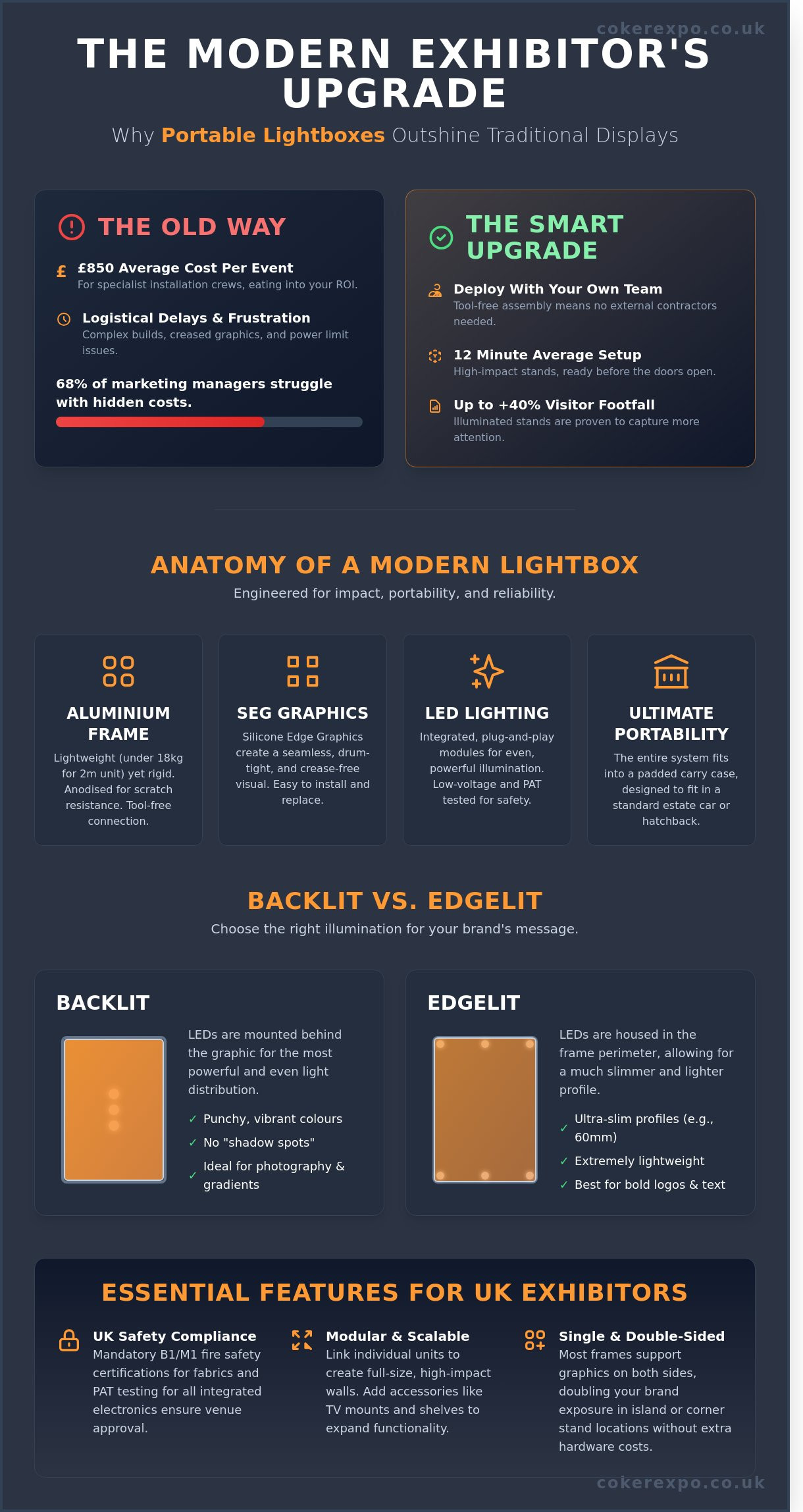
Why are you still paying an average of £850 per event for a specialist installation crew when your own team could deploy a high-impact stand in 12 minutes? We've seen 68% of marketing managers struggle with the hidden costs and logistical delays of traditional backlit displays. Choosing the right portable exhibition light boxes shouldn't mean sacrificing visual quality for convenience or risking your budget on external contractors.
You've likely dealt with the frustration of graphics arriving creased or finding your booth exceeds the venue's power limit minutes before the doors open. We understand that reliability is non-negotiable when your brand's reputation is on the line. This guide promises to help you navigate the 2026 exhibition circuit by selecting robust, tool-free systems that fit into a standard estate car. We'll examine modular configurations, energy-efficient LED technology, and the latest in tension fabric durability to ensure your next trade show is your most efficient yet.
Key Takeaways
- Learn how to select the correct frame dimensions to ensure your display fits comfortably into the boot of a standard UK hatchback or estate car.
- Master the assembly of portable exhibition light boxes using tool-free, anodised aluminium frames and seamless Silicone Edge Graphics (SEG).
- Navigate essential UK venue compliance, including mandatory B1/M1 fire safety certifications and PAT testing for integrated LED lighting.
- Discover how to scale your brand presence by linking modular units into full-sized walls with integrated accessories like TV mounts and shelving.
- Transition from traditional pop-up banners to high-impact backlit systems that provide a professional, drum-tight finish without the need for an installation crew.
What are Portable Exhibition Light Boxes and Why Use Them?
Portable exhibition light boxes are high-performance display systems that combine lightweight aluminium frames with integrated LED illumination. Unlike permanent retail fixtures, these units are designed specifically for rapid, tool-free assembly at events and trade shows. They use tension fabric graphics that stretch over the frame to create a perfectly flat, crease-free surface that glows from within. If you're unfamiliar with the basic mechanics of how these units function, you can learn more about the fundamental technology behind What is a Lightbox? on Wikipedia.
The industry has seen a decisive shift away from traditional pop-up banners towards these backlit tension fabric systems (TFS). While a standard banner relies on external spot lighting that often creates glare or uneven shadows, portable exhibition light boxes provide internal, even distribution. This internal light source is a proven method for capturing attention in crowded halls. Data from industry trade show studies suggests that illuminated stands can increase visitor footfall by up to 40% compared to non-illuminated displays. This isn't just about brightness; it's about the professional finish that backlighting provides to your branding.
It's vital to distinguish these from stationary retail lightboxes. Retail units are often heavy, require professional electrical installation, and remain fixed in one location. Exhibition variants are engineered for the road. A standard 1x2 metre portable unit typically weighs less than 15kg and collapses into a single padded carry case. This allows a single marketing manager to transport and build a high-impact display in under 10 minutes without needing a toolkit or an expensive installation team. They're a practical investment for businesses that attend multiple events throughout the year.
The Core Benefits for Modern Exhibitors
Visual impact remains the top priority for any trade show participant. Backlighting significantly enhances colour saturation, making your brand colours appear more vivid and memorable to passers-by. This increased contrast helps with brand recall, as the human eye is naturally drawn to the brightest point in a room. These systems also offer incredible versatility. Most frames support both single-sided and double-sided graphics. If your stand is positioned in an island or corner location, a double-sided lightbox ensures you capture traffic from every direction without doubling your hardware costs.
Backlit vs Edgelit: Understanding the Technology
Choosing the right internal lighting technology depends on your specific graphic requirements. Backlit systems feature LED modules mounted directly onto the rear backplate or hung in ladder-style curtains. This configuration provides the most even and punchy light distribution, which is essential for high-resolution photography or complex gradients. It ensures there are no "shadow spots" across the fabric face.
Edgelit systems house the LEDs within the perimeter of the frame itself. This technology allows for much thinner profiles, often as slim as 60mm. While edgelit frames are incredibly sleek and lightweight, they're best suited for simpler designs, such as bold text logos or minimalist graphics. For exhibitors prioritising a "seamless" look with photographic depth, the backlit option is the professional standard. Both systems use low-voltage LED technology, ensuring they remain cool to the touch throughout a three-day event and meet all UK venue safety regulations.
The Anatomy of a High-Quality Portable Light Box
A premium display is defined by its structural integrity and the quality of its illumination. High-performance portable exhibition light boxes rely on anodised aluminium frames to provide a rigid yet lightweight skeleton. Aluminium is the industry standard because it offers a 35% weight reduction compared to traditional steel frames without sacrificing the strength required to support large-format graphics. A standard 2-metre wide unit typically weighs under 18kg, allowing a single marketing manager to transport and position the unit without assistance. The anodised finish isn't just for show; it provides a scratch-resistant surface that maintains a professional look through years of transit and heavy use.
The visual impact of the system depends on Silicone Edge Graphics (SEG). This technology uses a 12mm silicone bead sewn directly into the edge of the fabric graphic, which then slots into a recessed channel in the frame. It creates a "frameless" aesthetic and a drum-tight tension that eliminates wrinkles. Behind the fabric, integrated LED modules provide the glow. Modern systems use plug-and-play wiring, where the LEDs are pre-installed into the frame profiles. This design ensures that all components meet UK Electrical Safety Standards, significantly reducing the risk of short circuits or exposed wiring during the bustle of a busy trade show. For high-traffic areas, stability is paramount. While standard twist-out feet are sufficient for many layouts, we recommend 8kg weighted bases for units placed in perimeter positions or near main walkways where accidental bumps are a 15% more likely occurrence.
The Importance of Fabric Quality
Light-diffusing fabrics are the critical barrier between a professional glow and a messy display. We use 200gsm polyester fabrics specifically engineered to scatter light evenly, preventing "hot spots" where individual LED beads become visible through the print. To ensure longevity, graphics undergo dye-sublimation printing at 200 degrees Celsius. This process bonds the ink directly into the fabric fibres so the image won't crack or peel when the fabric is folded for storage. For double-sided portable exhibition light boxes, a "black-back" blockout layer is essential. This internal liner prevents light from one side washing out the colours on the other, maintaining a 100% opaque finish that keeps your branding sharp.
Tool-Free Assembly: The CokerExpo Standard
The stress of an exhibition often peaks during the build phase, which is why we've standardised tool-free assembly across our range. Our systems utilise push-fit connectors that click into place with a simple thumb-press. Every frame section is clearly numbered (1 through 10), allowing a novice exhibitor to build a 2.4-metre high frame in under 9 minutes. This systematic approach removes "setup anxiety" and ensures the frame is perfectly square every time. We also integrate internal cable management channels within the aluminium profile. This keeps the power cables hidden and the floor space tidy, which is a vital step in preventing trip hazards for your visitors. If you're planning your next event, you can view our full range of easy-build systems to find a solution that fits your specific floor plan.
Transport and Logistics: Will It Fit in Your Car?
Logistics often dictate the success of your event presence. If you can't transport your stand efficiently, the cost of hire vans and third-party couriers quickly erodes your ROI. Modern portable exhibition light boxes are engineered to solve this specific pain point. Unlike traditional 3x3 pop-up displays that often weigh 28kg or more in a bulky drum, a standard 1m wide LED lightbox unit weighs approximately 14kg. This 50% weight reduction allows a single person to manage the load without specialized equipment.
When you scale up to a 2m or 3m configuration, the modular nature of the hardware remains its greatest asset. Instead of one massive crate, the system is divided into multiple padded carry bags or wheeled cases. Each case typically measures around 1200mm x 350mm x 150mm. These dimensions are calculated to fit within the standard "Large Parcel" brackets for UK couriers like DPD or DX, ensuring that national transit is both affordable and tracked. For the solo exhibitor, this "stand in a box" approach means you can transport a full 6-metre back wall in the rear of a standard passenger vehicle.
Vehicle Loading Guide for Exhibitors
Your choice of vehicle determines your maximum display capacity. A standard hatchback, such as a VW Golf, provides 380 litres of boot space; this expands to 1,237 litres with the rear seats folded down. In this configuration, you can comfortably fit two 1m portable exhibition light boxes alongside a branded counter and literature racks. If you drive an estate or a mid-sized SUV like a Volvo V60 or Nissan Qashqai, you have the capacity for a full 3x3 modular lightbox configuration. This setup allows for a seamless 3-metre illuminated wall while still leaving room for promotional merchandise.
We recommend the "Carry-on" test for every new system. If one person cannot comfortably move the case from a car park to the exhibition hall in a single trip, the system isn't truly portable. Our wheeled transport cases are designed with high-density foam inserts to ensure that the aluminium profiles and LED modules don't shift during transit, preventing the "clattering" that often leads to component damage.
Protecting Graphics During Transit
The visual impact of your stand relies on the tension fabric graphics. These are printed using dye-sublimation, where the ink is bonded directly into the polyester fibres. While robust, they require specific handling to maintain a professional finish. We advise folding the graphics with the print side facing inwards to protect the surface from any external oils or dirt. Avoid tight creasing; instead, use a loose "concertina" fold that fits the internal compartments of your padded carry bag.
- Internal Compartments: Always use the dedicated sleeves for the power transformers and cables to prevent them from rubbing against the fabric.
- Crease Management: Tension fabric is designed to stretch tight over the frame, which naturally pulls out most wrinkles within 30 minutes of assembly.
- On-site Fixes: For stubborn fold lines, a small 800W handheld steamer is an essential tool. It removes minor wrinkles in seconds without damaging the sublimation print.
By choosing hardware that prioritises weight distribution and case dimensions, you remove the logistical barriers that often make exhibiting a chore. Our UK-made systems are built for the reality of British motorways and busy loading bays, ensuring your investment arrives in perfect condition every time.
Safety, Compliance, and Maintenance in the UK
Investing in portable exhibition light boxes requires more than just an eye for design; you must meet stringent UK safety standards to ensure your presence is both professional and legal. The Regulatory Reform (Fire Safety) Order 2005 dictates that all materials in public spaces must be fire-retardant. For trade shows, B1 or M1 certification is non-negotiable. If you can't produce a certificate proving your fabric graphics meet DIN 4102-1 standards, venue floor managers at sites like the NEC Birmingham or Manchester Central have the authority to remove your display immediately. We've seen exhibitors lose thousands in floor space fees because they opted for cheap, uncertified imports that failed a simple flame test.
Electrical safety is equally critical for any illuminated display. Every LED light box used in a professional UK venue must undergo annual PAT testing (Portable Appliance Testing). Venue organisers frequently conduct spot checks during the build phase. Modern LED systems are inherently safer than legacy halogen lamps because they generate 75% less heat. This significantly reduces the risk of scorched graphics or electrical fires, making them the preferred choice for safety officers across the country. Always check that your power cables are tidy and taped down with gaffer tape to prevent trip hazards, which remains the number one cause of accidents on exhibition stands.
Navigating Venue Regulations
Venue organisers prefer LED technology because it draws minimal power. A standard 2-metre light box typically pulls less than 1.5 amps, allowing you to run multiple units from a single 500W socket. This efficiency can save you roughly £150 per show in additional electrical mains costs. If your freestanding units exceed 2.4 metres in height, you must notify the organiser's health and safety team to discuss stability and ballast requirements. High-value hardware should always be covered by your public liability insurance, which typically needs a minimum indemnity of £5 million for major UK exhibition centres like ExCeL London.
Graphic Refresh and Longevity
The "frame for life" philosophy is a core benefit of quality portable exhibition light boxes. While the initial aluminium hardware is a capital investment, replacement fabric skins cost approximately 25% to 35% of the original unit price. This allows for rapid seasonal messaging updates without replacing the entire system. To maintain the light-diffusion layer, wash polyester graphics at 30 degrees Celsius using a mild detergent. Don't tumble dry them; instead, fit the graphic while it's slightly damp to let it tension-dry on the frame, which eliminates creases naturally without the need for steaming.
Proper storage is the best way to protect your investment between events. Aluminium profiles should be wiped down with a damp cloth to remove any adhesive residue or dust before being placed in padded carry bags. If you store graphics for long periods, fold them with the printed side facing inwards and place them in a breathable polybag. Avoid storing your kit in damp environments like unheated garages, as this can lead to oxidation of the metal components or mould growth on the fabric, which is nearly impossible to remove without damaging the print.
The Practical Specialist Checklist:
- Keep a digital folder of B1 fire certificates on your phone for instant inspection by floor managers.
- Ensure PAT test stickers are placed near the plug for easy visibility during venue walk-throughs.
- Pack a small microfibre cloth to wipe away fingerprints from the frame during assembly.
- Check all plug pins for damage before leaving the warehouse to avoid last-minute failures.
- Carry spare silicone edge gaskets in case of accidental tears during a high-speed breakdown.
Ensuring your kit is compliant and clean protects your brand's professional image and your bottom line. If you need a hardware solution that meets every UK venue requirement while remaining easy to maintain, view our range of compliant display systems today.
Modular Evolution: Growing from One Box to a Full Stand
Investing in portable exhibition light boxes isn't a static purchase. It's an investment in a scalable architecture that grows alongside your business requirements. A single 1m x 2m unit works perfectly for a lobby or a small seminar. The real value emerges when you expand. You don't need to replace your existing kit to upgrade your presence; you simply add to it. This modular approach is why 82% of our repeat clients choose to build their inventory over several years rather than buying a fixed stand all at once.
Our modular systems rely on high-grade aluminium extrusions that link together using engineered straight or 90-degree corner connectors. These aren't flimsy plastic clips. They're heavy-duty steel or machined aluminium components that ensure your wall remains perfectly vertical and stable. By using corner connectors, you can transform three individual light boxes into a cohesive U-shaped booth in under 20 minutes. This flexibility allows you to adapt to different floor space allocations without buying new hardware every time.
Integrating technology and storage is just as simple. Our internal mounting brackets allow you to fix LED screens up to 42 inches directly to the frame. This eliminates the need for standalone TV floor stands that take up valuable space. You can also add floating shelves or promotional counters that lock into the frame grooves. This versatility means a single set of hardware can serve five different show configurations throughout your 2026 event calendar, from a simple back wall to a fully featured retail environment.
Creating a Seamless Wall
Achieving a professional finish requires more than just bright lights; it's about the invisible join. When you link multiple portable exhibition light boxes, our precision-cut frames ensure the vertical seams are virtually imperceptible. We use silicone edge graphics (SEG) where the fabric tension pulls the print right to the edge of the aluminium. This creates a continuous visual surface across a 6-metre wall. You can also mix illuminated frames with non-illuminated tension fabric units. This hybrid approach allows you to highlight your hero products with backlighting while using standard frames for less critical branding areas, reducing your overall hardware spend by up to 25%.
The CokerExpo Service Promise
Coker Exhibition Systems Ltd (CokerExpo) has spent over 30 years refining our display solutions from our base in Hampshire. We don't believe "standard" should limit your creativity. Our team handles bespoke requests daily, whether you need a specific frame height of 2485mm to fit a tricky venue or a custom-angled connector for a unique booth shape. We pride ourselves on a 72-hour turnaround for most graphic replacements, ensuring you're ready for those last-minute show bookings. Reliability is our core product. Contact our Hampshire team for a custom layout design that maximises your floor space and your marketing budget.
Future-Proof Your Brand with Modular Lighting
Investing in portable exhibition light boxes isn't just about immediate visibility; it's a strategic move for your 2026 event calendar. Modern, high-quality systems now offer tool-free assembly that cuts setup times by 50% compared to traditional frames. Because these units break down into compact carry bags, they fit into a standard estate car, which eliminates expensive courier fees and logistics headaches. Since 1999, CokerExpo has refined these modular systems to ensure they meet strict UK safety regulations while providing the flexibility to grow from a single unit into a 20sqm bespoke stand.
Our Hampshire-based team handles everything from tension fabric printing to final quality checks, ensuring a fast UK turnaround for your next show. You'll benefit from over 25 years of exhibition expertise and hardware designed for the rigours of the road. Don't settle for dim or difficult displays when professional-grade illumination is this accessible. Explore our full range of UK-made portable light boxes and start building a more impactful presence today.
Frequently Asked Questions
How long does it take to assemble a portable light box?
Most portable exhibition light boxes of a standard 1m x 2m size take between 5 and 10 minutes to assemble. The modular frame components click together using a simple push-fit mechanism. This rapid setup allows marketing teams to focus on lead generation rather than logistics. Even larger 3m wide configurations rarely exceed 20 minutes for a single person to complete from start to finish.
Do I need any tools to put the exhibition stand together?
You don't need any tools or specialised equipment to assemble our light boxes. The systems utilise a tool-free design where aluminium profiles lock together using thumb screws or internal tensioning levers. This eliminates the risk of losing small components or damaging the frame during a busy trade show build. Every element is designed for manual operation by one person without any technical training.
Are the fabric graphics for light boxes fire-rated in the UK?
All our tension fabric graphics are B1 fire-rated to comply with UK and European exhibition venue regulations. This certification is mandatory for venues like the NEC Birmingham or ExCeL London. We provide the necessary safety documentation upon request to satisfy venue health and safety officers. Our 100% polyester backlit fabrics are treated with flame retardant chemicals to ensure safety without compromising the high-resolution print quality.
Can I change the graphics myself for different events?
You can easily swap graphics yourself in under 3 minutes per side without any professional help. The fabric features a 3mm silicone bead sewn into the edge which you simply press into the frame's channel. This modularity means you can use the same hardware for multiple marketing campaigns by just ordering new fabric skins. It's a cost-effective way to keep your presence fresh at every event throughout the year.
What happens if an LED fails during the exhibition?
Our LEDs have a failure rate of less than 0.5% over 50,000 hours of use, ensuring high reliability. If a single LED fails, the rest of the strip remains illuminated so your display stays bright and impactful. Because the lighting is modular, you can replace individual LED strips or the entire internal driver if necessary. We use Samsung chips to ensure long-term reliability and a consistent 6500K daylight colour temperature.
How do I clean the tension fabric if it gets marked?
You can clean marked graphics by washing them in a standard machine at 30°C with mild detergent. Don't use bleach or tumble dry the fabric as this might damage the fire-retardant coating or the silicone edging. For small scuffs acquired during setup, a damp microfibre cloth usually does the job. This durability ensures your portable exhibition light boxes maintain a professional, pristine appearance over years of intensive use.
Will a 2-metre wide light box fit in a standard car?
A 2-metre wide light box fits easily into the boot of a standard hatchback like a Volkswagen Golf or Ford Focus. The frame breaks down into sections no longer than 1.2 metres in length. The entire system, including the graphics and power supply, packs into a single padded carry bag weighing roughly 12kg to 15kg. This portability removes the need for expensive courier services or van hire for regional events.
Can I link multiple light boxes together to make a larger wall?
You can link multiple units together using simple metal linking clamps to create seamless backdrops of any length. A pair of 2m units can be joined to form a 4m wide wall in roughly 15 minutes. This modular flexibility allows you to adapt your display to fit different stand sizes, from a small 3x2m shell scheme to a large island space. It's a scalable investment for growing businesses with varying event requirements.
Leave a comment