

Lighting Truss Design for Trade Shows: The Professional Guide to Impact and Infrastructure
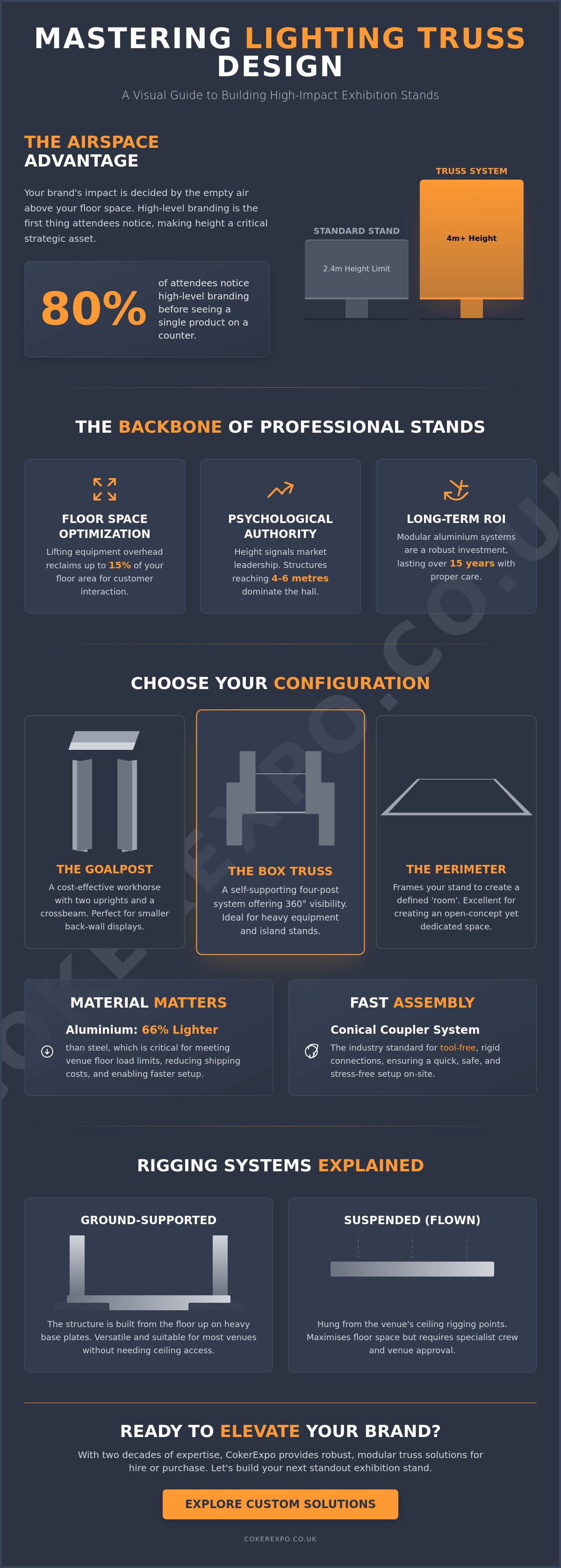
Your brand's impact at an exhibition is often decided by the four metres of empty air above your floor space. While many exhibitors focus solely on floor-level furniture, industry observations suggest over 80% of attendees notice high-level branding before they see a single product on a counter. It's common to worry that heavy-duty hardware might clash with your brand aesthetics or create a logistical nightmare during the build phase. You need a solution that balances structural integrity with a clean, professional finish.
This guide helps you master lighting truss design for trade shows to create a robust, compliant, and visually seamless environment. We'll show you how to move beyond industrial-looking frames to build a sophisticated infrastructure that supports heavy lighting and high-impact graphics. You'll learn about modular systems that adapt to different floor plans, ensuring your investment remains versatile for every UK venue from the NEC to ExCeL London. We'll cover essential rigging safety and the practical benefits of tool-free assembly for a faster, stress-free setup.
Key Takeaways
- Understand why modular trussing outperforms standard shell schemes by providing a robust framework for high-level branding and maximum floor visibility.
- Discover how to select the optimal lighting truss design for trade shows by comparing goalpost, box, and island configurations to manage visitor flow effectively.
- Learn the technical requirements for integrating high-impact spotlights and exhibition lightboxes directly into your structure to create a seamless, professional environment.
- Navigate UK safety regulations and venue requirements with a clear breakdown of the differences between ground-supported and suspended (flown) rigging systems.
- Explore how CokerExpo’s flexible hire-to-buy model and two decades of specialist expertise provide a cost-effective infrastructure for your growing event schedule.
The Fundamentals of Lighting Truss Design for Trade Shows
A lighting truss is a modular framework engineered from high-grade aluminium or steel. It serves as the primary infrastructure for mounting stage lights, digital signage, and heavy AV equipment. While many exhibitors settle for the standard 2.4-metre height of a shell scheme, professional lighting truss design for trade shows allows brands to break free from these physical constraints. There is a clear distinction between lightweight decorative gantry systems, often used for simple banner support, and structural rigging designed to carry substantial payloads. The former provides a visual frame, while the latter acts as a heavy-duty skeleton for complex technical integrations.
Understanding The Fundamentals of Lighting Truss Design is essential for any exhibitor looking to move beyond basic stand setups. This structural logic allows for the creation of "Brand Architecture," where height and scale are used to dominate the visual landscape of the exhibition hall. By moving your branding into the "airspace" above your stand, you ensure visibility from the entrance of the venue, regardless of your floor position.
Why Trussing is the Backbone of Professional Stands
Suspending equipment overhead clears the floor for lead generation and product demonstrations. A standard 6m x 6m stand can lose up to 15% of its usable area when ground-supported pillars and base plates are used. By utilising lighting truss design for trade shows to lift equipment, you reclaim that space for customer interaction. Height creates a powerful psychological landmark. In a crowded hall like the NEC or ExCeL London, sightlines are often blocked by neighbouring stands. A structure reaching 4 or 6 metres high ensures your brand is visible from across the hall.
- Floor Space Optimization: Removing ground supports increases the flow of foot traffic.
- Psychological Authority: Height signals market leadership and brand confidence.
- Long-term ROI: Modular aluminium systems are a robust investment, often lasting over 15 years with regular safety inspections.
Common Truss Materials and Their Benefits
Aluminium remains the industry standard because it weighs roughly 66% less than steel. This weight reduction is critical for meeting UK venue floor load restrictions, which often range between 1,000kg and 2,000kg per square metre. While "Natural" mill-finish aluminium offers a technical, industrial look, powder-coated finishes in matte black or white provide a high-end aesthetic for premium branding. These finishes help the structure blend into the background or stand out as a design feature. The conical coupler system is the industry standard for fast assembly, utilizing tapered pins and couplers to create a genderless, rigid connection between truss sections without the need for complex tools.
Choosing the Right Truss Configuration for Your Stand Layout
The geometry of your lighting truss design for trade shows does more than hold up lamps; it dictates how people interact with your brand. A well-planned configuration acts as a silent steward, guiding visitors through your product zones. Perimeter trussing is particularly effective here. By outlining the boundary of your floor space, you create a psychological "room" that separates your team from the busy aisle traffic. This defined footprint helps secure your presence even in high-density halls like the NEC or Olympia London.
Your choice of configuration should reflect your stand's purpose. If your goal is high-volume lead generation, an open-concept layout is essential. If you're hosting private demonstrations, a more enclosed truss structure can provide the necessary privacy. Modular systems provide the flexibility to change these layouts between shows, ensuring your hardware remains a versatile business asset rather than a one-time expense.
Standard Truss Layouts and Their Applications
- The Goalpost: This is the workhorse for smaller 3m or 4m back-wall displays. It uses two uprights and a single crossbeam. It's cost-effective and provides essential height for spotlights without eating into your floor space.
- The Box Truss: For larger sites, a box gantry offers 360-degree visibility. It's a self-supporting four-post system that allows for heavy equipment loads and high-impact branding on all sides.
- The Perimeter Gantry: This creates an "open-concept" stand that feels like a dedicated room. It frames the stand at height, leaving the ground level completely clear for furniture and demonstrations.
Scaling Your Design: From 3x3 to Island Stands
Modular systems allow you to adapt to different floor space bookings without buying entirely new hardware. For a standard 3x3m stand, a 250mm ladder or deco truss is often sufficient for light duty. However, when your span exceeds 5 metres, you should move to 290mm square trussing. This larger profile provides the structural integrity needed to prevent sagging over long distances and ensures your overhead infrastructure remains perfectly level.
You can use universal corner blocks and T-junctions to add multi-level tiers or secondary support beams for heavy LED screens. Integrating these structural choices with your overall exhibition stand design ensures your layout is optimized for both visual impact and commercial ROI. If you're unsure which configuration fits your next booking, our team can help you select the right modular truss components for your specific needs. Using the right lighting truss design for trade shows means you don't just occupy space; you command it.
Integrating Lighting and Visual Media into Your Truss
A professional lighting truss design for trade shows transforms a simple frame into a high-performance utility grid. The hardware serves as the backbone for three primary fixture types: spotlights for precision product focus, wash lights to bathe the floor area in brand colours, and LED battens for linear accents. Beyond illumination, the structural gantry acts as a built-in cable management system. By running power and DMX cables along the internal chords of the truss, you eliminate trip hazards and maintain a clean, professional aesthetic that doesn't distract from your messaging.
Modern setups often involve mounting exhibition lightboxes directly to the truss frame. This integration creates a seamless transition between structural support and visual media. When you combine modular trussing with Tension Fabric Systems (TFS), the result is a massive, high-impact graphic wall that looks like a permanent architectural feature rather than a temporary stand. It's a robust solution that provides the infrastructure for your entire brand presence.
Strategic Lighting Placement for Maximum Impact
Success relies on the "Golden Triangle" of exhibition lighting. This involves positioning a Key light for primary focus, a Fill light to soften harsh shadows, and a Backlight to lift the subject away from the background. To avoid glare on glossy graphics, angle your fixtures at 45 degrees rather than pointing them directly at the surface. Colour Rendering Index (CRI) is a quantitative measure of a light source's ability to reveal the true colours of your products accurately, which is vital for retail or textile displays where colour fidelity drives sales.
Combining Truss with Tension Fabric and Lightboxes
Attaching large-scale graphics to your gantry is straightforward using Keder tracks or specialized clips that lock into the truss profile. This method allows for massive, drum-tight fabric displays that can be back-illuminated for a 24/7 glow. Beyond static graphics, the structural integrity of the truss supports the integration of heavy AV equipment. You can securely mount digital screens, projectors, or interactive touchpoints directly into the framework using universal clamps. This approach ensures your visual media is elevated above the crowd, increasing your stand's visibility across the entire exhibition hall.
Safety Standards and Logistics for Truss Rigging in the UK
Safety is the primary concern for any exhibitor. You might worry if your design is structural sound or if the venue will even allow it on the floor. In the UK, compliance isn't optional; it's the foundation of your presence. Effective lighting truss design for trade shows balances aesthetic impact with strict engineering limits. You have two main options: ground-supported or flown structures. Ground-supported systems sit on heavy-duty base plates and are generally faster to approve. Flown (suspended) trussing hangs from the venue's ceiling. While flown systems clear up floor space, they require specialist riggers and involve significantly higher venue costs.
Every professional truss system comes with weight loading tables. These documents specify exactly how much equipment, such as moving heads or LED screens, you can safely hang over specific spans. Overloading a point load can lead to structural failure, so we provide precise data to keep your stand compliant. Our systems focus on tool-free assembly. By using conical couplers or simple hand-tightened connectors, you can reduce on-site labour costs by up to 35% compared to traditional nut-and-bolt systems. It's about working smarter, not harder, during the high-pressure build phase.
UK Exhibition Venue Regulations and Compliance
Major UK venues like the NEC Birmingham, ExCeL London, and Olympia follow the eGuide. This document outlines the health and safety standards for every event. If your lighting truss design for trade shows exceeds 4 metres in height or carries complex, offset loads, the venue will require a structural engineer’s report. Additionally, any graphics or tension fabrics attached to the frame must be fire-retardant to BS 5867 standards. We ensure your hardware meets these rigorous benchmarks before it leaves our warehouse, providing the necessary sign-off documentation to satisfy venue organisers.
Logistics: Transporting and Building Your Truss Stand
Logistics shouldn't be a headache for your marketing team. Our modular sections are designed to fit into standard transit vans, avoiding the need for expensive HGV transport. Building the stand follows a logical, step-by-step sequence. You start with the base plates, then connect the uprights before finally securing the top chords. This ground-up approach ensures stability at every stage of the build. For a deeper dive into the specific hardware used in these builds, check out our truss truss guide for an analysis of structural hardware.
Ready to build a safe, impactful presence at your next UK event? Browse our range of compliant exhibition truss systems and get expert advice on your next design.
Custom Truss Solutions and Hire Services from CokerExpo
CokerExpo operates as a practical specialist with over 20 years of expertise in the exhibition sector. We understand that a lighting truss design for trade shows must be more than just functional; it has to be a reliable foundation for your brand's presence. Our team manages the entire process from our UK base, ensuring every component meets rigorous quality standards before it reaches the venue floor. We provide the infrastructure that allows your marketing message to stand out in crowded halls.
For growing businesses, our hire-to-buy model offers a strategic advantage. It allows you to trial a specific configuration without committing to a full capital purchase immediately. If the setup proves successful at your event, you can transition to ownership, making it a cost-effective way to scale your exhibition assets. Because our hardware is manufactured in the UK, we maintain total control over lead times, often providing bespoke solutions when international suppliers cannot meet the deadline. This local manufacturing ensures that every gantry and connector is robust enough for repeated use.
Bespoke Design and Event Planning Support
Visualising a complex structure on a 2D floor plan is difficult for even the most experienced marketing managers. We bridge this gap by providing detailed 3D CAD renders of your proposed stand. These visuals allow you to see exactly how your lighting truss design for trade shows will interact with your graphics and floor space. We don't just provide the metalwork; we ensure the hardware integrates seamlessly with large-format tension fabric printing for a professional, high-impact finish.
Efficiency is at the heart of our design philosophy. We prioritise tool-free assembly systems that reduce your on-site build time significantly. This focus on fast-turnaround solutions means your team spends less time handling components and more time engaging with potential leads. Our end-to-end service includes everything from initial planning and 3D design to national delivery and on-site advice. We take the technical stress out of the equation so you can focus on your ROI.
Next Steps: Planning Your Next Trade Show Structure
Starting your project is straightforward. You only need to provide your floor plan dimensions and any venue height restrictions. Our consultants will then work with you to integrate high-impact elements like dynamic lightboxes or rotating displays into the truss framework. These additions transform a standard gantry into a dynamic focal point that captures attention from across the hall. We've helped thousands of clients navigate complex venue regulations and structural requirements over the last two decades.
Ready to elevate your presence at your next event? Contact CokerExpo for a custom lighting truss design quote to discuss your requirements with our technical team and receive a bespoke 3D render of your stand.
Elevate Your Professional Stand Infrastructure
A strategic lighting truss design for trade shows transforms a basic floor plan into a high-visibility brand environment. Selecting the right configuration depends on your stand layout and weight requirements, but the priority remains safety and structural integrity. Since 1999, Coker Expo has provided UK businesses with robust, modular systems that adhere to strict national safety standards. We've spent over 20 years refining our hardware to ensure it delivers maximum impact with minimal logistical friction.
Our UK-based manufacturing facility enables a fast national turnaround, so your equipment arrives exactly when you need it. We specialise in tool-free assembly, which removes the stress of complex builds and lets your team focus on engaging visitors. Whether you require a custom gantry or a standard hire solution, our expertise ensures your lighting and media are integrated seamlessly into a secure, professional frame.
Ready to build a more impactful presence? Explore Our Range of Modular Exhibition Truss Systems today. We're here to help you make your next event a resounding success.
Frequently Asked Questions
What is the difference between a lighting truss and a gantry system?
A lighting truss refers to the individual modular components, while a gantry system describes the complete overhead framework created by those parts. In the UK exhibition industry, these terms are often used interchangeably to describe the structural skeleton of a stand. Our 25mm or 50mm aluminium systems provide the robust foundation needed to support both branding and heavy equipment.
Do I need a specialist team to assemble a trade show truss?
You don't always need a specialist team for modular lighting truss design for trade shows, especially with our tool-free conical connector systems. Two people can typically assemble a ground-supported 3m x 3m booth in under 45 minutes. However, if your design requires overhead rigging from the hall ceiling, UK venues like the NEC or ExCeL require qualified riggers to perform the final lift and attachment.
Can I hang heavy LED screens from a standard exhibition truss?
Yes, but you must calculate the point load and total weight against the manufacturer's load table. A standard 50mm square truss can often handle over 500kg across a 4m span, while a lighter deco truss might only support 50kg per metre. Always verify the specific weight of your panels; for instance, a 500mm x 500mm LED cabinet often weighs between 7kg and 9kg.
Are there height restrictions for truss stands in UK exhibition halls?
Most UK exhibition venues enforce a standard height limit of 4m for stand structures. If your lighting truss design for trade shows exceeds this, you must submit a "Complex Structure" request to the venue organisers at least 28 days before the event. Venues like Olympia or Manchester Central frequently allow heights up to 6m or 10m for space-only plots, provided you submit structural calculations.
Is it better to hire or buy an exhibition truss system?
Buying an exhibition truss system is usually more cost-effective if you attend more than 3 events per year. A modular aluminium system typically pays for itself within 18 months when compared to recurring hire fees. If you only exhibit once a year or have limited storage space, hiring provides flexibility without the long-term maintenance and storage responsibilities.
How do I ensure my truss design meets UK fire safety regulations?
Ensure all banners or fabrics attached to your truss meet BS 5867 Part 2 Type B standards for flame retardancy. Aluminium truss itself is non-combustible, but any lighting cables must be PAT tested within the last 12 months. Local authorities and venue managers at sites like the SEC Glasgow often conduct spot checks to verify that your stand materials don't contribute to the hall's fire load.
Can I add more sections to my truss system later if I book a larger stand?
You can easily expand your system by adding extra lengths and corner blocks as your stand space grows. Our modular components are designed for cross-compatibility, meaning a 4m x 3m goalpost rig can be extended into a 6m x 6m perimeter frame with a few additional 1m or 2m sections. This scalability ensures your initial investment remains useful even as your floor space requirements increase.
Leave a comment