

Choosing Durable External Notice Boards: A Complete Guide
An external notice board is either a secure communication hub or a maintenance liability that compromises your professional image. While many frames look resilient in a showroom, they often fail when faced with persistent moisture ingress or local vandalism. You've likely dealt with the frustration of ruined paper notices or cheap frames that corrode within months. It's a logistical drain that diverts attention from your core operations and reflects poorly on your venue branding.
This guide ensures you master the technical specifications required to select durable External Notice Boards for any professional environment. We'll show you how to identify high-performance hardware that offers a maintenance-free solution and total security for public-facing information. We'll cover essential standards like the IP55 weather rating and the BS EN 13501-1 fire safety classification, which became mandatory in March 2025. You'll also learn about the planning regulations that dictate how and where you can install your displays. This technical breakdown simplifies the procurement process, helping you invest in infrastructure that matches your professional standards and stands the test of time.
Key Takeaways
- Identify the technical features that separate professional-grade, weather-sealed units from standard frames that fail in outdoor conditions.
- Evaluate the benefits of different frame materials and glazing types to balance long-term durability with high-impact visual appeal.
- Determine the correct capacity and mounting style for your External Notice Boards to ensure they meet the specific logistical needs of your venue.
- Navigate the latest UK fire safety standards and planning permissions to ensure your outdoor signage remains compliant and secure.
The Role of External Notice Boards in Professional Communication
Professional external notice boards serve as the critical infrastructure for secure, 24/7 site communication. Unlike a standard pinboard found in a staff room, these are engineered as fully glazed, sealed units designed to withstand the harsh environmental pressures of the UK. While the History of the bulletin board began with simple wooden frames for indoor use, the modern outdoor equivalent is a high-performance piece of hardware. It acts as a reliable hub for public-facing information, ensuring that site rules, safety notices, and community updates remain legible and protected.
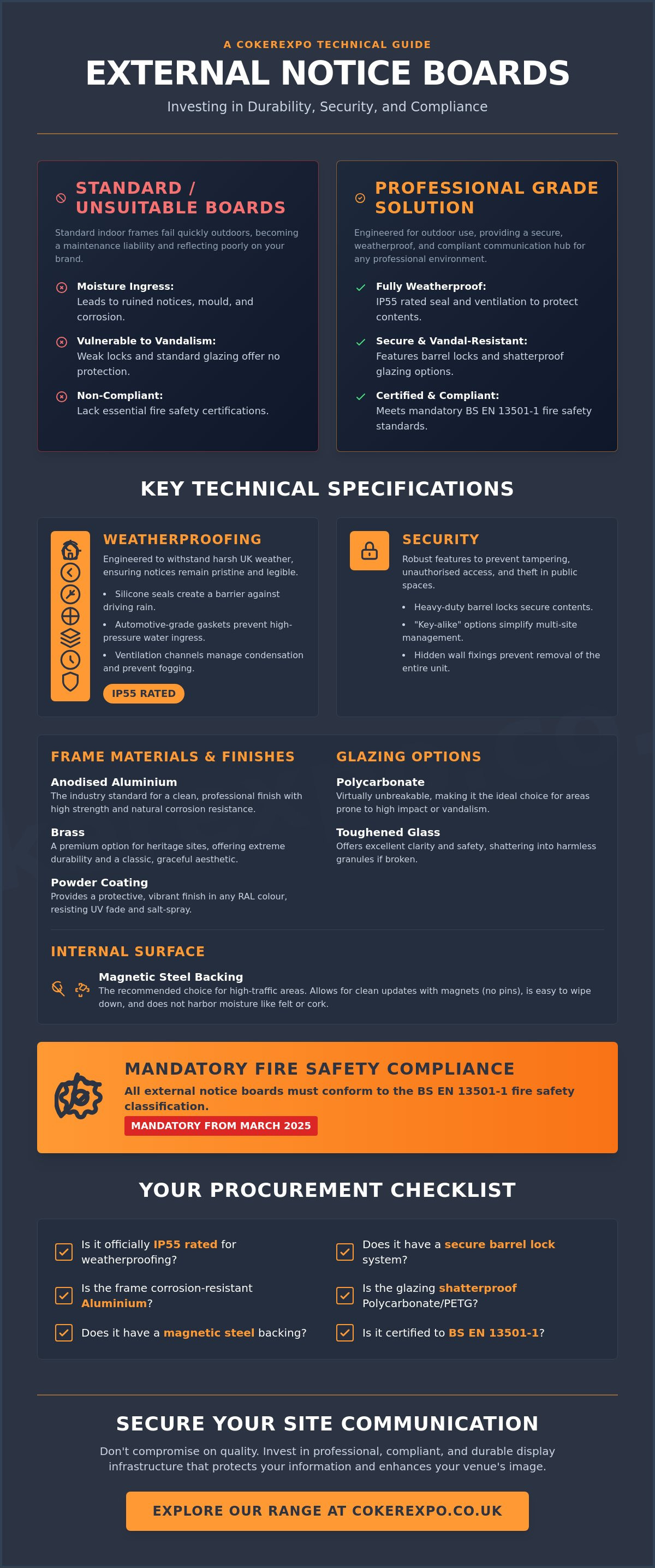
Standard indoor boards fail almost immediately when placed in outdoor conditions. Without specialized seals, moisture ingress saturates the backing material, leading to mold growth and the destruction of paper notices. High humidity also causes standard frames to warp or corrode, rendering them unsightly and non-functional within weeks. For managers of corporate campuses, public parks, and healthcare facilities, these boards are a functional necessity for site management. They provide a controlled environment for information that must be accessible to the public without constant supervision.
Security and Vandal Resistance Standards
Security is a primary concern for public-facing displays in professional environments. High-quality units feature lockable doors with heavy-duty barrel locks to prevent unauthorized access or tampering with official notices. For managers overseeing multiple sites, "key-alike" options are essential. This allows staff to access every unit with a single master key, which simplifies the logistical process of updating information. To prevent opportunistic damage, these units utilize reinforced glazing such as shatterproof PETG or toughened glass. Furthermore, hidden wall fixings ensure the entire unit cannot be easily removed or stolen from the building facade.
Weatherproofing and Condensation Management
True weatherproofing requires a sophisticated approach to moisture management. High-quality External Notice Boards utilize internal silicone seals and automotive-grade gaskets to create a barrier against driving rain. However, a total seal can lead to condensation issues. Professional units incorporate subtle ventilation channels that allow air to circulate safely. This prevents the "greenhouse effect" where heat trapped behind the glazing causes fogging or moisture build-up that obscures the display. While a water-resistant seal might shed surface rain, a truly weatherproof seal protects the internal contents from wind-driven moisture and high-pressure water jets from any direction.
Technical Specifications: Materials, Glazing, and Finishes
Choosing the right materials for External Notice Boards determines whether the unit lasts five years or twenty. Anodised aluminium is the industry standard for its high strength-to-weight ratio and natural resistance to corrosion. It provides a clean, professional finish that requires minimal maintenance in most environments. For heritage sites or premium corporate headquarters, brass notice cases provide a superior aesthetic that ages gracefully without losing structural integrity. These units are often favored for their classic appearance and extreme durability in coastal or high-exposure areas.
The choice of internal surface affects daily usability and long-term cleanliness. Magnetic steel backings are highly recommended for high-traffic public areas. They allow for the use of magnets rather than sharp pins, which are easily lost or misused. Steel surfaces are also easier to wipe down and don't harbor moisture like traditional felt or cork. If your branding requires a specific look, powder-coated finishes offer a robust solution. This process applies a protective layer that resists UV fade and salt-spray corrosion, ensuring the frame remains vibrant even in direct sunlight.
Frame Construction and Metalwork
Precision-engineered mitred corners and heavy-duty hinges are vital for longevity. In professional settings, the door is opened frequently for information updates. Weak hinges will sag over time, which compromises the weatherproof seal and makes the unit difficult to lock. High-quality frames use reinforced corners to maintain structural squareness. This attention to detail allows for precise RAL colour matching, enabling you to align your communication infrastructure with your corporate identity without sacrificing resilience.
Glazing Options for High-Traffic Areas
Glazing choice is a balance between safety, clarity, and impact resistance. Polycarbonate is virtually unbreakable, making it the ideal choice for public thoroughfares prone to vandalism. It's significantly tougher than standard acrylic or Perspex. Toughened glass offers superior scratch resistance and stays clear for longer, but it is heavier. All glazing should be UV-stable to prevent the yellowing or clouding that affects cheaper alternatives. For compliance in sensitive areas, ensure the entire assembly meets the BS EN 13501-1 fire safety standard, which tests the fire performance of the complete unit rather than just individual materials.
Sizing and Mounting: Planning Your Outdoor Display
Selecting the correct dimensions for External Notice Boards requires more than just counting the number of documents you intend to display. You must distinguish between the external frame size and the "effective viewing area," which is the actual visible space behind the glazing. Standard capacities range from compact 1xA4 units for single permits to expansive 30xA4 configurations for large-scale site directories. Professional installation is paramount to ensure safety. A board that isn't level or securely anchored poses a significant risk in public thoroughfares and compromises the integrity of the weatherproof seals described in previous sections.
Sizing for Maximum Visibility
The distance of your primary audience should dictate the board size. If viewers are walking past at a distance of three meters or more, a small A4 board will likely be overlooked. For high-traffic areas, larger boards allow you to leave "white space" around notices, which significantly improves readability and document rotation. This principle of visual hierarchy is similar to designing shell scheme graphic panels, where clarity at a distance is the priority for effective communication.
Mounting Options: Wall vs. Freestanding
Wall-mounted units are the most efficient choice for building entrances, provided the substrate is suitable. Mounting on brick, stone, or timber requires specific heavy-duty fixings to handle the weight of the glazed unit and resist wind loads. For open-plan campuses or green spaces where wall space is unavailable, post-mounted boards are the logical solution. These freestanding units are often used alongside larger exhibition and event structures to create comprehensive information hubs at outdoor venues. Whether you choose a single-post or twin-post configuration, the goal is to position the information at a comfortable eye level for the average adult viewer.
To find the ideal configuration for your facility, view our full range of professional External Notice Boards and technical mounting accessories.
Why CokerExpo is the Trusted Choice for Display Infrastructure
CokerExpo brings over 25 years of specialized experience to the professional display hardware sector. We recognize that for facility managers and site decision-makers, External Notice Boards represent more than just a frame; they're a critical piece of communication infrastructure. Our approach prioritizes B2B reliability and long-term durability over the short-lived savings of budget alternatives. We act as a knowledgeable partner, providing the technical expertise required to ensure your hardware meets the specific logistical demands of your environment. By positioning these displays as a vital part of a wider signage strategy, we help you maintain a consistent and professional presence across your entire venue.
Professional Grade vs. Budget Alternatives
The long-term ROI of investing in heavy-duty aluminium or brass notice cases is substantial. Budget frames frequently fail due to hinge fatigue, seal degradation, or UV damage, leading to repeated replacement costs and logistical stress. Our professional-grade units are engineered for high-use areas where reliability is non-negotiable. We also ensure the availability of spare parts and replacement glazing, allowing you to maintain your displays without replacing the entire unit. High-quality, robustly constructed displays naturally enhance brand trust by demonstrating a commitment to quality and site maintenance.
Bespoke Solutions for Unique Environments
Every professional venue has unique requirements that off-the-shelf products can't always meet. We provide the flexibility to handle bespoke requests, including custom sizing and precision RAL colour matching to align with your corporate branding. Many clients choose to integrate these units with other high-performance hardware, such as professional display lightboxes, to create a unified information network. This cohesive approach ensures your communication is both functional and aesthetically aligned with your professional standards.
View our full range of external notice boards and display cases to find the secure, maintenance-free solution your facility requires.
Securing Your Site Communication Infrastructure
Selecting the right hardware is a fundamental investment in your venue's long-term operational efficiency. By prioritizing technical specifications like automotive-grade seals and shatterproof glazing, you eliminate the logistical stress of ruined notices and frequent repairs. It's clear that successful site management depends on choosing External Notice Boards that balance visibility with total security. Whether you require wall-mounted units for a corporate entrance or freestanding posts for a public park, the focus must remain on resilience and ease of maintenance.
CokerExpo has provided UK-based expertise since 1999, specializing in heavy-duty B2B display hardware that stands up to the most demanding environments. We don't just sell frames; we provide authoritative advice on exhibition and event infrastructure to ensure your communication remains effective. Our team is ready to help you navigate specific RAL requirements or bespoke sizing to match your brand identity. We understand the pressure of maintaining a professional image in public-facing spaces.
Explore our professional external notice boards and secure display cases
Take the first step toward a more secure and professional display solution today.
Frequently Asked Questions
Are external notice boards completely waterproof?
External notice boards are engineered to be weatherproof and water-resistant rather than completely waterproof. Most professional units carry an IP55 rating, which signifies protection against low-pressure water jets and limited dust ingress. High-quality internal silicone seals and automotive-grade gaskets prevent rain from saturating your notices. While they withstand heavy UK downpours, they aren't designed for full submersion. Regular inspection of the seals ensures the unit remains effective over many years.
What is the best material for an outdoor notice board frame?
Anodised aluminium is the industry standard for professional environments due to its exceptional strength-to-weight ratio and natural resistance to corrosion. It doesn't rust and maintains its structural integrity without the warping issues associated with timber. For heritage sites or high-end venues, brass is an excellent alternative that offers extreme durability and a premium aesthetic. Both materials represent a sound business investment because they require minimal maintenance compared to budget plastic frames.
Can I get a notice board with a custom RAL colour?
Yes, you can specify custom RAL colours for most professional External Notice Boards to align with your corporate branding. This is achieved through a robust powder-coating process that provides a hard-wearing, UV-resistant finish. Providing a specific RAL code at the time of ordering ensures your communication infrastructure matches your venue's existing architectural features. This customization allows you to maintain a professional aesthetic while benefiting from high-performance hardware.
How do I prevent condensation in my outdoor notice board?
Condensation is prevented by selecting units with integrated ventilation channels that allow air to circulate behind the glazing. A total seal often traps humidity, leading to fogging that obscures your information. Professional units use subtle vents that let moisture escape without allowing rain to enter. You should also ensure that these ventilation points remain clear of debris. Correct mounting with a slight air gap behind the frame can also help regulate temperature differences.
What is the difference between polycarbonate and toughened glass glazing?
Polycarbonate is a high-impact material that's virtually unbreakable, making it the superior choice for areas prone to vandalism or accidental damage. It's lighter than glass but provides significant resilience in public spaces. Toughened glass offers higher scratch resistance and superior long-term clarity, though it's heavier and can shatter under extreme force. For most public-facing External Notice Boards, polycarbonate is preferred for its safety profile and ability to withstand physical interference.
Do external notice boards come with a warranty for outdoor use?
Professional-grade boards typically include a manufacturer's warranty that covers structural integrity and the performance of the weatherproof seals. These warranties are essential for B2B procurement as they provide reassurance against premature corrosion or hardware failure. You should always check the specific terms for outdoor applications, as budget indoor boards won't be covered for external use. Investing in hardware from a specialist partner ensures you have access to technical support and spare parts if required.
Leave a comment