

Creative Ideas for Shell Scheme Booths: Transforming Standard Spaces in 2026
The standard 3m x 3m shell scheme is not a design dead end; it is an untapped architectural opportunity for your brand. Most marketing managers dread the boxy look and those intrusive aluminium poles that disrupt a clean brand aesthetic. We understand that working within these rigid constraints often feels like a compromise on visual quality. This guide explores creative ideas for shell scheme booths that replace dated graphics with seamless, high-impact visuals. By focusing on smart hardware choices, you can achieve a bespoke look that commands attention in any 2026 exhibition hall.
You don't need a massive budget or a week-long setup to create a professional presence. We'll show you how to use modular tension fabric systems and tool-free assembly to turn a basic space into a premium environment. Our strategies focus on reusable assets that increase footfall and simplify logistics on tight event deadlines. You'll learn how to hide the shell scheme structure entirely, ensuring your brand is the only thing visitors see. With 2026 trade show trends favouring sustainability and fast turnaround times, these professional tactics will help you secure a significant return on your show investment while using durable, UK-made hardware.
Key Takeaways
- Learn how to hide unsightly aluminium uprights by applying graphics over the frame to achieve a seamless, high-end custom look on a standard budget.
- Explore creative ideas for shell scheme booths using modular gantry systems and internal trussing to add height, professional lighting, and structural impact.
- Discover how to integrate functional lead-capture hubs and motion-based displays to improve visitor flow and maximise engagement in compact spaces.
- Reduce on-site labour costs by adopting the 2026 standard for tool-free assembly and modular hardware designed for rapid, stress-free deployment.
- Ensure a professional execution at every UK event by implementing pre-show build protocols and logistics planning that guarantee a robust finish.
Understanding the Shell Scheme Canvas in 2026
In 2026, the standard shell scheme remains the primary entry point for businesses at a trade show. It's essentially a pre-built modular box consisting of white infill panels, aluminium uprights, and a fascia board. Most exhibitors fail because they treat these panels as individual noticeboards. They pin posters or roll-up banners inside the frame, which highlights the temporary, "budget" nature of the space. To implement effective creative ideas for shell scheme booths, you've got to think over the framework rather than within it.
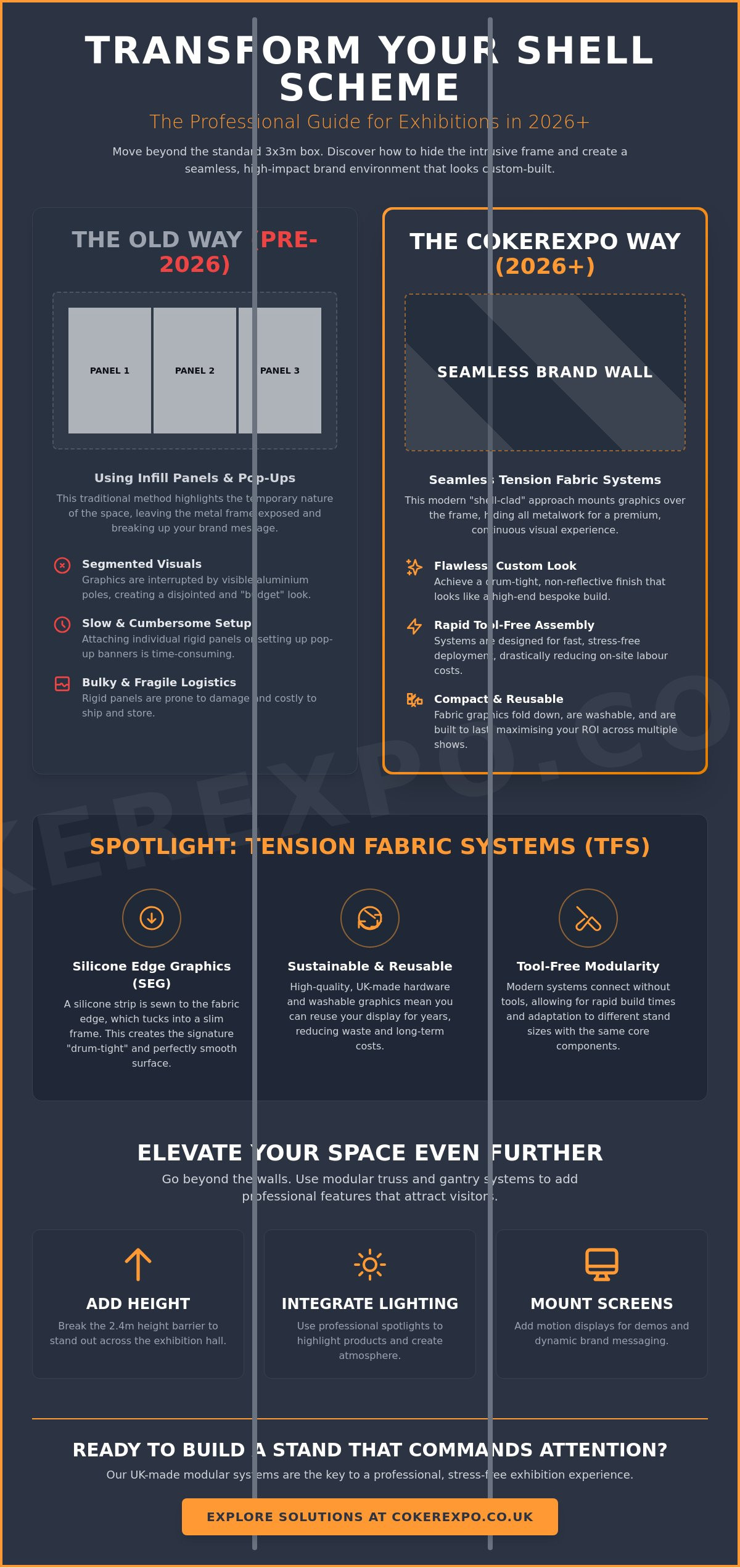
The 2026 trend has shifted decisively away from flimsy pop-up banners toward integrated modularity. Modern exhibitors now use tension fabric graphics or "shell-clad" systems that clip directly onto the aluminium poles. This approach hides the metalwork and creates a seamless, high-end look. You're no longer limited by the 1-metre width of a single panel. Instead, you can create a continuous 6-metre wall of brand imagery that looks like a bespoke build but retains the cost-efficiency of a shell scheme.
Success requires working within strict physical constraints. You'll typically face a weight limit of approximately 12kg per linear metre. Most organisers prohibit drilling or permanent fixings. You're also confined to a rigid footprint, usually 3m x 3m or 6m x 3m. Understanding these boundaries is the first step toward breaking them visually.
The Anatomy of a Shell Scheme
Standard UK shell schemes are 2.4m high. This height is your most valuable asset. The fascia board, which carries your company name, is often the first thing exhibitors want to change. While it provides structural stability, many organisers allow you to remove it if your internal structure is self-supporting. This opens up the stand and removes the "boxed-in" feeling. Professional exhibition stand design always begins with the floor plan. You need to know exactly where the uprights sit to ensure your graphics don't have a metal pole cutting through a key piece of text or a person's face in your imagery.
Why Creative Planning Beats High Budgets
You don't need a massive budget to stand out; you need a "Practical Specialist" mindset. Start by identifying a "Hero" piece. This might be a single backlit LED fabric wall or a unique modular counter. Clutter is the enemy of the small booth. By focusing on vertical space, you keep the floor clear for lead generation and movement. We prioritise tool-free assembly and fast turnaround times because trade show mornings are high-pressure environments. Using UK-made modular hardware ensures your components fit the metric dimensions of British exhibition halls perfectly. It's about choosing robust, versatile systems that allow for a professional finish without the need for a specialist build crew.
Seamless Visuals: Beyond the Standard Infill Panel
Standard shell schemes often feel restrictive because of visible aluminium uprights and recessed infill panels. Implementing creative ideas for shell scheme booths requires moving away from the segmented "box" look. While traditional Foamex panels are a cost-effective entry point, they leave the metal structure exposed, which can interrupt your brand's visual flow. For 2026, the most effective strategy involves bypassing these constraints to create a continuous wall of graphics.
The "Invisible Frame" technique is achieved by mounting graphics in front of the poles rather than inside the channels. This hides the industrial-looking aluminium and makes a 3x3m space feel like a bespoke built stand. Using custom wallpaper with textured finishes, such as wood grain or industrial concrete, provides a high-end interior feel without the weight or cost of real timber. This approach transforms a cold, temporary structure into a professional brand environment that commands attention.
Tension Fabric Systems (TFS) for Shell Schemes
Silicone edge graphics (SEG) represent the gold standard for a professional finish. The fabric is printed using high-resolution dye-sublimation and finished with a silicone strip that tucks into a slim profile frame. This creates a drum-tight surface with zero reflections, which is vital for high-quality photography in busy exhibition halls. Unlike rigid boards, fabric graphics are washable and fold down into a small bag, which significantly reduces shipping costs and storage requirements. For technical specifications on panel sizes and mounting options, consult our ultimate guide to shell scheme graphic panels.
Illuminating Your Brand with LED Lightboxes
Backlit displays are no longer optional for brands wanting to stand out in a crowded hall. Industry data suggests that backlit graphics can increase visitor engagement by up to 40% compared to non-illuminated prints. Integrating a freestanding lightbox as a welcome beacon at the corner of your stand draws the eye from across the hall. This approach aligns with exhibit stand design best practices by creating a clear focal point that guides visitor traffic into your space.
Modern LED technology ensures the light is even and heat-free, making it safe for all-day use in enclosed spaces. These systems are designed for tool-free assembly, allowing your team to focus on networking rather than complex construction. You can find detailed setup instructions and hardware options in our exhibition lightboxes guide. If you want to transform your next event, consider how modular display systems can hide your shell scheme's skeleton and create a premium brand environment.
Structural Innovations: Using Truss and Gantry Systems
Standard shell scheme booths are often criticized for their rigid, boxy appearance. You can break this mold by installing an internal truss system. This creates a "stand-within-a-stand" that provides structural integrity and a high-tech finish. For engineering or tech firms, the industrial look of a raw aluminum gantry communicates a brand identity of precision and strength. When transforming standard shell scheme booths, moving away from the flimsy plastic-coated poles of the standard kit is the first step toward a premium presence. Safety remains the priority in UK venues like the NEC or Olympia London. Professional rigging is essential if you're suspending heavy equipment or complex lighting rigs. Most UK venues require structural calculations and RAMS (Risk Assessment and Method Statement) for any overhead installation. Using a modular gantry system ensures you meet these compliance standards while supporting heavy products that would otherwise clutter your floor space. It's a robust solution that turns a 2.4m high box into a multi-dimensional display.Creative Truss Configurations
A "Goalpost" truss structure is one of the most effective creative ideas for shell scheme booths. By positioning two uprights and a crossbar at the front of your 3m x 3m space, you create a high-level branding point that's visible from across the hall. You can also use trussing to partition your area, creating a semi-private meeting zone without blocking sightlines. If you're testing the waters, hiring exhibition truss for a single event is a cost-effective way to access professional-grade hardware without a large capital outlay.Lighting Rigs and AV Integration
Functional Elements to Maximise Visitor Flow
Optimising a standard stand requires more than just aesthetics; it demands a layout that directs traffic and facilitates engagement. One of the most effective creative ideas for shell scheme booths involves rethinking the promotional counter. Rather than a passive barrier, it acts as a robust lead-capture hub. Positioning a counter at the front edge of your space allows staff to scan badges without forcing visitors to cross an invisible threshold. This simple shift in placement can reduce entry friction by up to 25% according to industry flow analysis.
Movement is a powerful psychological trigger. Integrating battery-operated display turntables adds a dynamic layer to static products, drawing the eye from across the aisle. Research from the Center for Exhibition Industry Research (CEIR) suggests that motion can increase booth dwell time by over 30%. Beyond hardware, flooring serves as a critical boundary marker. Replacing the standard-issue venue carpet with custom cord carpet or branded vinyl instantly defines your territory, signalling a premium presence that differentiates your brand from the surrounding shell scheme rows.
Furniture selection must be surgical. Bulky armchairs or wide tables block the entrance and create "dead zones." Opt for slimline bar stools and high-top tables to keep the floor plan open and inviting. This ensures a seamless transition for visitors moving from the gangway into your branded environment. Compact furniture keeps the focus on your products while providing a professional space for brief consultations.
Interactive Product Showcasing
360-degree visibility is essential for physical hardware. Rotating stands ensure every angle of a product is visible without manual handling. To add a digital layer, integrate tablet stands directly into fabric counters. This allows visitors to browse technical specifications or sign up for newsletters instantly. The psychology of movement works here too; a spinning product stops 40% more traffic than a stationary one, providing a natural opening for your sales team to start a conversation.
Smart Storage Solutions
Clutter ruins brand perception. Use modular counters with "hidden" internal shelving to store brochures, lead forms, and personal items. For secondary information zones, folding display boards offer a versatile way to present data-heavy content without overwhelming your main graphics. Maintaining a tidy, professional environment is non-negotiable for high-impact exhibiting. A clean space allows your primary message to breathe and ensures visitors focus on your solutions rather than your logistics.
Ready to upgrade your stand layout? Explore our range of modular counters and display hardware to find the perfect fit for your next event.
Professional Execution: Planning, Assembly, and Logistics
The 2026 standard for exhibition hardware focuses on tool-free assembly. This shift isn't just about convenience; it's about the bottom line. By 2025, labor costs for specialist stand builders in the UK rose by approximately 15%, making self-build systems a financial necessity for many SMEs. Using modular frames that click or twist together allows a two-person marketing team to complete a setup in under two hours. This eliminates the need for expensive contractor passes and onsite power tools.
Successful exhibitors always perform a full trial build at their own premises at least two weeks before the event. This pre-show testing identifies missing components or graphic alignment issues that would be catastrophic on the trade show floor. Logistics also dictate your hardware choices. High-performance modular systems now collapse into wheeled transit cases designed to fit into a standard estate car or a small van like a VW Transporter. This portability can save a business £400 to £600 in courier and freight handling fees per event.
Prioritising "Made in the UK" hardware ensures fast turnarounds and reliable quality. When a last-minute change occurs, having a domestic manufacturer means replacement parts or updated graphics can arrive within 24 to 48 hours. This local supply chain is the backbone of implementing creative ideas for shell scheme booths without the risk of international shipping delays.
The 5-Step Setup Strategy
- Step 1: Floor and power layout verification. Mark out your footprint and ensure the venue-supplied power socket is positioned where your AV or lighting will actually sit.
- Step 2: Structural frame or truss installation. Build from the ground up. Ensure the base plates are level before locking the vertical uprights.
- Step 3: Graphic application. Apply your SEG (Silicone Edge Graphics) or magnetic panels. Start from the top corner and work across to maintain tension.
- Step 4: Lighting and AV calibration. Secure your LED arm lights and test all screen connections. Hide cables behind the frame for a professional finish.
- Step 5: Final styling and lead-capture readiness. Position your furniture and ensure your digital lead-capture tools are synced to the venue Wi-Fi.
Ensuring Long-Term ROI
Maximising your investment requires hardware that scales. Choose modular components that work for a 3x3 shell scheme but can also expand into a 6x3 space for larger shows. Fabric graphics offer the best longevity; they're washable, fold flat without creasing, and weigh 60% less than traditional PVC panels. You can easily refresh your brand's presence for a new campaign by swapping out a single custom wallpaper or fabric panel rather than commissioning an entirely new stand. This adaptability is central to sustainable creative ideas for shell scheme booths, allowing you to stay current without repeating your initial capital expenditure. Proper storage in padded carry bags will extend the life of your frames for over a decade of heavy use.
Elevate Your 2026 Exhibition Strategy
Standing out in a crowded 2026 exhibition hall requires moving beyond the basic "box" mentality. By implementing these creative ideas for shell scheme booths, you transform a standard 9sqm or 12sqm space into a high-impact brand experience. The key lies in using seamless visuals and modular structures that provide a custom look without the custom price tag.
Coker Expo supports your goals with over 25 years of industry expertise and a focus on practical, high-performance hardware. Our tool-free, modular systems are designed for rapid assembly, ensuring your team stays focused on lead generation rather than logistics. With our UK-based manufacturing, we provide the fast turnaround and robust quality required for the fast-paced trade show environment. It's about more than just a display; it's about creating a professional infrastructure for your success.
Explore our range of Shell Scheme Graphic Panels and Lightboxes to start planning your transformation. We're ready to help you make a lasting impression.
Frequently Asked Questions
Can I attach things to the shell scheme walls provided by the organiser?
You cannot screw, nail, or drill into the standard 4mm or 6mm MDF panels provided by the organiser. Doing this results in damage charges that often exceed £100 per panel. Instead, use heavy-duty Velcro or specialized shell scheme clips designed to hook over the aluminium frame. These tools allow you to hang graphics and lightweight products without risking your deposit or damaging the infrastructure.
How do I hide the aluminium uprights of a shell scheme booth?
Hiding the uprights requires a seamless graphic solution like a tension fabric system or shell scheme cladding. These systems sit 50mm in front of the poles to create a continuous wall of branding. By using creative ideas for shell scheme booths like modular fabric frames, you eliminate the visual break of the 40mm aluminium poles. This transforms a basic booth into a high-end custom stand.
Is a 3x3 shell scheme big enough for a professional display?
A 3x3 metre stand provides 9 square metres of floor space, which is the industry standard for small to medium exhibitors. This footprint comfortably accommodates a 1000mm wide reception counter, two seated staff members, and three visitors simultaneously. With smart modular furniture and vertical branding, you can maintain a professional presence without the booth feeling cramped. It's the most cost-effective way to secure a premium hall position.
What is the best type of lighting for a shell scheme stand?
LED arm lights are the most efficient choice because they consume 80% less power than traditional halogen bulbs. Most UK venues charge for electrical mains by the kilowatt, so using low-energy 12W or 24W LED spotlights keeps your utility costs down. Mount these directly onto the top rail of the shell scheme. We recommend 5600K daylight-balanced bulbs to ensure your graphic colours remain accurate under venue lighting.
Do I need a professional team to set up a shell scheme stand?
You don't need a professional crew if you invest in tool-free assembly systems. Most modular fabric displays and pop-up stands are designed for a single person to build in under 30 minutes. This approach saves you the £400 to £800 daily rate typically charged by exhibition contractors. It gives your team full control over the setup process and ensures you aren't waiting for late deliveries on the build day.
Can I use a fabric tension system on a shell scheme?
Yes, fabric tension systems are the most popular way to implement creative ideas for shell scheme booths in 2026. These systems use a silicone edge graphic (SEG) that slots into a lightweight aluminium frame. The fabric is printed using dye-sublimation technology, which produces vibrant, crease-free results. Because the fabric is single-piece, you get a 3-metre wide seamless wall that's far more impactful than traditional 1-metre PVC panels.
How much does it cost to upgrade a shell scheme stand?
Upgrading a standard shell scheme typically starts with high-quality graphics. While the organiser provides the basic structure, bespoke printed panels or fabric overlays are an additional investment. According to 2024 industry benchmarks, exhibitors spend roughly 20% to 30% of their total show budget on stand interiors. This investment ensures your booth stands out from the hundreds of identical white boxes in the exhibition hall.
What are the fire safety requirements for shell scheme graphics in the UK?
All materials used in UK exhibitions must be fire retardant to British Standards, specifically BS 5867 Part 2 Type B. Your graphics must have a Class 1 or Class 0 fire rating to satisfy venue health and safety inspectors. Most venues require you to keep the manufacturer's fire certificate on-site during the event. We ensure all our tension fabrics and PVC materials meet these rigorous safety specifications as standard.
Leave a comment