

Custom Wallpaper for Professional Displays: The Ultimate B2B Guide
Your exhibition stand has exactly three seconds to capture a prospect's attention before they move to the next aisle. You already know that a professional environment is the foundation of brand trust, yet many marketing teams struggle with large-scale graphics that appear pixelated or fail to meet strict UK venue regulations. A blank or poorly finished wall at a trade show is more than an eyesore; it's a wasted investment in a space that can cost upwards of £500 per square metre. Integrating high-impact custom wallpaper into your display strategy ensures your brand isn't just seen, but remembered.
This guide explains how to transform commercial interiors and exhibition stands into seamless, authoritative brand experiences. We'll solve the common headaches of fire safety compliance, specifically regarding BS EN 13501-1 standards, and provide technical clarity on achieving crisp image resolution at scale. You'll gain a clear understanding of the design-to-installation process, ensuring your next display is robust, compliant, and ready for a fast turnaround. We'll show you how to move from a basic shell scheme to a sophisticated, high-performance environment with absolute confidence in your materials.
Key Takeaways
- Identify the most durable substrates for commercial environments, focusing on breathable materials that prevent mould growth in older British buildings.
- Apply the "Viewing Distance" rule to your artwork preparation to ensure high-impact clarity without unnecessary file weight on large-scale displays.
- Learn how a professional site survey identifies structural issues like damp or blown plaster to ensure your custom wallpaper achieves a flawless, long-lasting finish.
- Explore Tension Fabric Systems (TFS) as a modular, silicone-edged alternative that provides a perfectly flat, drum-tight finish for exhibition stands.
What is Custom Wallpaper in a Professional Context?
In a professional setting, bespoke wallpaper isn't just a decorative choice; it's a high-performance branding tool. While the history of wallpaper dates back centuries as a domestic luxury, modern commercial murals have evolved into sophisticated large-format graphics. Businesses now move beyond simple paint to create immersive environments that communicate brand values instantly. A 2023 report on commercial interior design found that immersive environments can increase customer dwell time by 15%, making custom wallpaper a functional asset for retail and corporate spaces alike. It transforms a static wall into a dynamic marketing channel.
Commercial vs. Residential Wallpaper: Key Differences
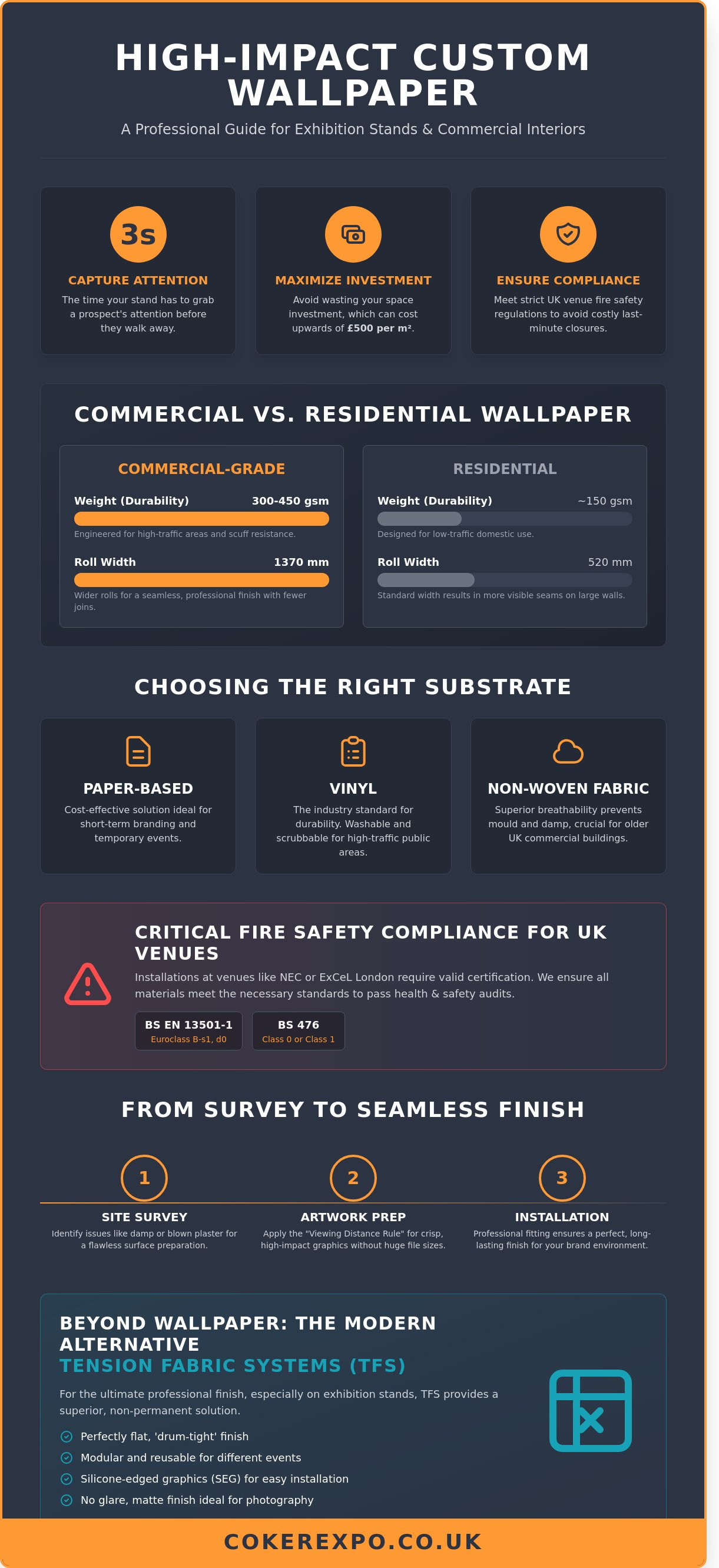
Commercial-grade custom wallpaper is engineered for durability. Unlike residential options, professional materials typically weigh between 300gsm and 450gsm. This extra weight provides essential scuff-resistance in high-traffic corridors or busy exhibition stands. You'll also find that professional rolls are significantly wider, often measuring 1370mm compared to the standard 520mm residential width. This larger format allows us to minimise seams and deliver a more cohesive visual. Adhesive choice is equally critical; we use heavy-duty permanent pastes for long-term office fit-outs and textile "peel and stick" options for short-term events where a clean removal is mandatory.
The Strategic Role of Large-Format Graphics
Effective branding requires total consistency. Custom graphics allow marketing managers to synchronise the visual identity of a showroom with their latest exhibition stand or head office. It's a practical way to direct foot traffic. By using a bold statement wall, you can pull visitors toward a specific product launch or information desk. We always recommend non-reflective, matte finishes for these installations. This ensures that when customers take photos for social media or professional photographers document your stand, there's no glare to distort the brand imagery. It's a technical detail that makes a massive difference in how your business is perceived online.
- Durability: 300gsm+ materials withstand heavy public contact.
- Seamlessness: 1370mm wide drops reduce the number of visible joins.
- Versatility: Options for both permanent office decor and temporary event branding.
Materials and Technical Specifications for UK Businesses
Selecting the right substrate for custom wallpaper depends on your venue's environment and the duration of your campaign. While the history of wallpaper shows a transition from hand-painted papers to mass-produced rolls, modern commercial displays require high-performance materials. We typically specify three main types: paper-based, vinyl, and non-woven fabrics. Paper-based options offer cost-effective short-term branding. Vinyl is the industry standard for durability. Non-woven fabrics provide superior breathability. This is vital in older UK commercial properties where trapped moisture leads to mould and structural damp.
UV-stable inks are non-negotiable for professional displays. Harsh exhibition spotlights or direct sunlight through shopfront windows can fade standard prints within 6 months. We use high-grade pigments that maintain 100% colour saturation under intense lighting. For aesthetic choice, smooth finishes highlight fine photographic detail. Conversely, textured hide or stucco finishes mask imperfections on uneven 19th-century masonry walls. Your choice of texture can also reduce glare, which is a common issue in brightly lit trade show halls.
Fire Safety and Compliance for Public Venues
UK venue managers at sites like the NEC or ExCeL London won't allow installations without valid certification. You must ensure your custom wallpaper meets BS476 Class 0 or 1, or the more recent Euroclass B-s1, d0 standard. These ratings measure flame spread and smoke production. We provide full technical data sheets for every installation to pass health and safety audits. This documentation prevents last-minute booth closures during exhibition build-up and ensures your brand remains compliant with the Regulatory Reform (Fire Safety) Order 2005.
Durability and Maintenance in High-Traffic Zones
Retail and hospitality environments require specific washability ratings. A washable rating handles light sponging. A scrubbable rating is necessary for 24-hour transport hubs or corridors where luggage scuffs are frequent. For 2024 healthcare projects, we suggest anti-microbial coatings that inhibit 99.9% of bacteria growth. While temporary event vinyl lasts 12 months, our heavy-duty commercial papers carry a 10-year lifespan when applied with professional-grade adhesive. If you need technical advice on material selection, our team can recommend a bespoke solution tailored to your specific wall type.
Designing for Scale: Artwork Preparation and Resolution
Transitioning from a standard A4 brochure to a 10-metre display wall requires a shift in technical perspective. While 300dpi is the industry standard for hand-held print, custom wallpaper for large-scale environments follows the "Viewing Distance" rule. If your audience stands three metres away, 72 to 100dpi at full size is often sufficient to maintain a crisp appearance. Attempting to force a 300dpi resolution on a wall of that scale results in massive file sizes that crash RIP software and slow down production without providing any visible benefit to the human eye.
For brand logos and typography, vector graphics are the only professional choice. Unlike raster images that rely on fixed pixels, vector files use mathematical paths to maintain perfect clarity at any scale. This prevents the jagged "staircase" effect on edges when a logo is expanded to fill a boardroom. If you must use raster elements, ensure they are high-quality TIFFs rather than compressed JPEGs to avoid compression artefacts that become glaringly obvious at large sizes.
Technical precision is non-negotiable for a seamless finish. We require a minimum 50mm bleed on all four sides of the artwork. This provides a safety margin for walls that aren't perfectly square, a common issue in both modern offices and older exhibition halls. For multi-drop installations, a 10mm to 20mm overlap ensures patterns align perfectly. This allows the installer to "double-cut" the join, resulting in a butt-joint that looks like a single, continuous surface.
Resolution Requirements for Large-Scale Murals
The effective PPI (pixels per inch) depends entirely on the proximity of the viewer. For a feature wall in a narrow corridor where people stand one metre away, aim for 150 PPI. For large-scale murals in foyers or exhibition stands viewed from five metres, 35 to 50 PPI is the professional benchmark. If your source imagery lacks the necessary detail, tools like Topaz Photo AI or Adobe’s "Super Resolution" can help recover clarity. Interpolation is a software-driven technique that creates new pixels based on existing data to expand low-resolution files for large-format print.
Colour Consistency and Brand Matching
Achieving exact CMYK output to match your brand guidelines is a common challenge because different substrates absorb ink differently. A Pantone reference that looks perfect on coated paper might shift when printed on a textured, fabric-backed vinyl. We recommend a "hard proof" or a 600mm sample strip before the full print run. This physical test is the only way to verify how the ink reacts with the specific custom wallpaper material. You must also consider the venue lighting; 4000K LED office lights can make cool tones appear clinical, while natural light through UV-treated glass can soften the vibrance of your brand colours. Testing the sample in situ prevents costly reprints and ensures the final installation meets your expectations.
Professional Installation: From Site Survey to Final Drop
Professional installation is a sound investment for any commercial project. While high-quality custom wallpaper represents a significant brand asset, its impact depends entirely on the precision of the application. A botched installation leads to peeling edges, misaligned graphics, or bubbling, which undermines your professional image. Engaging an expert team ensures that your investment is protected and the final result meets the high standards your business demands.
The process begins with a rigorous site survey. This isn't just about measuring height and width; it's a technical assessment of the substrate. Installers check for "blown" plaster, where the material has pulled away from the brickwork, and use moisture meters to ensure levels are below 5%. Damp walls are the primary cause of adhesive failure. We recommend adding a 50mm bleed to all dimensions to account for "run out" in older buildings where walls are rarely perfectly square. Professionals also map out complex obstacles like sockets, data ports, and HVAC vents, ensuring the custom wallpaper design doesn't lose critical text or logos to a light switch.
Wall preparation is the next critical phase. This involves "sizing" the wall, a process of applying a diluted adhesive or specialized primer to seal the surface. It prevents the porous plaster from drinking the moisture out of the paste too quickly, which allows for a stronger, more even bond. Without proper sizing, the wallpaper becomes difficult to reposition during the hang, leading to visible gaps or creases.
Installation Techniques for a Seamless Look
To achieve a flawless finish, installers use the "overlap and double-cut" method. They overlap two drops of custom wallpaper by approximately 20mm and then slice through both layers with a fresh surgical blade. This creates a perfect butt-joint where the pattern aligns with zero visible seams. Industrial-grade fungicidal adhesives are used instead of standard DIY pastes. these high-performance adhesives offer superior wet-tack and durability for heavy-duty commercial murals. For maintenance, a simple wipe with a damp microfibre cloth is usually sufficient to keep the display looking sharp for years.
Temporary Solutions for Exhibitions and Pop-Ups
For trade shows and short-term retail activations, permanent adhesives aren't practical. We often recommend low-tack self-adhesive vinyl. This material provides a high-end look but can be stripped away in minutes without leaving residue or damaging the venue's walls. When working with shell schemes, the surface is often too uneven for direct application. The solution is "over-boarding" with 3mm Foamex panels. This creates a perfectly flat, rigid substrate that allows your branding to look like a permanent architectural feature rather than a temporary fix.
Ready to elevate your next event? Explore our professional display solutions to find the perfect hardware for your bespoke graphics.
Beyond Wallpaper: Tension Fabric Systems (TFS)
While custom wallpaper offers a permanent solution for office branding, Tension Fabric Systems (TFS) provide a versatile alternative for dynamic B2B environments. These systems use Silicone Edge Graphics (SEG), where a thin silicone gasket is sewn into the perimeter of a high-definition fabric print. This gasket slots into a recessed groove in an aluminium frame, creating a drum-tight finish that looks like a solid wall but weighs a fraction of the mass. The result is a perfectly flat surface without the bubbles or peeling risks often associated with traditional adhesives.
Fabric displays eliminate the glare found with vinyl or gloss finishes. This makes them the preferred choice for 92% of professional photographers at trade events. By integrating LED arrays behind the fabric, you can transform a standard display into a powerful lightbox. This ensures your brand "glows" even in dimly lit exhibition halls, providing a depth of colour that traditional printed paper simply cannot match.
Wallpaper vs. TFS: A Comparison for Exhibitors
Traditional custom wallpaper requires professional installers and significant curing time. In contrast, TFS frames are designed for rapid deployment. A standard 3x3 metre frame can be assembled in under 15 minutes by a single person. Portability is another major factor. A 5-metre graphic, which would require a large van if printed on rigid boards, folds down into a small carry bag. This reduces logistical costs by roughly 60% and allows for easy storage between events.
- Setup Speed: Fabric frames use push-fit technology, bypassing the need for pastes or messy adhesives.
- Portability: Large-scale graphics are lightweight and can be transported in a standard passenger car.
- Sustainability: Most modern fabrics are PVC-free and printed using water-based inks, while the aluminium frames are 100% recyclable.
Bespoke Display Solutions from CokerExpo
At CokerExpo, we specialise in merging high-impact graphics with modular engineering. Our systems often combine custom fabric frames with robust modular trussing to create multi-level stands that command attention. We stand by our tool-free assembly promise, ensuring that your team can focus on lead generation rather than struggling with complex hardware. While fabric is ideal for seamless large-format visuals, you might also consider foamex signs if you need a rigid, cost-effective alternative for structural wall cladding.
Based in Hampshire, our specialist team provides end-to-end support for national projects. Whether you're planning a single-site installation or a UK-wide exhibition tour, we have the hardware and the expertise to deliver. Contact us today to discuss your specific display requirements and let us help you make a lasting impression at your next event.
Elevate Your Brand with Precision Display Solutions
Choosing the right custom wallpaper or display system is a strategic decision that impacts your brand's authority and venue safety. Every installation must balance high-resolution design with strict UK fire safety and venue compliance to ensure a professional, legal finish. By prioritising technical specifications like image resolution and site-specific material choices, you'll avoid common pitfalls and achieve a seamless, high-impact look that lasts throughout your event.
Coker Expo brings over 25 years of exhibition and event expertise to your project, acting as a reliable partner for UK businesses. We specialise in tool-free assembly and fast turnaround times, providing the infrastructure you need without the stress of complex setups. Our team understands that time is a critical factor in the exhibition industry; that's why we focus on robust, portable systems that don't compromise on visual quality. You're not just buying a display; you're securing a solution built on British reliability and technical craftsmanship.
Explore our range of high-impact Tension Fabric Systems and bespoke graphics
Take the next step in your display strategy and see how easy it is to make a lasting impression.
Frequently Asked Questions
Is custom wallpaper suitable for exhibition stands?
Yes, custom wallpaper is an excellent choice for shell schemes and bespoke timber exhibition stands. It provides a seamless, high-impact finish that hides joins between panels, which traditional graphic boards can't achieve. Our commercial-grade materials are designed to withstand the heat of exhibition hall lighting, often reaching 25 degrees Celsius, without peeling or curling at the edges.
What is the best resolution for custom wallpaper printing?
You should supply your artwork at a resolution of 300 DPI at 100% of the final print size for the best results. If you're creating a large-scale mural over 5 metres wide, we can accept 150 DPI to keep the file size manageable while maintaining visual clarity. This ensures your branding looks sharp and professional even when visitors are standing just 1 metre away from your display.
Can I install custom wallpaper myself in a commercial space?
It's possible to install the wallpaper yourself, but we recommend a two-person team for any wall higher than 2.4 metres. Professional installers can typically finish a standard 10-metre wall in under 3 hours, ensuring perfectly aligned seams and a bubble-free finish. If you're working on a tight build schedule at a venue like the NEC, hiring an expert often prevents costly errors and saves valuable time.
How do I know if my wallpaper meets UK fire safety regulations?
Your custom wallpaper must have a fire rating certificate, specifically Euroclass B-s1, d0 or the British Standard BS 476 Class 0. These certifications are a legal requirement for materials used in UK public spaces and exhibition venues under the Regulatory Reform (Fire Safety) Order 2005. We provide the necessary data sheets with every order so you can satisfy venue health and safety officers during the build phase.
What is the difference between "paste-the-wall" and "peel-and-stick"?
Paste-the-wall products require you to apply a specialised adhesive directly to the substrate, which gives you a 10-minute window to slide and align the paper accurately. Peel-and-stick is a self-adhesive vinyl that works like a large decal, making it faster to apply but much harder to reposition once it touches the surface. For long-term office interiors, the paste-the-wall method usually offers a more durable and permanent bond.
Can custom wallpaper be removed without damaging the wall?
Yes, our strippable wallcoverings are designed to be removed in full sheets without leaving stubborn residue or tearing the underlying plasterboard. This is a vital feature for temporary retail pop-ups or short-term exhibitions where you're contractually required to return the space to its original condition. To ensure a clean release, it's essential to prime the wall with a high-quality sealer 24 hours before you begin the installation.
How long does it take to print and deliver bespoke wallpaper?
Our standard production time is 3 to 5 working days from the moment you approve your digital proofs. Because we manufacture everything in the UK, we can often offer an expedited 48-hour turnaround for urgent projects that need to meet a strict event deadline. Every order of custom wallpaper is shipped via a tracked overnight courier to ensure it arrives safely at your office or venue.
Can I use custom wallpaper on a curved wall or architectural feature?
You can certainly use custom wallpaper on curved surfaces, provided the radius isn't tighter than 300mm. We recommend using a non-woven or fabric-backed material for these features because they offer more flexibility than standard paper. For complex shapes like structural pillars, using narrower 600mm drops makes the application process much easier and helps maintain perfect pattern alignment across the curve.
Leave a comment