

Designing a Truss Structure for Banners: The Professional Engineering & Design Guide
A banner display that sags or fails under wind pressure isn't just an eyesore; it's a liability that can compromise your brand's reputation and public safety. You likely understand that achieving a high-impact presence requires more than just a large print. It demands a structural foundation that can withstand environmental forces while keeping the fabric perfectly tensioned. Designing a truss structure for banners is a precise task where structural engineering meets graphic presentation, and getting the math wrong often leads to significant logistical stress.
We've developed this guide to help you master the technical and aesthetic principles of creating robust, professional displays. You'll gain a clear blueprint for choosing truss dimensions and secure attachment methods that ensure a wrinkle-free finish. We'll explore critical compliance factors like the International Building Code (IBC) 2024 and ASCE 7-22 wind load requirements. This article provides a logical breakdown of how to calculate velocity pressure and account for banner porosity to build a display that represents a sound business investment.
Key Takeaways
- Understand how the "sail effect" impacts structural integrity and why calculating wind load is non-negotiable for outdoor safety.
- Learn the technical fundamentals of designing a truss structure for banners to ensure your frame is both stable and aesthetically professional.
- Identify the optimal configuration for your event, whether you need a simple goalpost backdrop or a high-impact 360-degree branding cube.
- Discover precise tensioning methods, such as bungee eyelets or wrap-around graphics, to eliminate wrinkles and achieve a flawless finish.
- Evaluate the practical advantages of hiring versus purchasing professional-grade aluminium truss to streamline your event logistics and budget.
The Fundamentals of Designing a Truss Structure for Banners
Successful execution begins with a shift in perspective. You aren't just selecting a frame; you're engineering a system to support specific brand objectives. Whether you're constructing a branding tower for a festival, a finish line for a marathon, or a massive exhibition backdrop, the structure must be both functional and visually clean. Designing a truss structure for banners requires a balance between aesthetic impact and the logistical reality of the event space.
Professional systems rely on 50mm aluminium tubing as the primary material. This is the industry standard because it offers the necessary rigidity to prevent bowing under the tension of large-format prints. To understand the engineering behind these frames, it helps to look at What is a Truss? and how its components work together. A standard display truss consists of "chords," which are the main longitudinal tubes, and "webbing," the diagonal supports that distribute the load. These elements are joined using conical couplers. These couplers provide a secure, rattle-free connection that's easy to assemble and dismantle without specialized tools.
Starting with the Graphic Dimensions
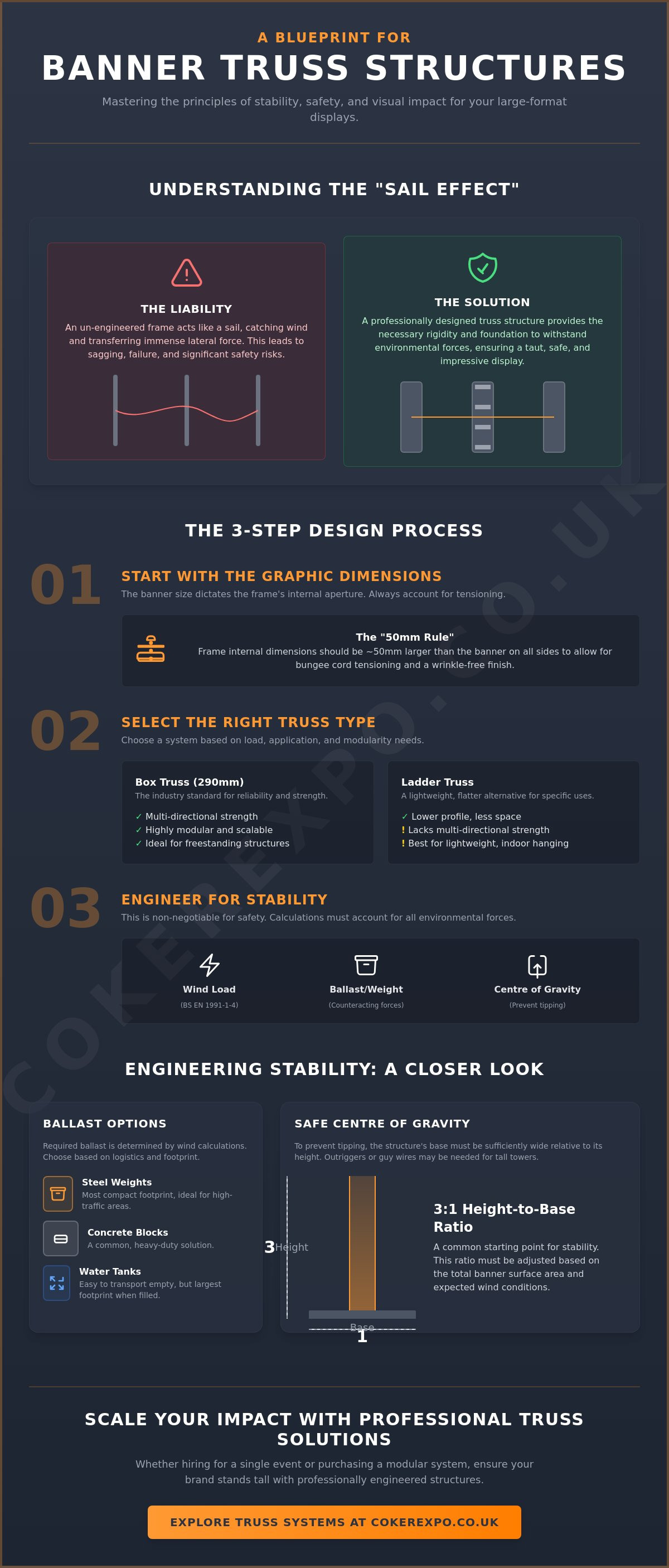
The banner size is the primary driver of your design. It dictates the internal aperture of the frame. You must account for a tensioning gap, often called the "50mm rule." This means the internal dimensions of your truss frame should be roughly 50mm larger than the banner on all sides. This space allows for bungee cords or tensioning ties to pull the fabric taut. When you order large-format printing, include "bleed" in your graphic design to ensure no white edges show. The total footprint of the structure will be the banner area plus the width of the truss sections and the footprint of the base plates.
Modular vs. Custom Truss Systems
For most commercial applications, a standard 290mm box truss is the most reliable choice. It's modular, which means you can scale it from a simple goalpost to a complex cube using interchangeable sections. If you're working on lightweight indoor hanging banners, a ladder truss might suffice. It's flatter and uses less space, though it lacks the multi-directional strength of box truss. The flexibility of your design relies on corner blocks and heavy-duty base plates. These components allow you to create 90-degree angles and provide the essential stability needed for freestanding structures in high-traffic environments. This modularity makes the system a sound business investment for companies with a busy event calendar.
Engineering Stability: Load-Bearing and Wind Calculations
Moving from the conceptual blueprint to the physical build requires a strict focus on physics. When you're designing a truss structure for banners, you're essentially creating a giant sail. A solid vinyl banner acts as a massive wind catchment, transferring immense lateral force to the aluminium frame. This "sail effect" can turn a stable structure into a hazard if the engineering doesn't account for environmental variables. Ignoring these forces is the primary cause of structural failure in public spaces.
For outdoor applications, calculations must align with the BS EN 1991-1-4 standard, which dictates wind actions on structures. You can't rely on guesswork here. Consulting established Safety Guidelines for Temporary Structures is a vital step in ensuring your design accounts for peak gust speeds and site-specific exposure categories. Professional designers use these metrics to determine the required ballast, whether that involves water tanks, concrete blocks, or steel weights. While water tanks are easier to transport, steel weights provide a much more compact footprint for high-traffic areas.
Maintaining a safe centre of gravity is equally critical. A standard height-to-base ratio of 3:1 is a common starting point, but this must be adjusted based on the surface area of the banner. If you're designing a tall branding tower, you'll likely need outriggers or guy wires to extend the effective footprint and prevent tipping. If you're unsure about the specific stability requirements for your event, exploring professional lighting truss hire options can provide access to pre-calculated systems that prioritize safety.
Indoor vs. Outdoor Design Constraints
Indoor environments offer more control but present their own challenges, such as floor loading limits and ceiling height clearance. You must ensure the weight of the truss and ballast doesn't exceed the venue's kg/m² capacity. Outdoor setups require more aggressive stabilization, including ground anchors and outriggers. Mesh banners are preferred for high-wind outdoor truss designs because their perforated surface allows air to pass through, significantly reducing the lateral pressure on the frame.
Structural Integrity and Rigging
Understanding the difference between vertical and horizontal load-bearing capacities is fundamental. While a truss can support significant weight hanging vertically, the horizontal force of wind against a banner puts different stresses on the conical couplers and webbing. Bracing is essential for any span exceeding four metres to prevent the structure from twisting. For any overhead rigging, industry standards mandate a 5:1 design factor, meaning the hardware must be capable of supporting five times the intended load to ensure total reliability.
Choosing the Right Configuration: Goalposts, Cubes, and Towers
Selecting the geometry of your frame is a decision that balances visual impact with the physical footprint available at your venue. Designing a truss structure for banners requires you to match the configuration to the specific flow of foot traffic. If you're setting up at a marathon or an entryway, a goalpost structure is the most efficient choice. These consist of two vertical legs and a horizontal crossbar, providing a clear path for attendees while offering a large header for branding. While simple, they require substantial base plates or outriggers to compensate for their narrow profile.
For central locations where visitors approach from all sides, box frames and cubes are superior. These configurations provide four distinct faces for branding, allowing for 360-degree visibility. Cubes are inherently more stable than goalposts because their interconnected perimeter creates a rigid space frame. This geometry naturally resists twisting and provides multiple points for ballast attachment. If your event requires a landmark rather than a wall, truss towers are the answer. They occupy a minimal floor area but extend vertically to cut through the visual noise of a crowded exhibition hall.
Complex event environments often demand custom multi-tier designs. These structures can incorporate different banner sizes at varying heights or even integrate lighting and promotional counters into the base. By using modular conical couplers, you can expand a basic tower into a multi-functional branding hub. This flexibility ensures your hardware remains a versatile business investment that adapts to different floor plans and marketing goals.
Designing for Single vs. Double-Sided Graphics
The choice between single and double-sided graphics impacts your internal bracing strategy. Single-sided banners allow you to use standard diagonal webbing for support. However, double-sided displays require you to hide the bracing within the "sandwich" of the two fabric layers. You must ensure that internal cross-bracing doesn't create visible shadows when the banners are backlit by venue lighting. Using offset bracing or black-back fabric can help maintain structural integrity without obscuring your message.
The Logistics of Scale
Scale dictates the truss profile you must use to maintain a professional appearance. While 250mm or 290mm truss is sufficient for small entryways, you'll need to transition to 400mm truss for large-format murals. This larger profile prevents the horizontal beams from sagging under the weight and tension of the fabric. Transport is another critical design factor. Ensure your structure uses component lengths, such as 2-metre or 3-metre sections, that fit into standard delivery vans. Most banner structures are ground-stacked for ease of assembly, but you should consider "flying" the structure via hoists if floor space is at a premium and the venue allows for overhead rigging.
Seamless Integration: Banner Attachment and Tensioning Methods
The final stage of designing a truss structure for banners is selecting the hardware that bridges the gap between the aluminium frame and the graphic. Even the most robust engineering fails to impress if the banner is wrinkled or poorly aligned. Achieving a professional, high-impact finish depends on uniform tension across the entire surface area. This requires a calculated approach to how the fabric or vinyl is secured to the chords.
The bungee and eyelet method remains the most versatile choice, particularly for outdoor environments. By using elasticated cords, you allow the banner to move slightly under wind pressure, which prevents the eyelets from tearing and reduces the peak load on the truss. For a more architectural look, wrap-around graphics can create a seamless pillar effect. This method involves printing a single large-format graphic that encases the entire truss section, hiding the industrial hardware completely. If your project requires a high-end signage appearance, Keder track integration is the superior option. By attaching plastic tracks to the truss, you can slide in graphics with beaded edges, creating a perfectly flat, drum-tight display that rivals permanent installations.
Consistent tensioning is vital to prevent graphic distortion. You should always start tensioning from the corners and work toward the centre of each span. This ensures the image remains centered and the text stays legible. If you need assistance with the final execution, our team provides expert large format printing services tailored specifically for truss-mounted displays.
Material Choice for Truss Displays
Your choice of material must align with the structure's location. Traditional PVC is durable and cost-effective for most applications, while mesh is the non-negotiable choice for high-wind outdoor areas. For premium indoor events, tension fabric offers a non-reflective surface that looks excellent under photography lights. All materials used in UK exhibition venues must meet B1 or M1 fire retardancy standards to comply with health and safety regulations.
Concealing the Hardware
While the industrial look of aluminium is often desirable, some brands prefer to soften the aesthetic. Truss socks, made from fire-retardant stretch fabric, can be pulled over the sections to create a clean, monolithic appearance. You can also design internal lighting mounts to illuminate your banners from within, turning the entire structure into a giant lightbox. By integrating exhibition stand design principles, you can transform a basic utility frame into a sophisticated brand asset that maximizes your return on investment.
Scaling Your Impact with CokerExpo Truss Solutions
Transitioning from the technical blueprint to the physical event floor requires a partner that provides more than just hardware. Investment in professional-grade aluminium truss represents a sound business decision for companies looking to maintain a consistent, high-impact presence. While designing a truss structure for banners focuses on physics and aesthetics, the final execution relies on the quality of the infrastructure. Our systems are built for resilience, ensuring that your branding remains a stable, professional landmark throughout the duration of your event.
Choosing between hiring and purchasing your banner structure depends on your specific event calendar and logistical capacity. Lighting truss hire is an ideal solution for one-off exhibitions where a specific configuration, such as a large-span goalpost or a custom mural tower, is required for a single venue. Conversely, purchasing a modular system allows for repeated use across multiple tradeshows, offering a high return on investment for brands with recurring display needs. Both paths provide access to the same high-performance hardware, allowing you to scale your impact without compromising on structural integrity.
CokerExpo serves as the essential infrastructure for UK event success by combining domestic manufacturing quality with expert technical support. We handle bespoke requests with creative flexibility, moving quickly from initial concept to on-site delivery. Whether you need a simple freestanding frame or a complex aerial display, our hardware is designed for rapid assembly, respecting the high-pressure, deadline-driven nature of the exhibition industry.
The CokerExpo Advantage
- Rapid Assembly: Our conical coupler systems ensure fast, secure connections that reduce labour time and logistical stress during build-up.
- Safety First: We provide expert advice on rigging and ballast requirements, ensuring your large-format graphics comply with venue safety standards.
- Total Reliability: Every component, from base plates to corner blocks, is engineered for durability and ease of transport.
- Bespoke Flexibility: We project confidence in our ability to handle custom configurations, from massive outdoor towers to intricate indoor backdrops.
Next Steps for Your Project
Moving your project forward is a straightforward process. You can start by consulting with our event management and planning team to refine your structural requirements and tensioning strategies. For those seeking deeper technical specifications on load-bearing capacities and modular components, explore our comprehensive truss truss pillar. Once you've identified your ideal configuration, request a quote for a custom banner structure that matches your specific branding goals. We're ready to provide the craftsmanship and efficiency your next professional environment demands.
Engineering Your Next High-Impact Display
Mastering the technical requirements of banner truss design ensures your brand remains secure and visible in any environment. You've seen that structural stability depends on accurate wind-load calculations and the strategic use of ballast. Whether you select a simple goalpost or a complex 360-degree cube, the configuration must align with your venue's specific foot traffic and branding goals. Designing a truss structure for banners is a precise task that rewards careful planning with a flawless, wrinkle-free presentation that commands attention.
CokerExpo has provided UK-based expertise in high-impact exhibition hardware since 1999. We act as your reliable partner, offering national delivery and expert planning support to alleviate the logistical stress of event construction. Our team specializes in providing the essential infrastructure required for professional success, from modular lighting truss hire to custom large-format printing. We focus on the physical experience of the operator, ensuring that every system we provide is simple to transport and fast to assemble.
Explore Professional Truss Hire and Sales for Your Next Banner Project. We're ready to help you build a robust, professional display that stands the test of time and environmental pressure.
Frequently Asked Questions
What is the best type of truss for a large outdoor banner?
A 290mm or 400mm aluminium box truss is the industry standard for outdoor banner displays. The square profile offers superior resistance to the twisting forces generated by the sail effect of the fabric. While ladder truss is suitable for simple indoor backdrops, outdoor environments require the multi-chord strength of a box frame to maintain structural integrity under lateral wind pressure.
How do I calculate how much ballast I need for a truss tower?
Ballast requirements are determined by the banner's surface area and the local wind speed as defined by BS EN 1991-1-4. You must calculate the lateral force against the banner and provide enough weight at the base to prevent tipping. A standard 3:1 height-to-base ratio is a starting point, but high-wind areas often require concrete or steel weights that exceed the total weight of the truss itself.
Can I use a standard banner with a truss structure, or do I need special finishing?
You need specific finishing like reinforced eyelets or Keder edges to ensure the banner doesn't tear under tension. Designing a truss structure for banners requires a 50mm gap between the banner edge and the truss chord for bungee attachment. Standard hemmed banners without reinforcement will likely fail when subjected to the high tension needed for a professional, wrinkle-free appearance.
Is it better to hire or buy a truss structure for a one-off event?
Hiring is the most cost-effective choice for a single event because it eliminates the need for long-term storage and hardware maintenance. Lighting truss hire also allows you to access specialized components, such as corner blocks or outriggers, that might be too expensive for a one-time purchase. Buying is a sound investment only for companies that plan to use the same configuration across multiple annual exhibitions.
What are the safety regulations for rigging banners on truss in the UK?
In the UK, you must comply with the BS 7905-1 standards for lifting equipment and the BS 5975:2024 code of practice for temporary works. These regulations mandate that any temporary structure in a public space is designed, installed, and dismantled by competent persons. You should also maintain a site-specific risk assessment that includes wind-off procedures for extreme weather conditions.
How do I prevent my banner from wrinkling when attached to a truss frame?
Preventing wrinkles requires a systematic tensioning approach that starts from the corners and moves toward the center of each span. Using high-quality bungee cords provides a constant, forgiving pull that accommodates minor temperature changes and wind movement. If you're designing a truss structure for banners that requires a perfectly flat finish, consider using tension fabric systems for a drum-tight look.
Can I integrate LED lighting into my truss banner design?
Yes, exhibition lighting truss is specifically engineered to support both graphics and electrical fixtures simultaneously. You can use global truss clamps to attach LED par cans or floodlights to the chords, illuminating the banner from the front or back. Internal lighting mounts can also be used to turn a box frame into a giant freestanding lightbox, maximizing your brand's visibility in low-light environments.
What wind speed is considered dangerous for a truss banner structure?
Most safety protocols require banners to be lowered or removed when wind speeds reach 15 to 20 mph, often referred to as the wind-off threshold. While the aluminium frame might be engineered for higher gusts, the pressure on the banner can exceed the eyelet strength or destabilize the base. Always consult the manufacturer's load tables to determine the exact safety limits for your specific configuration.
Leave a comment