

Guide to Custom Aerial Hanging Display Lightboxes
The most valuable real estate at your next trade show isn't on the ground; it's the underutilised air space directly above your stand. You've likely felt the frustration of being overshadowed by larger booths or struggling to make your brand visible across a crowded, noisy convention hall. It's a logistical challenge where high floor costs often limit your physical footprint. By investing in a custom aerial hanging display lightbox, you can reclaim that "dead space" and transform it into a high-visibility beacon that commands attention from every corner of the venue.
This guide provides a professional roadmap for dominating the exhibition skyline using high-performance LED illumination. We'll show you how to achieve a seamless integration with exhibition truss while navigating the technical complexities of the industry. You'll gain a clear understanding of essential safety regulations, including OSHA 29 CFR 1926.251 rigging standards and NFPA 701 flame retardancy. We have structured this information to help you manage the logistical pressure of trade show planning and deliver a resilient, high-impact brand presence that represents a sound business investment.
Key Takeaways
- Bypass floor-level obstructions by utilizing vertical space to project your branding above the competition.
- Discover why a custom aerial hanging display lightbox relies on lightweight aluminium frames and high-output LEDs for safety and visual impact.
- Learn the essential steps for coordinating with venue technical manuals to ensure your rigging meets strict weight and safety requirements.
- Master the legibility rules and contrast techniques needed to keep your graphics clear and visible from the far end of the hall.
- Streamline your installation by integrating aerial displays with professional lighting truss for a faster and more reliable assembly process.
What is a Custom Aerial Hanging Display Lightbox?
A custom aerial hanging display lightbox is a suspended illuminated structure designed to project branding high above an exhibition stand. Unlike standard floor-standing units, these systems utilise the vertical volume of a venue to bypass the visual clutter of floor-level obstructions. An aerial lightbox is a tension-fabric system engineered for suspension and high-output LED illumination. By moving your primary brand identity into the rafters, you create a 360-degree beacon that ensures your presence is felt long before a visitor reaches your booth.
The primary function of these displays is to provide a clear, illuminated point of reference in a busy commercial environment. If you're researching What is a Trade Show? from a marketing perspective, it's essentially a battle for attention. Standard signage often gets lost at eye level, but these custom-built units allow for bespoke dimensions. You aren't limited to standard sizes; you can specify anything from traditional cubes and rectangles to complex circular "halo" designs that wrap around your entire stand perimeter.
The Mechanics of Tension Fabric Systems (TFS)
The structural integrity of these displays relies on advanced Tension Fabric Systems (TFS). These frames use silicone edge graphics (SEG), where the fabric print features a thin silicone strip sewn into the edge. This strip tucks into a recessed groove in the aluminium profile, creating a drum-tight, seamless finish that doesn't sag or wrinkle under tension. It's a professional-grade solution that looks permanent but remains easy to transport.
- Single-sided illumination: Ideal for displays positioned against a wall or focused on a specific aisle.
- Double-sided illumination: Provides maximum hall coverage, ensuring your brand is visible to visitors walking in either direction.
Why Height Matters in Exhibition Halls
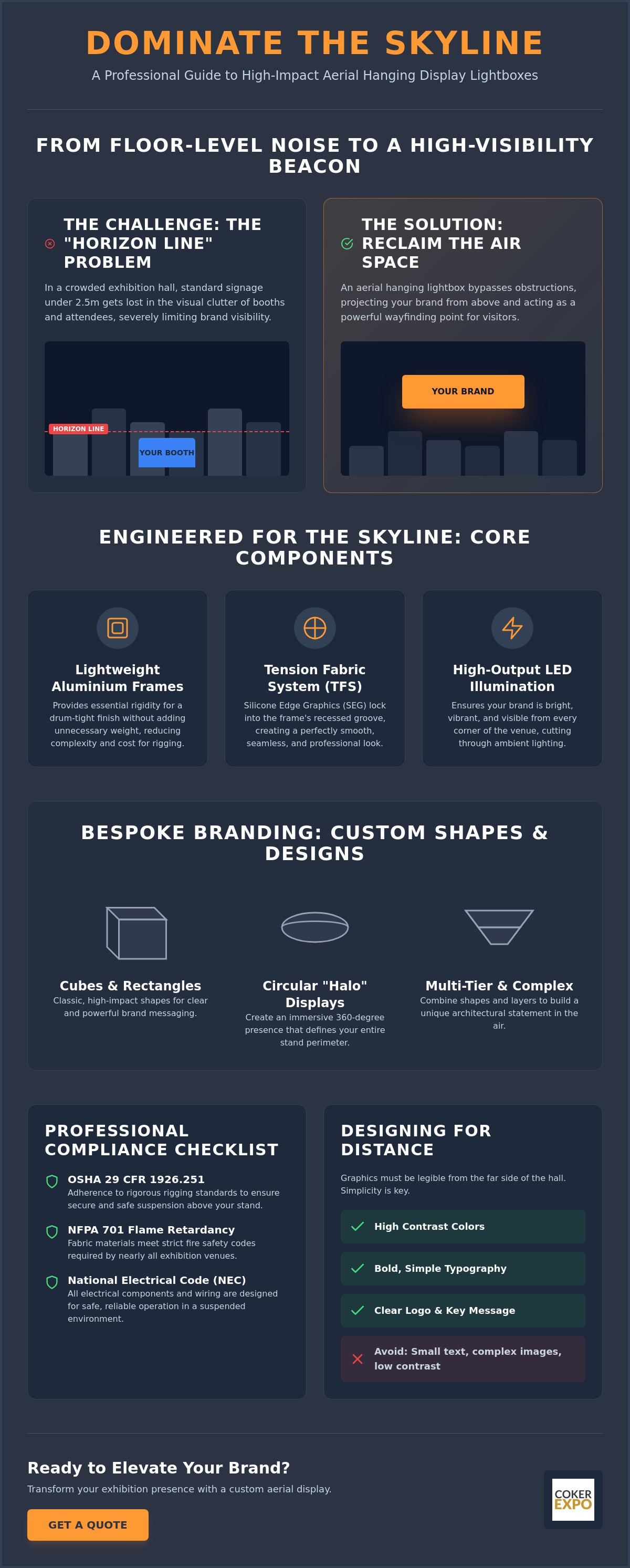
Most exhibition halls suffer from the "horizon line" problem, where the density of crowds and equipment blocks any display under 2.5 metres. By elevating your branding, you create a natural wayfinding point for visitors. This approach allows you to maximise the ROI of your floor space. Instead of using valuable square footage for large, bulky signage, you can dedicate your floor area to lead generation and product demonstrations while the custom aerial hanging display lightbox handles the heavy lifting of brand recognition from above. It's an efficient way to reclaim the underutilised space above your head.
Technical Specifications: Engineering for the Skyline
Engineering a custom aerial hanging display lightbox requires a precise balance between high-impact aesthetics and structural weight limits. We use high-grade aluminium profiles because they provide the necessary rigidity to keep fabric graphics drum-tight without adding unnecessary strain to the venue's rigging points. These lightweight frames are essential for reducing your overall rigging costs, as labour rates for heavy lifting can escalate quickly during a build. It's a pragmatic approach that ensures your display remains safe while looking permanent and professional.
Managing electrical components in a suspended environment is another critical technical hurdle. Transformers and power leads must be integrated into the frame or secured along the suspension cables to maintain a clean, professional appearance. To ensure total reliability and safety, our systems are designed to meet the rigorous safety benchmarks found in the National Electrical Code (NEC). This focus on safety and durability makes these displays a sound investment for companies that attend multiple shows per year, as the modular frames can be reconfigured or updated with new graphics as your brand evolves.
Custom Shapes and Bespoke Branding
You aren't restricted to standard four-sided cubes. Modern manufacturing allows for complex, curved, or circular "halo" structures that wrap around your stand's footprint. For those seeking Exhibition Stand Design inspiration, consider using multi-tier hanging units to create a sense of architectural depth. You can even mix illuminated and non-illuminated sections within a single display to draw the eye toward specific brand messages. If you're planning a complex layout, exploring our range of professional lightboxes is an excellent starting point for your technical planning.
The Role of LED Technology in Aerial Displays
We prioritise backlit LED modules for large-scale hanging units because they offer the most consistent illumination across wide surfaces. While edge-lit systems work well for smaller, shallower frames, backlighting ensures there are no dark spots or "hot spots" across large fabric spans. Colour temperature is equally important; we typically use LEDs rated at 6000K to 6500K. This daylight-balanced light ensures your brand colours remain accurate even under the often-yellowish hue of hall lighting. This technical attention to detail ensures your brand doesn't just glow, it looks exactly as your brand guidelines intended.
Logistics and Safety: Rigging Your Hanging Display
Successfully installing a custom aerial hanging display lightbox requires more than just high-quality hardware; it demands a rigorous logistical approach. The process starts long before you arrive at the venue. You must follow a structured sequence to ensure your display is both safe and compliant with local regulations. Getting these details right early prevents costly delays and ensures a smooth build-up phase.
- Step 1: Consult the venue’s technical manual. Every major site, such as the NEC or ExCeL, has specific rigging points and weight restrictions that dictate what you can hang.
- Step 2: Ensure all hanging hardware is load-tested. We provide components certified to UK safety standards to alleviate logistical stress during the inspection.
- Step 3: Coordinate with the official venue riggers. In most professional halls, only the venue's approved contractors are permitted to handle the primary suspension points.
- Step 4: Integrate the lightbox with a suspended lighting truss. This provides a stable foundation and prevents the display from rotating.
- Step 5: Conduct a final safety check. A qualified technician must handle the final power connection once the unit is at its designated height.
Understanding Venue Rigging Requirements
The complexity of your installation often depends on whether you use "dead hangs" or motor-assisted lifts. Dead hangs are fixed at a specific height, while motors allow the display to be lowered for maintenance or graphic changes. Early submission of technical drawings and RAMS (Risk Assessment and Method Statement) is critical. Many convention centres now require rigging plots to be submitted 20 to 30 days in advance to avoid penalty rates. Additionally, all fabrics must meet fire-retardant standards like B1 or M1. For a deeper understanding of these industry standards, refer to the IAEE Display Rules and Regulations.
Truss Integration for Large Displays
For larger stands, using an exhibition truss to create a support "halo" is the most effective way to manage multiple lightboxes. This infrastructure allows you to mount a custom aerial hanging display lightbox alongside other essential hardware. Our Truss Hire services provide the necessary framework to support these heavy loads while offering spots for additional downlighting. If you're ready to elevate your brand presence, view our complete range of exhibition displays and speak with our technical team today.
Designing for the Rafters: Visibility and Graphics
Designing for high-altitude viewing requires a significant shift in perspective. Standard graphic design rules for brochures or wall-mounted posters don't apply when your message is suspended six metres in the air. When you commission a custom aerial hanging display lightbox, your primary goal is legibility from the far side of the exhibition hall. We recommend following the "one inch per ten feet" rule for font sizing. If your display is positioned 30 feet away from the main aisle, your smallest text should be at least three inches tall. This ensures that your brand identity remains clear even in a cavernous venue with competing visual noise.
Contrast is your most powerful tool for visibility in a backlit environment. While it might seem counterintuitive, dark backgrounds often perform better on backlit fabric. A deep navy, charcoal, or black background allows illuminated logos and white text to "pop" without the light bleed that can wash out lighter colours. Simplicity is essential for success. You should reduce your message to a bold logo and a punchy slogan. The aerial space is for instant brand recognition; leave the detailed specifications and bullet points for your ground-level displays.
Optimising Graphics for Backlit Fabric
Large-format printing for lightboxes requires specific file preparation to maintain professional quality. We typically require a resolution of 100 to 150 DPI at full size to ensure crisp edges and smooth gradients. To achieve rich black levels and prevent a "greyed out" appearance when illuminated, we use high-density ink processes. You can use Shell Scheme Graphic Panels to provide the detailed product information at eye level while your aerial unit handles the high-impact 360-degree branding above the crowd.
Planning for the Long Term: Reusable Graphics
Investing in a custom aerial hanging display lightbox is a sound business decision because the hardware is built for resilience. While the aluminium frames are permanent, your marketing message can evolve. We use interchangeable fabric skins that allow you to swap graphics for different campaigns or product launches. This modularity significantly reduces your long-term exhibiting costs. To keep your graphics in peak condition, always roll the fabric onto a core rather than folding it. This prevents permanent creasing and ensures a smooth, drum-tight finish every time you rebuild your stand. In one recent build, a client used a circular halo lightbox to make a standard 6x3m stand feel like a major destination, proving that vertical scale often creates a greater impact than expensive floor square footage.
Elevate Your Brand Strategy for the Next Exhibition
Dominating the exhibition skyline requires a strategic blend of structural engineering and high-impact graphic design. By reclaiming the vertical space above your stand, you'll bypass floor-level congestion and establish a clear wayfinding point for every visitor in the hall. Success depends on selecting a custom aerial hanging display lightbox built with lightweight aluminium frames and professional-grade LED illumination that meets strict venue safety standards.
With over 25 years of UK exhibition experience, we provide the essential infrastructure and technical expertise needed to handle bespoke requests. Our team offers full event management and planning support, specializing in the seamless integration of high-output LED systems and exhibition truss. We focus on the physical experience of the operator, ensuring every system we build is resilient, easy to transport, and simple to assemble under tight deadlines. It's a pragmatic approach that transforms your aerial space into a high-performance marketing asset.
Ready to transform your presence at your next trade show? Consult with our exhibition experts for your custom aerial lightbox project and ensure your brand stands out from the rafters down to the floor.
Frequently Asked Questions
Do I need a special permit to hang a lightbox at an exhibition?
Most UK venues require formal technical approval rather than a specific permit. You must submit a Risk Assessment and Method Statement (RAMS) along with detailed technical drawings of your custom aerial hanging display lightbox to the venue's health and safety department. These documents are typically required 21 to 30 days before the event build-up begins. This process ensures your display meets all structural integrity and fire safety standards mandated by the venue.
How much does it cost to rig a hanging display in a UK venue?
Rigging costs are determined by the venue's official contractors and are separate from the hardware purchase. You'll typically pay for the number of suspension points required and the hourly labour rate for the riggers. Most major UK venues have a minimum four-hour call-out charge for their rigging teams. It's essential to consult the specific exhibitor manual for your event to account for these mandatory venue service fees in your budget.
Can I install a hanging lightbox myself?
You cannot install a hanging display yourself due to strict venue safety regulations and liability insurance requirements. While your team can assemble the aluminium frame and fit the fabric graphics on the ground, the actual suspension must be performed by the venue's primary rigging contractor. This ensures the unit is safely secured to the building's ceiling infrastructure. Attempting to bypass these rules can lead to the immediate removal of your display by the hall's fire marshal.
What is the maximum size for a custom aerial display?
There is no strict maximum size for a custom aerial hanging display lightbox, but dimensions are limited by the venue's point load capacity. We've manufactured structures exceeding six metres in length for major trade shows. Large displays often require multiple suspension points to distribute weight evenly across the ceiling beams. If you plan an exceptionally large unit, we recommend a structural engineering review to ensure the frame remains rigid under tension.
How is the power supplied to a suspended lightbox?
Power is supplied via a dedicated electrical drop from the venue's ceiling. You must order this service through the official electrical contractor for the event. The power cable is typically routed down one of the suspension wires to remain as discreet as possible. We integrate the transformers within the internal frame of the lightbox, which simplifies the connection process and maintains the clean, professional aesthetic of your elevated branding.
Are hanging lightboxes compatible with standard exhibition truss?
Our hanging lightboxes are fully compatible with standard exhibition truss systems. We use universal clamping hardware that allows the lightbox to be secured directly to the truss chords. This integration is common for larger stands where the truss acts as a support "halo" for both lighting and branding. Using a truss system often provides more flexibility for positioning the lightbox exactly where it will have the most significant visual impact above your stand.
Leave a comment