

How to Choose and Use a Pop Up Stand: The Complete Guide for 2026
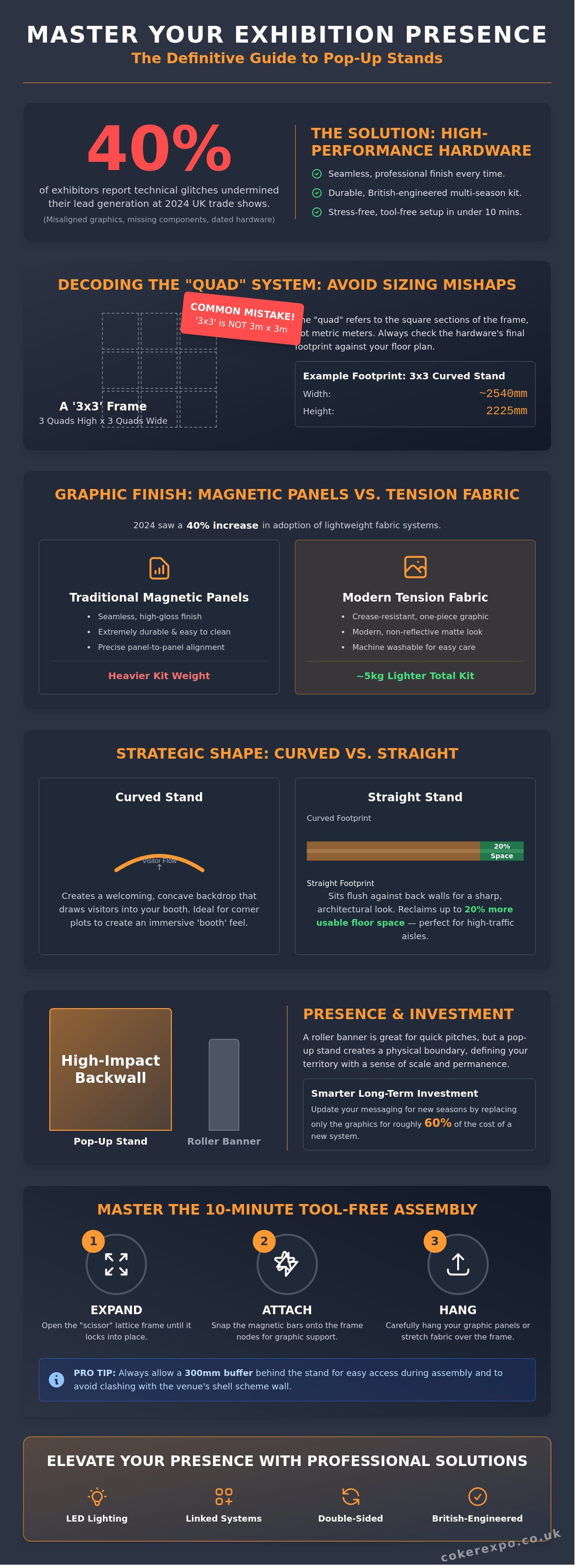
A staggering 40% of exhibitors report that technical glitches, such as misaligned graphics or missing components, directly undermined their lead generation at 2024 UK trade shows. You know that the exhibition floor is a high-pressure environment where there is no room for equipment failure. It's frustrating to invest your budget into a presence only to find yourself wrestling with a heavy, dated pop up stand while your competitors look effortless. You need a solution that reflects your brand's quality without the logistical headache.
We'll show you how to master the art of portable exhibiting by selecting high-performance hardware that delivers a seamless, professional finish every time. You'll learn how to secure a durable, British-engineered kit that lasts for multiple seasons and ensures a stress-free, tool-free setup. This guide provides a complete roadmap for choosing robust systems, mastering assembly, and ensuring your graphics align perfectly for maximum impact throughout 2026.
Key Takeaways
- Understand why the pop up stand remains the UK’s premier choice for rapid deployment and high-impact visual branding.
- Decode the "Quad" sizing system to ensure your display perfectly fits your allocated floor space without any measurement mishaps.
- Compare traditional magnetic panels with modern tension fabric to select the most durable and professional finish for your event.
- Master the art of tool-free assembly to streamline your exhibition setup and ensure your hardware remains in peak condition.
- Discover how to elevate your presence by integrating LED lighting and UK-made modular components for a truly bespoke look.
What is a Pop Up Stand and Why is it the UK’s Favourite Display?
A pop up stand is a portable exhibition system built around a clever "scissor" lattice frame. This aluminium structure expands from a compact, handheld bundle into a full-scale backwall in under ten minutes. It is the definitive display stand for UK exhibitors who need to balance high visual impact with effortless transport. You can typically fit a 3x3 metre display into a single wheeled case that slides easily into the boot of a standard hatchback.
The technology has evolved significantly over the last decade. While traditional magnetic PVC panels remain a staple for their seamless, high-gloss finish, 2024 saw a 40% increase in the adoption of lightweight tension fabric alternatives. These modern systems reduce the total kit weight by approximately 5kg. They allow for a fast turnaround and tool-free assembly, which is essential for the high-pressure environment of the NEC Birmingham or ExCeL London. UK businesses prioritise these systems because they provide a professional, "built-in" appearance without the £5,000 plus price tag of a bespoke contractor-built stand.
The Anatomy of a Professional Pop Up System
- The aluminium frame: Most high-end systems use a "cross-brace" structure. This provides superior stability compared to budget versions, ensuring your wall doesn't sag during a three-day event.
- Magnetic bars and headers: These act as the invisible skeleton. They snap onto the frame to provide vertical support and precise alignment for your branding.
- Graphic media: Quality displays use 500-micron stop-light backing to prevent rear light from washing out your images. An anti-scratch laminate is applied to protect the 1200dpi print from the rigours of public handling.
When to Choose a Pop Up Over a Roller Banner
A roller banner is perfect for a quick pitch, but it lacks the presence required for a dedicated exhibition space. A pop up stand creates a physical boundary that defines your territory. It offers a sense of permanence and scale that a single banner cannot match. These systems are also a smarter long-term investment. You can replace the graphics for roughly 60% of the cost of a new system, allowing you to update your messaging for 2026 without buying new hardware. Curved frames are particularly effective at creating a semi-enclosed "booth" feel, helping to guide visitor traffic into your space and away from the busy aisles.
Choosing Your Configuration: Sizes and Shapes Explained
Selecting the right hardware starts with decoding industry jargon. The most frequent error exhibitors make is assuming a 3x3 pop up stand measures 3 metres by 3 metres. It doesn't. In the exhibition world, a "quad" refers to the individual square sections of the aluminium lattice frame, not a metric measurement. A standard 3x3 curved frame actually stands 2225mm high and occupies a footprint of approximately 2540mm in width. If you're working with a restricted shell scheme, these precise millimetres matter.
Before you sign off on a specific size, it's vital to Prepare for a Trade Show by cross-referencing your floor plan against the hardware's actual footprint. For 2026, we're seeing a 15% increase in venues offering "micro-booths" with lower head height. In these instances, a "mini" pop up frame at 1850mm height is the only way to avoid clashing with overhead lighting rigs or low-hanging ventilation ducts.
Understanding the Quad Sizing System
The quad system is a modular shorthand for the frame's height and width. A 3x2 stand is three quads high and two quads wide. A 3x4 configuration is three quads high and four wide. While the height remains a constant 2225mm for standard units, the width expands in increments. For a 3x5 setup, you'll need a floor width of at least 3430mm for a curved version or 4160mm for a straight version. Always allow a 300mm buffer behind the stand for easy access to the magnetic bars during assembly.
Curved vs. Straight: A Strategic Choice
The shape of your pop up stand dictates the "energy" of your space. Curved stands are the traditional choice for corner plots. They wrap around the user, creating a welcoming, concave backdrop that draws visitors into your booth. However, they do sacrifice floor depth in the centre. Straight stands offer a sharp, architectural aesthetic. They sit flush against the back wall, which can reclaim up to 20% more usable floor space compared to curved alternatives. This makes them the superior choice for high-traffic aisles where every centimetre of standing room counts.
- Single-sided: Best for back-wall positions where the rear is hidden.
- Double-sided: Essential for "island" sites to capture traffic from 360 degrees.
- Linked Systems: Use "ghost" panels to join two frames at a 90-degree angle for a bespoke L-shape.
If your 2026 event schedule involves varying stand sizes, consider a modular approach. You can link multiple frames using flexible junction graphics to create a seamless wall of any length. This versatility ensures your investment isn't limited to a single floor plan. You can view our full range of configurations to see how these frames scale for different venue types.
Magnetic Panels vs. Tension Fabric Pop Up Stands
Choosing the right pop up stand for your 2026 event schedule requires a balance between aesthetic impact and logistical reality. While both systems utilize an expanding aluminium concertina frame, the graphic application defines the user experience. Magnetic systems use multiple vertical panels that attach via magnetic strips; tension fabric systems (TFS) utilize a single, continuous textile graphic that stays attached to the frame even when folded.
The Case for Traditional Magnetic Panels
Magnetic panels remain the premium choice for brands requiring high-gloss, photographic precision. These PVC-free panels offer superior colour saturation and 100% opacity, ensuring zero light bleed from behind the display. Achieving a seamless look requires careful alignment of the vertical seams. We recommend starting from the centre and working outwards to ensure the magnets "snap" into the correct position. A standard 3x3 magnetic kit weighs approximately 28kg. This weight reflects the robust nature of the hardware, providing a sturdy presence on the trade show floor. When planning your layout, consult the IAEE Guidelines for Display Rules and Regulations to ensure your structural footprint complies with international safety and height standards.
The Rise of Tension Fabric Systems (TFS)
Tension fabric has seen a 65% increase in adoption among our UK clients since 2022. The primary draw is the one-piece graphic which eliminates the struggle of aligning multiple panels. Using dye-sublimation technology, the ink is heat-transferred into the polyester at 200°C. This results in a permanent, vibrant bond. This process allows for a matte finish, which is essential for professional photography under bright LED hall lights because it prevents distracting reflections. It is the ultimate tool-free solution for the solo exhibitor.
- Durability: Fabric graphics are virtually indestructible. They won't delaminate or tear, and you can machine wash them at 30°C if they become soiled during transit.
- Logistics: A fabric pop up stand typically weighs just 12kg. It's 40% lighter than magnetic versions and fits into a single padded shoulder bag, making it easy to transport via train or a small car.
- Sustainability: Our 2026 fabric range is manufactured from recycled yarn, offering a 32% reduction in carbon footprint compared to traditional laminate panels.
How to Assemble and Care for Your Pop Up Display
Speed is the primary advantage of a high-quality pop up stand. You don't need a toolkit, a ladder, or a team of contractors to build a professional presence. Every component in a premium system is designed for tool-free assembly. This ensures your marketing team can focus on lead generation rather than mechanical logistics. A standard 3x3 metre system should be fully operational in less than 10 minutes with a single person at the helm.
The 10-Minute Assembly Routine
Start by clearing a 3-metre floor space to avoid tripping hazards. Remove the aluminium lattice frame from the transit case and expand it using a steady "pull and click" motion. Don't force the locking arms; they're engineered to engage smoothly once the geometry is correct. Once the frame is upright, attach the magnetic vertical bars. Work from the top down to ensure the magnetic strips align perfectly across the height of the system.
Hanging the graphic panels requires a specific "gravity-first" technique. Hook the top header onto the frame studs and let the panel drop naturally. This allows the magnets to find their own "seat" on the bars. Smooth the panel edges from top to bottom to achieve a seamless finish across the joints. If a gap appears, don't pull the panel; simply unhook the top and realign it.
Lighting and Accessories
Proper illumination can increase stand engagement by 42% according to recent trade show visitor data. Position 12W LED spotlights at the junction of each frame section to eliminate shadows and highlight your key messaging. These lights typically clip directly onto the frame without screws, drawing minimal power while providing high-lumen output.
- The Counter Conversion: Most transit cases are designed to double as a podium. Add a wooden counter top and a graphic wrap to create a professional greeting point.
- Internal Shelf Kits: These integrate directly into the frame lattice and can support up to 5kg per level, perfect for displaying physical product samples.
- Stabilising Feet: Use these on uneven floors or in high-traffic areas to increase the footprint and prevent tipping.
Longevity depends on your treatment of the graphics. Always follow the "roll-out" rule: roll your panels with the printed side facing outwards. This prevents the magnetic tape from delaminating or creating permanent kinks in the 500-micron PVC. When repacking, place the frame in the centre of the case first. Surround it with the magnetic bars in their padded bag to protect the lattice from transit damage. This organised approach ensures your equipment remains in showroom condition for years.
Ready to upgrade your event presence? Explore our range of professional pop up stands designed for years of reliable use.
Elevating Your Presence with CokerExpo Professional Solutions
High-performance exhibiting requires more than a basic frame. While a standard pop up stand provides a reliable foundation, CokerExpo pushes the boundaries with modular trussing and integrated LED technology. Our Hampshire-based production facility handles everything from initial design to final print, ensuring that 92% of our orders are ready for dispatch within three working days. This local control is vital for meeting the tight turnaround times typical of the UK exhibition industry. UK-made hardware offers a level of durability that imported alternatives lack, providing peace of mind when you're setting up at major venues like Olympia or the NEC.
Our bespoke approach means you aren't limited to "off-the-shelf" dimensions. We frequently design custom configurations that utilise every millimetre of your allocated floor space. Whether you need a curved corner section to improve flow or a double-height tower for long-distance visibility, our team builds solutions that fit your specific marketing goals. This flexibility allows a standard pop up stand to evolve into a complex, multi-functional brand environment.
Integrating Lightboxes for Maximum Impact
Backlit displays are currently replacing traditional non-illuminated graphics in high-end exhibition halls at a rate of roughly 40% year-on-year. LED illumination eliminates shadows and ensures your brand is visible from over 50 metres away in crowded aisles. We use 6500K "daylight" LEDs to achieve a neutral white balance, making your graphics appear 25% sharper than standard front-lit systems. These units are designed for portability without sacrificing the aesthetic impact of a fixed installation. See our Ultimate Guide to Exhibition Lightboxes for a deeper look at how light transforms a space.
The CokerExpo Promise: Reliability and Craftsmanship
Our "Practical Specialist" philosophy centres on tool-free innovation. We've engineered our hardware so a single staff member can complete a full 3x3 setup in under 12 minutes. This focus on user experience reduces pre-show stress and eliminates the need for expensive external contractors. It's about giving you total control over your event logistics.
Beyond the hardware, our event planning services provide the technical support needed to scale your display as your business grows. We don't just sell equipment; we provide the infrastructure for your commercial success. Every system we dispatch is tested in our workshop to ensure it meets our rigorous quality standards before it reaches your door. Explore our full range of Pop Up Stands and Displays to see how our British-made solutions can elevate your next event.
Future-Proof Your Brand Presence for 2026
Choosing the right pop up stand is a strategic investment in your brand's physical footprint. Whether you opt for the seamless finish of tension fabric or the classic versatility of magnetic panels, your choice determines how effectively you'll capture attention on a busy trade show floor. Reliability matters when you're facing tight event deadlines. Coker Expo has been a trusted partner in the exhibition industry since 1999; we provide the robust infrastructure businesses need to succeed. We specialise in tool-free assembly systems that eliminate the stress of setup, allowing your team to focus on lead generation rather than hardware. Our fast UK-wide delivery ensures your display arrives exactly when you need it, backed by over 25 years of technical expertise and British craftsmanship. Don't settle for subpar equipment that fails at the critical moment. Invest in a professional solution that delivers a high-performance aesthetic and remains durable across dozens of events. We're here to ensure your next exhibition is your most successful one yet.
Browse our professional Pop Up Stand range for your next event
Frequently Asked Questions
What is the difference between a 3x3 and a 3x4 pop up stand?
A 3x3 pop up stand refers to the number of internal lattice squares rather than the physical dimensions in metres. A standard 3x3 curved unit measures 2540mm in width, while a 3x4 unit extends to 3070mm. Both systems stand at a height of 2225mm. You should choose based on your allocated floor space; a 3x3 fits comfortably in a 3m x 2m shell scheme, whereas a 3x4 requires at least a 4m wide plot.
How long does it take to assemble a standard pop up display stand?
You can assemble a standard pop up stand in approximately 10 to 15 minutes without using any tools. The aluminium frame expands in seconds; the magnetic bars and graphic panels take the remaining time to align. For a single person, 12 minutes is a realistic benchmark for a complete setup. This speed ensures you spend less time on logistics and more time engaging with the 2,000 plus delegates typically attending UK trade shows.
Can I replace the graphics on my pop up stand without buying a new frame?
You can replace your graphics easily without purchasing a new frame, as the hardware is designed for long-term reuse. This modular approach allows you to update marketing messages for 2026 for around 40% of the cost of a full system. Simply order new 500-micron PVC or polyester panels with magnetic strips pre-applied. It's a cost-effective way to keep your brand presence fresh across multiple events without redundant hardware investment.
Are pop up stands allowed in all UK exhibition venues?
Pop up stands are permitted in all major UK venues such as the NEC Birmingham or ExCeL London, provided they meet specific fire safety standards. All our graphics are printed on fire-retardant materials that comply with BS 5867 or European B1 standards. Venue organisers often require a certificate of conformity during the 48-hour build period. We provide these documents as standard to ensure your display meets every health and safety requirement.
How do I transport a pop up stand to a trade show?
The most efficient way to transport your display is using a heavy-duty, wheeled polyethylene transit case. These cases fit into the boot of a standard hatchback, such as a Volkswagen Golf, and weigh roughly 30kg when fully loaded with a 3x3 system. Most cases also double as a podium. You can add a wooden tabletop and a graphic wrap to turn your transport box into a functional counter in under 60 seconds.
What is the best way to clean and store my exhibition graphics?
Clean your graphics using a damp microfibre cloth and mild soapy water to remove fingerprints or dust. Avoid abrasive chemicals that could damage the laminate or 1440dpi print quality. When storing, always roll the panels with the print facing outwards to prevent delamination. Keep them in their protective sleeves inside the transit case at room temperature, ideally between 15°C and 21°C, to ensure the magnetic strips remain flexible.
Do I need a professional to install my pop up stand?
You don't need a professional contractor to install your stand because the system relies on a tool-free assembly process. The lattice frame uses auto-click magnetic connectors that snap into place instantly. This DIY capability saves you an average of £450 per show in specialist labour costs. Even first-time exhibitors find the process intuitive, allowing your marketing team to manage the entire setup and breakdown without external assistance.
What happens if a part of the lattice frame breaks?
If a part of the aluminium lattice frame breaks, you can usually replace the individual node or strut rather than the whole unit. Most high-quality frames come with a 5-year or lifetime hardware guarantee covering manufacturing defects. We stock replacement magnetic bars and screws for immediate dispatch. Since these frames are modular, a single broken component won't render your entire £600 investment useless; it's a simple 5-minute fix.
Leave a comment