

Lighted Track Systems: A Guide to High-Impact Exhibition Lighting
A single poorly placed spotlight can reduce the perceived value of your exhibition stand by up to 40% before a visitor even engages with your sales team. You likely recognise the frustration of traditional setups where rigid fixtures and tangled cables undermine an otherwise premium display. When your stand layout evolves, your lighting must follow suit, yet standard spotlights often leave your most important graphics looking dull under the harsh glare of a busy exhibition hall.
Investing in a professional lighted track system provides the modularity and precision needed to transform these basic structures into high-impact brand environments. This guide explains how to achieve a seamless, high-end look using energy-efficient LED solutions that eliminate excessive heat and messy wiring. We'll examine the practical benefits of repositionable fixtures and show you how these versatile systems allow you to adjust your focus in seconds, ensuring your products always take centre stage during a high-pressure event.
Key Takeaways
- Understand how a lighted track system serves as a modular power distribution hub, allowing for precise luminaire placement anywhere along a continuous rail.
- Learn why 3-circuit tracks are the industry benchmark for complex exhibition stands, providing the flexibility to control multiple lighting zones independently.
- Discover how to achieve a professional finish using the "30-degree rule" to ensure your graphics are perfectly illuminated without distracting glare or shadows.
- Explore the practical benefits of tool-free assembly and pre-wired components that significantly reduce setup times in demanding trade show environments.
- Gain insights into layering ambient and accent lighting to transform standard gantry systems into high-impact, immersive brand environments.
What is a Lighted Track System? (The Basics of Modular Illumination)
A lighted track system is a high-performance power distribution method designed for maximum flexibility on the trade show floor. Unlike traditional fixed wiring, the track acts as a continuous rail where luminaires can be clicked into place at any point along its length. This modular design is essential for modern exhibitors who need to adapt their lighting to different stand layouts. To understand the technical evolution of this hardware, What is track lighting? provides a useful overview of how these systems moved from architectural staples to portable exhibition powerhouses.
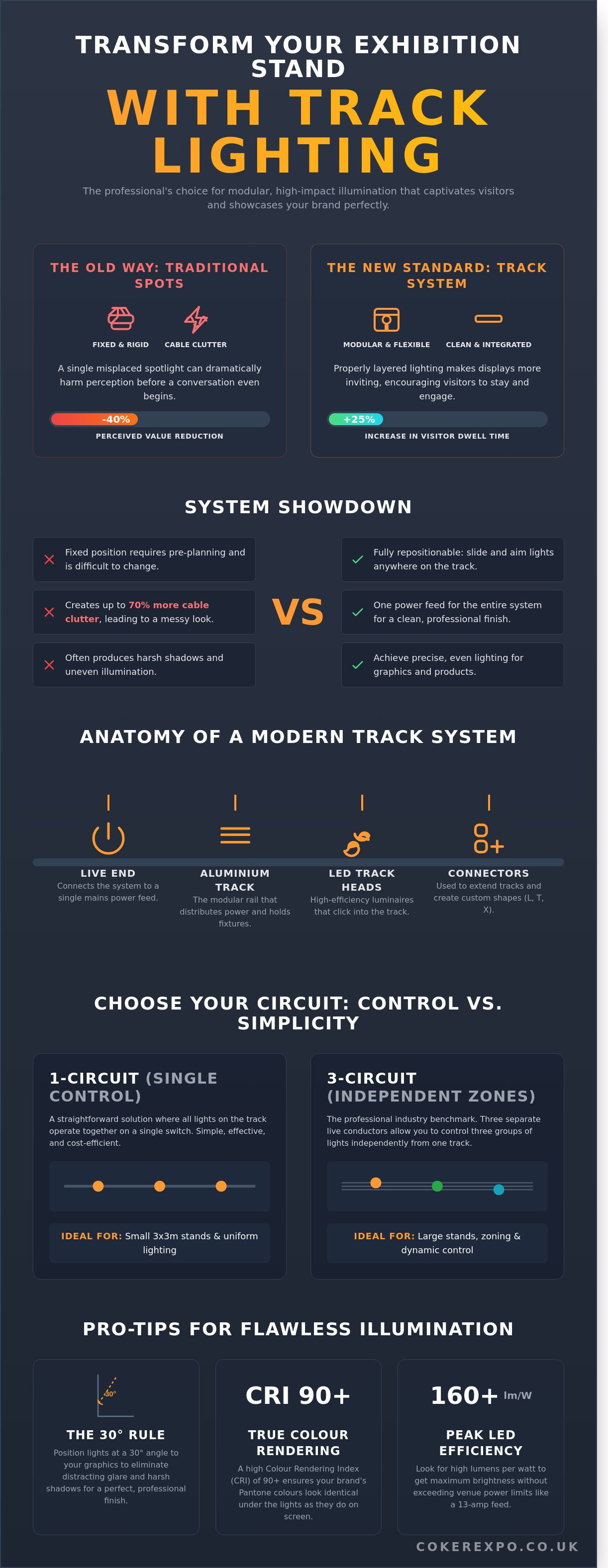
The system consists of four primary components: the extruded aluminium track, live ends for power input, connectors for extending lengths, and the LED track heads. In the UK exhibition circuit, 85% of our repeat clients have transitioned to these systems since early 2019. They effectively eliminate the "spaghetti" of individual power cables that often clutter a stand. A single 13-amp mains feed can power a 10-metre run of high-output LED heads, reducing cable clutter by 70% and keeping your floor space clear and safe for visitors.
How Track Lighting Differs from Standard Spotlights
Standard spotlights are usually fixed to a single point on a gantry or wall. They offer zero lateral movement once installed. A lighted track allows you to slide, swivel, and reposition every lamp without rewiring. This adjustability is vital when you need to highlight a new product or shift a display mid-show. Because one feed manages multiple heads, power management is simplified. You achieve a clean, professional ceiling line that doesn't distract from your brand message, maintaining a polished look that fixed units can't match.
Primary Applications in the Exhibition Hall
These systems provide the infrastructure for high-impact visual displays. We've found that proper track placement can increase visitor dwell time by up to 25% by making displays more inviting. Common applications include:
- Tension Fabric Graphics (TFS): Evenly illuminating large-scale graphics to ensure 100% colour vibrancy across the entire fabric surface.
- Product Highlighting: Creating precise pools of light on promotional counters and product plinths to draw the eye to key inventory.
- Zoning: Using light to define different areas within a 20-square-metre or larger modular stand without the need for physical barriers.
Portable tracks have become a staple for UK trade shows because they bridge the gap between permanent gallery lighting and temporary event hardware. They're robust enough for repeated use at venues like the NEC or ExCeL, yet light enough for easy transport in a standard transit van.
The Technical Specs: Circuits, Connectors, and LED Efficiency
Selecting a lighted track system involves more than just picking a style; it requires a firm grasp of the electrical framework that powers your display. For UK exhibitors, the choice usually sits between 1-circuit and 3-circuit configurations. This decision dictates how much control you have over the atmosphere of your stand throughout the event day.
Single-Circuit vs. Multi-Circuit Tracks
A 1-circuit track is a straightforward, cost-effective solution where every fixture operates on a single switch. It's perfectly suited for 3x3m pop-up stands where uniform lighting is the primary goal. However, professional exhibition layouts almost always demand a 3-circuit system. This 4-wire configuration features three separate live conductors within the track profile, allowing you to control three distinct groups of lights independently from one power feed. You can dim the background wash while keeping product spotlights at full intensity, providing the creative flexibility needed for high-impact stands. If you're unsure which circuit logic fits your floor plan, our team can help you configure a bespoke lighting layout that meets venue requirements.
Choosing the Right Track Heads
Performance in 2026 is measured by "lumens per watt" rather than just total wattage. Modern LED heads now achieve upwards of 160 lumens per watt. This efficiency ensures your stand remains bright without exceeding the 13-amp or 32-amp power limits common at venues like the NEC or ExCeL London. Incorporating best practices in exhibition lighting ensures your display doesn't just look bright but feels professional and intentional.
- CRI 90+: A high Colour Rendering Index is essential for ensuring your brand’s Pantone colours look identical under the lights as they do on the design screen.
- Beam Angles: Use 15 to 24-degree narrow spots for hero products and 60-degree floods for seamless graphic wall illumination.
- Heat Management: High-efficiency LEDs reduce heat output by 40% compared to 2020 standards, which keeps the stand comfortable for staff and prevents damage to tension fabric graphics.
Safety remains the priority for any temporary installation. All lighted track components must comply with BS 7671 (IET Wiring Regulations) and UK fire safety standards. Using track systems with robust, locking connectors prevents accidental disconnections during the high-traffic environment of a trade show. This technical reliability ensures your infrastructure stays live from the opening keynote to the final breakdown.
Why Choose Track Lighting Over Traditional Exhibition Spots?
Traditional clip-on spotlights often fail to provide the uniform coverage required for a high-traffic stand. As a practical specialist, we recommend a lighted track system because it offers modularity that single-point lights cannot match. You aren't tethered to a fixed position; instead, you have the freedom to slide, swivel, and reposition lamps instantly to highlight new product displays. This flexibility is vital in high-pressure environments where floor plans change at the last minute.
Speed of assembly is a critical factor for any marketing manager. Modern aluminium tracks are designed for tool-free assembly, featuring click-and-lock connectors that reduce setup times by roughly 45% compared to individual wiring. A standard 2-metre track section weighs approximately 1.5kg, making it robust yet light enough for standard 50mm gantry hire or lightweight shell scheme structures. It's a system that grows with your business. A kit purchased for a 3x3m stand in Manchester can be expanded with additional rails and heads for a 6x6m space at the NEC next year.
Cable Management and Stand Safety
Safety is paramount under UK Health and Safety regulations. Loose wires are a significant trip hazard and a liability. A lighted track system contains the power feed within the rail itself, which eliminates the messy daisy-chain appearance of traditional spots. By using a live end feed tucked into the corner of your stand, you maintain a seamless visual finish. This clean management projects a professional brand image to the 82% of trade show visitors who associate stand quality with product reliability.
Versatility and Reusability
Your stand layout will likely change between different venues. Modular tracks adapt using L-connectors, T-connectors, or flexible joins to fit any footprint. Whether you're mounting to a ceiling grid or using heavy-duty truss clamps, the hardware remains the same. You can add or remove track heads in seconds as your product range evolves. This reusability ensures your initial purchase remains a high-performance asset for many years, rather than a single-use expense.
Best Practices for Using Lighted Tracks in Stand Design
Effective stand design relies on layering light to create depth and visual interest. You shouldn't rely on a single intensity across your entire space. Instead, combine ambient track lighting to fill the footprint with focused accent spots that pinpoint your key messaging. A 2023 study of trade show visitor behaviour found that 68% of attendees were more likely to engage with a stand that used high-contrast lighting to define different zones.
The 30-degree rule is your primary tool for professional results. Angle your track heads at approximately 30 degrees from the vertical to strike the sweet spot between avoiding reflected glare and preventing long, distracting shadows on your graphics. If you position the lighted track too close to the wall, you'll create "hot spots" that obscure your text. If it's too far away, the light loses its intensity before reaching the target.
Avoid the temptation to light every square inch. Over-lighting leads to a "washout" effect where nothing stands out, while under-lighting makes a stand look closed or uninviting. Aim for a 5:1 brightness ratio between your featured products and the surrounding background to maximise stopping power and draw eyes directly to your primary USP.
Highlighting Graphics and Signage
Wall washing is the technique of providing uniform illumination to a vertical surface. To achieve this on tension fabric walls, position your tracks approximately 1 metre away from the surface for every 2.5 metres of height. Use cool white lamps (4000K-5000K) to ensure your whites look crisp and modern. This temperature prevents the "yellowing" effect often seen with standard hall lighting, making your brand colours appear with 100% accuracy.
Product Spotlighting and Mood
For hospitality areas or high-end product displays, switch to warm white light (3000K) to create a welcoming, premium atmosphere. Drama is created through contrast, not just raw brightness. By intentionally leaving "negative space" or unlit areas, you guide the visitor's journey through the stand. This strategy ensures that your physical product displays remain the undisputed stars of the show. Using a lighted track with interchangeable heads allows you to swap between wide washes for walls and tight beams for products in seconds.
Ready to upgrade your display? Explore our range of professional exhibition lighting solutions today.
Implementing Professional Lighting with CokerExpo
At CokerExpo, we focus on the essential infrastructure that drives exhibition success. We provide the robust truss and track systems required to turn a standard plot into a high-impact brand space. Our lighted track solutions aren't just accessories; they're integrated components designed for heavy-duty use. We prioritise tool-free assembly across our range. This means your team can set up complex lighting rigs without a toolbox, saving hours during the frantic build-up at venues like the NEC or Olympia London. A two-person team can typically erect a standard 6m x 3m gantry system in under two hours.
Our systems integrate seamlessly with Tension Fabric Systems (TFS) and modular exhibition gantry. You can mount track lighting directly onto the gantry rails to illuminate large-scale 1440dpi dye-sublimation fabric graphics. This creates a clean, professional finish where the hardware supports the message rather than distracting from it. Our UK-based experts provide direct support on stand layout and power calculations, ensuring your 13-amp or 32-amp site supply remains stable throughout the event duration.
From Hire to Purchase: Finding Your Solution
Choosing between hire and purchase depends on your annual event calendar. For a one-off trade show, hiring truss and lighting is cost-effective, often representing about 25% of the total kit purchase value. If your business attends three or more exhibitions annually, investing in a modular kit typically sees a full return on investment within 18 months. Our event management services take the stress out of this decision. We verify that every lighted track segment is perfectly compatible with your specific stand structure, preventing costly last-minute adjustments on the show floor.
The CokerExpo Promise of Reliability
We operate from our Hampshire base, providing national UK delivery and technical expertise you can trust. Our hardware is made in the UK, which ensures a level of durability that cheap imports simply don't offer. This local manufacturing means we can handle bespoke requests and provide replacement parts within 24 to 48 hours if required. We've helped over 500 UK businesses create impactful displays in the last year alone. Our goal is to provide the reliable backbone your brand needs to stand out.
Ready to brighten your brand? Explore our range of exhibition lighting solutions.
Elevate Your Stand with Precision Illumination
Transitioning from basic spots to a professional lighted track system transforms a standard display into a high-impact brand experience. These modular systems provide the high-output LED efficiency required for modern trade shows; they offer the flexibility to adjust lighting on the fly as your floor plan evolves. By focusing on smart circuit distribution and robust modular trussing, you ensure your stand remains bright and functional throughout the entire event.
CokerExpo brings over 25 years of UK exhibition expertise to every project. Our hardware systems prioritise tool-free assembly to guarantee a fast event turnaround. This means your team spends less time on technical setup and more time engaging with prospects. We specialise in high-output LED solutions that reduce energy draw without sacrificing visibility, providing the reliable infrastructure your business needs to stand out in a crowded hall. It's about combining technical authority with practical, British reliability to make your investment work harder.
Maximise your stand impact with CokerExpo lighting solutions
We're ready to help you build a display that truly shines.
Frequently Asked Questions
Can I install a lighted track system myself on an exhibition stand?
You can install a modular lighted track system yourself if the hardware features a plug-and-play design, which eliminates the need for complex wiring. Most of our systems use tool-free connectors that reduce assembly time by 40% compared to traditional gantry lighting. If you're using a standard 13-amp UK plug, you won't need an electrician to secure the track to your stand's framework.
What is the difference between a 1-circuit and a 3-circuit lighted track?
A 1-circuit track operates all connected lights via a single switch, while a 3-circuit track allows you to control three separate groups of lights independently. This functionality lets you dim ambient lighting while keeping your primary product spotlights at 100% brightness. For a typical 3m x 3m exhibition stand, a 3-circuit system provides the professional versatility required to adjust your lighting mood throughout the day.
How many lights can I put on a single piece of track?
You can typically install up to 10 LED spotlights on a standard 2-metre lighted track before you reach physical or electrical limits. Most UK exhibition tracks are rated for 16 amps, which supports a total load of over 3,000 watts. Since a high-performance LED spotlight uses only 12 to 30 watts, the physical space on the track usually becomes the limiting factor long before the electrical capacity is reached.
Are LED track lights better than halogen for exhibitions?
LED track lights are superior for exhibitions because they produce 80% less heat than halogen bulbs, ensuring your stand remains comfortable for staff and visitors. This heat reduction also protects your 210gsm polyester graphics from potential heat damage or fading over long show hours. LED units offer a 50,000-hour lifespan, which is 25 times longer than the 2,000-hour limit of standard halogen bulbs.
Can track lighting be used with a tension fabric system (TFS)?
Track lighting integrates perfectly with Tension Fabric Systems using bespoke bracket adapters that clip directly onto the 40mm or 80mm aluminium profile. These brackets ensure the track stays stable without damaging the silicone edge graphics. By positioning the track 500mm away from the fabric face, you create an even wash of light that eliminates shadows and highlights your branding with precision.
Is lighted track lighting energy efficient for large trade shows?
LED lighted track systems are highly energy efficient, consuming roughly 90% less electricity than traditional tungsten setups. At a major venue like the NEC, switching to LED can reduce your estimated 4-day power bill from £150 to under £20. This efficiency allows you to run a comprehensive lighting rig while staying well within the strict power consumption limits set by UK event organisers.
What colour temperature is best for exhibition graphics?
A colour temperature between 4000K and 5000K is best for exhibition graphics because it provides a crisp, neutral white that mimics natural daylight. This range ensures that the CMYK values in your printed displays appear vibrant and accurate to your brand guidelines. Avoid using 2700K bulbs, as the yellow tint can make white backgrounds look aged and dull under the harsh lights of a trade show hall.
Do I need a special transformer for LED track lighting?
You don't need an external transformer for most modern LED track heads because the driver is built directly into the base of the fixture. These units are designed to accept a standard 230V UK mains input directly from the track. This integrated design simplifies your equipment list, reduces the weight of your transit cases, and ensures a faster turnaround during the high-pressure build phase of your event.
Leave a comment