

Modular Tension Fabric Display Systems: The Professional Guide to Reconfigurable Exhibition Success
What if your exhibition stand wasn't a one-time expense, but a piece of reconfigurable infrastructure that scaled alongside your business growth? Most marketing managers treat event hardware as a sunk cost, yet modular tension fabric display systems offer a high-performance alternative that bridges the gap between portability and a bespoke, high-end aesthetic. You've likely felt the frustration of paying for a custom-built stand only to find it's useless for next month's smaller shell scheme space. Between the stress of tool-heavy assembly and the disappointment of wrinkled graphics that didn't survive transport, the traditional exhibition model is often more of a logistical burden than a brand asset.
This guide will show you how to master the logistics and ROI of modular fabric displays to create scalable, high-impact stands. We'll explore the technical specifications required for UK venue compliance, including the latest BS EN 13501-1 fire safety standards and March 2026 eGuide updates. You'll learn how to invest in hardware that lasts over five years while maintaining the flexibility to reconfigure a 3x3 backwall into a 6x3 island in minutes without a large installation crew.
Key Takeaways
- Learn how modular tension fabric display systems transform exhibition hardware from a one-off expense into reconfigurable infrastructure that adapts to any booth size.
- Understand the engineering differences between magnetic and mechanical connectors to balance rapid assembly with the structural stability required for larger stands.
- Calculate the true ROI of your investment by shifting your focus to the "Cost Per Show" metric and the low cost of graphic-only updates.
- Master the planning process for scaling your layout from a 3x3 backwall to a full island stand while maintaining compliance with UK venue standards.
- Discover why local UK production provides the essential speed and bespoke flexibility needed to meet tight exhibition deadlines without compromising on quality.
What are Modular Tension Fabric Display Systems?
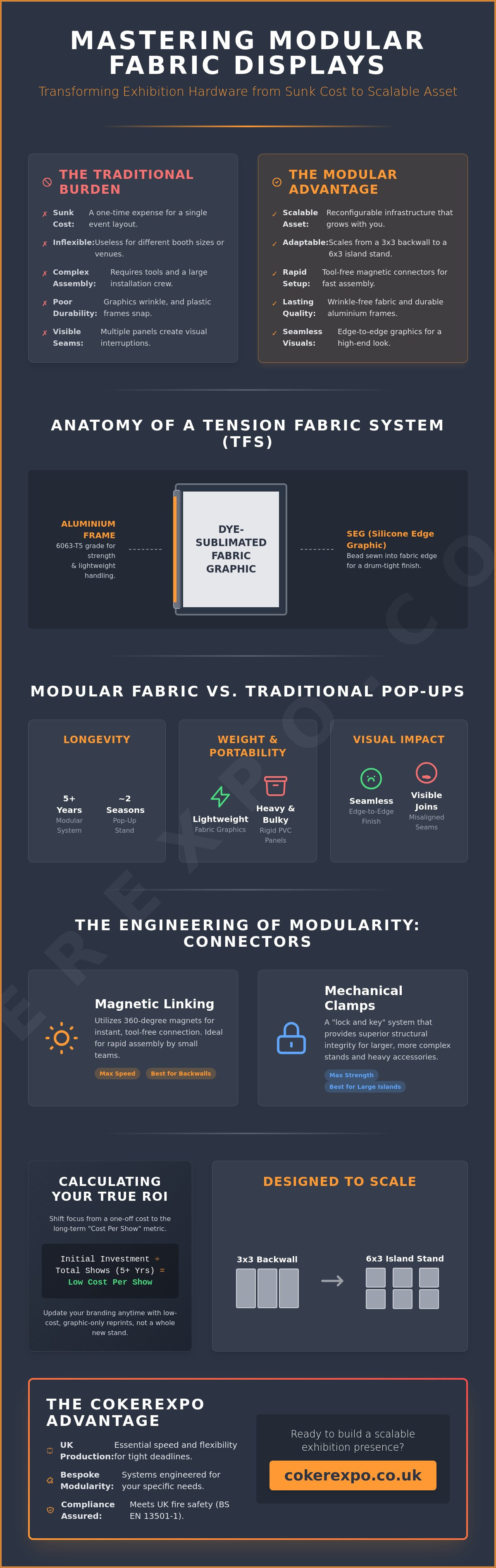
At its core, a modular tension fabric display system is a high-performance structural framework engineered for versatility and visual impact. Unlike static, single-use backdrops, these systems utilize lightweight aluminium extrusions paired with high-tension stretch fabric graphics. This combination creates a seamless, edge-to-edge branding surface that conceals the underlying hardware entirely. In the broader context of Trade show display systems, the modular fabric approach represents an evolution from heavy, rigid panels toward a more agile and professional infrastructure.
The "modular" designation is the primary driver of ROI for modern exhibitors. It refers to the ability to add, subtract, or re-angle individual frame sections to suit varying floor plans. Whether you're working within a restricted shell scheme or a sprawling island site, modular tension fabric display systems allow you to scale your presence without purchasing entirely new hardware for every event. By using either magnetic connectors for rapid linking or mechanical clamp systems for structural rigidity, these frames become a building block for your brand's physical environment.
The Anatomy of a Tension Fabric System (TFS)
The reliability of a TFS starts with the metal. Professional-grade systems use 6063-T5 grade aluminium. This specific alloy provides the structural integrity needed to support large-scale spans while remaining light enough for a small team to handle. The "tension" in the name comes from Silicone Edge Graphics (SEG). Each fabric panel features a thin silicone bead sewn directly into the edge. This bead is pressed into a recessed channel in the aluminium frame, stretching the fabric taut. This mechanism ensures a drum-tight, wrinkle-free surface that looks identical to a solid wall.
The graphics themselves are produced via dye-sublimation printing. This process uses heat to turn ink into a gas, which then bonds with the polyester fibres of the fabric. The result is a scratch-resistant, washable graphic with deep colour saturation that won't crack or peel when folded for transport.
Modular vs. Traditional Pop-Up Stands
Choosing modular fabric over traditional pop-up stands is a move toward long-term durability. Traditional pop-ups often rely on plastic "scissoring" lattices that are prone to snapping over time. They also require multiple vertical panels that create visible "seams" or "join lines" across your branding. Modular fabric systems eliminate these visual interruptions, providing a flat, continuous graphic area that looks bespoke rather than portable.
- Weight and Portability: Fabric graphics weigh significantly less than rigid PVC panels, reducing shipping costs and making national event circuits more manageable.
- Longevity: Aluminium frames are essentially permanent assets. While a pop-up might last two seasons, a well-maintained modular frame can remain in service for over five years.
- Visual Impact: The edge-to-edge finish ensures your brand message isn't fighting against visible hardware or misaligned panel joins.
The Engineering of Modularity: Connectors and Frames
The engineering behind modular tension fabric display systems determines how effectively your team can respond to changing floor plans. While the visual finish is consistent across most high-end systems, the connection mechanism is what dictates setup speed and structural limits. Most professional systems utilize either magnetic linking or mechanical clamps. Each serves a specific logistical purpose. It's the difference between a stand that's merely portable and one that's truly industrial-grade.
Magnetic systems are designed for maximum speed. These utilize 360-degree magnetic strips or internal magnets that snap frames together instantly. They're ideal for standard 3x3 backwalls where a two-person team needs to be show-ready in under 20 minutes. However, magnets have weight limits. For larger, more complex environments, mechanical clamp systems offer a "lock and key" approach. These connectors physically bite into the frame channels, providing the structural integrity required when integrating heavy accessories or truss truss structures.
Magnetic vs. Mechanical Linking
Choosing between these two isn't about quality, but about the specific demands of your event calendar. Magnetic connectors allow for tool-free, "push-and-click" assembly. They're the go-to for rapid-response events where time is your most expensive resource. Conversely, mechanical connectors are vital for island stands or heights exceeding 2.5m. They ensure the frame remains rigid even in high-traffic environments where accidental bumps are common. High-performance modular tension fabric display systems allow you to achieve curved, L-shaped, and U-shaped configurations by simply swapping the connector type. If you're planning a complex layout with overhead elements, mechanical stability is non-negotiable. You can view our range of TFS hardware to see which connection style fits your typical stand size.
Frame Profiles and Depth
The profile of the aluminium extrusion impacts both the footprint and the visual weight of the display. Slimline profiles, typically between 15mm and 30mm, are engineered for wall-mounting or shell scheme linings where space is at a premium. These provide a low-profile finish that doesn't eat into your floor space, making them perfect for smaller booths.
Freestanding profiles usually range from 50mm to 100mm. This extra depth isn't just for stability. It allows for double-sided graphics, turning a simple backwall into a functional room divider. More importantly, deeper profiles are essential for light diffusion. If you intend to add internal LED ladders to create a lightbox effect, a 100mm profile ensures the light spreads evenly without creating shadows on the fabric surface. This engineering detail is what separates a professional modular tension fabric display system from a basic retail frame.
Calculating the Real ROI: Reconfigurability & Lifecycle
A common mistake in exhibition procurement is evaluating a purchase based on the initial invoice rather than the total cost of ownership. While a custom-built wooden stand may appear impressive, its value often drops to zero the moment the show ends. In contrast, modular tension fabric display systems should be viewed as a long-term business asset. By shifting your perspective to the "Cost Per Show" metric, you can see how a higher initial investment in quality hardware drastically reduces marketing spend over a three to five-year period.
The primary driver of this ROI is the separation of the frame from the graphic. When your branding or messaging changes, you don't replace the entire stand; you simply order a new fabric skin. These "skins" represent a fraction of the cost of new hardware, allowing you to refresh your visual identity for every campaign without a massive capital outlay. This flexibility also applies to the physical footprint. A well-planned modular system allows you to scale from a 3x3 backwall to a 6x3 island stand by simply adding a few extra frame components and larger graphics, rather than starting from scratch.
Logistical savings further accelerate your return. Shipping and drayage fees at UK venues are often calculated based on weight and volume. Because aluminium frames are lightweight and fabric graphics can be folded into compact carry bags, you can often transport a full 6-metre stand in a standard estate car. This eliminates the need for specialized freight services and heavy-lifting crews, putting more of your budget back into lead generation.
The 5-Year Hardware Plan
To maximize your investment, treat your first purchase as a "master kit." This foundation of straight and curved frames serves as the skeleton for all future configurations. With basic maintenance, such as checking connectors and storing fabric in climate-controlled environments, these aluminium systems can remain in "as new" condition for over five years. By investing in a reconfigurable foundation, you eliminate the need for complete exhibition stand design revisions each year.
Sustainability and the Circular Economy
Modern procurement standards increasingly prioritize environmental impact. Modular systems align perfectly with the circular economy by moving away from the "build-and-burn" culture of single-use wooden or foamex stands. Aluminium is one of the most recyclable materials on the planet, maintaining its properties indefinitely. Additionally, the move toward polyester-based fabric graphics is a significant step forward; these materials are far easier to recycle than traditional PVC banners, which often end up in landfill. Choosing modular tension fabric display systems isn't just a financial decision, it's a commitment to a more sustainable exhibition presence.
Planning Your Modular Layout: From 3x3 to Island Stands
Success with modular tension fabric display systems starts with a calendar audit rather than a single floor plan. Before purchasing hardware, review your upcoming show dates to identify your most frequent booth dimensions. If your schedule consists of several 3x3m shell schemes and one larger 6x3m island site, your core investment should focus on a 3m master kit with expansion components. This approach ensures you aren't paying for excess hardware that sits in storage for the majority of the year.
Choosing the correct frame height is the next critical decision. While custom stands can reach impressive heights, standard UK venue regulations often cap shell scheme heights at 2.5m. Selecting a base height of 2.3m or 2.5m ensures your system remains compliant across the NEC, ExCeL, and regional centres. Once your height is set, you can select "bridge" components. These specialized connectors link separate walls at 90-degree angles, allowing you to transition from a flat backwall to an L-shaped or U-shaped configuration as your floor plan evolves.
Functional integration is where modularity proves its worth. You can browse our selection of modular components to see how integrated shelving and counters transform a simple wall into a retail-ready environment.
Designing Graphics for Modular Use
Effective modular design requires a "panel" mindset. Instead of one continuous image that only works at full width, design your graphics so that key branding elements are centered on individual frame sections. This prevents your logo from being lost in the corners of an L-shaped stand. For island sites, double-sided printing is essential. It maximizes your visibility from every walkway and allows you to use the internal space of the stand for private meetings while the exterior handles brand awareness.
Essential Accessories for Modular Systems
Accessories should enhance the professional finish of the stand without complicating the assembly. AV integration is a prime example. Modern frames allow you to mount monitors directly to the internal aluminium extrusions, creating a flush, "built-in" look that hides all cabling. Integrated shelving provides a stable platform for physical products, eliminating the need for bulky, mismatched furniture. For those looking to stand out in a crowded hall, lightboxes are the ultimate upgrade. Adding internal LED ladders to your modular fabric walls creates a vibrant, high-contrast display that draws the eye from across the venue.
The CokerExpo Advantage: Bespoke Modularity for UK Exhibitors
CokerExpo understands the high-pressure nature of the UK exhibition circuit. Local production in the UK isn't just a badge of quality; it's a logistical necessity. When deadlines are tight, having a partner who controls the manufacturing process ensures your hardware arrives on time and to specification. While many vendors offer standard, off-the-shelf kits, we provide bespoke modularity. If your booth requires a specific height or a custom-angled corner that isn't in a catalogue, we tailor the aluminium frames to fit your unique requirements. This flexibility ensures your modular tension fabric display systems never look like a compromise, but rather a precision-engineered brand environment.
We position ourselves as integration specialists. We don't just supply individual frames; we build ecosystems. This might involve combining high-tension fabric walls with folding display boards for smaller regional roadshows or integrating promotional counters and display turntables into a larger island site. We handle the technical logistics and structural calculations, allowing your marketing team to focus entirely on lead generation and visitor engagement.
Expert Event Planning and Management
Moving from a concept to the exhibition floor requires a clear roadmap for your hardware. Our team assists in mapping out your modular inventory to ensure maximum utility across your entire event calendar. We help you navigate the "Hire vs. Purchase" decision. For example, you might choose to own your core modular tension fabric display systems while utilizing our hire truss for one-off, large-scale overhead branding. This hybrid approach keeps your capital expenditure low while maintaining the ability to go big when the venue allows. With national support across all major UK venues, we ensure your infrastructure is show-ready, regardless of the location.
Advanced Integrated Solutions
To truly differentiate your brand, we offer advanced technical integrations that go beyond static walls. Dynamic lightboxes allow you to add movement and programmed animation to your fabric graphics, creating a "stop-and-stare" effect in high-traffic aisles. For exhibitors occupying large island stands, we provide truss-supported TFS. This allows for massive, high-level branding structures that remain structurally sound and compliant with the latest March 2026 eGuide safety standards. Whether you need a simple backwall or a complex, multi-room environment, our hardware provides the reliable foundation your success depends on.
Explore our full range of TFS Tension Fabric systems at CokerExpo and start building a reconfigurable exhibition inventory that grows with your business.
Future-Proofing Your Exhibition Strategy
Transitioning to modular tension fabric display systems represents a fundamental shift in how businesses approach event marketing. By prioritizing reconfigurable aluminium frames and high-tension graphics, you move away from the waste of single-use stands and toward a scalable infrastructure that adapts to any venue. Success on the show floor depends on hardware that balances rapid, tool-free assembly with the structural integrity required for high-traffic environments. You've seen how the right engineering, from magnetic connectors to deep frame profiles, can transform a simple backwall into a dynamic brand environment.
Since 1999, we've provided the seasoned expertise needed to navigate these technical logistics with total reliability. As a UK-based specialist in high-performance tension fabric frames, CokerExpo offers comprehensive support ranging from initial layout design to full event management. We handle the complexities of venue compliance and structural hardware so your team can focus on what matters most: capturing leads and building relationships. It's time to treat your display hardware as a long-term business investment rather than a recurring show expense.
Build your scalable exhibition infrastructure with CokerExpo’s modular TFS systems and secure a professional presence that grows alongside your business.
Frequently Asked Questions
Are modular tension fabric displays easy to assemble by one person?
Most standard frame sizes up to 3 metres wide are designed for straightforward solo assembly. Tool-free connectors allow you to build the structure and apply the graphic without professional assistance. For larger island stands or heights exceeding 2.5 metres, a second person is recommended to help manage the fabric tension and ensure the frame remains perfectly aligned during the final locking phase.
Can I wash the fabric graphics if they get dirty during an exhibition?
You can wash dye-sublimation printed graphics in a standard washing machine on a cool, 30-degree cycle. Because the ink is chemically bonded to the polyester fibres, the colours will not bleed or fade. It is vital to air-dry the fabric rather than using a tumble dryer. Machine drying can shrink the material, which makes it impossible to fit the silicone bead back into the frame channel.
Do modular fabric systems meet UK fire safety regulations for indoor events?
Professional modular tension fabric display systems utilize fabrics that comply with BS EN 13501-1 fire classification standards. This is the current mandatory requirement for construction products and textiles in UK exhibition venues. Always ensure your specific fabric carries a Euroclass B-s1, d0 rating to maintain total compliance with the latest venue eGuide safety regulations.
What is the difference between SEG and a standard fabric sleeve?
Silicone Edge Graphics (SEG) use a silicone bead sewn into the edge of the fabric that fits into a recessed frame channel for a drum-tight finish. Standard sleeves pull over the frame like a pillowcase. SEG provides a superior, edge-to-edge aesthetic without visible seams or sagging. This creates the high-end, professional appearance required for competitive B2B environments.
Can I add LED lighting to an existing modular fabric frame later?
You can often retrofit internal LED ladders to existing frames if the profile depth is sufficient for light diffusion. A minimum depth of 100mm is typically required to prevent "hotspotting" or visible shadows on the graphic surface. If your current hardware uses a slimline 15mm to 30mm profile, external clamp-on spotlights are the more practical and effective lighting solution.
How do I transport a 6-metre modular wall in a standard car?
The modular nature of the aluminium extrusions allows them to break down into sections that are typically under 1.2 metres in length. These components, along with the folded fabric graphics, fit into a standard estate car or large hatchback. This portability eliminates the need for expensive van hire or specialized courier services, drastically reducing the logistical costs of national event circuits.
Is it possible to mount a heavy TV or monitor onto a fabric display system?
Mounting a monitor is possible using specialized internal support brackets that attach directly to the aluminium framework. These brackets transfer the weight of the screen through the frame to the floor, ensuring the fabric doesn't sag. Always verify the weight capacity of your specific modular tension fabric display systems before attaching screens, as larger monitors may require additional structural bracing.
How long do the aluminium frames typically last with frequent use?
Industrial-grade 6063-T5 aluminium frames are designed to last over five years, even with frequent assembly and dismantling. Unlike plastic pop-up mechanisms that contain moving parts prone to failure, these static frames are incredibly resilient. You only need to replace the fabric graphics when your marketing message changes, which makes the hardware a sound one-time capital investment for your business.
Leave a comment