

Shell Scheme Electrics Package Explained: A Guide for UK Exhibitors
What if the most expensive part of your exhibition stand isn't the graphics or the floor space, but the single socket that causes your entire display to go dark during the opening hour? It's a common fear for UK exhibitors who find themselves caught between complex technical requirements and the high-pressure environment of a trade show floor. Having a shell scheme electrics package explained in plain English is the first step toward a reliable, high-impact presence. You shouldn't have to guess whether you need a 500W or 1000W socket, nor should you have to worry about tripping the power because of a simple calculation error.
We understand that managing technical logistics can be one of the most stressful aspects of event planning. This guide helps you master the technicalities of exhibition power and lighting so your stand performs exactly as intended. You'll gain a clear understanding of power limits and the confidence to order the correct infrastructure for your specific needs. We will cover everything from the latest BS 7671:2018+A4:2026 wiring regulations to practical tips for cable management, ensuring your stand looks professional and remains fully operational throughout the event.
Key Takeaways
- Identify the standard components of a utility bundle to ensure you receive the lighting and power sockets required for a professional presence.
- Master the 500-Watt Rule to calculate your power consumption accurately and prevent the risk of tripping breakers during peak show hours.
- This guide has the shell scheme electrics package explained in detail, helping you distinguish between standard day power and 24-hour supplies for essential equipment.
- Learn how to integrate electrical components seamlessly using Tension Fabric Systems (TFS) to hide unsightly cables and maintain a clean, high-impact aesthetic.
- Discover when to upgrade from basic packages to suspended lighting truss systems to increase visibility and command attention in a crowded exhibition hall.
What is a Shell Scheme Electrics Package? The Essentials
A shell scheme electrics package is a pre-configured utility bundle designed to provide immediate functionality to your exhibition space. Think of it as the essential infrastructure required to make your brand visible. When you book a trade show display, you usually choose between 'Space Only' and 'Shell Scheme'. Space only gives you a blank piece of floor, meaning you must hire contractors for every element. In contrast, a shell scheme includes the walls, carpet, and a basic electrical setup. Having the specifics of a shell scheme electrics package explained helps you avoid the logistical stress of sourcing individual components under tight deadlines.
Organisers mandate the use of official contractors for these installations. This isn't just about convenience; it's a critical safety requirement. Exhibition halls are high-load environments. Standardising the installation ensures that every stand complies with BS 7671:2018+A4:2026 regulations. This reduces the risk of electrical fires and ensures that the venue's master grid isn't compromised by faulty third-party wiring. It's a system built for reliability and speed of fulfillment.
Standard Components of a UK Exhibition Package
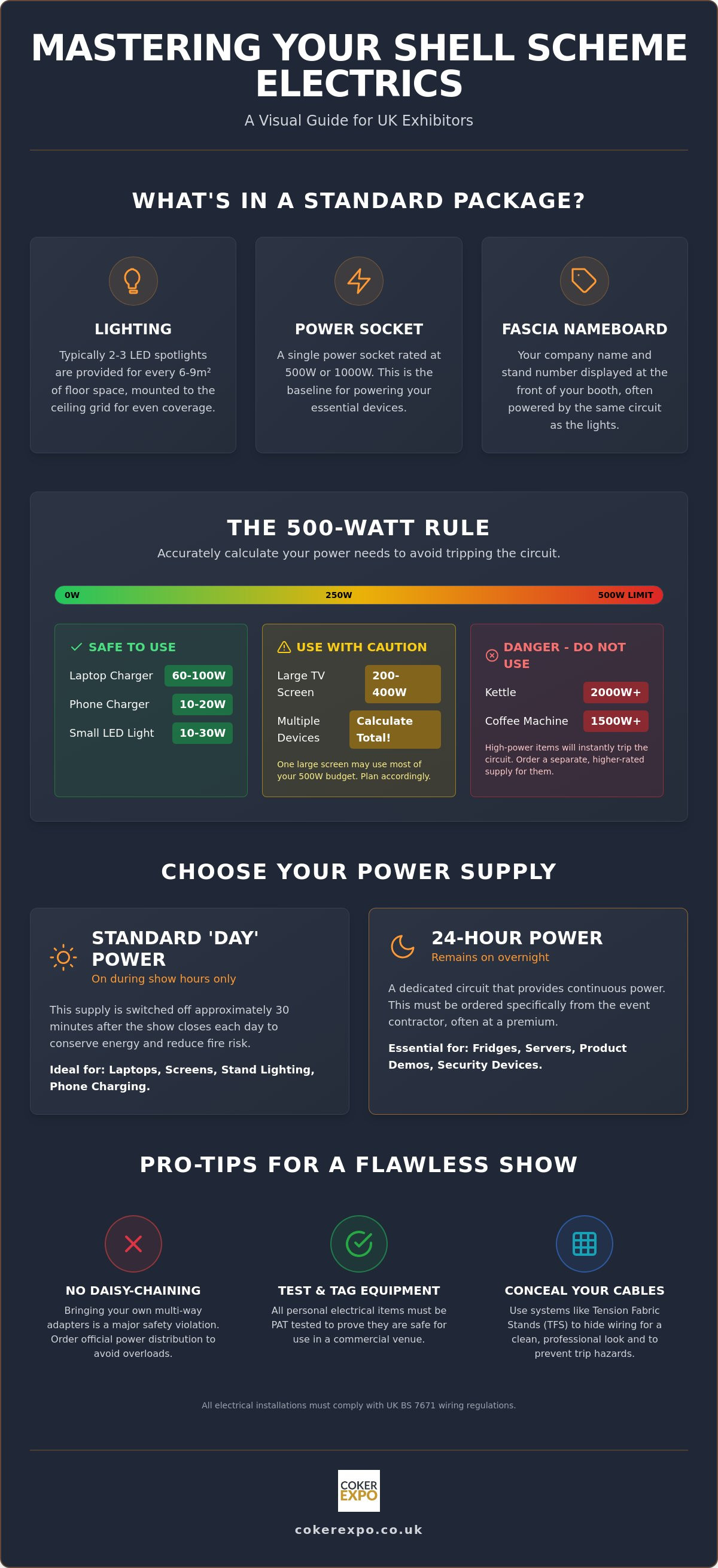
The contents of these packages vary by event, but most follow a predictable industry standard. Lighting typically includes two or three LED spotlights for every 6 to 9 square metres of floor space. These are usually mounted on the ceiling grid to provide even coverage across your graphics. Power is usually provided via a single socket, rated at either 500W or 1000W. Finally, the fascia nameboard provides your brand identity. It's positioned at the front of the stand and is often powered through the same internal circuit as your lighting.
Why You Can't Just 'Plug and Play'
It's tempting to bring domestic multi-way adapters from the office, but this is a major safety violation. Commercial venues have strict rules against 'daisy-chaining' sockets because it leads to circuit overloads. Every appliance you bring must be 'tested and tagged' to prove it's safe for use. Beyond safety, aesthetics matter. Cable management is critical when installing shell scheme graphic panels. If cables aren't tucked away properly, they create trip hazards and ruin the clean lines of your display. A professional setup ensures all wiring is concealed behind the structure, keeping the focus entirely on your products.
Calculating Your Power Requirements: Watts and Amps
Understanding the electrical capacity of your stand is the difference between a seamless show and a technical failure. The '500-Watt Rule' is the industry baseline. Most basic packages provide a single 500W socket, which is sufficient for charging mobile devices or running a single small display. However, if you plan to run multiple screens or high-performance hardware, such as systems from Overclockers Zone, you must total your equipment wattage before the show begins. Overloading a circuit doesn't just trip your stand; it can disrupt the entire row of exhibitors, leading to potential fines and downtime.
You must also distinguish between 'Day Power' and '24-Hour Power'. Standard electrical supplies are usually switched off 30 minutes after the show closes to conserve energy and reduce fire risks. If you are using fridges to store perishables or servers that require overnight data processing, you must order a dedicated 24-hour supply. Failing to specify this in your initial order often results in significant on-site surcharges from the venue contractor. Having the technical details of a shell scheme electrics package explained early allows you to budget for these requirements accurately.
Common Equipment Wattage Guide
- Laptops and tablets: These are low-draw devices, typically pulling between 60W and 100W, making them safe for any standard package.
- Coffee machines and kettles: These are the primary causes of electrical failure. A standard kettle can pull 2000W to 3000W, which will instantly blow a 500W or 1000W fuse.
Lighting Specs: LED vs. Halogen
Modern exhibitions have almost entirely shifted to LED lighting to comply with the Electrical Equipment (Safety) Regulations 2016. LEDs produce significantly less heat and consume a fraction of the power required by old halogen bulbs. When selecting lighting, consider brand consistency. 'Cool White' offers a crisp, clinical look ideal for tech brands, while 'Warm White' creates a more inviting atmosphere for hospitality or luxury goods. A 1000W total draw is the threshold where most basic packages require an upgrade to a more robust supply. If you need more light without the power drain, consider how professional lighting truss hire can enhance your stand's visibility while remaining within a standard shell scheme electrics package explained in your manual.
Integrating Electrics with High-Impact Displays
Once you understand the basic power limits of your stand, the focus shifts to aesthetic integration. High-impact visuals require more than just raw power; they need a clean, professional execution. Having a shell scheme electrics package explained in the context of visual hardware allows you to move beyond basic utilities toward a bespoke aesthetic. One of the most effective ways to achieve this is by using tension fabric systems. These frames act as a secondary skin for your stand, providing a dedicated cavity to hide unsightly cables, transformers, and sockets that would otherwise clutter your floor space.
Strategic socket placement is also vital for safety and flow. Default socket installations are usually centre-back, which often forces cables to run across high-traffic areas. This creates trip hazards and looks unprofessional. You should request sockets in specific corners or behind large furniture items to keep the floor clear. Use your lighting to draw the eye toward key interaction points, such as promotional counters or product demonstration areas, ensuring these zones are the brightest parts of your display.
Powering Lightboxes and Backlit Graphics
Modern stands frequently use dynamic lightboxes to create a high-end 'glow' that differentiates them from standard shell schemes. When planning these, you must consider the daisy-chaining limits. While LEDs are energy-efficient, connecting too many units to a single power source can cause voltage drops or heat buildup. Always ensure there is adequate ventilation behind fabric graphics to allow heat to dissipate. A well-ventilated system prevents the fabric from sagging and protects the internal electronics from premature failure.
Cable Management for Professional Stands
Professional stands rarely have visible wires. If you aren't using a fabric system, consider using raised exhibition flooring or platform systems to create a sub-floor for complex wiring looms. This is especially useful if you have multiple interactive screens or workstations positioned away from the perimeter walls. Coordination with your stand designer is essential here. By mapping out your electrical requirements during the design phase, you can ensure that every socket is positioned exactly where the hardware will sit. This precision eliminates the need for extension leads and maintains the clean lines of your brand environment.
Ready to elevate your exhibition presence with professional hardware? Explore our range of high-impact exhibition lighting and display systems to ensure your stand shines.
Upgrading Your Shell Scheme: Beyond the Basics
There comes a point where a standard utility bundle no longer reflects your brand's market position. When your objectives shift from simple attendance to total market dominance, moving toward a custom exhibition stand design is the logical next step. While we have already had the shell scheme electrics package explained as a baseline, these custom environments allow for integrated power solutions that are built into the fabric of the stand itself. This transition enables you to move away from perimeter-only power and toward a more dynamic, immersive layout.
Visibility in a crowded hall is often a matter of height. Investing in overhead lighting truss hire allows you to suspend high-intensity floodlights above the stand. This setup clears the ceiling grid of your shell scheme, creating an open, airy feel while ensuring your brand is visible from the far end of the venue. Additionally, adding movement with display turntables can significantly increase dwell time. These units require a consistent power supply, so you'll need to ensure your socket placement accounts for the rotation radius to prevent cable entanglement.
Creative Lighting Techniques
Standard white spotlights provide basic visibility, but creative techniques reinforce brand identity. Using coloured LED washes can bathe your walls in brand-accurate hues, creating a mood that white light cannot achieve. For high-value items, directional spotlighting on branded display plinths creates a focal point that naturally guides the visitor's journey. Directional light creates contrast and depth, whereas general ambient floodlighting can sometimes leave a stand looking flat and uninspired.
Planning for Future ROI
Efficiency in exhibition planning is grounded in long-term thinking. Investing in your own portable electrical accessories, such as high-quality LED arm lights or branded lightboxes, ensures you have reliable hardware for multiple shows. It's also vital to respect the venue's deadlines. Ordering your electrics during the 'early bird' window can save 20% to 30% on venue surcharges, which are often applied to late or on-site orders. Professional lighting transforms a standard shell scheme box into a compelling brand experience that justifies every penny of your marketing spend.
Final Contractor Checklist
- Does the order include the mandatory electrical testing and tagging fee?
- Is the socket placement marked clearly on the stand plan provided to the venue?
- Have you confirmed the difference between day power and 24-hour supply for fridges?
- Is there a dedicated isolation switch that is easily accessible for your staff?
- Have you verified that your total wattage is within the limits of the shell scheme electrics package explained in your manual?
Powering Your Success on the Show Floor
Achieving a high-impact presence in a competitive exhibition hall requires more than just good graphics. It demands a reliable technical foundation. By having the details of a shell scheme electrics package explained, you've taken the first step toward eliminating on-site technical hitches and hidden costs. Remember that calculating your total wattage accurately and distinguishing between day and 24-hour power are essential steps for maintaining a professional, uninterrupted display. These logistical details aren't just utilities; they are the essential infrastructure for your brand's success.
Maximise your stand's impact with CokerExpo's professional lighting and graphic solutions. Since 1999, we've provided expert UK-based event planning and specialized hardware, including high-impact LED lightboxes and exhibition lighting truss systems. Our team offers national support for all major UK exhibition venues, ensuring your installation meets every safety standard while looking exceptional. Don't let technical confusion dim your brand's potential. Plan with confidence and ensure your next show is your most successful yet.
Frequently Asked Questions
Can I use my own extension leads on a shell scheme stand?
You can use your own extension leads only if they have a valid PAT test sticker and aren't used for daisy-chaining. Most UK venues forbid the use of domestic multi-way adapters because they lack the robust surge protection required for commercial exhibition environments. It's best practice to order additional sockets at the correct wattage to ensure your equipment remains safe and compliant with venue fire regulations.
What happens if I exceed the wattage limit of my socket?
Exceeding the wattage limit will cause the circuit breaker to trip, immediately cutting power to your entire stand. This often disrupts neighbouring exhibitors sharing the same electrical loop, which can lead to administrative penalties or reconnection fees from the venue's official contractor. You should calculate your total draw before the show to ensure the shell scheme electrics package explained in your exhibitor manual covers your peak consumption.
Do I need 24-hour power for my exhibition stand?
You only need 24-hour power if you're running equipment that must stay active overnight, such as refrigerators for perishables or computer servers. Standard exhibition power is typically switched off 30 minutes after the hall closes for safety and energy conservation. If you don't order a dedicated 24-hour supply, your equipment will shut down unexpectedly, potentially causing data loss or equipment damage.
How many spotlights do I actually need for a 3x3m stand?
For a standard 3x3m stand, three spotlights are the industry recommendation to achieve even illumination. This setup usually places one light per linear metre of the back wall, providing enough brightness to make your graphics pop without creating dark spots. If you're using high-impact displays or have specific products on plinths, you might consider adding extra directional lighting to create better visual contrast.
Is the electrics package included in my stand price or is it extra?
Inclusions vary significantly between event organisers, so you shouldn't assume power is included in your floor space fee. While some 'premium' shell schemes include a basic lighting and power bundle, many organisers treat electrics as a separate cost. You must review the shell scheme electrics package explained section in your specific exhibitor manual to confirm exactly what is provided and what needs to be ordered separately.
What is a 'PAT test' and does my equipment need one?
A PAT test (Portable Appliance Testing) is a mandatory safety inspection for any electrical equipment you plug into the venue's grid. Every appliance, from your laptop charger to a large TV screen, must display a valid PAT sticker to prove it's safe for use. Venue safety officers frequently conduct spot checks during the build day and will insist on the removal of any untagged equipment to maintain site safety.
Leave a comment