

Shell Scheme Graphic Panels: The Professional Guide to High-Impact Exhibition Displays
A standard exhibition booth is a blank canvas, but it's also a high-stakes logistical challenge that can make or break your event ROI. Most managers dread the moment they arrive on opening morning only to find their graphics don't align with the frame or have been damaged in transit. When you invest in Shell Scheme Graphic Panels, you aren't just buying wall coverings; you're securing the essential infrastructure for your brand's success. It's a common frustration to see a marketing budget wasted on flimsy materials that fail to project the professional image your business deserves.
We understand the pressure of deadline-driven environments and the need for total reliability. This guide will help you navigate the technical specifications required to transform a basic shell scheme into a premium, seamless brand environment. You'll learn how to select high-impact materials that comply with the latest EN 13501 fire safety regulations while ensuring your stand is easy to assemble and reusable. We'll break down the choice between fabric and rigid panels so you can walk onto the exhibition floor with total confidence in your display's impact and durability.
Key Takeaways
- Evaluate the performance differences between PVC, Foamex, and Tension Fabric to select the ideal substrate for your specific logistical and aesthetic requirements.
- Avoid costly assembly errors by mastering measurement best practices for Shell Scheme Graphic Panels, accounting for the unique specifications of different venues.
- Transition from a standard rental booth to a premium brand environment by using seamless overlays that completely hide the underlying metal framework.
- Leverage integrated exhibition lighting and branded hardware to maximize your stand's visibility and professional presence in crowded event halls.
The Strategic Role of Shell Scheme Graphic Panels in Modern Exhibitions
Organisers provide a shell scheme as a blank canvas, often a utilitarian box that lacks brand personality. It's a modular system of aluminium poles and panels designed for efficiency rather than aesthetics. In any Trade Show Overview, you'll find that organisers provide these basic structures to ensure venue uniformity. For many businesses, Shell Scheme Graphic Panels act as the critical bridge between a basic rental space and the high-end appearance of a custom-built stand. While bespoke timber constructions are impressive, they're often prohibitively expensive for companies running a national circuit of events. High-quality panels provide a cost-efficient alternative that maintains a premium look without the logistical weight of permanent carpentry.
The psychological impact on your visitors shouldn't be underestimated. A seamless visual environment projects a sense of total reliability and attention to detail. When a stand looks fragmented or displays visible hardware, it can subtly erode visitor trust. By hiding the industrial framework of the booth, you create an immersive brand experience that commands authority. This transformation is essential for decision-makers who need to see a professional, established presence before they engage in high-value B2B conversations.
The Anatomy of a Shell Scheme: Frames, Poles, and Beams
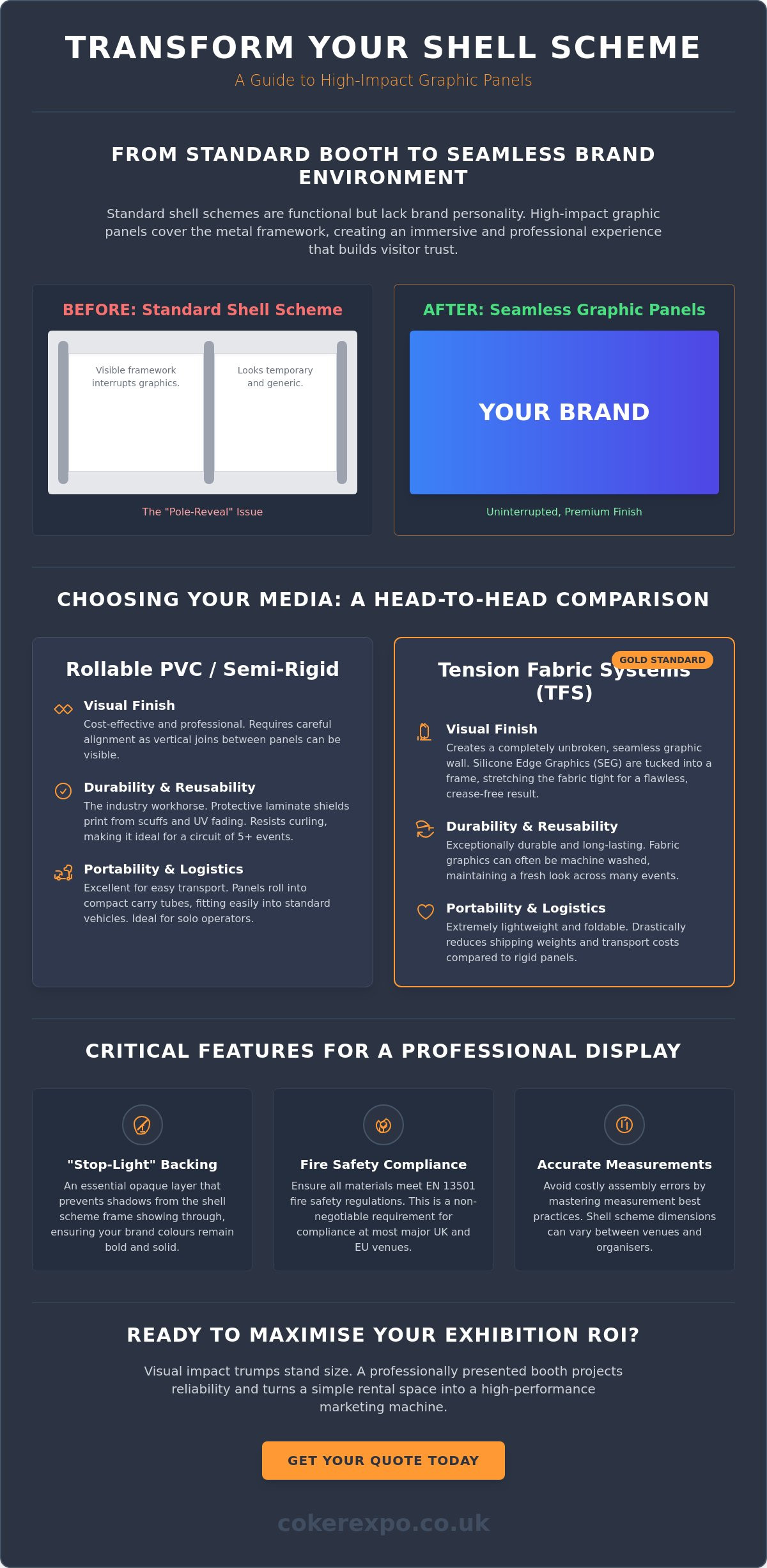
Most UK venues use a standard set of aluminium uprights and horizontal cross-beams to form the booth. Traditionally, exhibitors fixed graphics directly onto the internal panels using Velcro or magnetic strips. However, this often leads to the "pole-reveal" issue, where the silver aluminium frame interrupts the flow of your artwork. Modern Shell Scheme Graphic Panels solve this by using mounting systems that sit flush against or over the poles. This creates a continuous, uninterrupted image that looks like a permanent wall rather than a temporary installation.
Why Visual Impact Trumps Stand Size
It's a mistake to equate square footage with success. A compact 3x3m space with superior exhibition stand design frequently outperforms massive, poorly branded stands in lead generation and ROI. Consistency is the goal. Your brand needs to look identical across every venue on your calendar. Reusable panels ensure your colour profiles and messaging remain sharp across multiple show dates, turning a simple rental box into a high-performance marketing machine that respects your budget and your team's time.
Choosing the Right Media: Rollable, Rigid, and Tension Fabric Options
Selecting the correct substrate for your Shell Scheme Graphic Panels is a balance of logistical practicality and visual ambition. For exhibitors attending five or more events per year, the durability of the media becomes a primary concern. You need a material that resists curling, scratching, and fading while remaining easy to handle. A critical feature to look for is "stop-light" backing. This opaque grey or black layer on the reverse of the panel prevents shadows from the internal shell scheme frame or bright venue lights from showing through your graphics, ensuring your brand colours remain punchy and solid. Following exhibit stand design best practices means choosing media that reinforces your professional authority rather than detracting from it.
Rollable PVC and Semi-Rigid Media
The Rise of Tension Fabric (TFS) in Shell Schemes
If your goal is a completely unbroken graphic wall, TFS tension fabric systems represent the gold standard. This technology uses Silicone Edge Graphics (SEG) that tuck into a lightweight frame, stretching the fabric tight to remove any creases. Fabric is exceptionally lightweight, which drastically reduces shipping costs for international shows. It also eliminates the "join lines" seen with traditional panels, creating a massive, mural-style impact that mimics a custom-built stand. For those seeking the ultimate professional finish, exploring our range of Shell Scheme Graphic Panels can provide the high-end look your brand requires.
Fire Safety and Compliance for UK Venues
All professional graphic panels must meet UK fire safety standards for public indoor events. As of September 2024, the UK government has transitioned toward the EN 13501 European standard, withdrawing the older BS 476 classifications. Major venues now strictly enforce these "Reaction to Fire" requirements. If you use "cheap" unrated materials, health and safety officers have the authority to demand their immediate removal on opening morning. Investing in certified B1 or M1 rated media isn't just a legal necessity; it's a safeguard against the logistical nightmare of a dismantled stand.
Technical Specifications and Measurement Best Practices
Precision is the foundation of a professional stand. A common error among exhibitors is assuming that "standard" sizes apply across all UK venues. In reality, dimensions vary significantly between different shell scheme manufacturers. Before you commission your Shell Scheme Graphic Panels, you must obtain the Technical Exhibitor Manual from the event organiser. This document contains the exact specifications for the specific frame system being used. It's the only way to guarantee a perfect fit on opening morning.
Major frame types like Octanorm and Sodem have different panel tolerances. You need to distinguish between the "total panel size" and the "visible area". The visible area is the part of the graphic that remains once the panel is slotted into the aluminium uprights. If you place critical text or logos too close to the edges, they'll be obscured by the frame. For corner stands, internal and external dimensions also differ. You'll need to account for the thickness of the poles when designing your layout to ensure your brand message remains central and legible.
Seamless vs. In-Fill Panel Designs
Exhibitors usually choose between two primary mounting styles. In-fill panels sit directly inside the frame, leaving the aluminium poles exposed. This is the most straightforward method. However, it results in a segmented look. Conversely, seamless overlays use specialized clips to mount graphics over the structure. This approach hides the poles entirely, creating a continuous brand wall. While seamless designs offer maximum visibility, they require more precise measurement to ensure the panels meet perfectly at the corners. It's a choice between simple utility and a high-end, bespoke appearance.
Preparing Artwork for Large Format Printing
Quality starts with the file. Your imagery must be high-resolution, ideally between 100 and 150 DPI at full physical size. For logos and typography, vector graphics are the professional choice because they scale without losing sharpness. Artwork should account for a 10mm "quiet zone" around the edges where frame overlap may occur. This safety margin prevents important contact details or brand elements from being hidden by the hardware. To ensure your files are production-ready, you can view our full range of Shell Scheme Graphic Panels and technical templates.
Implementation: Maximising ROI with Professional Display Infrastructure
Transforming a basic rental into a high-performance marketing machine requires more than just aesthetics; it requires a strategic approach to infrastructure. While Shell Scheme Graphic Panels provide the essential visual foundation, your return on investment depends on how well you integrate that backdrop with functional hardware. A professional environment should guide visitors through a logical journey, using different "zones" for greeting, product demonstration, and lead capture. This transition from a simple box to a branded hub is what separates a successful show from a wasted budget.
Lighting is another critical factor that exhibitors often overlook. Exhibition halls are notoriously dimly lit, which can make even the best graphics look dull. Adding dedicated arm lights or integrated illumination ensures your brand messaging remains vibrant and readable from across the aisle. It's about creating a "pop" that stops foot traffic and encourages engagement.
Integrated Display Systems: Beyond the Flat Wall
To truly stand out in a crowded hall, you must break the monotony of flat surfaces. Integrating exhibition lightboxes into your layout provides back-lit brilliance that draws the eye. Beyond the walls, consider how you present your physical assets. Using folding display boards offers a versatile way to present brochures and technical data sheets without cluttering your main graphics. You can also add promotional counters and branded plinths to create professional touchpoints for lead generation.
Rapid On-Site Assembly and Transport Logistics
Logistical stress on opening morning is a significant pain for event managers. We recommend the "Coker Method" for rapid installation: a systematic approach that allows a single person to secure a full stand in under an hour without specialized tools. To maintain the professional look of your panels, always roll them with the graphic side facing outwards. This prevents the face of the print from kinking or creasing under tension. Because we manage domestic UK manufacturing, we offer rapid fulfillment and last-minute replacements that international suppliers can't match. This ensures your stand is always show-ready, regardless of tight deadlines.
Partnering with CokerExpo for National Exhibition Success
With over 25 years of experience in the UK exhibition sector, CokerExpo understands the high-pressure nature of tradeshow environments. Our Shell Scheme Graphic Panels are designed for resilience and durability, representing a sound business investment for companies on a national circuit. We specialize in bespoke sizing to ensure your graphics fit perfectly the first time, every time. Our hardware is built to be resilient, durable, and professional, reflecting the quality of your own brand. Don't leave your brand's physical presence to chance. Consult with our expert team today to secure the high-performance infrastructure your business deserves.
Securing Your Exhibition Success with Professional Infrastructure
Achieving a high-impact presence in a rental space requires a deliberate focus on material quality and technical precision. You've seen how selecting the right substrate and adhering to venue-specific measurements can eliminate the logistical stress of opening morning. By integrating professional lighting and functional hardware, you transform a basic booth into a powerful lead-generation tool that commands attention. Investing in premium Shell Scheme Graphic Panels ensures your brand maintains a consistent, authoritative image across every event on your calendar.
With over 25 years of exhibition display experience, CokerExpo provides the total reliability your business requires. Our UK-based production allows for rapid fulfillment and uncompromising quality control. We offer expert technical advice on frame compatibility, ensuring your graphics fit perfectly the first time. Explore our range of high-impact Shell Scheme Graphic Panels and transform your stand today. We're ready to help you command authority at your next event.
Frequently Asked Questions
What is the standard size for shell scheme graphic panels in the UK?
There isn't a single universal size for shell scheme panels in the UK because venues use different manufacturers like Octanorm or Sodem. While a width of 950mm is common, the height and visible area vary significantly between systems. You must consult your Technical Exhibitor Manual to confirm the exact specifications for your specific event booth. Relying on "standard" assumptions often leads to graphics that don't fit the frame correctly on opening morning.
Can I reuse my shell scheme panels at different exhibition venues?
You can reuse your graphics if the venue uses the same frame system and grid dimensions as your previous event. High-quality Shell Scheme Graphic Panels are designed for durability across multiple show cycles. However, you should always verify the panel tolerances in the exhibitor manual for each new show. Proper storage, such as rolling panels with the print facing out, is essential to maintain their professional appearance between exhibitions.
What is the difference between Velcro and magnetic fixings for shell scheme walls?
Velcro is the industry standard for securing in-fill panels due to its simplicity and low cost. It allows for quick adjustments if the panel isn't perfectly straight during the initial fit. Magnetic fixings are typically used for seamless displays where graphics must sit flush against the metal uprights. While magnets provide a very clean finish, they require more precise alignment and a compatible metal frame to function effectively on-site.
Do I need a special tool to install my shell scheme graphics?
Most graphic systems require no specialized tools for installation. You can usually fix panels by hand using Velcro or magnetic strips provided with your order. For seamless fabric displays, the silicone edge is pressed into the frame channel using only your fingers. This tool-free approach reduces logistical stress and allows your team to focus on engagement rather than complex construction on the morning of the event.
Are fabric shell scheme graphics better than PVC rollable panels?
Fabric graphics offer a premium, seamless look that eliminates the vertical join lines seen with PVC panels. They're also lighter and more resilient to creasing during transit. PVC rollable panels remain a practical choice for smaller stands and are often easier to clean between shows. Your choice should depend on whether you prioritize the mural-style impact of fabric or the cost-efficiency and transportability of PVC media.
How do I ensure my graphics comply with exhibition hall fire regulations?
You must use Shell Scheme Graphic Panels that meet the EN 13501 European standard or the older B1 fire rating. Professional suppliers provide fire certificates for their substrates, which you should keep in your on-site health and safety folder. Hall managers have the authority to test your stand materials. Using unrated or "cheap" alternatives can result in the immediate removal of your display, potentially ruining your event ROI.
Leave a comment