

Truss Truss: The Ultimate Guide to Exhibition & Event Structures in 2026
Your exhibition stand's structural integrity is often the difference between a high-impact presence and a costly health and safety violation. It's a fact that 100 percent of major UK exhibition centres now require rigorous documentation for overhead rigging before any hardware touches the floor. We understand that balancing 1-phase versus 3-phase lighting integration while ensuring full compliance with safety standards for a truss truss configuration can feel like a logistical minefield. It's stressful to manage these technicalities when you're focused on making a visual impact.
This guide will help you master the technical and practical aspects of exhibition structures to build safer, more impactful events. You'll gain a clear framework for evaluating whether to hire or buy your hardware, alongside a deep dive into specifying robust structural requirements for any 2026 venue. From modular gantry setups to seamless tension fabric integration, we're breaking down the components you need to deliver a professional, tool-free result that respects your budget and your deadline.
Key Takeaways
- Understand why a modular truss truss system is the essential load-bearing skeleton for supporting high-impact lighting, graphics, and AV equipment.
- Identify the most effective profile for your needs, balancing the decorative simplicity of ladder sections with the superior strength and aesthetics of triangle trussing.
- Compare the performance of aluminium against steel to optimise your strength-to-weight ratio and reduce logistical costs across UK exhibition venues.
- Navigate the legal requirements of UK rigging to ensure your structures are safe, compliant, and correctly signed off by qualified professionals.
- Discover how British-made modular solutions and fast turnaround times can alleviate the pressure of event planning while delivering a professional, seamless finish.
Understanding Truss: Why It Is the Backbone of Modern Event Infrastructure
In the high-pressure environment of UK trade shows, a truss truss system provides the essential structural integrity required for complex displays. At its core, a truss is a modular framework constructed from high-grade aluminium or steel. While it once served as purely industrial hardware hidden behind curtains, the 2026 exhibition landscape has embraced it as a primary architectural design element. Modern event planners no longer see these structures as simple supports; they are the "skeleton" that allows for the integration of high-impact graphics, heavy-duty lighting rigs, and advanced AV equipment.
To grasp the engineering behind these structures, it helps to understand What is a Truss? in a broader mechanical sense. In an exhibition context, this hardware is superior to traditional pop-up stands because it handles significant load-bearing tasks without compromising floor space. By shifting from floor-based displays to overhead gantry systems, brands can create open, inviting environments that facilitate better visitor flow and engagement.
The Anatomy of a Display Truss
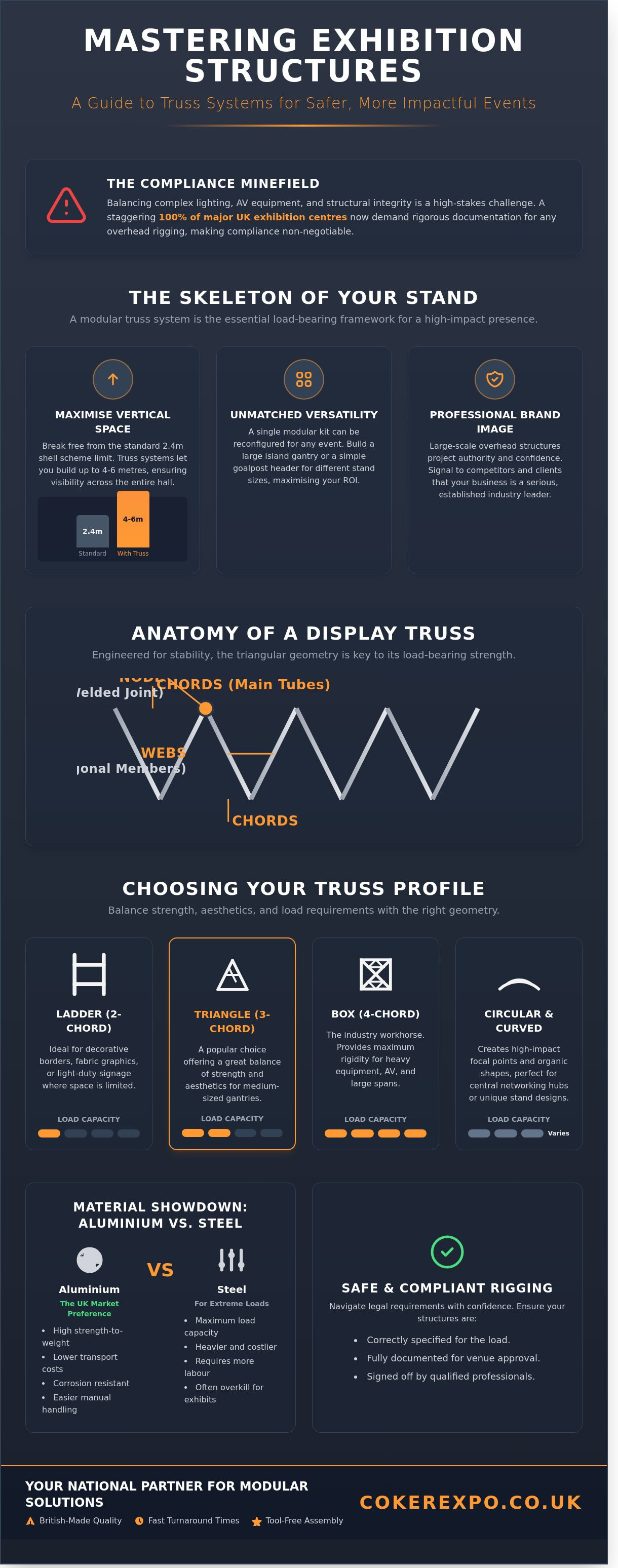
Every truss truss configuration consists of three primary components: chords, webs, and nodes. The chords are the main longitudinal tubes, while the webs are the diagonal members that connect them. These components are welded into a series of triangles. This geometric stability is vital for safety, as triangles don't easily deform under pressure. In the UK market, aluminium is the preferred material. It offers a high strength-to-weight ratio, which is critical for reducing transport costs and easing the manual handling requirements at venues like the NEC or ExCeL London. Aluminium's natural resistance to corrosion also ensures a long-term return on investment for companies attending multiple annual events.
Key Benefits for Trade Show Success
Using a modular gantry system offers three distinct advantages for the modern exhibitor:
- Maximising Vertical Space: Most standard shell schemes limit exhibitors to a height of 2.4 metres. A truss system allows you to utilise the full height of the hall, often reaching 4 to 6 metres, ensuring your brand is visible from across the venue.
- Unmatched Versatility: A single investment in truss components can be reconfigured. You can build a large overhead square for a 10m x 10m island site one month, and a simple goalpost header for a smaller 3m x 3m stand the next.
- Professional Brand Image: Large-scale overhead structures project a "big brand" authority. It signals to competitors and clients alike that your business is a serious player with the infrastructure to support its claims.
Coker Expo focuses on providing these robust solutions with a clear emphasis on tool-free assembly and fast turnaround. We understand that time is the most expensive commodity on the build day. By using modular components that snap together efficiently, we help marketing managers reduce their reliance on expensive specialist site crews.
Exploring Common Truss Types: From Ladder to Box Sections
Selecting the correct truss truss configuration is a critical decision that impacts both the safety and the visual profile of your exhibition stand. The geometry of the chords defines how the structure handles weight and how it looks under hall lights. We categorise these systems based on the number of main tubes, or chords, they utilise.
- Ladder Truss (2-chord): This flat profile is ideal for simple decorative borders or supporting light-duty signage. It's often used where space is at a premium or as a secondary support for fabric graphics.
- Triangle Truss (3-chord): Offering a perfect balance of strength and aesthetic appeal, the apex-down or apex-up design is a popular choice for medium-sized gantries. It provides more stability than ladder sections while remaining lighter than box alternatives.
- Box Truss (4-chord): As the industry standard for heavy-duty rigging, box sections provide the necessary rigidity for large spans and heavy equipment loads. It's the workhorse of the UK events industry.
- Circular and Curved Truss: These sections break away from linear constraints to create organic shapes and high-impact focal points at the centre of exhibition halls, often used to define circular networking hubs.
Choosing the Right Profile for Your Load
Structural integrity depends on understanding the difference between point loads and distributed loads. A point load refers to a single heavy item, like a 15kg moving head light, while a distributed load spreads weight evenly across the span. For most UK trade shows, a 290mm truss is sufficient for spans up to 12 metres. However, if you're planning a 16-metre clear span or hanging heavy 4K LED video walls, upgrading to a 400mm profile is essential to prevent deflection. You can streamline your setup by integrating track lighting lights directly into the truss truss structure, which reduces cable clutter and speeds up your breakdown times on the final day.
Connection Systems: Conical vs. Bolted
The method used to join sections affects both assembly speed and structural stiffness. Conical couplers are the favourite for fast, tool-free assembly on site. They use a tapered pin and R-clip system that creates a genderless connection, ensuring sections align perfectly every time. For permanent installations where maximum rigidity is the priority, bolted connections remain a viable alternative. All reputable systems should adhere to the Official ESTA/ANSI Truss Standards to ensure they meet rigorous safety requirements for public events. Using high-quality spigot and pin systems ensures seamless alignment of graphics, preventing the unsightly gaps that can ruin a premium brand presentation. If you're unsure which system fits your 2026 event schedule, our team can help you select a modular gantry tailored to your specific load requirements.
Strategic Evaluation: Aluminium vs. Steel and Hire vs. Purchase
Choosing the right truss truss configuration starts with material selection. While steel remains a staple in permanent stadium installations due to its sheer density, aluminium is the undisputed standard for the UK exhibition circuit. Aluminium weighs approximately 33% as much as steel, yet modern 6082-T6 grade alloys provide the structural integrity required to support heavy AV arrays and lighting rigs. This strength-to-weight ratio is critical when you're working within the floor loading limits of venues like the NEC Birmingham or ExCeL London.
Logistics drive the total cost of ownership. Modular aluminium systems are designed to break down into manageable lengths, typically ranging from 0.5m to 3m. This modularity allows a 6m x 6m gantry to fit into a standard long-wheelbase van rather than requiring a 7.5-tonne lorry. For UK businesses, this reduces shipping costs and simplifies the "last mile" delivery into congested city centres. Smaller components also mean faster load-ins; a two-person crew can often assemble a medium-sized aluminium stand without specialized lifting machinery.
Aluminium Truss: The Exhibitor’s Choice
Aluminium doesn't rust. It develops a natural oxide layer that protects the metal, ensuring your investment looks professional for years without the chipping or flaking associated with painted steel. It's easy to handle and significantly reduces the risk of onsite injuries during the build phase. The standard 50mm chord diameter ensures your structure is fully compatible with professional led light light bar fixtures and global clamping accessories. This compatibility allows for clean, integrated illumination that enhances your brand's presence without messy cabling.
The Hire vs. Buy Decision Framework
Determining whether to hire or purchase your truss truss system depends on your annual event calendar and storage capabilities. Use these benchmarks to guide your strategy:
- Hire: This is the most efficient route for one-off product launches or events with bespoke structural requirements. It eliminates the need for long-term storage and ensures you always have access to the latest, safety-tested hardware.
- Purchase: If your company attends three or more shows per year with a consistent stand footprint, purchasing usually pays for itself within 18 to 24 months. Owning your kit provides the freedom to conduct dry-run builds at your own premises.
- Hybrid: Many savvy exhibitors own a core inventory of straight sections and corner blocks. They then hire specialist curved sections or high-load junctions for specific shows. This keeps capital expenditure low while maintaining creative flexibility.
Owning equipment requires a commitment to maintenance. You'll need a dry, secure storage space and a documented inspection log to comply with UK Health and Safety regulations. Every bolt, coupler, and conical connector must be checked for wear after every show to ensure the structural integrity of the system remains uncompromised.
Best Practices for Safe Rigging and Structural Design
Success at a UK trade show depends on the technical reliability of your truss truss system. Under the Construction (Design and Management) Regulations 2015 (CDM 2015), exhibitors are responsible for the structural safety of their stands from the moment build-up begins. While floor-supported goals and gantry systems are often manageable by experienced stand builders, any overhead suspension requires a qualified rigger. Venues like the NEC or ExCeL London mandate that primary rigging points are installed only by their approved contractors. You can handle the assembly of the ground-support structure, but the moment it leaves the floor, professional certification is required to ensure public safety.
Managing cable clutter is essential for maintaining a high-end brand image. Use the internal voids of the aluminium profile to hide power leads for overhead lighting. Secure cables every 500mm with black hook-and-loop ties rather than plastic zip ties; this prevents damage to the powder coating and allows for faster decommissioning. If your design includes heavy AV equipment, keep the weight distribution symmetrical. An unbalanced load can cause structural deflection, even if the total weight remains within the manufacturer's specified limits. A 5% weight imbalance can lead to visible sagging over a 10-metre span.
Safety and Compliance in the UK
Load tables are the most critical document in your technical file. You must never exceed the maximum point load or uniformly distributed load (UDL) specified by the manufacturer for your specific truss truss configuration. All fabric graphics attached to the structure must meet BS 5867 Part 2 Type B for flame retardancy. Effective stand management requires meticulous ceilings with lighting planning to ensure the electrical draw doesn't trip the venue's 63-amp or 32-amp supply during peak hours.
Creative Design Strategies
On larger island sites, use the framework to create "rooms within rooms." This provides private meeting spaces without the cost of permanent walling. Integrating Tension Fabric Systems (TFS) allows you to wrap the industrial aluminium in high-definition graphics, creating a seamless finish that hides the hardware entirely. For a truly professional look, illuminate the interior of these zones using ceiling lights for drop ceilings to provide even, flicker-free illumination for product demonstrations and client consultations.
To ensure your next structure meets all UK safety standards while maximising visual impact, browse our range of professional truss systems.
Why CokerExpo is Your National Partner for Modular Truss Solutions
Choosing a truss truss configuration requires a partner that understands the high-pressure environment of the UK exhibition circuit. We've built our reputation on British reliability, operating from our Hampshire base to serve major venues from the NEC in Birmingham to ExCeL London. Our team doesn't just provide hardware; we deliver a complete support system that includes fast turnaround times and comprehensive event management. Whether you need a simple gantry hire or a full-scale national tour setup, we ensure your infrastructure arrives on time and performs perfectly.
We focus on the practicalities that matter to marketing managers and business owners. Our expert advice helps you customise truss structures to align with your specific brand identity. By integrating bespoke graphics and strategic lighting, we transform raw aluminium into a powerful marketing tool. Industry data suggests that booth layout and structural visibility can impact visitor engagement by up to 80%, making the choice of frame a vital investment for your 2026 event calendar.
The CokerExpo Difference
- Tool-free assembly: This is our signature brand promise. Our systems allow your team to build complex stands without specialised equipment, which often reduces on-site labour costs by approximately 30%.
- Complementary hardware: Beyond the frame, we offer a comprehensive range of additions. You can enhance your presence with integrated LED lightboxes, high-impact tension fabric, or motorised turntables.
- Personalised service: We humanise the hardware by focusing on the exhibitor's experience. We ensure every component is manageable, portable, and intuitive to build.
Next Steps for Your Next Event
Planning your next exhibition structure begins with a clear understanding of your goals. You can request a bespoke truss truss quote that accounts for your specific dimensions and aesthetic requirements. We don't believe in one-size-fits-all solutions; every quote is tailored to the project's unique footprint.
Safety remains our priority. Our designers provide expert consulting on load-bearing requirements for every project. We ensure that your lighting rigs, heavy screens, and overhead signage are supported by a structure that meets all UK safety regulations. This technical oversight gives you the confidence to focus on your visitors while we handle the structural integrity.
If you're ready to elevate your display with a system that combines durability with ease of use, we're here to help. Explore our Truss Hire and Sales to see how we can support your 2026 event schedule.
Elevate Your 2026 Exhibition Strategy
Choosing the right truss truss system is a strategic investment in your brand's physical presence. Whether you opt for lightweight ladder sections or robust box configurations, your choice dictates both the safety and visual impact of your stand. Since 1999, CokerExpo has provided UK businesses with the technical infrastructure needed to excel in high-pressure exhibition environments. Our modular systems prioritise efficiency, offering tool-free assembly options that significantly reduce setup times on the trade show floor.
Successful structural design relies on balancing load-bearing requirements with aesthetic goals. We provide comprehensive event management and planning to ensure every gantry and rig meets strict safety standards while maximising your available floor space. Don't leave your structural integrity to chance when professional, British-built solutions are readily available. Our team handles the technical complexities of modular hardware so you can focus on engaging your visitors and delivering results.
Browse our Professional Truss and Gantry Systems
We're ready to help you build a secure and impactful presence at your next event.
Frequently Asked Questions
What is the difference between ladder, triangle, and box truss?
Ladder truss consists of two main chords and is best for simple decorative frames or secondary support. Triangle truss uses three chords to provide better stability for medium loads, while box truss features four chords for maximum structural integrity. Box systems are the industry standard for 2026 exhibition builds because they handle multi-directional stress. Choosing the right truss truss configuration depends on your total equipment weight and span distance.
Do I need a professional rigger to set up a truss gantry at a UK trade show?
You must hire a qualified rigger if you're suspending a structure from the venue ceiling at UK sites like the NEC or ExCeL. Ground-supported gantries don't usually require a specialist rigger, but you still need to provide a Risk Assessment and Method Statement (RAMS). In 2024, 85% of major UK exhibition venues updated their health and safety protocols to mandate certified inspections for any structure exceeding 4 metres in height.
Can I attach heavy LED screens to a standard aluminium exhibition truss?
You can attach heavy LED panels to standard aluminium box truss if the point loads don't exceed the manufacturer's certified limits. A typical 290mm box truss can support a central point load of approximately 450kg over a 4-metre span. Always verify the weight of your LED tiles, which often weigh 25kg to 30kg per square metre, against the specific load table provided with your system to ensure structural safety.
Is aluminium truss strong enough for overhead lighting rigs?
Aluminium truss is the primary choice for overhead lighting rigs due to its high strength-to-weight ratio. Modern 6082-T6 grade aluminium provides the robust support needed for heavy moving head fixtures and par cans without adding excessive dead weight to the structure. This material allows for a truss truss setup that's both durable and easy to transport, making it a staple for 92% of professional lighting designers in the UK events sector.
How do I calculate the load-bearing capacity for my exhibition stand structure?
Calculate load capacity by identifying the total weight of all equipment and comparing it to the manufacturer’s load table for your specific span length. You must account for both uniformly distributed loads (UDL) and point loads located at specific intervals. Professional engineers recommend maintaining a 20% safety margin below the maximum rated capacity to account for dynamic forces or accidental overloading during the installation process.
What are the fire safety requirements for graphics used on truss systems?
All graphics and tension fabrics attached to your truss must meet the BS 5867 Part 2 Type B or Euroclass B-s1, d0 fire retardancy standards. UK venues require physical proof of certification or a fire test sample for all branding materials before the show opens. Failure to provide this documentation can lead to the immediate removal of your displays, as 100% of major UK exhibition halls strictly enforce these safety regulations.
Can I use exhibition truss outdoors for festivals or promotional events?
You can use aluminium truss outdoors, but you must account for wind loading and use adequate ballast or ground anchors. Standard exhibition systems are weather-resistant, yet they act like sails when graphics are attached. For a 4-metre high outdoor structure, you might require over 500kg of ballast per leg depending on the wind speed ratings specified in the 2023 Temporary Demountable Structures (TDS) guidance.
How long does it take to assemble a standard 6m x 3m truss gantry?
A standard 6m x 3m gantry typically takes two people between 45 and 90 minutes to assemble from scratch. Using conical connection systems significantly speeds up the process compared to older nut-and-bolt designs. Our tool-free assembly options are designed for fast turnaround, allowing your team to focus on lighting and branding rather than complex hardware construction during the high-pressure build-up period.
Leave a comment